On this page · 12 sections
- What changed in iOS 27.2 beta 4?
- 1. App Tracking Transparency: changes for EU users
- 2. StoreKit testing fixes in Xcode
- 3. Known StoreKit issue: subscription bundles
- 4. UIKit: default layout margins are now zero
- 5. Simulator runtime: cloning may fail
- 6. Known issues in Health, Shortcuts and Nearby Interaction
- 7. How to test your app against iOS 27.2 beta 4
- 8. What Flutter developers should do
- Conclusion
- How eCorpIT can help
- References
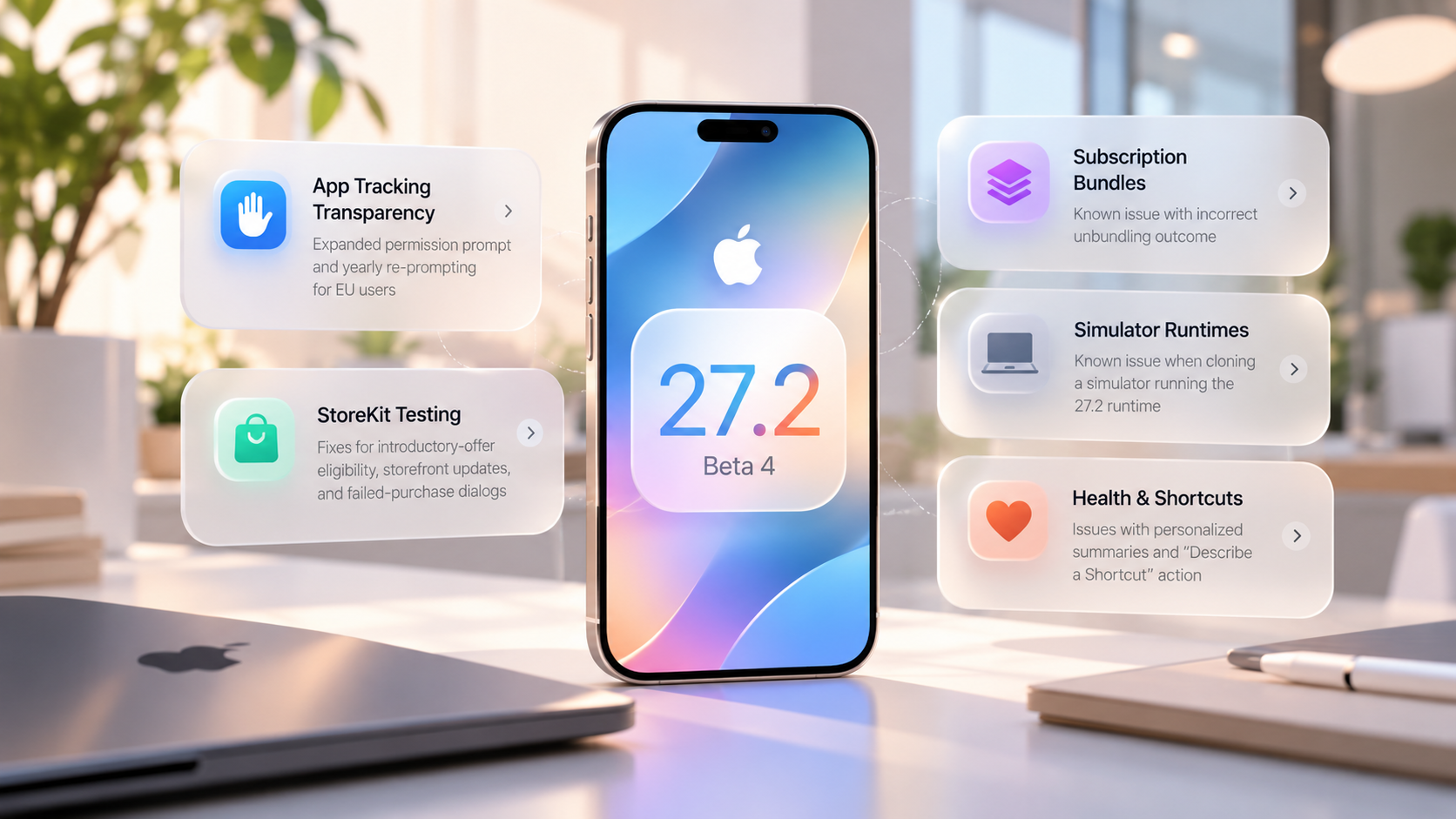
Summary. Apple released iOS and iPadOS 27.2 beta 4, build 24B5110a, on 13 October 2026. The release notes add App Tracking Transparency's expanded prompt and yearly re-prompting for EU users, record two renames of the new ATT method, fix three StoreKit testing bugs, and list known issues in subscription bundles, simulator cloning, Health, Shortcuts and Nearby Interaction. They also change a UIKit default: on iOS 27.1 and later a view's default layout margins are zero. This guide explains each item and gives a testing checklist for native iOS and Flutter apps.
For developers, release notes are more than a list of operating system changes. They show which parts of an app deserve extra testing before the next release or update.
Important: this article covers beta software, not a final public release. Apple updates its release notes with each beta, so check the iOS and iPadOS 27.2 release notes for the current status.
About this article. This guide is based on Apple's iOS and iPadOS 27.2 beta 4 release notes, Apple's developer releases feed and Apple's App Tracking Transparency, StoreKit and UIKit documentation, as checked on 17 October 2026. Researched with AI assistance and reviewed by our editorial team.
What changed in iOS 27.2 beta 4?
| Area | Documented change or issue | Who should pay attention |
|---|---|---|
| App Tracking Transparency | Expanded prompt and yearly re-prompting for EU users; the new request method renamed | Apps that request tracking authorisation |
| StoreKit testing | Fixes for introductory-offer eligibility, storefront updates and failed-purchase dialogs | Apps with in-app purchases and subscriptions |
| Subscription bundles | Known issue: a purchase can unbundle a subscription instead of throwing an error | Apps that sell subscriptions inside a bundle |
| UIKit | Default layout margins for a view are zero on iOS 27.1 and later | Apps whose UIKit layouts rely on layout margins |
| Simulator runtimes | Known issue: cloning a simulator running the 27.2 runtime may fail | Teams that clone simulators for testing |
| Health | Personalised summaries may not generate; the redesigned Health app is not in this beta | Teams testing Health-related flows |
| Shortcuts | The Describe a Shortcut action may fail | Apps that integrate with Shortcuts |
| Nearby Interaction | A session using a DL-TDoA configuration may be invalidated with a timeout | Apps using DL-TDoA ranging |
Read each row the way Apple labels it: some items are new features, some are fixed issues and some are known issues that remain open.
The SDK for this beta ships with Xcode 27.2. Apple's releases feed lists Xcode 27.2 beta 3, build 27B5038j, on 14 October 2026, and its release notes set out the compatibility requirements.
1. App Tracking Transparency: changes for EU users
The release notes say App Tracking Transparency now supports an alternative expanded prompt and re-prompting on a yearly basis for users in the European Union. The alternative prompt is required for users in France, Germany, Italy, Poland and Romania.
The new request method has also been renamed during the beta cycle. The notes record a rename from usingExpandedInterface to preferExpandedInterface, and then a further rename to the form requestTrackingAuthorizationPreferringExpandedInterface:. Apple's documentation currently lists the Swift method as requestTrackingAuthorization(preferExpandedInterface:additionalInformationAction:completionHandler:), marked beta. The colon-terminated name reads like the Objective-C form, so check the SDK headers in your Xcode beta before you write code against it. Our guide to ATT in iOS 27.2 covers the prompt and re-prompting in more depth.
What this means for developers
If your app requests tracking authorisation, review the permission flow and check that the app handles each answer correctly:
- Confirm the request appears at the intended point in the user journey.
- Check behaviour when authorisation is granted, denied or not yet determined.
- Test the flow for users in the five countries where the alternative prompt is required.
- Check that advertising and analytics integrations respect the user's choice.
- Review your privacy disclosures so they describe the app's behaviour accurately.
These are recommended checks. The release notes do not say every app that uses ATT needs code changes.
What Flutter developers should check
Flutter apps reach ATT through a plugin or their own platform-channel code. If your app uses ATT, inspect that plugin and its native code rather than assuming the Dart layer handles everything, and watch for plugin updates that adopt the renamed method. Test the real authorisation flow on a device and confirm your app acts on the status the system returns. Apple's App Tracking Transparency documentation is the authoritative reference.
2. StoreKit testing fixes in Xcode
Apple lists three resolved issues in StoreKit testing.
Introductory-offer eligibility
Fixed: introductory-offer eligibility did not reset immediately after calling SKTestSession.clearTransactions().
What to test: repeat your introductory-offer tests after clearing transactions and confirm the results reflect the intended test-session state.
Storefront and locale updates
Fixed: changing the storefront or locale through SKTestSession did not propagate through Storefront.updates.
What to test: if your purchase flow reacts to storefront or locale changes, check that the updates reach your app and that localised prices and product details behave as expected.
Failed-purchase dialogs
Fixed: failed purchases using SKTestSession could show error dialogs even when dialogsDisabled was set to true.
What to test: rerun failed-purchase scenarios and confirm your automated tests behave as expected with dialogs disabled.
These fixes concern the StoreKit testing environment in Xcode. They are not a promise that every production purchase or subscription issue is resolved.
StoreKit regression-testing checklist
For apps with in-app purchases, test:
- Successful and failed purchases.
- Cancelled purchases.
- Introductory-offer eligibility.
- Storefront and locale changes.
- Subscription entitlement updates.
- Purchase restoration and transaction handling.
Apple's StoreKit documentation covers the implementation details, and our article on StoreKit commitment plans covers another iOS 27 purchase option.
3. Known StoreKit issue: subscription bundles
Apple lists one known issue for subscriptions that belong to a subscription bundle: making an in-app purchase for such a subscription incorrectly allows the user to unbundle it instead of throwing an error. This is a known issue, not a fix.
Why it matters
Subscription bundles let customers get several subscription services through one combined offer. Apps that sell them need to handle purchase outcomes and entitlements carefully, and an unexpected result makes it hard to tell whether a bug sits in your own logic or in the platform.
What developers should do
If your app supports subscription bundles:
- Identify the purchase flows that involve bundled subscriptions.
- Test the affected scenario in a development environment.
- Record the OS build, StoreKit configuration, steps to reproduce and the result.
- Do not treat the unexpected result as the intended production behaviour.
- Check later release notes for an update.
Do not change production subscription or entitlement logic to work around a beta issue until you understand the expected behaviour. Apple's guidance on subscription bundles and suites explains how bundles are meant to work.
4. UIKit: default layout margins are now zero
The notes describe a UIKit change that applies on iOS 27.1 and later: the default layout margins for a UIView are zero. A view controller still gives its root view the system minimum layout margins, which vary with the presentation context. To inherit those margins in a subview, set the subview's preservesSuperviewLayoutMargins property to true.
What to test: look at any UIKit screen that positions content against a view's layout margins rather than the view controller's root view. Content that used to sit inside a default inset may now touch the edges. Our article on iOS 27.1 layout changes covers other UI shifts in the same release.
5. Simulator runtime: cloning may fail
Apple lists a known issue: cloning a simulator device running runtime 27.2 might fail because of incorrect file permissions. Apple gives a workaround, which deletes leftover temporary files from the source device's data folder:
find ~/Library/Developer/CoreSimulator/Devices/<SOURCE_UDID>/data -name '*.sb-????????-??????' -delete
Replace <SOURCE_UDID> with the identifier of the simulator you are cloning; xcrun simctl list devices shows it. Run the command only against the source device you intend to clone.
If cloning still fails, record the runtime and Xcode versions, check whether a newly created simulator behaves the same way, and keep the error output. A cloning failure does not by itself point to a bug in your app.
6. Known issues in Health, Shortcuts and Nearby Interaction
Health
Personalised summaries may not generate as expected in the Insights tab of the Health app. Separately, the redesigned Health app is not included in this beta: it was in the previous beta for testing only. If you update, your Health data from the previous beta stays on the device and can be viewed in Settings, and Apple says the redesigned app will return in an upcoming beta.
These issues concern Apple's Health app. The notes do not say third-party health apps or HealthKit integrations are affected, so test only the flows your app actually uses.
The notes also carry a consumer warning: people with an upcoming Quest lab appointment should wait to update until they receive their results.
Shortcuts
The Describe a Shortcut action might fail with an error asking the user to try again later. If your app integrates with Shortcuts, test your own actions and separate failures in Apple's documented action from problems in your integration.
Nearby Interaction
An NISession running with a DL-TDoA configuration in a foreground app might be invalidated unexpectedly with a resource timeout error. Apple's workaround is to run a new NISession with the same DL-TDoA configuration.
For all of these, check later beta release notes before treating the behaviour as permanent.
7. How to test your app against iOS 27.2 beta 4
Step 1: review the release notes
Map the frameworks and flows your app uses against the notes, and test those first instead of every system feature.
Step 2: prepare the development environment
Install an Xcode 27.2 beta, which bundles the iOS and iPadOS 27.2 SDK, and the matching simulator runtime. Confirm your Mac, dependencies and test devices are set up for it.
Step 3: build and launch the app
Check for build failures, dependency problems, launch problems and unexpected runtime behaviour. A successful build alone does not prove the app works on the beta.
Step 4: test critical flows
Prioritise what matters to your app:
- Tracking authorisation, if used.
- In-app purchases and subscriptions.
- UIKit screens that depend on layout margins.
- Login and authentication.
- Notifications and deep links.
- Core navigation and user journeys.
- Native plugin integrations.
This is a general regression checklist, not a list of extra changes Apple announced.
Step 5: document reproducible problems
For every issue, record:
- Device model and OS build.
- Xcode and SDK versions.
- Steps to reproduce.
- Crash logs or error messages.
- Whether the issue also occurs on a stable OS version.
That record separates a beta-specific issue from an existing bug, and it is what Apple's Feedback Assistant needs if you report it.
Step 6: retest later betas
Behaviour changes between betas. Repeat the relevant tests on each new build, and do not carry temporary workarounds into production without proving they are still needed.
8. What Flutter developers should do
Treat iOS beta testing as two jobs: Dart-level regression testing and native platform checks. Not every Flutter app needs a code change for iOS 27.2 beta 4; the work depends on its plugins and features.
- Check that your Flutter version supports the Xcode beta you plan to use.
- Review native dependencies; CocoaPods becomes read-only on 2 December 2026, so our SwiftPM migration playbook is worth reading now.
- Test ATT if the app requests tracking authorisation, and watch for plugin updates for the renamed method.
- Retest StoreKit purchase flows if the app sells in-app purchases.
- Check notifications, deep links and other critical journeys.
- Investigate native crashes with full logs; our guide to the mprotect failed: 13 debug error covers one common iOS 27 problem.
- Confirm behaviour on supported devices before you submit an update.
If a failure appears only on the beta, isolate the feature and reproduce it before you change native configuration or app architecture. The StoreKit fixes and known issues in these notes are not evidence of a general Flutter compatibility problem.
Conclusion
iOS and iPadOS 27.2 beta 4 matter most for apps that use App Tracking Transparency, StoreKit or UIKit layout margins. Review the ATT changes and the method rename, rerun StoreKit tests, plan around the subscription-bundle issue, check margin-based layouts, and use Apple's workaround if simulator cloning fails. For Flutter teams, focus on the native integrations your app actually uses.
Above all, keep Apple's documented behaviour separate from your own test results, and recheck the release notes before you ship.
How eCorpIT can help
eCorpIT is a Gurugram-based technology organisation, founded in 2021, assessed at CMMI Level 5 and MSME certified, with senior-led engineering teams working across AWS, Microsoft and Google platforms. Our iOS and Flutter teams test client apps against each iOS beta, covering tracking authorisation, StoreKit purchase flows and native plugins, and report what needs fixing before the public release. Talk to us at /contact-us/.
Last updated: 17 October 2026.