
On this page · 11 sections
- The headline most Flutter developers are getting wrong
- What mprotect failed: 13 actually means
- The timeline — this has been building since early 2025
- Why iOS 27 matters right now
- Build mode comparison — where you are safe and where you are not
- Commands to reproduce and work around it
- What to actually do about it
- Frequently asked questions
- How eCorpIT can help
- Closing note
- References
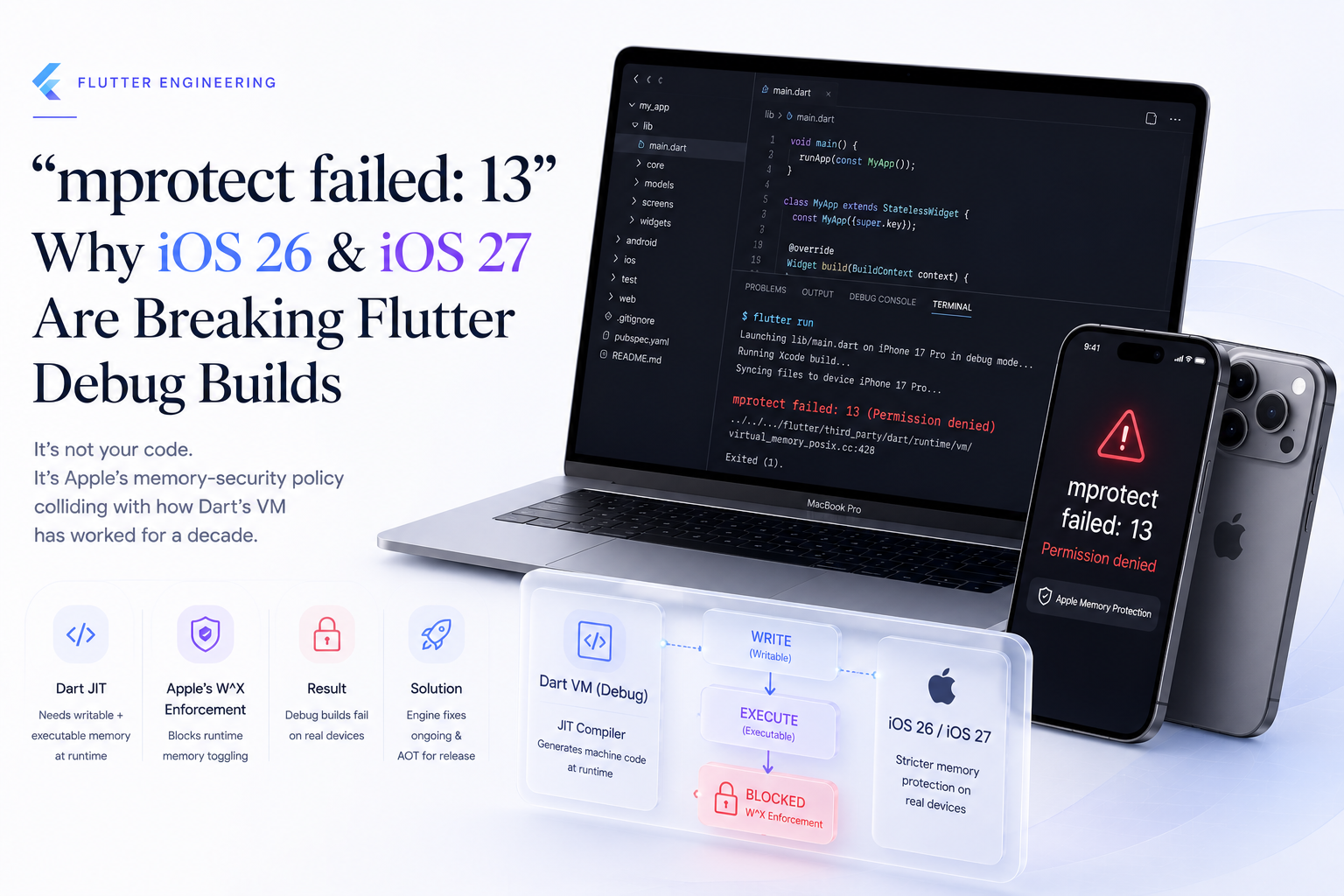
Summary. If you have upgraded a physical iPhone to iOS 26 or the iOS 27 developer beta (first seeded June 8, 2026 at WWDC; beta 3 on July 6, 2026) and hit ../../../flutter/third_party/dart/runtime/vm/virtual_memory_posix.cc: 428: error: mprotect failed: 13 (Permission denied) when running flutter run in debug mode on a real device, it is not your code. It is Apple's evolving W^X (write-xor-execute) memory-protection model colliding with Dart's JIT compiler, which Flutter's debug and profile modes have used for a decade. Flutter 3.35 switched from raw `mprotect()` calls to Apple's own `pthread_jit_write_protect_np()` API, which fixed the original hard crash — but iOS 26.4 introduced a new, intermittent EXC_BAD_ACCESS on a `DartWorker` thread after the app sits idle for 5-30 seconds on a physical device, and that variant is not yet fully resolved as of early-mid 2026. Release and Profile builds (both AOT) are not affected; the iOS Simulator is not affected; only debug mode on a physical iOS 26/27 device is. Your CI/CD pipeline is not at risk. This article covers what mprotect failed: 13 actually means, the full iOS 18.4 → 26 → 26.4 → 27 timeline with tracked issue numbers (#163984, #184533), a build-mode comparison table, workaround commands, and what to plan for as iOS 27 heads toward its expected general release around September 14, 2026.
The headline most Flutter developers are getting wrong
If you have upgraded a physical iPhone to iOS 26 (or now iOS 27 beta) and tried to flutter run in debug mode, you have probably hit this wall:
../../../flutter/third_party/dart/runtime/vm/virtual_memory_posix.cc: 428: error: mprotect failed: 13 (Permission denied)
The instinct is to blame your project, your CocoaPods setup, or a bad Flutter upgrade. It is none of those. This is Apple restricting how apps can toggle memory pages between writable and executable at runtime, even when the app carries the developer debugging entitlement. Flutter's debug and profile modes have depended on exactly that kind of runtime memory toggling for years — so when Apple tightened it, Flutter's JIT pipeline broke on real hardware, not simulators.
This is not a Flutter bug in the traditional sense. It is two systems — Apple's evolving memory-protection model and Dart's JIT compiler — colliding, and the collision has now stretched across three iOS generations: 18.4, 26, and the iOS 27 betas currently rolling out.
What mprotect failed: 13 actually means
mprotect() is a POSIX system call used to change the protection flags on a block of memory — for example, flipping a page from read-write to read-execute. On newer iOS versions, the OS enforces stricter limits on an app's ability to modify its own runtime memory permissions, which is the direct cause of the "Permission denied" error (errno 13).
Here is why Flutter needs this in the first place: Flutter's Dart VM in debug mode uses Just-In-Time (JIT) compilation, which needs to modify memory pages and switch them between writable and executable states, and that switching requires calling mprotect() at runtime. Hot reload, hot restart and live breakpoint debugging all depend on the VM being able to generate and re-generate machine code on the fly — which means repeatedly flipping those page permissions.
The technical chain runs through the Dart VM's kernel/AST binary format: even in JIT mode, Dart does not run raw source, it interprets a pre-compiled "Kernel" binary and generates machine code from it at runtime, which is what forces the mprotect call in the first place.
Apple's job-to-be-done here is unrelated to Flutter specifically — it is about closing a class of runtime code-injection exploits. This was not targeted at Flutter; it is part of Apple's broader push to strengthen app security by preventing dynamic memory execution and reducing the risk of runtime code injection. The restriction just happens to also break legitimate JIT-based workflows like Flutter's debug mode.
The timeline — this has been building since early 2025
| iOS version | Date | What happened |
|---|---|---|
| iOS 18.4 beta | Early 2025 | First reports of mprotect failed: 13 crashing Flutter debug builds on physical devices, tracked in Flutter issue #163984 |
| iOS 26.0 | September 2025 | iOS 26 beta 1 broke Flutter's debug mode on physical devices outright, with the only workaround being the simulator or downgrading to iOS 18.x |
| iOS 26.4 | Early 2026 | Partial engine fix shipped (Flutter 3.35, switching to pthread_jit_write_protect_np()), but a new intermittent variant appeared: EXC_BAD_ACCESS on a DartWorker thread after the app sits idle 5-30 seconds on a physical device. Tracked in Flutter issue #184533 |
| iOS 27 beta 1 | June 8, 2026 | Apple seeded the first iOS 27 developer beta on the day of the WWDC 2026 keynote. Underlying W^X enforcement was not reversed |
| iOS 27 beta 3 | July 6, 2026 | Third developer beta. Behaviour consistent with 26.4 as of this writing |
| iOS 27 public beta | Expected mid-July 2026 | Same W^X enforcement expected to persist |
| iOS 27 general release | Expected ~September 14, 2026 | Timing consistent with Apple's historic Monday-after-iPhone-launch pattern |
The pattern is clear: this is not a one-off regression that got patched. It is Apple systematically hardening runtime memory execution across major OS versions, and Flutter's JIT-dependent debug mode keeps getting caught in it. The 3.35 engine fix was correctly designed — it switched from raw mprotect() calls to Apple's own pthread_jit_write_protect_np() API for toggling write/execute state — but iOS 26 appears to asynchronously revoke execute permission on JIT memory pages that have not been recently accessed, which crashes the VM when it later tries to run code on those pages.
Why iOS 27 matters right now
As of this writing, iOS 27 is only a few betas in — beta 3 landed July 6, 2026, with public beta expected the week of July 13-17, 2026, and general release predicted around September 14, 2026 (eCorpIT's iOS 27 release timeline covers the full schedule). The release cycle is focused on trust-and-safety features, performance refinements, expanded parental controls, and the new Apple Intelligence / Siri AI overhaul (eCorpIT's WWDC 2026 keynote coverage).
Two things are worth being precise about, because a lot of blog posts on this topic are not:
- There is no confirmed, widely-reported iOS-27-specific new JIT crash yet. Apple has not announced a further tightening of the memory-protection model in the iOS 27 release notes as of beta 3. The honest current status is that iOS 27 inherits the same W^X enforcement introduced in 26/26.4, not that it introduces a brand-new mechanism.
- That inheritance is exactly the risk. If the iOS 26.4 idle-page revocation behaviour persists unchanged into iOS 27, every Flutter app doing physical-device debug testing on the iOS 27 beta is exposed to the same intermittent
EXC_BAD_ACCESScrash — just under a new OS version number. Teams should test this explicitly rather than assume "iOS 26.4 fixes carry forward."
A separate but related iOS 27 change worth flagging in the same breath: Apple has been pushing developers toward the UIScene lifecycle architecture since iOS 13, and once an app is built against the iOS 27 SDK, a UIKit app that has not migrated to `UISceneDelegate` will fail to launch — Apple currently emits warnings rather than blocking launch, and has signalled it will enforce this in a release after iOS 26 (an app already built against an older SDK keeps running on an iOS 27 device). This is a distinct problem from the JIT/mprotect issue but hits the same iOS 26 → 27 transition window. If your team is triaging iOS 27 compatibility, do not conflate the two — one is a debug-time JIT crash, the other is a launch-time architecture requirement.
Build mode comparison — where you are safe and where you are not
| Build mode | Compilation | Hot reload | Runtime mprotect calls |
Crashes on iOS 26/27 physical device? |
|---|---|---|---|---|
| Debug | JIT | Yes | Yes, repeatedly | Yes — this is where mprotect failed: 13 and the idle EXC_BAD_ACCESS both happen |
| Profile | AOT (with some JIT diagnostics) | No | Minimal | Mostly safe; occasional edge cases reported |
| Release | AOT | No | None | Safe — this is what ships to the App Store |
| Debug on Simulator | JIT | Yes | Yes | Safe — the simulator does not enforce the same page-protection rules |
The practical takeaway for a dev team: your CI/CD release pipeline is not at risk. This is purely a local physical-device debug workflow problem.
Commands to reproduce and work around it
Confirm your environment first:
            flutter doctor -v
flutter --version
If you are hitting the crash on a connected physical device, switch build modes to keep working while a permanent fix lands:
            # Instead of the default debug run:
flutter run -d <your-device-id>

# Use profile mode (near-production performance, some diagnostics, no hot reload):
flutter run --profile -d <your-device-id>

# Or release mode (fully AOT-compiled, closest to what ships):
flutter run --release -d <your-device-id>
For your daily hot-reload workflow, point at a simulator instead of the physical device:
            open -a Simulator
flutter devices          # confirm the simulator is listed
flutter run -d "iPhone 16 Pro"   # or whichever simulator is listed
A minimal way to confirm whether your specific app is exposed to the iOS 26.4-style idle-crash variant (not just the original hard mprotect failure) is to reproduce the pattern Flutter engineers used in issue #184533: run any JIT-heavy operation, let the app sit idle on a physical device for 10-30 seconds, then trigger JIT-compiled code again. If it crashes with EXC_BAD_ACCESS on a DartWorker thread and the fault has no symbol at the address, you are looking at the same idle-page-revocation issue — not a bug in your own code.
What to actually do about it
If you are hitting the crash today:
- Run on a real device in Release or Profile mode instead of Debug — both use Ahead-of-Time compilation, which does not require runtime memory changes and therefore does not hit the
mprotectwall. You lose hot reload, but you keep working builds.
- Use the iOS Simulator for your daily hot-reload workflow — simulators do not enforce the same memory security restrictions, so full debug mode, hot reload, hot restart and breakpoints all continue to work there.
- Update to a current stable Flutter release. The engine team's move to
pthread_jit_write_protect_np()in Flutter 3.35+ was a real fix for the original hard crash — it just did not fully close the idle-page edge case that showed up in 26.4.
- If your app has a hard dependency on physical-device debug testing (common with plugins like MLKit, camera or AR SDKs that do not run on simulators), budget for intermittent crashes during longer manual test sessions and avoid leaving the app idle mid-session until this is resolved upstream.
If you are planning ahead for iOS 27:
- Treat "works fine on iOS 26.4" as a necessary but not sufficient condition. Re-run your physical-device debug sessions on the iOS 27 beta specifically, including idle/backgrounding scenarios, before you assume parity.
- Separately confirm your app has completed the UIScene migration — a launch-time requirement once you build against the iOS 27 SDK, regardless of the JIT issue.
- Watch the Flutter engine repository rather than relying on OS version alone; fixes for this class of bug land in engine/Dart VM releases, not in Flutter's Dart-language releases.
- For deeper context on iOS 27 App Intents migration and the broader Siri AI integration that will affect your app's Siri surfacing, see eCorpIT's iOS 27 App Intents developer guide.
Frequently asked questions
How eCorpIT can help
eCorpIT builds and maintains Flutter apps for clients across India, the US and the UK — including iOS 26/27 upgrade audits, JIT crash reproduction, Dart VM debug workflow reviews, iOS 27 App Intents integration, UIScene migration and end-to-end mobile app engineering with senior-only delivery. Our Flutter work spans fintech, healthcare, sports & events, education and retail.
If your team is hitting mprotect failed: 13 or the idle EXC_BAD_ACCESS variant, or planning an iOS 27 upgrade path for your Flutter app, our engineering team can help. Reach us at ecorpit.com/contact-us/ or contact@ecorpit.com.
Closing note
mprotect failed: 13 on Flutter iOS debug is a story that will look familiar to anyone who has watched a security-driven OS change collide with a legitimate developer workflow: it is not a bug that was introduced, it is a boundary that was hardened, and the workflow on the other side has to be redesigned around the new boundary rather than argued out of it. AOT-compiled release and profile builds, the simulator, and CI/CD are all safe. Debug on iOS 26/27 physical devices needs a workaround until the upstream fix for the idle-page variant lands. Plan around that constraint, not against it.
References
- Flutter Issue #163984 — Debug mode and hot reload fail on iOS due to JIT restriction: github.com/flutter/flutter/issues/163984
- Flutter Issue #184533 — Intermittent EXC_BAD_ACCESS in Dart VM JIT on iOS 26.4: github.com/flutter/flutter/issues/184533
- Apple Developer Documentation —
pthread_jit_write_protect_np(): developer.apple.com
- Sathya Baman — "Flutter Debug Mode Is Broken on iOS 18.4 / iOS 26" (Medium): medium.com
- Sailesh Shakya — "Flutter Debug Mode Blocked on iOS 26 Devices" (Medium): medium.com
- MacRumors — "Apple Seeds Third iOS 27 and iPadOS 27 Betas to Developers": macrumors.com
- Fone.tips — "iOS 27 Beta Release Date: Apple's Full 2026 Timeline": fone.tips
- Dilum De Silva — "Flutter 3.38 Broke My iOS App" (UIScene migration): medium.com
- eCorpIT — When Is iOS 27 Dropping? Full Release Timeline: ecorpit.com/when-is-ios-27-dropping/
- eCorpIT — WWDC 2026: Apple Intelligence and Tim Cook's Final Keynote: ecorpit.com/wwdc-2026-apple-intelligence-tim-cook-final-keynote/
- eCorpIT — iOS 27 App Intents Developer Guide: ecorpit.com/ios-27-app-intents-siri-ai-developer-guide-2026/
- eCorpIT — Hire Flutter Developers: ecorpit.com/hire-flutter-developers/
Last updated 6 July 2026 by the eCorpIT Editorial team. We will refresh this article when Flutter engine issues #163984 and #184533 close, when iOS 27 lands in public release, and when Apple publishes guidance on debugger entitlements for JIT workflows.