On this page · 10 sections
- The 5 lessons at a glance
- Lesson 1: Treat the model as swappable infrastructure
- Lesson 2: Start with evals, not vibes
- Lesson 3: Tokens and latency are product decisions
- Lesson 4: Ground and verify outputs
- Lesson 5: Build security and compliance in from day one
- Putting the five together
- FAQ
- How eCorpIT can help
- References
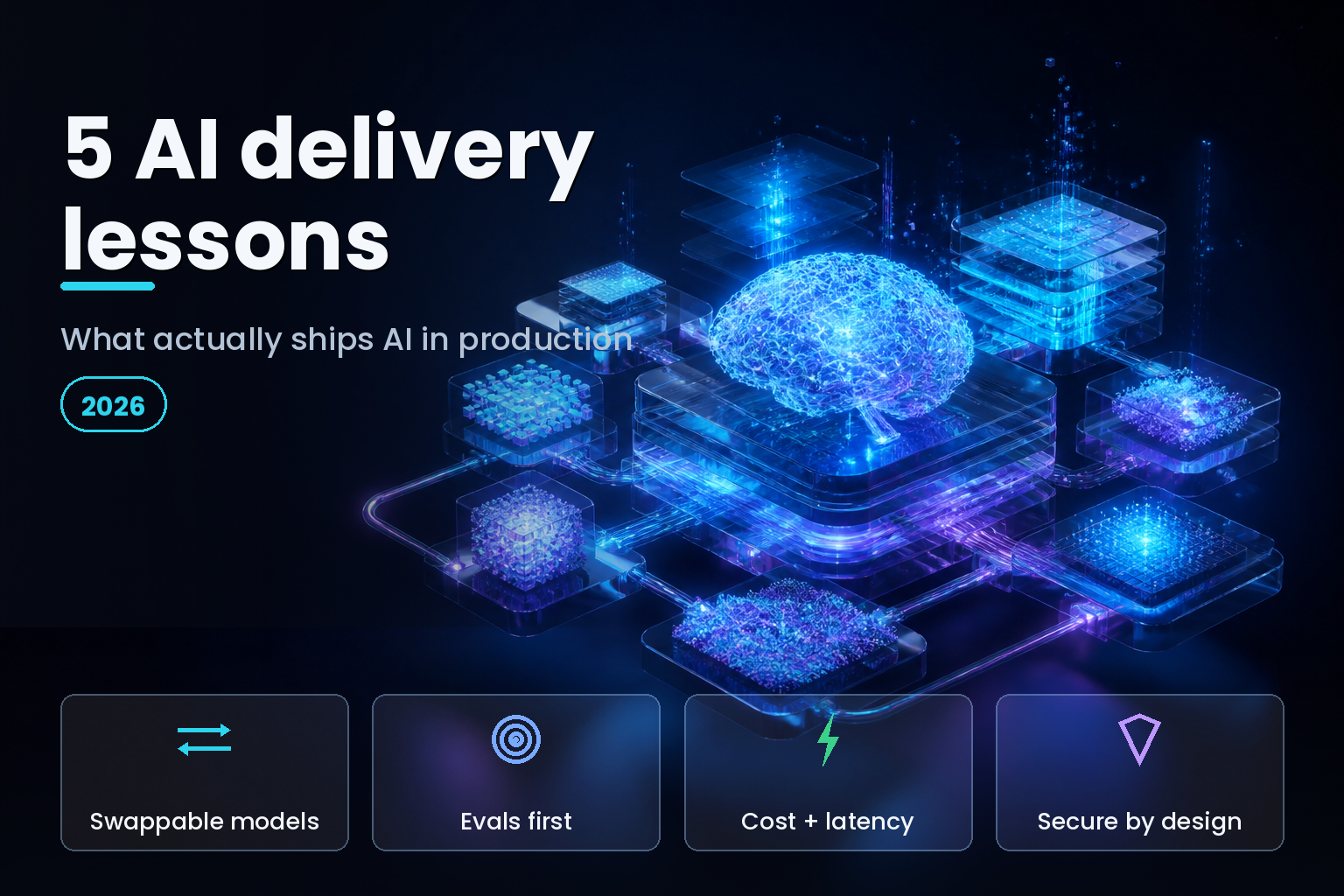
Summary. eCorpIT has built and shipped AI features since the company started in 2021, and the patterns that separate a demo from a dependable product have become clear. Five lessons carry most of the weight in 2026: treat the model as swappable infrastructure, start with evals instead of vibes, budget tokens and latency as product decisions, ground outputs with retrieval and citations, and build security and compliance in from day one. The context makes the case. Model prices fell roughly 80% from 2025 to 2026, with Claude Opus 4.8 at $5/$25 and GPT-5.5 at $5/$30 per million tokens as of June 2026, per BenchLM. Gartner predicted at least 30% of generative AI projects would be abandoned after proof of concept by the end of 2025, citing poor data quality, weak risk controls, escalating cost, and unclear value, per Gartner. These are the lessons our senior engineering teams use to stay on the right side of that number.
The 5 lessons at a glance
| # | Lesson | Why it matters | The practice |
|---|---|---|---|
| 1 | Model is swappable infrastructure | Prices and leaders change monthly | Abstract the model behind an interface |
| 2 | Evals before vibes | Demos hide regressions | Keep a labeled test set and gate on it |
| 3 | Tokens and latency are product | Cost and speed shape retention | Right-size the model per task; cache; stream |
| 4 | Ground and verify outputs | Hallucinations erode trust | Retrieve context, cite sources, verify claims |
| 5 | Security and compliance first | Prompt injection is the top LLM risk | Least-privilege tools, human approval, DPDP by design |
Lesson 1: Treat the model as swappable infrastructure
The fastest way to build technical debt in 2026 is to marry one model. Prices and capabilities move every month. Across the industry, token prices dropped roughly 80% from 2025 to 2026, and the spread between tiers is wide: Google's Gemini 3.1 Flash-Lite runs about $0.10/$0.40 per million tokens while a frontier model like GPT-5.5 sits at $5/$30, per BenchLM. Even Apple rebuilt Siri on Google's Gemini models this year, a reminder that no assistant, however large, is locked to one provider, per Apple.
The practice is to put the model behind an interface, so switching provider or tier is a configuration change rather than a rewrite. Keep prompts, tools, and evaluation separate from the specific model behind them. We track the pricing shifts closely, and covered one round in our note on the OpenAI and Anthropic price moves. The real cost of an AI feature is rarely the first model you pick; it is the rework when you need the next one.
Lesson 2: Start with evals, not vibes
A demo that looks great in a meeting can still fail one user in five, and you will not know without measurement. This is where projects die: Gartner predicted at least 30% of generative AI efforts would be abandoned after proof of concept by the end of 2025, and over 40% of agentic AI projects will be canceled by the end of 2027, in both cases for unclear value and weak controls, per Gartner.
The practice is an evaluation set before a launch date. Assemble real inputs with known-good outputs, score every prompt or model change against it, and treat a drop in that score as a build failure, the same way a failing unit test blocks a release. Evals turn "it feels better" into a number you can defend to a client. They also make Lesson 1 safe, because you cannot swap models with confidence unless you can measure whether quality held.
Lesson 3: Tokens and latency are product decisions
Cost and speed are not back-office concerns; they shape whether people keep using the feature. Output tokens cost more than input because they take more compute, and the gap between tiers is large enough to change a business case. The practice is to right-size the model to the task: a cheap, fast model for classification and extraction, a mid tier for most generation, and a frontier model only for genuinely hard reasoning.
| Task | Suggested tier | Example price per 1M tokens (Jun 2026) |
|---|---|---|
| Classification, extraction, routing | Small and fast | Gemini 3.1 Flash-Lite $0.10/$0.40 |
| Everyday generation and chat | Mid tier | Claude Sonnet 4.6 $3/$15; Gemini 3.1 Pro $2/$12 |
| Hard reasoning, complex agents | Frontier | Claude Opus 4.8 $5/$25; GPT-5.5 $5/$30 |
| High-volume repeat context | Any, with caching | Cache reads discounted sharply |
Caching is the underused lever. OpenAI's GPT-5 family offers around 90% savings on cached reads, and Anthropic charges roughly 10% of the base input price for cache hits, per BenchLM. Stream responses so the interface feels fast even when the full answer takes a moment. These prices are current as of June 2026 and will keep moving, which is exactly why Lesson 1 pairs with this one.
Lesson 4: Ground and verify outputs
A model that sounds confident and is wrong is worse than one that admits uncertainty. The durable fix is retrieval: pull the relevant facts from a trusted source at query time, pass them to the model, and ask it to answer from that context with citations. Grounding cuts hallucination and gives users a link to check, which matters more as AI search engines increasingly reward content they can trace.
Pair retrieval with a verification step for anything high-stakes. Before an answer reaches a user, check that each material claim traces to a retrieved source, and route anything unverifiable to a human or a safer fallback. This is the same discipline we apply to our own content and delivery pipelines, and it is the practical difference between an assistant a client trusts and one they quietly stop using. We set the wider strategy in our generative AI enterprise strategy guide.
Lesson 5: Build security and compliance in from day one
Security is not a phase after the model works. In the OWASP Top 10 for LLM Applications 2025, prompt injection is the number one risk, LLM01, covering both direct inputs that alter behaviour and indirect inputs pulled from a website or document, per TrojAI. When a model is wired to tools that can act, an injection can turn into real damage.
The practice is defence in depth: least-privilege tooling so the model can only do what it must, input and output filtering, human approval for high-risk actions, and regular adversarial testing, as OWASP guidance recommends. Privacy sits alongside it. In India, the Digital Personal Data Protection Act 2023 (DPDP) governs how personal data is handled, so we design applications aligned with DPDP and equivalent requirements rather than claiming blanket compliance. Building these controls early is far cheaper than retrofitting them after an incident.
| LLM risk | Practical mitigation |
|---|---|
| Prompt injection (direct and indirect) | Least-privilege tools; filter inputs and outputs |
| Sensitive data exposure | Minimise data sent; redact PII; align with DPDP and GDPR |
| Unsafe tool actions | Human approval for high-risk operations |
| Untested behaviour | Adversarial testing and red-teaming before launch |
Putting the five together
The lessons reinforce each other. Evals make model swaps safe. Right-sizing depends on knowing quality held. Grounding and verification protect trust, and security protects everything. None of this requires a frontier model or a large team; it requires discipline applied from the first prototype. That is the honest lesson from five years of shipping AI delivery: the model is the easy part, and the engineering around it is what ships.
FAQ
How eCorpIT can help
eCorpIT is a Gurugram-based technology consulting organisation, established in 2021, with senior-led engineering teams and a CMMI Level 5 process foundation. We help founders and engineering leaders ship AI delivery that survives contact with real users: model-agnostic architecture, evaluation harnesses, cost and latency budgets, retrieval and verification, and security aligned with the DPDP Act and equivalent requirements. If you are moving an AI feature from prototype to production, contact us or explore our mobile app development services.
References
- BenchLM, LLM API pricing comparison 2026 (June 2026).
- PricePerToken, LLM API pricing 2026: compare 300+ AI model costs (2026).
- CloudZero, LLM API pricing comparison (2026).
- Gartner, 30% of generative AI projects will be abandoned after proof of concept by end of 2025 (29 July 2024).
- Gartner, Over 40% of agentic AI projects will be canceled by end of 2027 (25 June 2025).
- OWASP via TrojAI, The 2025 OWASP Top 10 for LLMs (2025).
- Oligo Security, OWASP Top 10 LLM, updated 2025: examples and mitigation strategies (2025).
- Apple Newsroom, Apple unveils next generation of Apple Intelligence, Siri AI, and more (June 2026).
- Business Standard, WWDC 2026: Apple unveils Siri AI, Gemini-powered Apple Intelligence (9 June 2026).
- Gartner, Lack of AI-ready data puts AI projects at risk (26 February 2025).
_Last updated: 2 July 2026._