On this page · 10 sections
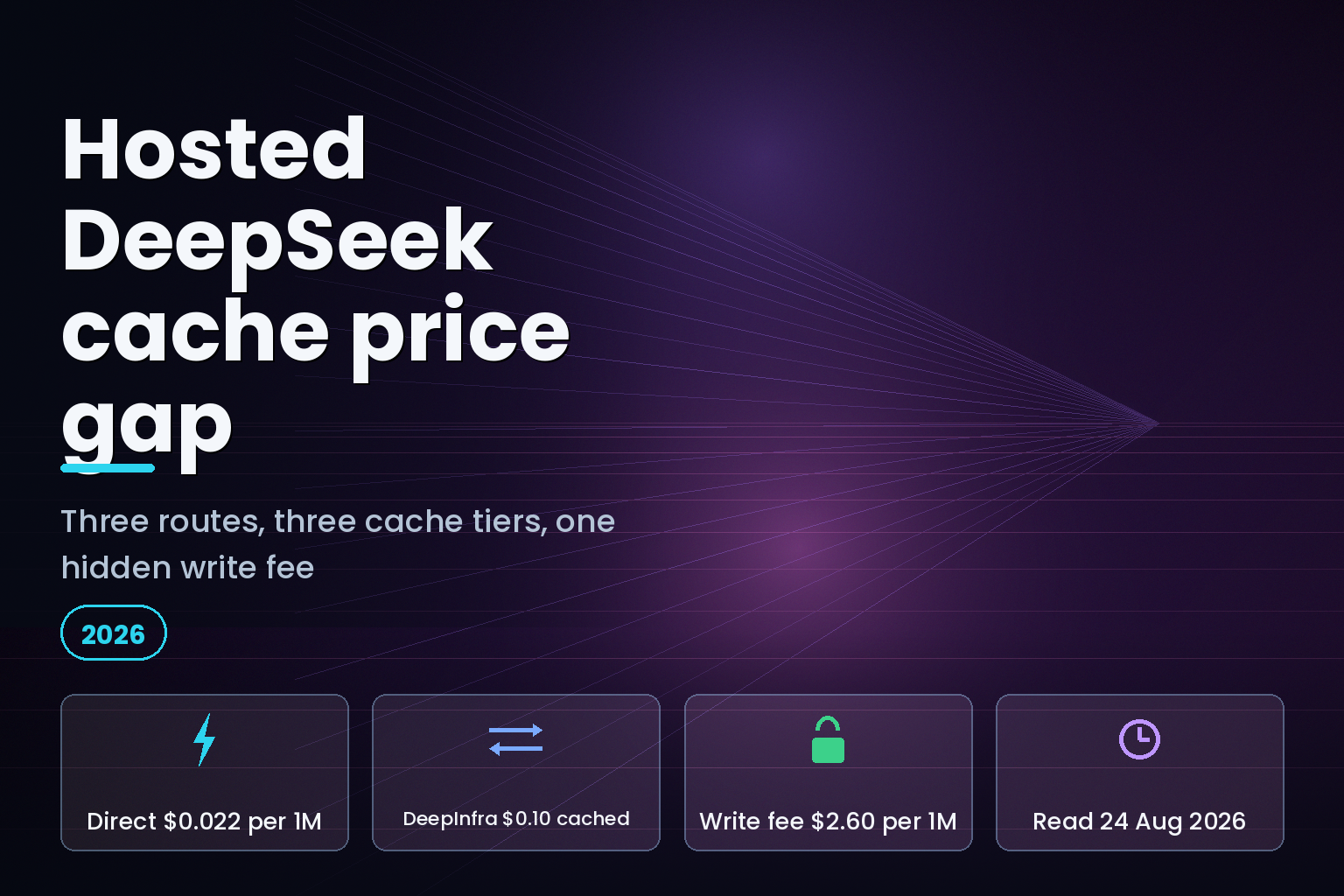
Summary. As of 24 August 2026, DeepSeek bills a cache hit on deepseek-v4-pro at $0.022 per million input tokens off-peak and $0.044 at peak. DeepInfra bills the same cached input at $0.10, and both Fireworks AI and Baseten bill it at $0.145. That is 4.5x and 6.6x the direct off-peak rate for the identical checkpoint, DeepSeek-V4-Pro-0813. DeepInfra adds a charge the other two do not publish at all: writing the cache costs $1.625 per million tokens for five minutes of retention and $2.60 per million for one hour, the second figure being exactly its output price and twice its standard input price. That line does not appear anywhere in the rendered text of DeepInfra's own pricing page. It appears only on the individual model page. For a coding agent whose traffic is mostly replayed prefix, the cache tier is the bill, and the four routes do not rank the way the headline input prices suggest.
What the four rate cards actually say
Every figure below was read from the vendor's own page on 24 August 2026, in US dollars per million tokens.
DeepSeek's models and pricing page splits every rate into peak and off-peak. Peak hours are 01:00 to 04:00 and 06:00 to 10:00 UTC, Monday through Friday; every other hour is off-peak, and off-peak rates are half the peak rates. The deepseek-v4-pro model version is DeepSeek-V4-Pro-0813, with a 1M context window, a 384K maximum output and a concurrency limit of 500.
| Route (per 1M tokens) | Input, cache miss | Input, cache hit | Output |
|---|---|---|---|
| DeepSeek direct, off-peak | $0.66 | $0.022 | $1.98 |
| DeepSeek direct, peak | $1.32 | $0.044 | $3.96 |
| DeepInfra, standard tier | $1.30 | $0.10 | $2.60 |
| DeepInfra, flex tier (0.8x) | $1.04 | $0.08 | $2.08 |
| DeepInfra, priority tier (1.5x) | $1.95 | $0.15 | $3.90 |
| Fireworks AI, serverless | $1.74 | $0.145 | $3.48 |
| Baseten Model APIs | $1.74 | $0.145 | $3.48 |
Two things fall out of that table immediately. Fireworks and Baseten publish three identical numbers for the same model, which makes the choice between them a latency and tooling decision rather than a price one. And the spread on cache hits is far wider than the spread on anything else: $0.022 to $0.145 is a 6.6x range, while the cache-miss input range on those same standard tiers is 2.6x and the output range 1.8x.
| Route | Cache discount vs its own miss price | Cache write charged? | Opt-in needed for the cached rate? |
|---|---|---|---|
| DeepSeek direct | 30x ($0.66 to $0.022) | No published charge | No, on by default |
| DeepInfra standard | 13x ($1.30 to $0.10) | Yes, $1.625 or $2.60 per 1M | Yes, pick a retention window |
| DeepInfra flex (0.8x) | 13x ($1.04 to $0.08) | Yes, scaled by the same 0.8x | Yes, pick a retention window |
| Fireworks serverless | 12x ($1.74 to $0.145) | No published charge | Yes, session-affinity hint |
| Baseten Model APIs | 12x ($1.74 to $0.145) | No published charge | Not documented |
The charge that is not on the pricing page
DeepInfra's pricing page lists DeepSeek-V4-Pro as "$1.30 / $0.10 cached" input and "$2.60" output. Its rendered text contains no occurrence of the phrase "cache write" and no occurrence of "retention". The only place those strings appear in the page source is an interface translation blob for the billing dashboard, which carries a usage_amount_cache_write_tokens label that the visible page never renders.
The charge is real, and it is on the DeepSeek-V4-Pro-0813 model page. Under "Prompt cache retention" that page prices a cache write at $1.625 per million tokens to retain for five minutes, a 1.25x multiplier on standard input, and $2.60 per million to retain for one hour, a 2x multiplier. The page adds that content is "retained in whole blocks of 1,024 tokens; the remainder is billed as standard input," and that priority and flex tiers scale the write price the same way they scale input and output.
So the DeepInfra cache is a two-sided instrument. You pay up front to put a prefix in it, then you pay $0.10 per million to read it back. DeepSeek's context caching documentation describes the opposite arrangement: the disk cache "is enabled by default for all users, allowing them to benefit without needing to modify their code," each request writes cache prefix units automatically, and neither the caching guide nor the pricing page contains a cache-write price at all.
Break-even, in one calculation
Take a support agent that runs a 40,000-token stable prefix (system prompt plus tool schemas plus a retrieved document set) and issues 30 calls against it inside an hour, each returning 800 output tokens.
| Cost line | DeepSeek direct, off-peak | DeepInfra standard, 1h retention | Fireworks serverless |
|---|---|---|---|
| First call, prefix as input | $0.0264 | $0.0520 | $0.0696 |
| Cache write, 40K tokens | none published | $0.1040 | none published |
| 29 cached replays of 40K | $0.0255 | $0.1160 | $0.1682 |
| Output, 30 x 800 tokens | $0.0475 | $0.0624 | $0.0835 |
| Hour total | $0.0994 | $0.3344 | $0.3213 |
The direct route costs about 30 percent of either host for that shape of work. Run the same arithmetic during DeepSeek's peak window and the direct total roughly doubles to $0.1988, which still beats both. The reason is structural rather than promotional: DeepSeek's cache hit is 3.3 percent of its cache-miss price, a 30x discount, while DeepInfra's is 7.7 percent and Fireworks' and Baseten's are 8.3 percent, both closer to 12x. The more of your traffic is replayed prefix, the worse the hosted routes look, which is the reverse of the usual assumption that a host undercuts the model vendor.
Fireworks prices a cache you have to opt into
Fireworks documents its cached rate more carefully than either competitor, and the caveat is the interesting part. Its prompt caching guide states that caching "is enabled by default for all Fireworks models and deployments" and that "the default discount is 50%, but the exact discount varies by model." For DeepSeek-V4-Pro the model library page shows $1.74 against $0.145, a 91.7 percent discount rather than 50 percent, so the guide's default is not the number you should budget against.
The operational catch sits two paragraphs lower: "Prompt caching only works within 1 replica. If you are using serverless or a deployment with multiple replicas, you need to give us hints for where to send the traffic to maximize prompt cache hit rates." The hint is a per-user or per-session identifier, placed either in the user field of the request body or in an x-session-affinity header. Fireworks also documents x-prompt-cache-isolation-key for forcing separation, and a reset_prompt_cache field accepting all, none or new_session.
None of that is emitted by an unmodified OpenAI SDK call. A team that swaps a base URL and an API key, which is precisely the migration Fireworks and its competitors advertise, gets round-robined across replicas and pays $1.74 rather than $0.145. The published cached rate is reachable, but it is opt-in, and the opt-in is a code change.
Baseten publishes the same $0.145 cache-input column on its pricing page but its Model APIs overview contains no occurrence of session affinity, replica pinning or prompt-cache configuration. The document tells you to "point an existing OpenAI or Anthropic SDK at Baseten's inference endpoint" and stops there. The same page notes that a Fast tier exists for some models with its own slug, pricing and rate limits, and that "if Fast capacity is saturated, Baseten serves the request on base-model capacity instead of failing it," which quietly changes your unit price mid-workload. Baseten's own table already shows what an absent cache tier looks like: GPT OSS 120B carries a dash in the cache-input column while DeepSeek V4 Pro carries $0.145.
Why this lands now
Agent traffic is what makes the cache tier decisive. DeepInfra's own Series B announcement on 6 May 2026 put a number on it: agent systems "can require 50-100+ model calls per task and operate continuously," and the company estimated that close to 30 percent of its weekly token volume comes from agents. Nikola Borisov, co-founder and CEO of DeepInfra, said in the same release: "Inference is no longer a thin layer - it's the system constraint that will define the majority of workloads."
Fifty to a hundred calls per task against a shared prefix is a workload where the cache tier is nearly the entire bill. A pricing comparison built on headline input and output rates, which is what most procurement spreadsheets contain, will rank these four routes wrongly for that traffic.
What to check before you switch
Read the model page, not the pricing page. DeepInfra's cache-write charge is a worked example of a real cost line that lives one click away from the summary table. Then instrument the response: DeepSeek returns prompt_cache_hit_tokens and prompt_cache_miss_tokens in the usage block of every response, so a day of production traffic tells you your true hit ratio before you model anything.
If your hit ratio is above roughly 60 percent, the direct route wins at both peak and off-peak on current rates and no arithmetic about UTC windows changes that. Below that, the comparison turns into the ordinary input-and-output contest and DeepInfra's flex tier at $1.04 and $2.08 becomes competitive. If you go to Fireworks, budget an engineering ticket for the session-affinity header, because the cached rate is unreachable without it. The real cost of moving an agent between inference routes is usually the cache semantics, not the endpoint.
The same care applies to the clock. Our earlier analysis of the DeepSeek V4 peak and off-peak UTC windows covers how the direct route's two-tier day interacts with agent scheduling, and the Together AI DeepSeek V4 Pro rate cascade covers a fourth host that resolves the peak question differently again. Teams weighing a move off managed inference entirely should start with the DeepSeek V4 self-hosted versus API GPU cost break-even and the broader AI agent unit economics and cost per task model. The cache-write pattern is not unique to DeepInfra either; see our note on OpenAI prompt caching and cache-write cost.
India-specific considerations
None of the four routes discussed here publishes an India region for DeepSeek-V4-Pro-0813. DeepInfra states in its May 2026 announcement that it owns and operates GPU infrastructure across eight United States data centres with further locations planned. Baseten's pricing page directs regional requests to sales, and its dedicated-deployment rate card is quoted in US dollars per minute, from $0.01052 for a T4 to $0.16633 for a B200. For an Indian team under the Digital Personal Data Protection Act 2023, prompt content sent to any of these endpoints leaves the country, and a cached prefix by definition persists on the provider's storage for the retention window you paid for. DeepInfra's five-minute and one-hour retention options are therefore a data-residency decision as much as a cost one, and the shorter window is the cheaper and the tighter of the two.
FAQ
How eCorpIT can help
eCorpIT builds and operates production inference paths for agent workloads, including cache-hit instrumentation, route comparison against measured traffic rather than headline rate cards, and the session-affinity plumbing that hosted caches require. Our senior engineering teams work under CMMI Level 5 and ISO 27001:2022 practices, and design applications aligned with DPDP requirements where prompt content crosses a border. If you are weighing a move between inference routes, book an inference cost review or read how we staff AI engineering work.
References
- DeepSeek API Docs, Models and Pricing - peak and off-peak rates, model versions, concurrency limits.
- DeepSeek API Docs, Context Caching - cache enabled by default, prefix unit persistence, usage fields.
- DeepInfra Pricing - DeepSeek family per-token rate card.
- DeepInfra, DeepSeek-V4-Pro-0813 model page - tier multipliers and prompt cache retention pricing.
- Fireworks AI, DeepSeek-V4-Pro model page - serverless input, cached input and output rates.
- Fireworks AI Docs, Prompt caching - replica scope, session affinity headers, default discount.
- Fireworks AI Pricing - serverless, training and on-demand structure.
- Baseten Pricing - Model APIs token table and dedicated instance rates.
- Baseten Docs, Model APIs overview - OpenAI-compatible endpoint, Fast tier fallback behaviour.
- DeepInfra, We've raised $107M Series B - 4 May 2026, agent call volumes and infrastructure footprint.
- AIwire, DeepInfra Closes $107M Series B - 6 May 2026, Nikola Borisov quote and agent token share.
Last updated: 24 August 2026.