On this page · 11 sections
- What shipped, and on what date
- The three-rate table AWS publishes and xAI does not
- The 200K cliff, and why nobody has told you which side of it you are on
- The residency premium in numbers
- What breaks in the integration, not the invoice
- Four smaller contradictions worth checking before you quote a number
- India-specific considerations
- What is still unknown
- FAQ
- How eCorpIT can help
- References
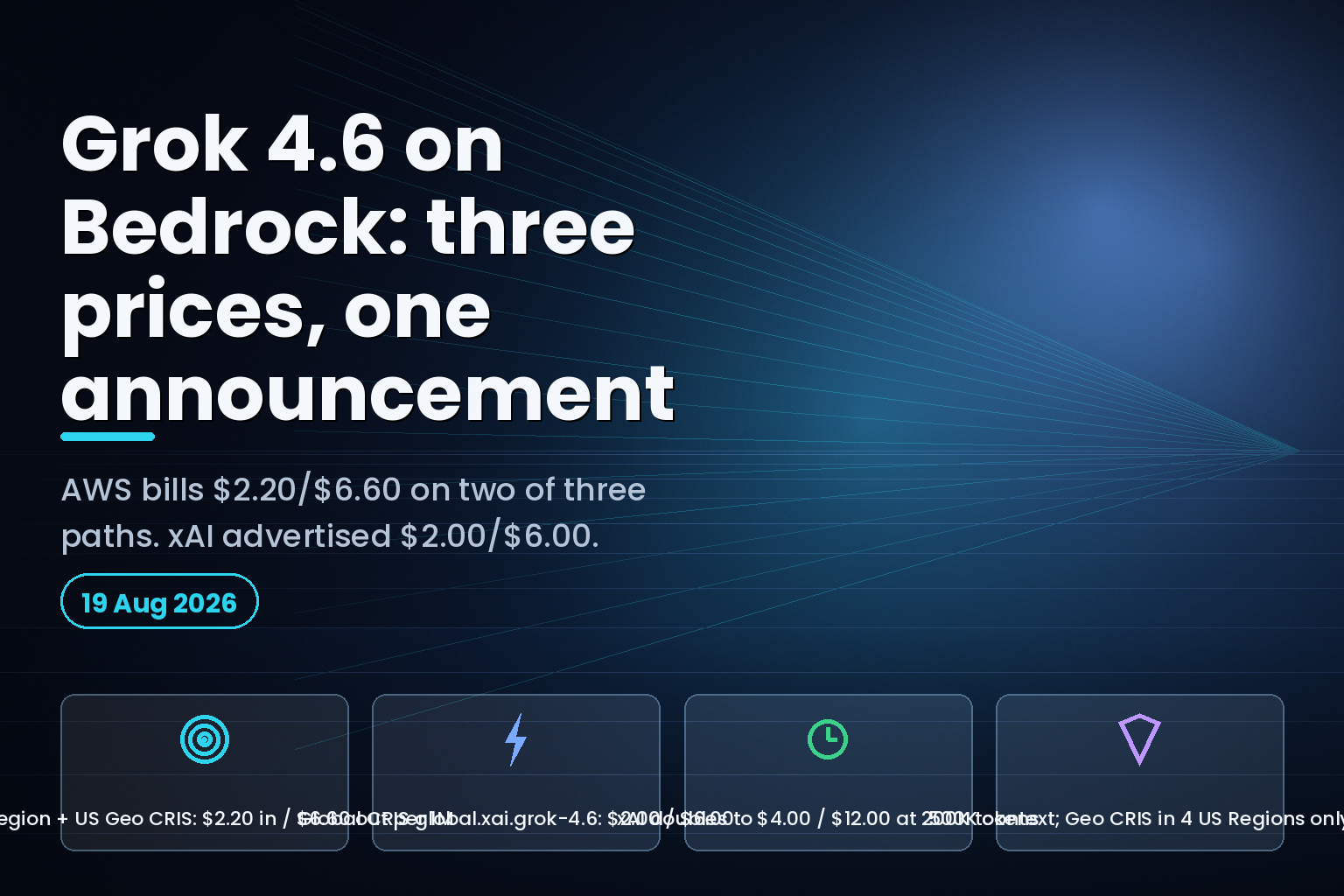
Summary. xAI announced Grok 4.6 as generally available on Amazon Bedrock on 19 August 2026 and printed one price: "Input : $2 per 1 million tokens", "Output : $6 per 1 million tokens". AWS's own model card for the same model prints three prices. Only the Global cross-Region inference profile, global.xai.grok-4.6, is billed at $2.00 and $6.00. In-Region and the US Geo profile us.xai.grok-4.6 are both billed at $2.20 input and $6.60 output — 10 percent higher. The US Geo profile is the one AWS recommends for data residency, so the teams with the strictest residency requirement pay the premium. A second gap is larger: xAI's own pricing page doubles Grok 4.6 to $4.00 input and $12.00 output once a prompt reaches 200,000 tokens, and applies that rate to every token in the request. AWS publishes no such threshold anywhere, and the model's headline feature is a 500K context window.
What shipped, and on what date
AWS posted "Amazon Bedrock now supports SpaceXAI Grok 4.6 with Cross Region Inferencing" on 19 August 2026. The AWS model card for the same model gives a "Model launch date" of 18 August 2026. xAI's announcement post is dated 19 August 2026. xAI's own model documentation at docs.x.ai was last updated on 12 August 2026, so Grok 4.6 was already live on the SpaceXAI API a week before the Bedrock GA.
The model card records a 500K-token context window and reasoning effort configurable across four levels: low, medium, high and xhigh. That is a change from Grok 4.3, whose AWS model card records a 1M-token context window and four different levels — none, low, medium and high. Moving from 4.3 to 4.6 on Bedrock halves your usable context and removes the ability to switch reasoning off entirely.
The three-rate table AWS publishes and xAI does not
Here is what each primary source states, per 1 million tokens.
| Path | Input | Output | Cache read |
|---|---|---|---|
Bedrock In-Region (bedrock-mantle) |
$2.20 | $6.60 | $0.55 |
Bedrock US Geo CRIS (us.xai.grok-4.6) |
$2.20 | $6.60 | $0.55 |
Bedrock Global CRIS (global.xai.grok-4.6) |
$2.00 | $6.00 | $0.50 |
| SpaceXAI API, prompt under 200K tokens | $2.00 | $6.00 | $0.50 |
| SpaceXAI API, prompt at or over 200K tokens | $4.00 | $12.00 | $1.00 |
The Bedrock rows come from the AWS model card, which footnotes them "All prices are per 1 million tokens. Pricing shown is for the Standard tier." The SpaceXAI rows come from docs.x.ai/developers/pricing, last updated 3 July 2026.
Two things follow immediately. First, the $2/$6 that xAI put in its Bedrock announcement is real, but it is one of three Bedrock rates, and it is the one attached to the profile that "serves requests from any commercial AWS Region where the model is available" — in other words, the profile a team with an India or EU data-processing constraint cannot use. AWS's What's New post is explicit that the Global profile is cheaper: it gives "the broadest access to Bedrock capacity and the highest throughput during demand spikes, at a lower per-token cost." xAI's post does not mention that a second, higher rate exists.
Second, AWS's public Bedrock pricing page has no Grok 4.6 row at all. As of 21 August 2026 its xAI section lists a single model, Grok 4.3, at $1.25 input, $0.20 cached input and $2.50 output, in three Regions — US East (N. Virginia), US East (Ohio) and US West (Oregon). Anyone pricing this deployment from the page AWS points procurement teams at will price the wrong model.
The 200K cliff, and why nobody has told you which side of it you are on
xAI's pricing page carries this rule in plain language: "Models with long context pricing bill the long context rates for all tokens in a request once its prompt reaches the model's long context threshold." For Grok 4.6 that threshold is 200,000 tokens and the long-context rate is double. A 210,000-token prompt is not billed as 200,000 cheap tokens plus 10,000 expensive ones. The whole request moves to $4.00 and $12.00.
AWS publishes no equivalent. Its model card lists flat rates and a service-tier table in which Standard is supported and Priority, Flex and Reserved are not. There is no threshold column, no long-context footnote, and no Grok 4.6 row on the pricing page to carry one.
That leaves two possibilities and no way to distinguish them from documentation. Either Bedrock genuinely bills Grok 4.6 flat to 500K, in which case Bedrock is materially cheaper than the SpaceXAI API for exactly the long-agent workloads xAI built the model for. Or the threshold applies and AWS has not documented it, in which case a repository-scale coding agent will silently bill at twice the rate a finance team modelled from the model card. The only safe move before 200K-token prompts reach production is a metered pilot: run a deliberate 210,000-token request, wait for it to land in the AWS Cost and Usage Report, and read the rate off the line item rather than off a page.
The residency premium in numbers
Take a coding-agent workload of 40 million input tokens and 8 million output tokens a month — a small team running a handful of concurrent agents.
| Path | Monthly input cost | Monthly output cost | Total |
|---|---|---|---|
| Global CRIS at $2.00 / $6.00 | $80.00 | $48.00 | $128.00 |
| US Geo CRIS at $2.20 / $6.60 | $88.00 | $52.80 | $140.80 |
| SpaceXAI API, long context at $4.00 / $12.00 | $160.00 | $96.00 | $256.00 |
The residency premium is $12.80 a month at that volume, or roughly ₹1,100 — trivial. At 40x that volume it is about $512 a year, still small against engineering time. The number that actually matters is the third row. Crossing 200K on the SpaceXAI API doubles the bill, and it is a property of prompt length, not of your commitment tier, so it moves without anyone changing a contract. Teams doing this work at scale should read our Bedrock versus direct API cost math alongside the Grok 4.6 agent cost comparison before committing a routing rule.
What breaks in the integration, not the invoice
The billing gap is the visible problem. Three documented constraints are the ones that will actually cost you a sprint.
In-Region inference does not exist on `bedrock-runtime`. The model card's sample-code note states it plainly: on bedrock-runtime you must name a cross-Region inference profile, us.xai.grok-4.6 or global.xai.grok-4.6, and "This model is not available for in-Region inference on that endpoint." The In-Region path exists only on the bedrock-mantle endpoint, and only in us-west-2. AWS's own models-region-compatibility page goes further and marks In-Region as unsupported in every Region including us-west-2 — while the model card still prints an In-Region price. AWS publishes a rate for an option one of its own pages says is unavailable.
You cannot have structured outputs and cross-Region scale at the same time. On bedrock-runtime — the only endpoint with the CRIS profiles — the model card lists structured outputs as not supported. On bedrock-mantle, which has no CRIS profiles and runs in one Region, they are supported. docs.x.ai lists structured outputs as a standard capability of the model, so this is a Bedrock-side split, and it forces a choice between JSON-schema-constrained output and multi-Region throughput.
Application inference profiles are not supported. The What's New post advertises "cost itemization in AWS Cost Explorer and the AWS Cost and Usage Report". The model card's feature table for bedrock-runtime lists application inference profiles under Not Supported and restricts projects to "default project only". Application inference profiles are the standard mechanism for tagging Bedrock spend per team or per application. Without them, cost itemisation on this model stops at the account and model level. If you split one Bedrock account across several products, that is the difference between an attributable bill and a shared one. Our AI gateway and model routing service exists partly because per-application attribution has to be recovered at the gateway when the platform will not provide it.
There is also an IAM detail that will produce a 403 on first call: the model card states your identity needs bedrock:InvokeModel on the account's default project ARN in addition to the inference profile.
Four smaller contradictions worth checking before you quote a number
- Cached input has three different prices. xAI's Bedrock post says "Cached input : $0.30 per 1 million tokens". docs.x.ai lists $0.50 for Grok 4.6 short context and $1.00 long context. AWS lists cache read at $0.55, $0.55 and $0.50 across its three paths. $0.30 is the cached rate docs.x.ai publishes for Grok 4.5.
- The reasoning default is contradicted. AWS's model card says the
reasoningparameter defaults to"low". docs.x.ai/developers/grok-4-6 says "Low, medium, high (default), or xhigh". Reasoning tokens bill as output, so a wrong assumption here is a live cost error, not a cosmetic one.
- The parameter has two names. xAI documents
reasoning_effort. AWS documents only areasoningobject, called asreasoning={"effort": "high"}. The stringreasoning_effortdoes not appear on the AWS model card. Both listxhigh.
- "All AWS Regions" is not the region table. The What's New post says cross-Region inference "is available in all AWS Regions where Amazon Bedrock is offered." The model card shows Geo CRIS in four US Regions only — us-east-1, us-east-2, us-west-1 and us-west-2 — and Global CRIS across roughly 31 commercial Regions. No GovCloud Region appears in either table, although Grok 4.3 received its own GovCloud announcement in mid-2026.
One more, for anyone browsing rather than searching: the User Guide's xAI model-card index page still rendered only Grok 4.3 when we checked on 21 August 2026, describing it as "xAI's latest model". Grok 4.6 was reachable by direct URL but absent from its own index.
India-specific considerations
No Indian Region appears in the Geo CRIS table — it is US-only. ap-south-1 (Mumbai) and ap-south-2 (Hyderabad) appear in the Global CRIS list, which by AWS's own description "serves requests from any commercial AWS Region where the model is available". A team subject to a contractual or sectoral data-processing-location commitment therefore cannot use Global CRIS to satisfy it, and the US Geo profile keeps processing in the United States, not in India. Under the Digital Personal Data Protection Act 2023, cross-border transfer is permitted except to countries the central government restricts by notification, so the constraint here is usually contractual or sectoral rather than statutory — but it is the kind of thing that gets discovered during a customer security review, not during architecture. The same trap appears in OpenAI's zero-data-retention endpoint coverage, where residency and retention are scoped differently from what the marketing page implies.
The real cost is usually the routing rule, not the model. Pick Global CRIS and you take the $2.00 rate and lose the residency story; pick US Geo and you pay 10 percent more for a US, not Indian, processing location.
What is still unknown
Whether Bedrock applies xAI's 200K long-context multiplier is undocumented on both sides. AWS publishes no Grok 4.6 row on its pricing page, so there is no authoritative AWS rate outside the User Guide. GovCloud availability is unstated rather than denied — absence from a region table is not an AWS statement of unavailability. Batch, Priority, Flex and Reserved rates do not exist to quote, because the model card lists those tiers as unsupported.
FAQ
How eCorpIT can help
eCorpIT builds and operates model-routing layers for teams running production LLM workloads across more than one provider, including per-application cost attribution where the platform does not supply it. We are CMMI Level 5, MSME Certified and ISO 27001:2022 certified, and we design deployments aligned with DPDP Act 2023 data-processing requirements. If you are choosing between Bedrock profiles, a direct provider API, or a gateway in front of both, our cloud FinOps guidance for Indian teams covers the modelling. Talk to our senior engineering team through /contact-us/.
References
Last updated: 21 August 2026. All prices and model details verified against the primary sources listed above on that date.