On this page · 9 sections
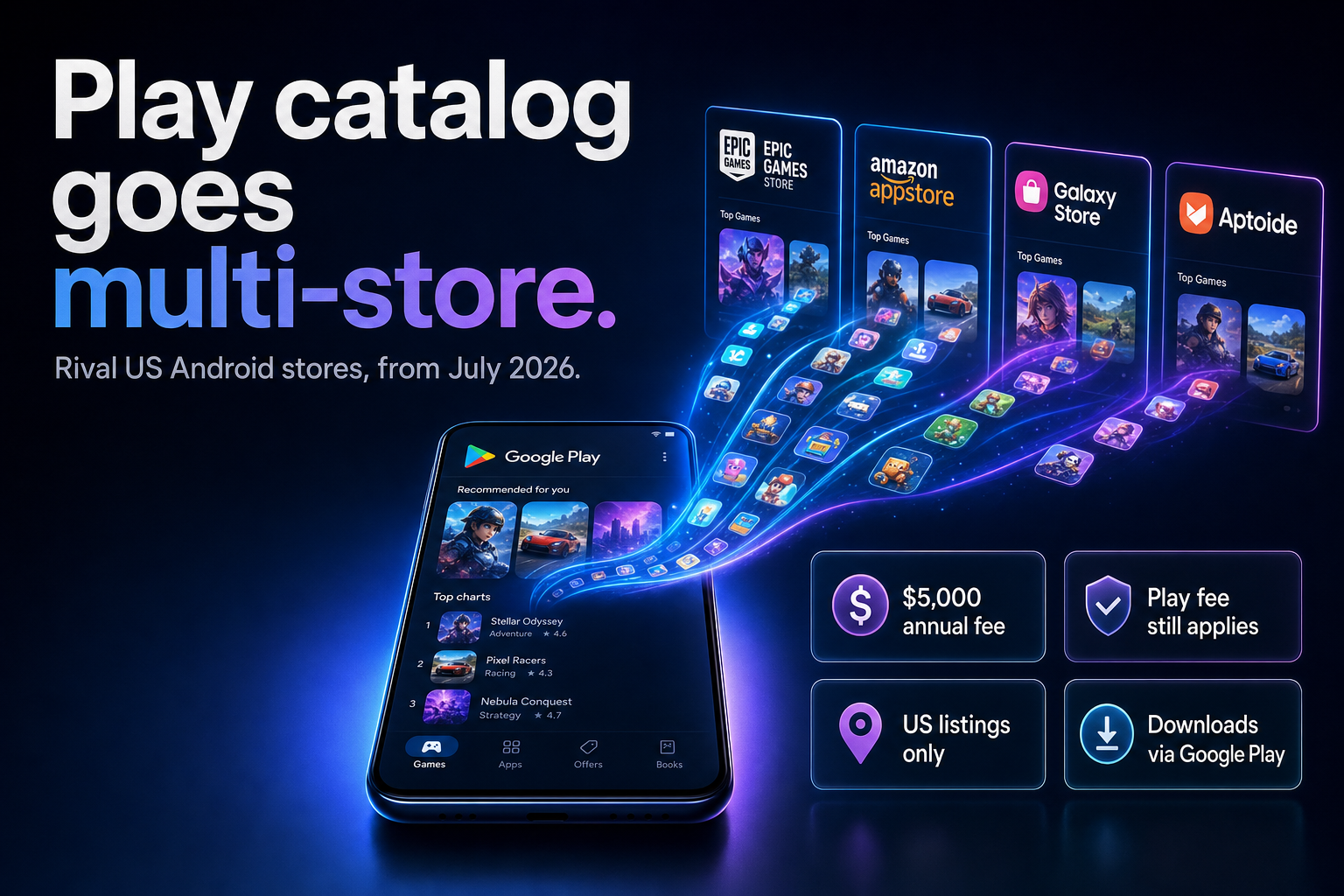
Summary. On July 22, 2026, Google began letting third-party US Android app stores list and distribute apps straight from the Google Play catalog, the biggest shift in Android distribution since sideloading. The Play Catalog Access Program comes out of the Epic Games antitrust case: after the Ninth Circuit upheld the injunction on September 12, 2025 and a proposed settlement collapsed, Google and Epic jointly withdrew their motion on July 15, 2026, leaving the October 2024 permanent injunction in force. Two facts decide most of what follows. Rival stores pay Google a $5,000 annual access fee, and every install still completes through the Google Play system, so Google keeps collecting its service fee on those downloads. Your US listings are included by default, and opting out is a deliberate choice. This guide covers what changed, what it costs, and what publishers should do.
What changed on July 22, 2026
Before this week, a US Android user found your app on Google Play or installed it manually by sideloading. Now an approved third-party US store can enroll in the Play Catalog Access Program, pull a daily snapshot of the Play catalog from Google Cloud Storage, show your listing inside its own storefront, and start the install through Google's Inline Install API. The download then finishes through the Google Play system on the same terms as a direct Play download, and Google's service fee still applies.
The default matters. Google's developer guidance states that US app and game listings are made available to enrolled stores automatically, unless the developer opts out. Stores pay a $5,000 annual access fee for the security and policy reviews Google runs during onboarding, and they must keep malware under 1% of install attempts over a 30-day rolling window to stay in.
| Dimension | Before July 22, 2026 | After July 22, 2026 |
|---|---|---|
| Where a US user finds your app | Google Play, or manual sideload | Google Play plus enrolled third-party US stores |
| Who completes the install | Google Play | Google Play, even from a third-party store |
| Who collects the service fee | Google, service fee still applies | |
| Cost to the third-party store | Not applicable | $5,000 annual access fee |
| Your listing's default state | Play only | Available to US stores unless you opt out |
| Catalog freshness | Not applicable | Daily snapshot, refreshed at least weekly |
The catch: downloads and the fee still run through Google
This is a store within a store, not a clean break from Google. As TechTimes put it, Google now hosts rival Android stores but still controls every download. A user who taps install inside a rival storefront is handed to Google Play to finish the transaction, and Google collects its service fee on it. The third-party store gets the discovery surface; Google keeps the billing rail.
That is separate from Google's other 2026 change. On June 24, 2026, Google agreed to lower Play Store fees and allow alternative billing in the US, UK and European Economic Area. The catalog program does not add or remove those fees. If you were counting on rival stores to cut your effective take rate, that saving comes from the separate billing changes, not from being listed elsewhere.
How the Epic v. Google fight got here
The program is the tail end of a long antitrust fight. A December 2023 jury found Google had operated an app store monopoly and charged developers fees that were too high. A permanent injunction issued in October 2024 required Google to support rival Android stores, and the Ninth Circuit upheld it on September 12, 2025. Google made its first compliance changes on October 29, 2025, ending anti-steering rules and the requirement to use Google Play Billing.
Google then tried to soften the remedy. On March 4, 2026, Google and Epic asked the court to enter a revised Modified Injunction. That effort stalled once it became clear the court was unlikely to approve it, and on July 15, 2026, Google and Epic jointly withdrew the motion, leaving the original remedy in force. A Google spokesperson told The Verge the company would "focus on executing our recently announced global business model evolution to deliver greater app store choice, lower prices, and more opportunities for developers and users." With the settlement gone, the original remedy took effect and the catalog opened on July 22, 2026.
What a third-party store must do to carry your app
The requirements sit between you and any store that wants your listing, and they are worth knowing before you judge the risk. A participating store must target US users, register as an organization, and operate as an open marketplace with clear, non-discriminatory policies. It has to hold developer authorization and respect intellectual property, and its main purpose must be app discovery, install and management, with a real user-facing storefront.
On safety, a store must prevent malware and potentially harmful apps, publish a privacy policy, offer parental controls, and stay under the 1% malware threshold. On catalog handling, it must use Play catalog data only for US distribution, refresh at least weekly, tell users that catalog apps come from the Google Play Store before triggering an install, and it cannot charge users extra fees for those apps or share catalog data with anyone. The store submits its own app for review; Google does not re-review the individual apps it pulls from the catalog.
Should you opt out or stay in?
For most publishers the honest answer is that staying in costs nothing extra and adds US reach. Because Google's fee and billing run either way, opting out does not save money; it only removes storefronts. The real reasons to opt out are about control and brand, not economics.
| Factor | Reasons to stay in (the default) | Reasons to opt out |
|---|---|---|
| Reach | More US storefronts and discovery surfaces | You want a single, controlled channel |
| Economics | No change; Google's fee and billing still apply | No cost saving from leaving |
| Brand and IP | Stores must show your name, version and permissions | Concern about presentation or impersonation |
| Support | Installs and ownership changes need user consent | You do not want tickets from another store's flow |
| Trust and safety | Malware capped at 1%, stores are policy-reviewed | You distrust a specific marketplace's moderation |
If you stay in, treat it as a distribution surface to monitor rather than set and forget. Keep your listing metadata, screenshots and permissions clean, since that is what every store now renders. Watch for impersonation and confusing clones, and confirm your app registration in Play Console so you keep a verified developer identity across surfaces. If you opt out, document the decision and revisit it, because the reach you decline is real. Either way, the same July 2026 Play policy updates on user data and target API levels still apply to your app.
India-specific considerations
The program is US-only. It does not open the Play catalog to third-party stores in India, and stores may not use catalog data to distribute outside the United States. The one place it touches Indian teams is reach: an Indian studio that publishes to US users has its US listings included by default and can opt out the same way any developer can.
India runs its own version of this fight through the Competition Commission of India. In October 2022, the CCI found Google had abused its dominant position by mandating the Google Play Billing System, and in 2025 the NCLAT partially upheld that finding while cutting the penalty to ₹216.69 crore. The Supreme Court has since admitted cross-appeals from Google, the CCI and the Alliance of Digital India Foundation, so the Indian remedy is still unsettled. Whichever storefront ends up carrying an app, the publisher stays the data fiduciary under the DPDP Act 2023 for how that app collects and processes user data. The parallel to watch is Apple, which faces its own Epic case at the US Supreme Court in late 2026 or early 2027 and separate EU Digital Markets Act rules that already force alternative marketplaces on iOS in Europe.
FAQ
How eCorpIT can help
eCorpIT is a Gurugram-based, senior-led engineering organisation that builds and maintains Android apps for founders and product teams shipping to global and Indian users. We can review how your listings, permissions and developer registration hold up now that rival US stores can render them, help you decide whether to opt out, and keep your app aligned with the July 2026 Play policy and target API requirements. If you want a distribution and compliance review, talk to us or read more about our Android app development service.
References
- An update regarding Google Play's policies for developers serving users in the US, Play Console Help
_Last updated: July 26, 2026._