On this page · 11 sections
- What Z.ai actually shipped
- The benchmarks, read honestly
- The API price gap is real, but it is not one-sixth
- The self-hosting math: 753B parameters, 1.5 TB of weights
- Break-even is a throughput problem, not a price problem
- Open weights do not mean sovereignty
- India-specific considerations
- How to decide
- FAQ
- How eCorpIT can help
- References
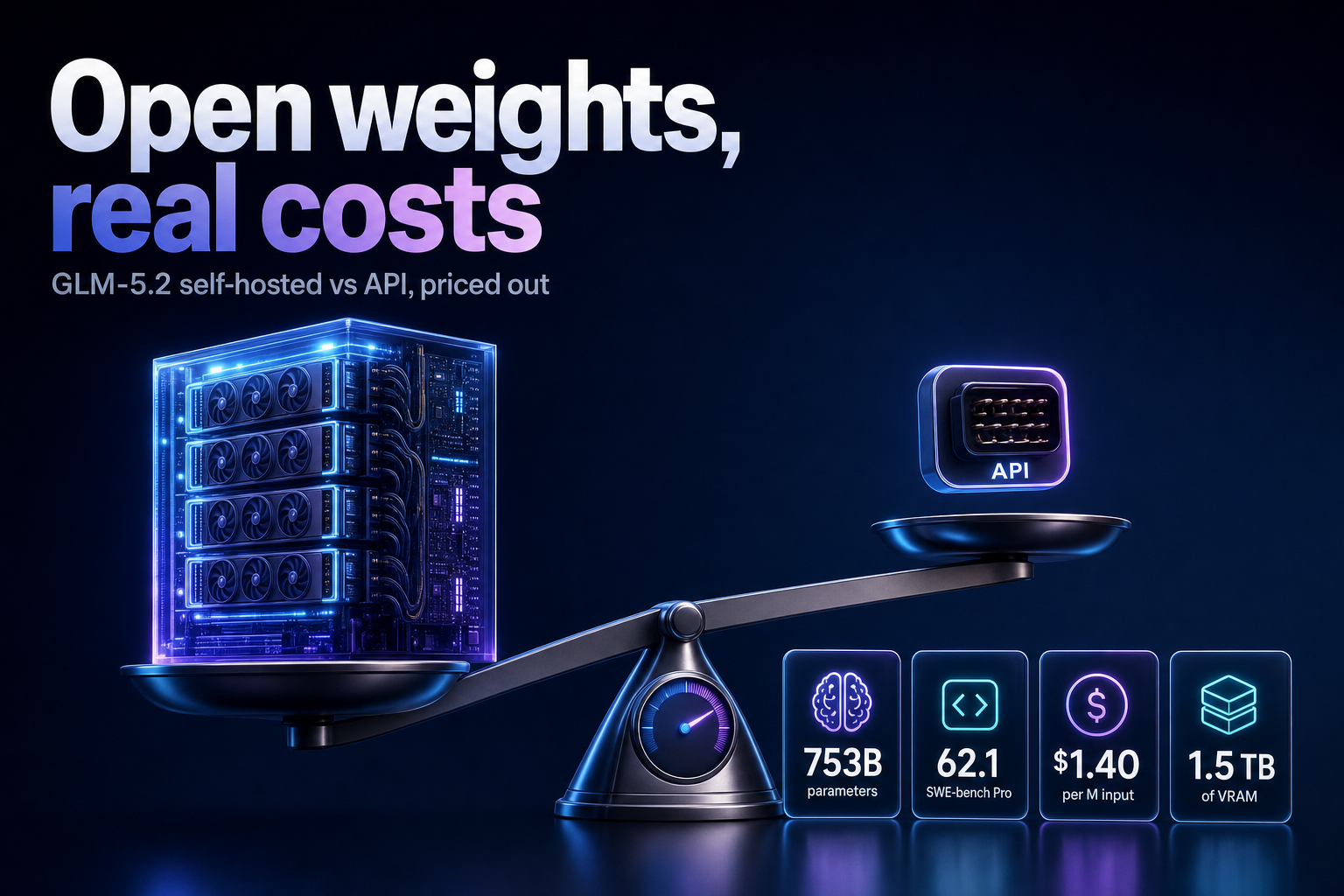
Summary. Z.ai released GLM-5.2 on 16 June 2026: 753 billion parameters, a 1M-token context window, and an MIT licence with no regional limits. It scores 62.1 on SWE-bench Pro against 69.2 for Claude Opus 4.8 and 58.6 for GPT-5.5, and Z.ai lists it at $1.40 per million input tokens and $4.40 per million output tokens, against $5 and $25 for Opus 4.8. That price gap is real. The gap that gets ignored is the one between using the Z.ai API and running the weights yourself: 753B parameters at BF16 is roughly 1.51 TB of GPU memory, which does not fit on a single 8-GPU node until you quantise it. One AWS p5en.48xlarge with eight NVIDIA H200s and 1,128 GB of HBM3e costs $49.75 an hour on Capacity Blocks in US West after AWS raised the rate about 15% in January 2026. Run it for a 720-hour month and the bill is $35,820, or about ₹34.1 lakh at ₹95.26 to the dollar. To beat the Z.ai API at that price you need to push roughly 17.9 billion tokens a month through the node. Almost nobody does.
This article works through the arithmetic, using vendor list prices as of July 2026 and the benchmark numbers Z.ai published on its own model card. The conclusion is not "self-hosting is bad". It is that self-hosting GLM-5.2 buys you jurisdiction, not savings, and teams keep buying it for the wrong reason.
What Z.ai actually shipped
GLM-5.2 is a Mixture-of-Experts model from Z.ai, the Beijing company formerly known as Zhipu AI. The Hugging Face model card lists 753B parameters in BF16 tensors under an MIT licence, and the weights had 142,547 downloads in the month after release. The launch post, published 17 June 2026, describes the headline feature as a "solid 1M-token context" rather than a nominal one, and Z.ai is explicit about the distinction: "A 1M context is easy to claim, but much harder to keep reliable under real engineering pressure."
Two architecture changes carry that claim. IndexShare places one lightweight indexer at the first of every four transformer layers and reuses its top-k indices across all four, which Z.ai says cuts per-token indexer FLOPs by 2.9x at 1M context. The multi-token-prediction layer used for speculative decoding was reworked, lifting the acceptance length from 4.56 to 5.47 tokens, a 20% gain. Both matter for anyone serving the model themselves, because they change throughput per GPU-hour, which is where self-hosting economics live or die.
The licence is the part that changed the conversation. MIT with no regional restriction means you may download the weights, run them on your own hardware, fine-tune them, and ship products built on them without asking Z.ai for anything. Neither Anthropic nor OpenAI offers that at any price.
The benchmarks, read honestly
Z.ai publishes a full comparison table on the model card. Reproduced below are the coding and agentic rows that matter for a coding-agent decision, with Z.ai's own reported figures for competitors.
| Benchmark | GLM-5.2 | Claude Opus 4.8 | GPT-5.5 | Gemini 3.1 Pro |
|---|---|---|---|---|
| SWE-bench Pro | 62.1 | 69.2 | 58.6 | 54.2 |
| Terminal-Bench 2.1 (Terminus-2) | 81.0 | 85.0 | 84.0 | 74.0 |
| FrontierSWE (Dominance) | 74.4 | 75.1 | 72.6 | 39.6 |
| MCP-Atlas (public set) | 76.8 | 77.8 | 75.3 | 69.2 |
| NL2Repo | 48.9 | 69.7 | 50.7 | 33.4 |
| DeepSWE | 46.2 | 58.0 | 70.0 | 10.0 |
| SWE-Marathon | 13.0 | 26.0 | 12.0 | 4.0 |
| Tool-Decathlon | 48.2 | 59.9 | 55.6 | 48.8 |
Read the top four rows and GLM-5.2 looks like a peer of the frontier: within 1.0 point of Opus 4.8 on MCP-Atlas, within 0.7 on FrontierSWE, ahead of GPT-5.5 on both. Read the bottom four and a different model appears. On NL2Repo, which asks an agent to build a repository from a natural-language spec, Opus 4.8 scores 69.7 and GLM-5.2 scores 48.9, a gap of nearly 21 points. On SWE-Marathon, an ultra-long-horizon benchmark covering work like building compilers and optimising kernels, GLM-5.2 scores 13.0 against 26.0 for Opus 4.8. Z.ai says so itself in the launch post: on SWE-Marathon the model "still has room to grow".
The honest summary is that GLM-5.2 is close to the frontier on bounded tasks and clearly behind it on the longest, least-specified ones. That maps neatly onto how teams actually use coding agents. If your agent fixes tickets, writes tests, and runs bounded refactors, the 7-point SWE-bench Pro gap costs you retries. If your agent is expected to take a vague brief and build a service, the 21-point NL2Repo gap costs you the task.
One caveat on all of it: these are the vendor's numbers, run in the vendor's harness. Z.ai's footnotes are unusually detailed about it, listing OpenHands for SWE-bench Pro, Claude Code 2.1.156 for ProgramBench, and Gemini-3.0-Pro as the MCP-Atlas judge. Detailed footnotes are a good sign. They are not the same as independent replication.
The API price gap is real, but it is not one-sixth
The reporting around GLM-5.2 settled on "one-sixth the cost". The list prices behind that claim, taken from each vendor's own pricing page in July 2026:
| Model | Input, $/M tokens | Cached input, $/M | Output, $/M tokens |
|---|---|---|---|
| GLM-5.2 (Z.ai) | 1.40 | 0.26 | 4.40 |
| GLM-5.1 (Z.ai) | 1.40 | 0.26 | 4.40 |
| Claude Opus 4.8 | 5.00 | 0.50 | 25.00 |
| Claude Sonnet 5 (to 31 Aug 2026) | 2.00 | 0.20 | 10.00 |
| GPT-5.5 | 5.00 | 0.50 | 30.00 |
| GPT-5.6 Sol | 5.00 | 0.50 | 30.00 |
| GPT-5.6 Luna | 1.00 | 0.10 | 6.00 |
Sources: Z.ai pricing, Claude pricing, OpenAI API pricing.
Where does one-sixth come from? Not from input: $5.00 against $1.40 is 3.6x. It comes from output. GPT-5.5 at $30.00 against GLM-5.2 at $4.40 is 6.8x, and Opus 4.8 at $25.00 is 5.7x. So the headline ratio is the output-token ratio, and coding agents are input-heavy. A realistic agent trace is roughly 80% input and 20% output once you count file context, tool results, and repeated system prompts. Blend at that ratio and the picture tightens:
GLM-5.2: (0.8 x $1.40) + (0.2 x $4.40) = $2.00 per million tokens. Claude Opus 4.8: (0.8 x $5.00) + (0.2 x $25.00) = $9.00 per million tokens. GPT-5.5 and GPT-5.6 Sol: (0.8 x $5.00) + (0.2 x $30.00) = $10.00 per million tokens.
That is 4.5x against Opus 4.8 and 5.0x against GPT-5.5, not 6x. Two adjustments push it back the other way. First, Anthropic's pricing page notes that Opus 4.7 and later, plus Sonnet 5, use a newer tokenizer that "produces approximately 30% more tokens for the same text". Compare on identical source code rather than on tokens and Opus 4.8's effective rate rises by roughly a third, which lands the real-world ratio close to the six that the headlines claimed. Second, GLM-5.2 is not the cheapest option on the table on input: GPT-5.6 Luna lists at $1.00. Luna is not a frontier coding model, but if your workload is bulk summarisation rather than agentic engineering, the open-weight argument evaporates.
Two more line items get missed. On OpenRouter, GLM-5.2 was being served at $0.7546 input and $2.372 output during a 46% promotional discount across 26 providers, well under Z.ai's own list. And the GLM Coding Plan, which is how most developers will actually meet the model, does not bill per token at all. Z.ai's launch post states that GLM-5.2 "consumes quota at 3x during peak hours and 2x during off-peak hours", with peak defined as 14:00-18:00 Beijing time. A subscription whose burn rate triples for four hours a day is a different cost model from a per-token API, and it is the one your finance team will be reconciling.
The self-hosting math: 753B parameters, 1.5 TB of weights
Here is where the open-weight argument meets a purchase order. Model weights need memory proportional to parameter count times bytes per parameter. The card lists BF16 tensors, so at full precision:
753,000,000,000 x 2 bytes = 1,506 GB, or about 1.51 TB.
An AWS p5en.48xlarge, per AWS's own P5 instance page, carries eight NVIDIA H200 GPUs with 1,128 GB of HBM3e in total. So GLM-5.2 at BF16 does not fit on one node. You need two, plus the interconnect tax and the tensor-parallel complexity that comes with crossing a node boundary.
Quantise to FP8, which Z.ai supports directly by publishing GLM-5.2-FP8 weights alongside the BF16 release, and the arithmetic changes:
753,000,000,000 x 1 byte = 753 GB, leaving 1,128 - 753 = 375 GB for KV cache, activations, and CUDA overhead on a single node.
375 GB of KV headroom sounds generous until you remember what you bought this model for. Z.ai's own engineering note is blunt about the consequence: extending context from 200K to 1M tokens "shifts the primary inference bottleneck from computation to KV-cache capacity", and IndexShare reduces FLOPs without proportionally reducing KV-cache size per token. Long-context coding agents are exactly the workload that eats KV cache. The 1M context you are paying for is the thing that makes one node too small.
| Line item | Figure | Source or derivation |
|---|---|---|
| Parameters | 753B | Hugging Face model card |
| Weights at BF16 | ~1.51 TB | 753B x 2 bytes |
| Weights at FP8 | ~753 GB | 753B x 1 byte |
| GPU memory, p5en.48xlarge | 1,128 GB HBM3e | AWS P5 instance page |
| KV-cache headroom at FP8 | ~375 GB | 1,128 - 753 |
| Node rate, US West | $49.75/hour | AWS Capacity Blocks, January 2026 |
| One node, 720-hour month | $35,820 | $49.75 x 720 |
| Same in rupees | ~₹34.1 lakh/month | at ₹95.26 to the dollar |
That $49.75 is not a stable number either. AWS raised Capacity Blocks pricing on p5e.48xlarge and p5en.48xlarge by about 15% in January 2026, with US West going from $43.26 to $49.75, as DatacenterDynamics reported. An AWS spokesperson told the publication that "EC2 Capacity Blocks for ML pricing are dynamic and vary based on supply and demand patterns", and Gartner VP analyst Lydia Long argued the same point publicly: "AWS has always been clear that Capacity Blocks are dynamically priced, so this is no more an anomaly than Spot Pricing fluctuations are." Both are correct, and both are the problem. You are swapping a per-token price you can forecast for an hourly price that moves with someone else's supply curve. We covered that repricing in detail in our note on the AWS EC2 Capacity Blocks GPU price rise.
Break-even is a throughput problem, not a price problem
Take the FP8 single-node case at $35,820 a month and compare it to the Z.ai API at a blended $2.00 per million tokens. The break-even volume is:
$35,820 / $2.00 per M tokens = 17,910 million tokens, or roughly 17.9 billion tokens a month.
Below that volume, the API is cheaper. Above it, the node is. So the only question that matters is whether your team can generate 17.9 billion tokens a month, and whether one node can serve them.
A 720-hour month is 2,592,000 seconds. Serving 17.9 billion tokens across it requires:
17,910,000,000 / 2,592,000 = about 6,900 tokens per second, sustained, every second of the month.
This is the number that kills most self-hosting business cases, and it almost never appears in the vendor comparison posts. Sustaining ~6,900 tokens per second from one 8-GPU node means near-perfect utilisation with high concurrency and short contexts. Long-context coding agents are the opposite: bursty, KV-cache hungry, and idle at night. The real cost is the migration and the idle time, not the code.
Work it from the other end. A developer running a coding agent hard might burn 50 million tokens a month. Break-even at 17.9 billion tokens therefore needs roughly 358 such developers, all pointed at one node, all day. If you have 358 heavy agent users, you are not reading a build-versus-buy article, you already have a platform team. If you have 30, your node runs at under 10% utilisation, your effective rate is about $20 per million tokens, and you have paid ten times the API price for the privilege of racking it yourself.
None of this makes self-hosting wrong. It makes the savings argument wrong. Nobody should self-host GLM-5.2 to save money at small scale, and the teams that will be glad they did it are the ones who needed something money cannot buy from an API.
Open weights do not mean sovereignty
That something is jurisdiction, and it is the one thing the price tables cannot express.
An MIT licence on the weights says nothing about where an API call goes. Route a request to Z.ai's cloud and your prompt, which for a coding agent means your source code, your configs, and sometimes your customer data, is processed on infrastructure inside China and under Chinese law. That is not a hypothetical objection; it is the reason enterprise adoption has been slower than the benchmarks suggest it should be. Reuters reported on 2 July 2026 that GLM-5.2 had climbed OpenRouter's usage charts to sit above Anthropic's models, that Snowflake CEO Sridhar Ramaswamy and venture capitalist Marc Andreessen had praised it, and that David Sacks called it a "mini DeepSeek moment", saying: "We now have a Chinese open-weight model that is as good as the currently available models from OpenAI and Anthropic."
The same Reuters analysis carried the counterweight. "I have seen some discussion among European companies about whether it could be used in enterprise settings," said Wei Sun, principal AI analyst at Counterpoint Research. "In the EU and U.S., some clients, partners and regulated industries may simply be unwilling to accept Chinese models in their AI stack, regardless of technical performance or price."
Read that quote as a procurement fact rather than a geopolitical opinion and the decision tree gets simple. If your customers, your auditors, or your contracts will not accept a Chinese-hosted inference endpoint, the Z.ai API is off the table no matter what it costs, and the MIT licence is what turns "no" into "maybe". You download the weights, run them in your own VPC or your own rack, and the jurisdiction question answers itself. That is worth paying for. It is just not a saving, and a business case that describes it as one will not survive its first review.
The corollary is worth stating plainly: the cheap thing and the sovereign thing are two different products. GLM-5.2 through the Z.ai API is the cheap thing. GLM-5.2 on your own GPUs is the sovereign thing, and it costs more than Claude Opus 4.8 until you are very large. Teams keep conflating them because the model name is the same.
India-specific considerations
For an Indian team the calculus has two extra terms.
The first is DPDP. India's Digital Personal Data Protection Rules were notified on 14 November 2025, and the phased timeline runs through a legacy-data revalidation point on 13-14 November 2026 to full enforcement on 13-14 May 2027, after which the Data Protection Board can impose penalties up to ₹250 crore for major violations. DPDP governs personal data, not source code, so a coding agent working on a stateless library is not in scope simply because the endpoint is foreign. The exposure appears the moment your prompts carry personal data: a production stack trace with user emails in it, a CSV of customer records pasted in for a migration script, a test fixture built from real signups. Those are ordinary coding-agent inputs, and routing them to any offshore endpoint is a cross-border transfer that you must be able to account for. The right control is a data-flow rule and a prompt filter, not a blanket ban. We set out the wider compliance bill in our analysis of DPDP compliance costs for Indian startups and the operational readiness work in the DPDP consent manager framework guide.
The second is the hardware. Everything above priced a US West node because that is the published rate. An Indian team wanting the weights inside India is choosing between an in-region cloud GPU allocation, a colocated rack, or a government-backed compute allocation, and none of those come with a stable public per-hour price you can put in a spreadsheet. At the ₹95.26 to the dollar rate India Briefing used in May 2026, one US West node at $35,820 a month is about ₹34.1 lakh, or roughly ₹4.09 crore a year before storage, egress, or the platform engineer who keeps vLLM running. Compare that with a ₹2-3 lakh monthly API bill for a 30-developer team and the shape of the decision is clear enough without a business case.
How to decide
Three questions, in this order.
Will your customers and regulators accept inference on a Chinese-hosted endpoint? If no, the Z.ai API is out and your only GLM-5.2 option is self-hosting. Price it against Opus 4.8 honestly, and expect to lose on cost below a few hundred heavy users.
Can you sustain thousands of tokens per second, all month? If no, self-hosting loses on cost by a wide margin. Utilisation, not the sticker price, decides this.
Is your agent doing bounded work or open-ended work? If bounded, GLM-5.2's 62.1 on SWE-bench Pro at a blended $2.00 per million tokens is strong value. If open-ended, the 48.9 on NL2Repo against Opus 4.8's 69.7 is the number to argue about, and paying $9.00 per million tokens to finish the task is cheaper than paying $2.00 to not finish it.
For most teams the answer is neither pure option. Route bounded, high-volume, low-sensitivity work to GLM-5.2 through an API, keep the hard long-horizon tasks on Opus 4.8 or GPT-5.6 Sol, and keep anything carrying personal data on an endpoint whose jurisdiction you can name. We laid out that routing pattern in our LLM hybrid routing decision framework, and the model-by-model comparison in GPT-5.6 vs Claude Sonnet 5 for enterprise agents. If you do land on self-hosting, Kubernetes OCI image volumes for model weights covers how to ship 753 GB of weights to a node without rebuilding your container story.
FAQ
How eCorpIT can help
eCorpIT is a Gurugram-based technology consultancy that helps engineering teams put numbers on decisions like this one before they become architecture. We benchmark candidate models against your own workload rather than a vendor's harness, measure the token mix your agents actually produce, and build the utilisation model that tells you whether a GPU node beats an API at your volume. Where jurisdiction is the constraint rather than cost, we design deployments around DPDP requirements and keep the data-flow rules enforceable in code. If you are weighing an open-weight model against a frontier API, talk to our team and we will start with your traces, not a spreadsheet.
References
- zai-org/GLM-5.2 model card, Hugging Face, accessed 16 July 2026.
- GLM-5.2: Built for Long-Horizon Tasks, Z.ai, 17 June 2026.
- Z.AI developer pricing, Z.ai, accessed 16 July 2026.
- Z.ai: GLM 5.2 model page, OpenRouter, accessed 16 July 2026.
- Pricing, Claude Platform Docs, Anthropic, accessed 16 July 2026.
- Pricing, OpenAI API, accessed 16 July 2026.
- Amazon EC2 P5 instances, Amazon Web Services, accessed 16 July 2026.
- AWS quietly increases prices for H200 EC2 instances by 15%, DatacenterDynamics, 6 January 2026.
- Analysis: A new, inexpensive Chinese AI model is catching up with Anthropic, OpenAI on their home turf, Reuters via Investing.com, 2 July 2026.
- When does India's DPDP law begin full enforcement? 2026-2027 timeline explained, India Briefing, 11 May 2026.
- IndexCache: Accelerating Sparse Attention via Cross-Layer Index Reuse, arXiv, March 2026.
- GLM-5: from Vibe Coding to Agentic Engineering, Z.ai GLM-5 Team, arXiv, February 2026.
- zai-org/GLM-5.2-FP8 model card, Hugging Face, accessed 16 July 2026.
Last updated: 16 July 2026.