On this page · 12 sections
- The seven questions at a glance
- 1. Does Google see our data when employees use Siri AI?
- 2. Where do Siri AI queries actually go?
- 3. Is Apple now dependent on a competitor for its core AI?
- 4. Could the DOJ antitrust case disrupt Siri AI?
- 5. Can we control or disable Siri AI on managed iPhones?
- 6. Are the privacy promises actually auditable?
- 7. What should our 2026 Apple AI policy say?
- India-specific considerations
- FAQ
- How eCorpIT can help
- References
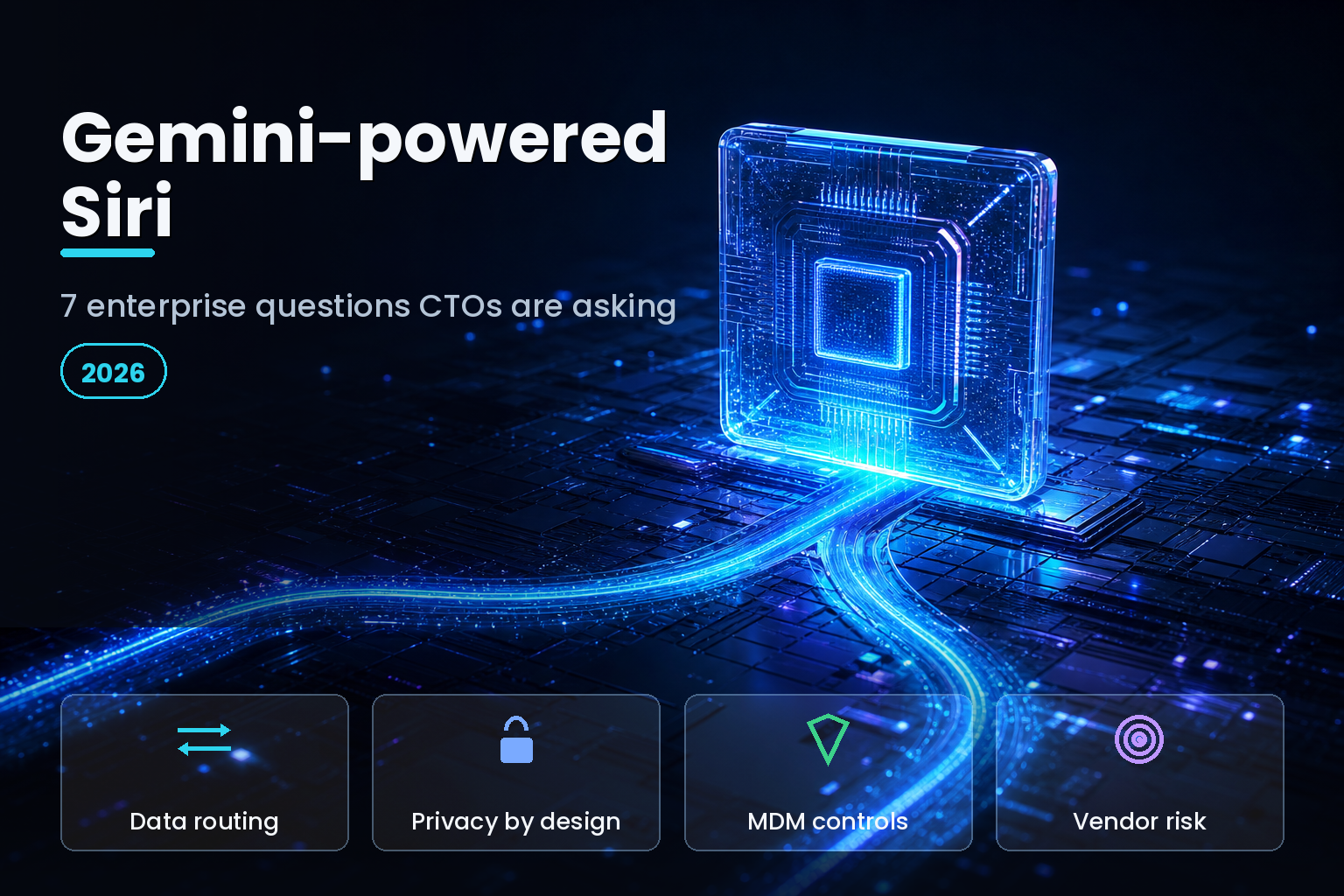
Summary. Apple's rebuilt Siri AI runs on a custom 1.2-trillion-parameter Google Gemini model, under a deal announced January 12, 2026 that pays Google about $1 billion per year. For CTOs the first question is data exposure, and the technical answer is a three-tier routing system: simple requests stay on the device, harder ones go to Apple's Private Cloud Compute, and the heaviest reasoning routes to Google Cloud on Nvidia Blackwell B200 GPUs. Apple says queries are anonymised and tokenised, and that Google is contractually barred from training on Apple user data. The deal also collides with the United States antitrust case targeting Google's $20 billion-a-year search arrangement. Siri AI ships with iOS 27 this fall as an English opt-in beta. Below are 7 questions enterprise leaders are asking, with what is verified, what is only promised, and what to put in your 2026 Apple AI policy.
Apple spent two years promising a smarter Siri and shipping delays. At WWDC on June 8, 2026, it shipped the rebuild, and the surprise was the engine: a competitor's model. That single fact changes how a security or platform leader has to think about Siri. The assistant your employees already trust is now partly a Google system, routed and wrapped by Apple. The seven questions below are the ones worth answering before the feature reaches your fleet.
The seven questions at a glance
| Question | Short answer | Enterprise risk |
|---|---|---|
| Does Google see our data? | No, per Apple's design and contract | Low, but unaudited |
| Where do queries actually go? | On-device, Private Cloud Compute, or Google Cloud | Medium |
| Is Apple dependent on a competitor? | Yes, for the top tier of reasoning | Strategic |
| Could antitrust disrupt this? | Possible; the deal is an antitrust exhibit | Medium |
| Can we disable it on managed devices? | Yes, via MDM keys | Low |
| Are the privacy promises auditable? | Not yet independently | Medium |
| What should our policy say? | Region and role-aware controls | Action needed |
1. Does Google see our data when employees use Siri AI?
The short answer Apple gives is no. The longer answer is that you are trusting a design and a contract rather than a wall. Apple processes Siri AI requests through its own Private Cloud Compute infrastructure, where it says personal data is not retained after a request and is not accessible to Apple or anyone else. In the joint announcement, Google and Apple confirmed that the next generation of Apple Foundation Models is built on Gemini models and Google cloud technology, while Apple controls the data path.
Two safeguards sit under the promise. Apple anonymises and tokenises queries so that, in its account, neither Apple staff nor Google can tie a request to a named user. And Google is contractually barred from training future models on Apple user query streams. Back in January, Google publicly confirmed it would not receive Apple user data under the deal. For a CTO, the honest framing is that data protection here rests on contract terms and Apple's architecture, not on the data never leaving Apple-controlled systems.
2. Where do Siri AI queries actually go?
Siri AI uses a three-tier routing model, and knowing which tier a request hits is the difference between an on-device action and a query that reaches a third-party cloud. The routing is automatic and not user-visible, which is exactly why it belongs in your risk assessment.
Tier one keeps simple work on the device: timers, music, notifications, smart-home control, and similar tasks run on Apple's own on-device models with no network hop. Tier two sends harder requests, such as multi-step reasoning and cross-app actions, to Apple's Private Cloud Compute. Tier three routes the heaviest reasoning to Google Cloud, where the custom Gemini model runs on Nvidia Blackwell B200 GPUs built for trillion-parameter inference. Nvidia's confidential-computing feature encrypts data while it is processed on those GPUs, which adds a hardware safeguard on top of the contract. The practical point: some share of complex employee queries will leave Apple's infrastructure for Google's, even though the data-handling terms follow them there. The mechanics broadly match the architecture covered in Apple's own newsroom material and independent WWDC reporting.
3. Is Apple now dependent on a competitor for its core AI?
Yes, for the top tier, and that is a strategic fact more than a security one. Apple's previous self-built cloud models could not match the capability Apple wanted, so it licensed a custom 1.2-trillion-parameter Gemini model and pays Google roughly $1 billion per year for it, as SiliconANGLE and others reported from WWDC. Notably, Gemini is not branded inside Siri's interface, so most users will not know a Google model answered them.
For enterprise planning, the dependency creates a supplier-concentration question. The most capable layer of Apple's assistant now comes from a single external provider that also competes with Apple in phones, browsers, and AI. Apple is unlikely to treat that as permanent, which means the model behind Siri AI could change at the next contract cycle. If your internal tooling or app behaviour is tuned to today's Siri AI responses, treat the underlying model as a dependency that can move. This is the same supplier-concentration risk that runs through any serious enterprise AI strategy in 2026.
4. Could the DOJ antitrust case disrupt Siri AI?
It could, and the deal is already part of the argument. Commentators expect the United States Department of Justice to cite the Gemini-Siri arrangement in its remedies push against Google, because it stacks on top of the existing roughly $20 billion-a-year search-default payment. Rebecca Haw Allensworth, an antitrust professor at Vanderbilt University, argued that the Gemini-Siri deal "essentially creates a second exclusive pipeline" between the two companies, raising the same structural concerns as past platform cases.
The enterprise takeaway is timeline risk, not legal exposure for you. A remedy that forces structural separation or unwinds parts of the commercial relationship could change how Siri AI is built or delivered. That is one more reason to keep any Apple-assistant dependency loosely coupled, with a fallback path that does not assume Siri AI stays exactly as launched.
5. Can we control or disable Siri AI on managed iPhones?
Yes. Apple gives IT the controls through the standard MDM Restrictions payload on supervised devices, and the relevant keys arrived with iOS 18.2 and macOS 15.2. Three matter most. The allowAssistant key disables Siri entirely. The allowIntelligence key turns off Apple Intelligence while keeping basic Siri. The allowChatGPTIntegration key stops Siri from handing requests to ChatGPT.
The limits matter as much as the keys. As MDM vendors document, several features including Clean Up in Photos, Natural Language Search in Photos, and Visual Intelligence cannot currently be blocked through MDM. And Apple has not published clear guidance on whether a future multi-model Siri can have its model choice standardised or audited across a fleet. So you can switch the assistant off or constrain it today, but you cannot yet finely govern which model answers a given query.
| MDM control | What it does | Limitation |
|---|---|---|
| allowAssistant | Disables Siri entirely | Removes basic Siri too |
| allowIntelligence | Disables Apple Intelligence, keeps basic Siri | Granular per-feature control is limited |
| allowChatGPTIntegration | Blocks Siri's ChatGPT fallback | Does not govern the Gemini tier |
| Writing Tools, Genmoji, Image Playground | Blockable via boolean keys | Must be set per profile |
| Clean Up, Visual Intelligence, Photos search | Not blockable today | No MDM key available yet |
6. Are the privacy promises actually auditable?
This is the question that separates comfort from proof. As of June 2026, no independent audit of the Google Cloud tier has been published, and contractual bans on training can be renegotiated in a later deal. Apple's Private Cloud Compute design is built to allow external verification of its server software, which is a strong position. The Google-hosted tier is the part with less public assurance.
For a regulated enterprise, treat the privacy posture as strong-by-design and unverified-by-third-party for now. If your compliance program requires evidence rather than vendor assurance, that gap belongs in your risk register, with a review date set for when Apple or an auditor publishes more on the third-party tier. Hardware-level encryption on the Blackwell GPUs helps, but it is a control, not an audit.
7. What should our 2026 Apple AI policy say?
Make it specific and device-aware. Decide, by role, whether managed users may enable Siri AI at all, and set the matching MDM keys before iOS 27 reaches the fleet this fall. Where Siri AI is allowed, document what personal data it can reach inside your own apps through App Intents, and whether that crosses any data-residency or sector rule you are bound by. Keep a fallback for any internal workflow that calls Siri AI, so a model change or an antitrust remedy does not break it. And note the regional split: the same assistant is blocked on EU iPhones and pending in China, which we cover in detail in our analysis of Siri AI across three regions.
The real cost here is usually governance, not the feature itself. The technology arrived; the policy to manage it across roles, regions, and a third-party model is the work.
India-specific considerations
For Indian enterprises, Siri AI is available at launch because India sits in the English-first group, so the questions above apply directly rather than later. The data point to get right is the Digital Personal Data Protection Act (DPDP) 2023. Because Siri AI can read personal context from messages, mail, photos, and notes, and because the heaviest queries can route to Google Cloud outside India, any deployment touching employee or customer personal data should map that flow against DPDP obligations on cross-border processing and purpose limitation. We design applications aligned with DPDP requirements rather than asserting any product is automatically compliant, and the same posture fits Apple-assistant features: document the data path, then decide through MDM whether managed users should have that access.
FAQ
How eCorpIT can help
eCorpIT is a senior-led technology consulting organisation in Gurugram that helps CTOs and security teams turn announcements like this into a workable policy. We assess where Siri AI fits your data rules, design App Intents and fallbacks that stay resilient if the underlying model changes, and configure region and role-aware MDM controls for managed Apple fleets, with data flows mapped against DPDP and GDPR expectations. If you are deciding how Gemini-powered Siri should behave on company devices before iOS 27 ships, contact us to scope an Apple AI governance plan.
References
_Last updated: June 22, 2026._