On this page · 9 sections
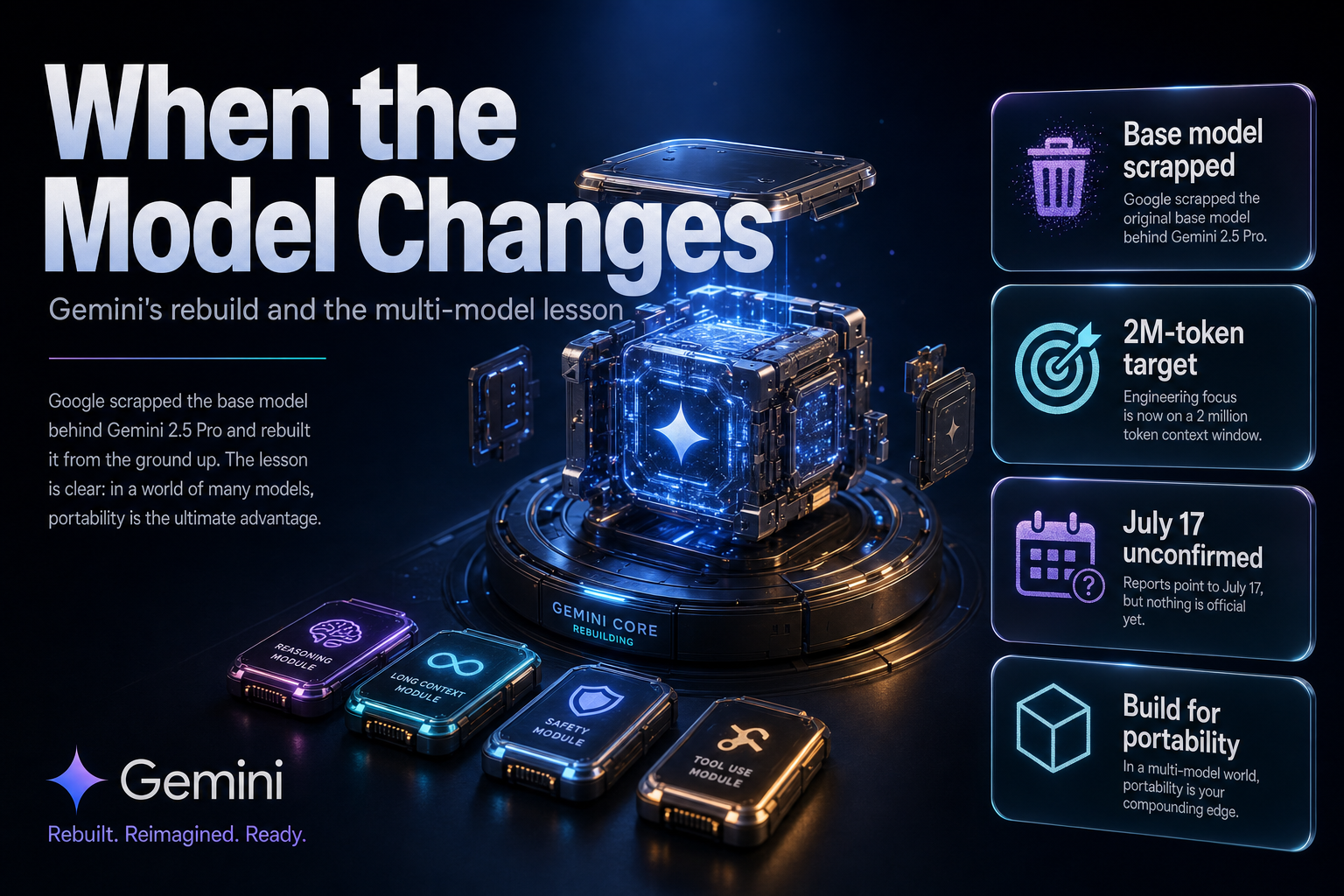
Summary. Google DeepMind pushed the release of Gemini 3.5 Pro to a targeted July 17, 2026, after scrapping the model's base architecture and rebuilding it from the ground up. Reporting says engineers found structural failures in recursive tool-calling and hit performance ceilings in multi-step mathematical reasoning and scene generation, so DeepMind abandoned the prior base rather than ship it. The rebuilt model is said to target a 2 million-token context window and a Deep Think reasoning layer, though Google has not confirmed the date, the context size, or pricing, so treat the specifics as unconfirmed. It arrives into a crowded field: OpenAI's GPT-5.6, priced from $1 to $30 per million tokens, launched July 9, 2026, and Anthropic's Fable 5 is in the same tier. For enterprises the story is not really about one model slipping a few weeks. It is a clean illustration of model-roadmap risk, and why a multi-model strategy beats betting your product on any single vendor's timeline.
What happened
Google DeepMind decided the existing Gemini 3.5 Pro base was not good enough and rebuilt it rather than patch it. According to reporting from BigGo, TechTimes, and others, the trigger was structural: failures in recursive tool-calling and scene generation, plus ceilings in multi-step mathematical reasoning that a tune could not fix. The overhaul aims to compete with GPT-5.6 and Fable 5 on exactly those weaknesses.
Two things deserve emphasis. First, the headline features, a 2 million-token context window, a Deep Think reasoning layer, and autonomous workflow capabilities, are reported targets, not confirmed specifications, and Google has not officially committed to the July 17 date or any pricing. Second, scrapping a base model is a significant, expensive decision, which cuts both ways for how you should read it.
A yellow flag and a green flag
The honest reading of a full rebuild is mixed, and it helps to hold both sides.
On the green side, abandoning a base model rather than shipping it shows a real quality bar. A vendor willing to eat the cost of a rebuild is one that would rather be late than ship a model with structural weaknesses, which is what you want from a provider you depend on. The delay is evidence of discipline, not just trouble.
On the yellow side, a scrapped architecture and a slipped, unconfirmed date are a reminder that model roadmaps are volatile and outside your control. If your product assumed Gemini 3.5 Pro on a certain date with a certain context window, that assumption just moved, and it could move again. Neither reading is wrong; together they argue for not being dependent on the outcome.
The real lesson: model-roadmap risk
Here is the uncomfortable truth that this episode makes concrete: even if you never decide to switch models, the vendor switches for you. A production prompt is effectively a contract, a set of assumptions about how a specific model version interprets language, structures output, and handles edge cases. When the model changes, or slips, or is rebuilt, that contract is voided even though your prompt text did not move.
That risk is not unique to Google. Every frontier lab is iterating fast, deprecating versions, and changing behaviour between releases. An enterprise that hard-wires one model into its product inherits that lab's roadmap, timeline, and judgement calls. The defence is architectural, not contractual. Our comparison of GPT-5.6 tiers and of GPT-5.6 versus Claude Sonnet 5 for agents shows how quickly the relative standings move.
Single-vendor versus multi-model
The choice is between inheriting one vendor's risk and spreading it. The tradeoffs are concrete.
| Dimension | Single-vendor | Multi-model |
|---|---|---|
| Roadmap risk | Inherits one lab's timeline | Spread across providers |
| Switching effort | High, rewrite per vendor | Low with an abstraction layer |
| Cost control | One price list | Route to cheapest that qualifies |
| Capability fit | One model for all tasks | Best model per task |
| Failure blast radius | Whole product affected | Fail over to an alternative |
Enterprises that built an abstraction layer into their first AI deployment were later able to add a second provider or switch their primary model with 60% to 80% less migration effort than teams that coded directly against one vendor's API. That is the measurable payoff of designing for portability before you need it.
How to build for portability
Multi-model is an architecture decision you make early, not a rescue you attempt after a vendor disappoints. Four moves cover most of it.
| Move | What it does |
|---|---|
| AI gateway or abstraction layer | One unified API across providers; write integration once |
| Multi-model architecture | Run 2 to 3 providers so no single one is load-bearing |
| Exit clauses and data portability | Contract terms that let you leave with your data |
| Open standards (MCP, ONNX) | Reduce proprietary coupling in tools and models |
An AI gateway sits between your application and the model providers, so swapping or adding a model is a configuration change rather than a rewrite. Pair it with an evaluation harness that scores each model on your own tasks, so a roadmap change at one lab becomes a routing decision rather than a fire drill. Our look at the Gemini Enterprise agent platform covers the governance layer that sits alongside this.
India-specific considerations
For Indian enterprises the multi-model case has an extra dimension. Cost sensitivity rewards routing each workload to the cheapest capable model, which multi-model architecture enables directly. Data protection under the Digital Personal Data Protection Act, 2023 may require keeping some workloads on India-hosted or sovereign models, so an abstraction layer that can route sensitive traffic to a resident model without rewriting application code is not just a hedge against roadmap risk, it is a compliance tool. Build the gateway once and it serves both goals.
How eCorpIT can help
eCorpIT is a Gurugram technology consultancy, founded in 2021, that helps enterprises build AI systems resilient to a volatile model landscape. Our senior-led teams design AI gateways and abstraction layers so you can run two or three providers and switch primaries without rewrites, build evaluation harnesses that score models on your own tasks, and structure deployments so sensitive workloads route to compliant, India-hosted models under Digital Personal Data Protection Act, 2023 requirements. We treat model choice as a routing decision, not a bet. To design a multi-model AI architecture, contact us.
FAQ
References
- Google delays Gemini 3.5 Pro to July 17: the strategic play behind the scrapped base model — HackerNoon
- Google delays Gemini 3.5 Pro launch after scrapping its base model — Startup Fortune
- AI model gateways: vendor lock-in prevention — TrueFoundry
- How to avoid AI vendor lock-in: a 5-step risk framework — AI Assembly Lines
- GPT-5.6 API pricing: Sol, Terra and Luna rates — AI Pricing Guru
_Last updated: July 14, 2026._