On this page · 8 sections
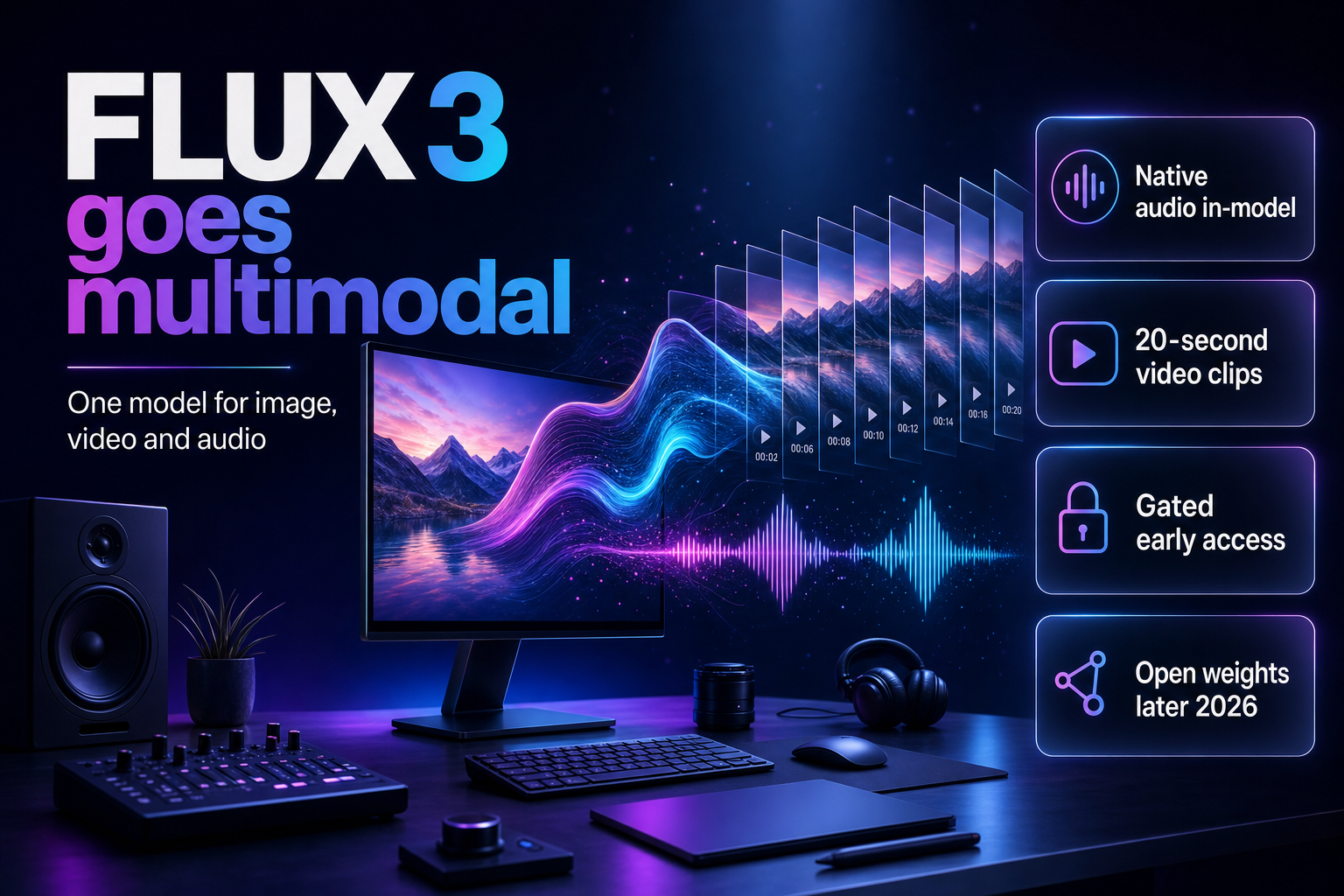
Summary. Black Forest Labs launched FLUX 3 on 23 July 2026, and the headline for creative teams is one model doing what used to take three. FLUX 3 generates up to 20 seconds of video with dialogue, sound effects and background music in a single pass, with audio produced by the same framework that makes the video frames rather than stitched on afterward. Black Forest Labs, based in Freiburg, Germany, trained one set of weights on images, video and audio together, then extended the same model to predict robot actions, a direction Bloomberg framed as a move into physical AI. For marketers the practical point is timing: as of 25 July 2026 only FLUX 3 Video and FLUX 3 Action are in gated early access to selected partners, FLUX 3 Image is expected in the coming weeks, and the open-weight FLUX 3 Dev is planned for later in 2026. There is no public API or pricing yet. For reference, the prior generation, FLUX.2, launched on 25 November 2025 and runs from about $0.015 per image, so FLUX 3 access will not be free. This guide sets out what FLUX 3 changes, how it compares to the current video models, and what creative and marketing teams should do now rather than after the launch scramble.
The one-line version: FLUX 3 is a real shift worth planning for, but it is not yet a tool you can buy. The winning move this quarter is preparation, not a stack rebuild.
What FLUX 3 actually is
FLUX 3 is Black Forest Labs' multimodal frontier model. Instead of a separate model for images, another for video and another for sound, it uses one architecture trained across all three, plus a robot-action head on the same base. The company calls the category visual intelligence, spanning generative media, robotics and simulation.
The reasoning behind that design comes from the company's co-founder. "You can't cheat reality. A model that only learns images can only generate images. But the world is not made of still frames. It moves, sounds, changes, and responds," said Robin Rombach, Co-Founder and CEO of Black Forest Labs, on launch. His argument is that joint training across modalities makes each one better, because a model that has learned how scenes move and sound understands them more fully than one trained on still images alone.
For a marketing team, the abstract argument matters less than one concrete consequence: sound. FLUX 3 generates audio natively, in the same inference pass as the video. That is the feature the current field does not have.
The native-audio advantage, and who lacks it
Today a marketing team producing an AI video clip typically generates the visuals in one tool and then adds voiceover, music and effects in a separate step or a separate model. FLUX 3 collapses that into one generation. According to VentureBeat's launch coverage, no other major AI video model generates audio natively within the same architecture, including Kling v3 Pro, Seedance 2.0, Runway Gen-4.5 and Luma Ray 3.2, which rely on separate audio models or post-processing.
| Video model | Native audio in the same model? |
|---|---|
| FLUX 3 | Yes, dialogue, effects and music in one pass |
| Kling v3 Pro | No, separate audio or post-processing |
| Seedance 2.0 | No, separate audio or post-processing |
| Runway Gen-4.5 | No, separate audio or post-processing |
| Luma Ray 3.2 | No, separate audio or post-processing |
For short social and ad content, where a 15 to 20 second clip with matched voice and music is the whole deliverable, a single-pass image-to-video-to-audio model removes a real production step. That is the part of FLUX 3 a marketing team should actually care about, more than the robotics headline.
What is available now, and what is not
The caution is that most of FLUX 3 is not yet something you can use. As of 25 July 2026, the rollout is gated.
| FLUX 3 component | What it does | Availability, late July 2026 |
|---|---|---|
| FLUX 3 Video | Up to 20-second video with native audio | Gated early access, selected partners |
| FLUX 3 Action | Robot-action prediction (physical AI) | Gated early access, selected robotics partners |
| FLUX 3 Image | Still-image generation | Expected "in the coming weeks" |
| FLUX 3 Dev | Open-weight multimodal backbone | Planned for later in 2026 |
| Public API and pricing | Self-serve access and published rates | Not yet announced |
That gating shapes the right response. You cannot standardise a campaign workflow on a model you cannot access, and pricing that is not published cannot go into a budget. The FLUX.2 family gives a rough anchor, with the production tier around $0.03 per megapixel on Black Forest Labs and image generations from about $0.015 on third-party hosts, but FLUX 3 video and audio will be priced separately and are unknown today.
What creative and marketing teams should do now
Treat this quarter as preparation. The teams that move first when access opens will be the ones that did the groundwork while the model was still gated.
Run a small pilot the moment image or video access opens, on one real use case such as short social clips, and measure it against your current stack on time, cost and how much manual audio and editing it removes. Do not rebuild your production pipeline on early access; keep your existing image and video tools running until FLUX 3 is generally available and priced. Watch the open-weight FLUX 3 Dev release specifically, because an open multimodal backbone is what would let a brand self-host for tighter control over style, data and cost, the same reason teams weigh open image models today. Our look at video-generation cost for marketing teams covers how to run that comparison.
Set the governance now, not later. Decide how you will label AI-generated video and audio, how you handle likeness and voice rights, and how provenance metadata travels with each asset, before the volume of synthetic content jumps. Our guide to content authenticity and watermarking for marketers is the place to start.
India-specific considerations
For Indian brands and agencies, native audio in one model is a direct fit for a multilingual market: a single generation that produces matched Hindi, Tamil or regional-language voice with the video removes a dubbing and mixing step that is otherwise done per language. The governance side carries local weight too. Under the Digital Personal Data Protection Act, 2023, any use of a real person's face or voice as training or reference input is personal data, so likeness and consent handling belong in the brief from the start. Pricing discipline also matters more here: with FLUX 3 rates unpublished and the FLUX.2 anchor already in dollars per megapixel, an agency running high volumes of regional creative should model the rupee cost per finished asset before committing a campaign to it.
How eCorpIT can help
eCorpIT (eCorp Information Technologies Private Limited) is a Gurugram technology consultancy, founded in 2021, with senior-led teams across AI, engineering and digital marketing, and CMMI Level 5 and MSME credentials. We help brands and agencies fold new generative models into their content pipelines without betting the workflow on unproven access: running structured pilots, comparing cost and output against the current stack, and building the provenance, rights and data-handling controls that AI video and audio now need, designed aligned with DPDP requirements. If you want a plan for testing FLUX 3 and similar models when they open, talk to our team, and see our GEO and AEO content service for how we build content that earns visibility.
FAQ
References
_Last updated: 26 July 2026._