On this page · 13 sections
- What ERP actually costs in 2026
- The 70% failure statistic is not what the primary source says
- The India compliance layer that decides it
- When to buy, and when to build
- What we build
- How we deliver
- The stack
- Engagement model and indicative bands
- India-specific considerations
- Why eCorpIT
- FAQ
- How eCorpIT can help
- References
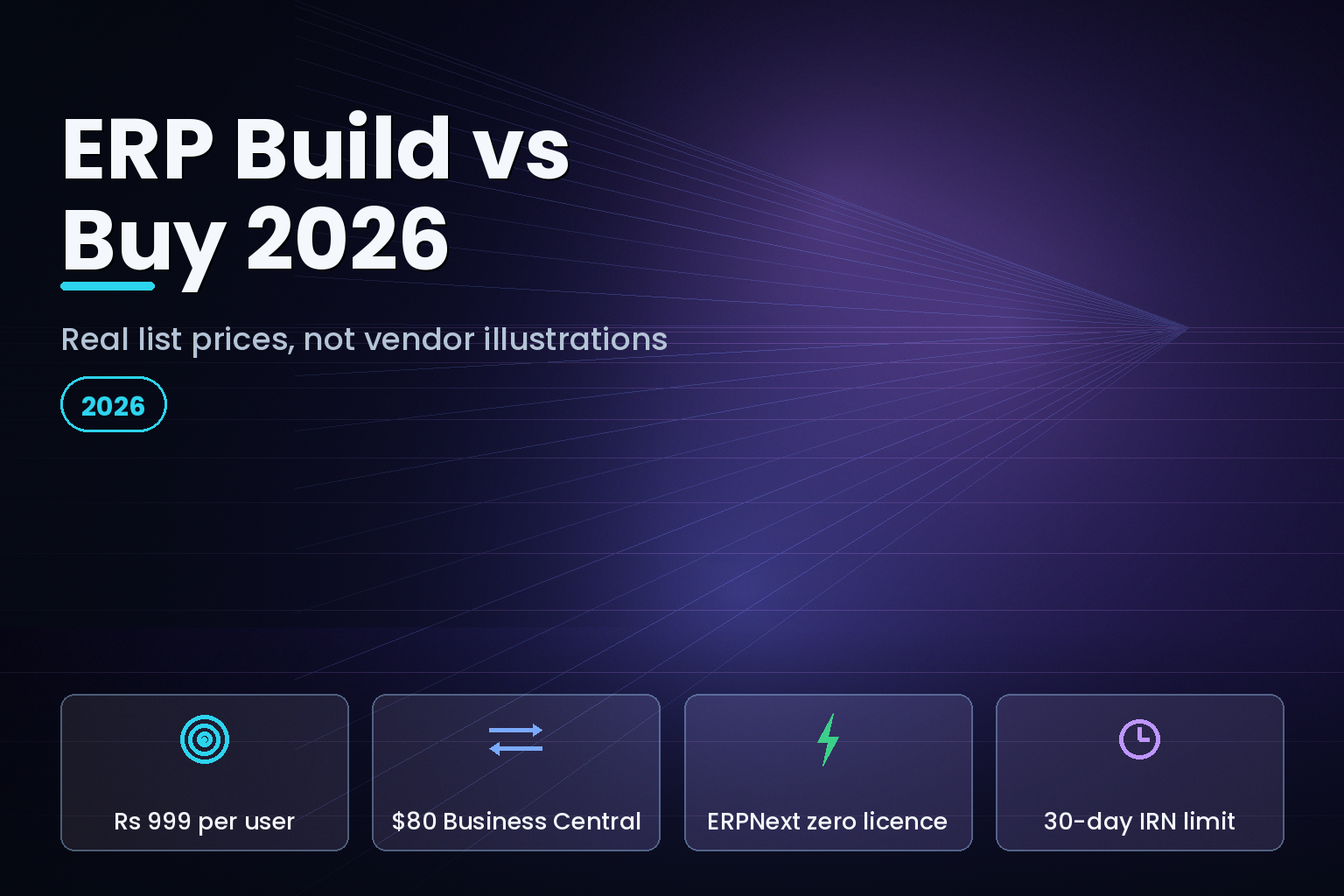
Summary. Zoho ERP lists its Standard plan at Rs 999 per user per month billed annually and Premium at Rs 2,499, with a 5-user minimum and a 100,000-transaction annual ceiling on Standard. Microsoft lists Dynamics 365 Business Central Essentials at $80 per user per month and Premium at $110, with a $8 Team Members licence for approvers. ERPNext v16 charges no licence fee at all under AGPL-3.0, with Frappe Cloud hosting from $5 per month. Those numbers span a 200-fold range, and the gap between them is where the build-versus-buy question actually gets decided. Panorama Consulting's 2026 ERP Report, released 4 March 2026, found that more than a quarter of organisations exceeded their project budgets, with additional technology purchases the leading cause.
We build and extend ERP systems for Indian mid-market operators from Gurugram. This page sets out what the 2026 numbers are, where a package works, and where a custom build is the cheaper answer.
What ERP actually costs in 2026
Every vendor prices on a different unit, which is why comparisons circulating in search results are usually wrong. Zoho charges per user and per employee separately. Microsoft charges per named user. Frappe charges for compute, not for people. SAP publishes no list price at all.
| Platform | List price (2026) | Pricing unit | Published limits |
|---|---|---|---|
| Zoho ERP Standard | Rs 999/user/month annual, Rs 1,399 monthly | Per user, plus Rs 249/employee/month | 100,000 transactions/org/year, min. 5 users |
| Zoho ERP Premium | Rs 2,499/user/month annual, Rs 2,999 monthly | Per user, plus Rs 249/employee/month | 300,000 transactions/org/year |
| Business Central Essentials | $80/user/month, paid yearly | Per named user | No manufacturing or service order module |
| Business Central Premium | $110/user/month, paid yearly | Per named user | Adds manufacturing and service orders |
| Business Central Team Members | $8/user/month, paid yearly | Per named user | Read, approve, update select records only |
| ERPNext v16 | Rs 0 licence, AGPL-3.0 | None. Hosting only | Frappe Cloud sites from $5/month |
| SAP Business One | Not published | Named and limited user types | Partner quote required |
Two details in that table are worth reading twice.
First, Zoho's per-employee charge is separate from its per-user charge. A 12-user finance and operations team with 140 shop-floor employees on the Standard plan pays for both lines, not one. Zoho's own documentation draws the distinction: users configure the system, employees access payroll, expense and field workflows through a self-service portal. Zoho ERP is also not bundled into Zoho One, which the vendor states directly in its pricing FAQ.
Second, Business Central's $80 headline is not what most mid-market estates actually pay. Manufacturing and service order management sit only in the $110 Premium tier, so a manufacturer cannot buy the cheaper plan and add the module later. In the other direction, the $8 Team Members licence covers reading data, approving workflows and updating select records, which is exactly what department heads and approvers do. A 40-person estate where 12 people transact and 28 approve costs far less than 40 times $80, and quotes that miss this are the usual reason a Business Central proposal looks worse on paper than it is. Note also that the Sales Order Agent and Payables Agent are not included in either tier: both require Copilot Credits, sold separately, and an Azure subscription.
Frappe's own two pricing pages disagree on server costs, which is a useful caution about treating any vendor page as final. The ERPNext pricing page quotes servers from $20 per month (Rs 1,800) and a premium tier from $125 (Rs 5,400). The Frappe Cloud pricing page quotes servers from $40 per month (Rs 3,600). Both were live in August 2026. Price the tier you actually need through the configurator before you build a business case on either figure.
The 70% failure statistic is not what the primary source says
Search results and vendor blogs quote a 68% or 70% ERP failure rate and budget overruns averaging 189%, usually attributed to Panorama Consulting. Panorama's own press release for the 2026 ERP Report, dated 4 March 2026, says something narrower and more useful: more than a quarter of organisations exceeded their project budgets, and the leading cause was additional technology that had to be bought mid-project.
The report's headline finding is about business intelligence, not failure. Panorama found business intelligence was the most significantly deployed digital initiative, at 55.3% of organisations.
Chris Devault, Senior Manager of Client Services at Panorama, described the mechanism: "Organizations often discover fatal misfits late in the project, so they turn to additional technology, scope expansion, and custom builds. This is why it's essential to work with an independent ERP consultant who prioritizes long-term architectural fit over license sales."
That is the whole build-versus-buy question stated precisely. The expensive failure mode is not choosing the wrong package. It is choosing a package, discovering six months in that a core process does not fit, and then paying for a second system to cover the gap.
The India compliance layer that decides it
Generic ERP breaks at the same place in India every time: the invoice registration portal. These are hard rules with hard dates, and they are enforced by rejection, not by warning.
Since 1 April 2025, any business with aggregate annual turnover of Rs 10 crore or more must report e-invoices to an IRP within 30 days of the invoice date. The threshold was previously Rs 100 crore. As the official IRIS IRP advisory puts it, the portal will reject invoices older than 30 days: an invoice dated 1 April 2025 had to be reported by 30 April 2025. IRN generation simply stops working after the window closes.
Three further changes landed in the IRP production release notes and each one touches integration code:
- A 40% GST rate was added to the tax rate master on 21 September 2025. Hardcoded rate enumerations in an older billing integration will reject it.
- Multi-factor authentication became mandatory on the IRP portal on 10 July 2025, with an OTP sent to mobile and email at every login. Any process that assumed a scriptable portal login broke that day.
- Notification No. 20/2025 (Central Tax), dated 31 December 2025, relaxed total-item-value validation for RSP-based tax calculation, effective for document dates on or after 1 February 2026. Errors 2194, 2234 and 2235 are now suppressed where at least one line-item HSN is notified for RSP-based calculation.
Alongside this, an e-way bill cannot be generated where the document date is more than 180 days old, a validation added on 17 March 2025.
None of this is exotic. All of it is the kind of detail a package handles for the mainstream case and fails on at the edges, and the edges are where mid-market manufacturers and distributors live.
When to buy, and when to build
The honest test is not a feature matrix. It is whether your margin comes from the process the ERP would standardise.
| Decision vector | Buy a package | Build or extend |
|---|---|---|
| Time to first live transaction | 6 to 14 weeks on a standard chart of accounts | 12 to 24 weeks for a first module |
| Upfront cost | Licence only, from Rs 0 (ERPNext) to Rs 2,499/user/month | Engineering cost front-loaded, no per-seat fee |
| Cost at 200 users | Scales linearly with headcount | Flat. Compute cost only |
| Process fit | Good for finance, purchase, standard stock | Required where the process is the differentiator |
| Data control and residency | Vendor-determined region | Your cloud account, your region |
| Maintenance overhead | Vendor upgrades, forced version cadence | Yours, on your schedule |
| Exit cost | Data export, re-implementation | Source code you own |
Buy when your finance, purchase and inventory processes are ordinary and you need to be live this quarter. Zoho ERP and Business Central both do this well, and a competent implementation partner beats a custom build on cost and time every time in this case.
Build or extend when a process on your critical path has no package equivalent. Batch-and-expiry logic in pharma distribution, beat-level scheme settlement in FMCG, job costing across parallel work centres in engineering-to-order, and multi-state stock transfer with RSP-based tax are the four we see most often in Gurugram and the wider NCR.
The middle path is the one most mid-market buyers should take: run ERPNext or Zoho for the standard ledger, and build the differentiated module against its API. ERPNext makes this cheaper than most because there is no licence to pay twice and no per-user penalty for adding shop-floor access. ERPNext v16, released after roughly two years of work with 600-plus contributors and more than 50 new features, added stock reservation for work orders, landed cost vouchers for subcontracting receipts and a consolidated trial balance across child companies. Those three alone close gaps that previously needed custom code.
The real cost is usually the migration, not the code.
What we build
We work on four kinds of ERP engagement:
Custom module development against an existing ERP. We build the differentiated process as a first-class module inside ERPNext, or as an extension against the Business Central or Zoho API, so it upgrades with the platform instead of sitting outside it.
GST and e-invoicing integration. IRN generation, ship-to GSTIN handling, e-way bill generation inside the 180-day document window, and reconciliation against the 30-day reporting rule. We have written about the GST e-invoicing ship-to GSTIN integration problem in detail.
Warehouse and inventory extensions. Bin-level putaway, wave picking and barcode workflows where the package's ten-location ceiling or fixed bin model does not match the physical site. This overlaps closely with our warehouse inventory and WMS app development work.
Full custom ERP. Reserved for cases where the operating model has no package analogue. This is the smallest share of our work and we say so when it is not warranted.
How we deliver
- Process and portfolio audit. Two to three weeks. We map the current process, quantify the technical debt in the systems being replaced, and identify the specific misfits that Panorama's data says surface late and cost the most. This produces a written fit-gap report before anyone commits to a platform.
- Platform decision. We recommend buy, build or hybrid with the licence arithmetic attached at your actual headcount and transaction volume, not a vendor's illustrative figure.
- Data migration design. Chart of accounts, item master, open transactions, and the historical set. This is where most ERP projects lose their schedule.
- Build and integrate in fortnightly increments, with the compliance path (IRN, e-way bill, TDS, e-invoice reconciliation) proven against the sandbox IRP before any production cutover.
- Cutover and stabilisation. Parallel run through one full statutory cycle, then handover with runbooks and the source code.
The stack
ERPNext and the Frappe Framework on Python and MariaDB where the ledger is open source. Business Central AL extensions where the client is already committed to Microsoft. Zoho Deluge and REST for Zoho estates. Postgres and Python or Node for genuinely custom builds, on AWS, Azure or Google Cloud in an Indian region. React and TypeScript for operator-facing screens, with offline data synchronization on the shop-floor and field applications, because warehouse Wi-Fi is not a design assumption we are willing to make.
Engagement model and indicative bands
We work in three ways. A fixed-scope discovery and fit-gap audit, priced as a single deliverable. A time-and-materials build for module work where the scope will move. A fixed-price phase for a defined module with a signed specification.
We do not publish a rate card, because an ERP number quoted without your transaction volume, user count, statutory footprint and data-migration scope is a number designed to be wrong. What we will do on a first call is give you the licence arithmetic for your actual headcount across the three platforms above, which is usually enough to tell you whether the build question is even live.
India-specific considerations
An ERP holds employee payroll records, customer contact data and vendor bank details, which places it squarely inside the Digital Personal Data Protection Act 2023. We design ERP systems aligned with DPDP requirements: purpose limitation on personal data fields, retention rules on employee records after exit, consent capture where customer contact data is used beyond the transaction, and audit logging of access to payroll tables. eCorpIT holds ISO 27001:2022, CMMI Level 5 and MSME certification, and we build to those controls.
On residency, both Frappe Cloud and the major hyperscalers offer Indian regions. If you self-host ERPNext under AGPL-3.0, residency is entirely your decision, which is one of the quieter arguments for the open-source route in regulated distribution.
Why eCorpIT
eCorpIT is eCorp Information Technologies Private Limited, founded in 2021 and based at Sector 83, Gurugram. We are a senior-led, multi-disciplinary organisation holding CMMI Level 5, ISO 27001:2022 and MSME certification, and we are partners of AWS, Microsoft and Google. We work across the NCR manufacturing and distribution belt, which is why the compliance detail above is written from integration work rather than from a vendor datasheet. Our related commercial pages cover custom software development company engagements, the wider software development company in India practice, and logistics app development company work that frequently sits next to an ERP rollout.
FAQ
How eCorpIT can help
We start with a fixed-scope fit-gap audit that maps your process against the three platforms priced above and returns the licence arithmetic at your real headcount and transaction volume. If a package fits, we will tell you so and scope the implementation. If a module needs building, we build it inside the platform rather than beside it, with the IRN and e-way bill path proven against the sandbox IRP before cutover. Talk to our team through /contact-us/ with your user count, turnover band and the one process you believe no package handles.
References
Last updated: 16 August 2026.