On this page · 11 sections
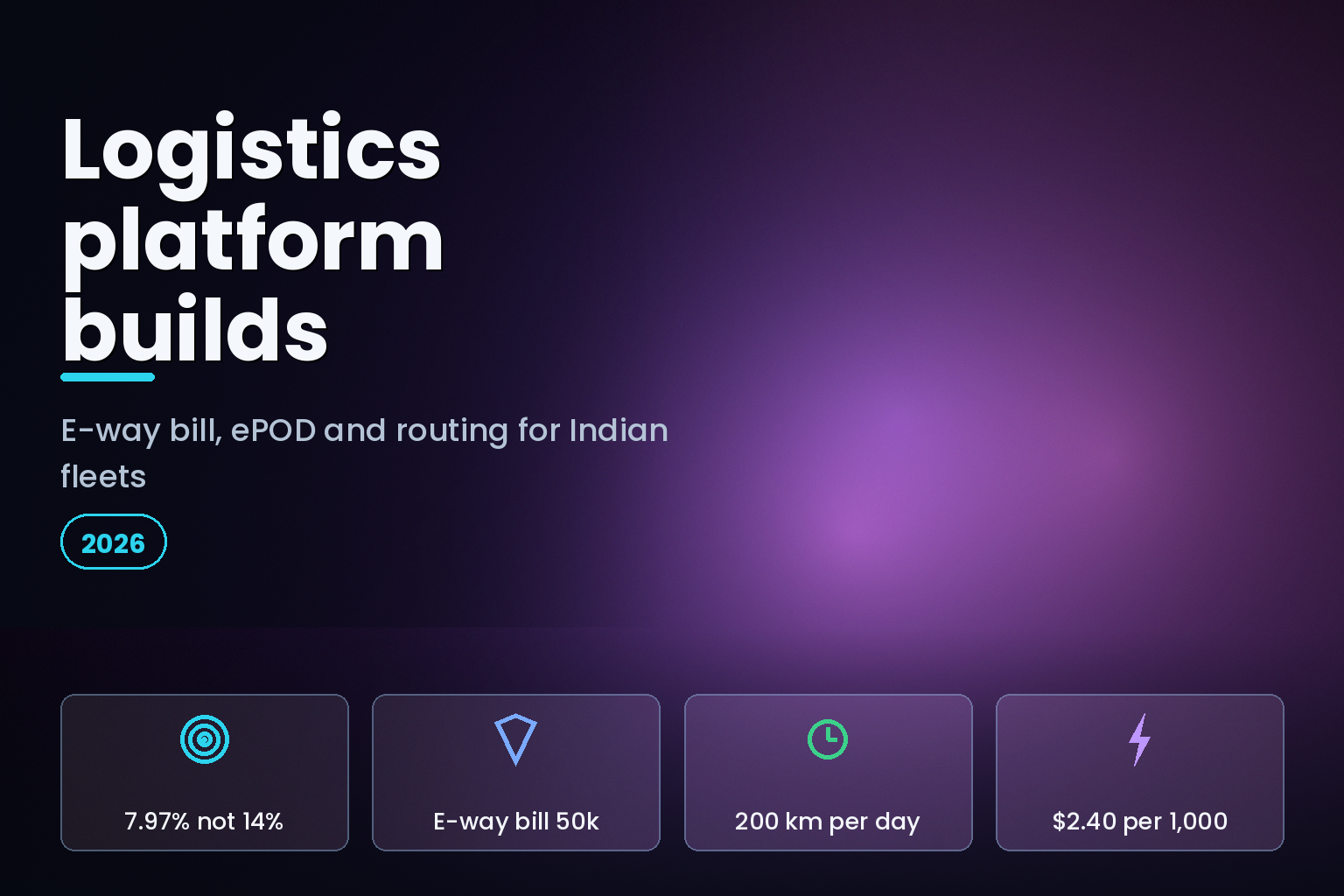
Summary. Start with a number almost every logistics vendor page still gets wrong. On 20 September 2025 the Ministry of Commerce and Industry stated that logistics costs in India "were often misrepresented, with commonly cited figures of 13-14% of GDP derived from external studies or partial datasets", and put the assessed figure at about 7.97% of total GDP, from work by NCAER for DPIIT (PIB, 20 September 2025). If your business case rests on halving a 14% number, the case is built on a figure the government has disowned. The rest of the build is equally specific: an e-way bill is required above ₹50,000 of consignment value, its API tier needs at least 1,000 invoices a day and a static IP, validity runs at 200 km per day, and Google's Fleet Routing lists at $2.40 per 1,000 shipments in India against $30.00 globally. This page covers what we build, the integrations that actually gate a launch, and how eCorpIT runs the engagement.
What a logistics platform has to get right
A logistics app is four systems that have to agree with each other continuously: the order and consignment record, the vehicle and driver state, the statutory document trail, and the proof that delivery happened. Most failed builds we are called into have three of the four and a gap where the fourth should be.
Sahil Barua, Managing Director and Chief Executive Officer of Delhivery Limited, framed the direction of travel in the company's FY25 annual report: "The third key tailwind in our favour comes from the continued formalisation of the supply chain industry, driven by government initiatives and market dynamics. The implementation of the National Logistics Policy (NLP) and Gati Shakti programme, alongside platforms like the Unified Logistics Interface Platform (ULIP) and ICEGATE, will be instrumental in integrating multimodal transportation, reducing logistics costs, and enhancing supply chain visibility." Formalisation means your platform has to produce machine-readable evidence, not paper that gets scanned later.
The e-way bill is a product requirement, not a finance task
This is the integration that most often slips to the end of a build and then blocks the launch. The rules below come from the CGST e-way bill rules and the National Informatics Centre documentation published on the e-way bill portal.
| Rule | What it requires | Where it lands in the product |
|---|---|---|
| Threshold | Required where consignment value exceeds ₹50,000; optional below | Consignment value has to be computed at booking, not at dispatch |
| Part A | Furnished by the registered consignor or consignee | Shipper onboarding must capture GSTIN and validate it |
| Part B | Conveyance details, furnished by the transporter on handover | Driver and vehicle assignment must complete before movement |
| Part B exemption | Not required where goods move under 10 km within the State to the transporter's place | Distance check at the first leg |
| Validity | One day per 200 km, counted in 24-hour blocks from generation | Delay handling and extension prompts belong in the driver app |
| Extension window | Only 8 hours before to 8 hours after expiry, on stated causes | A scheduled job, not a human remembering |
| Cancellation | Within 24 hours of generation | Booking amendments need a hard cut-off |
| Deemed acceptance | Recipient deemed to accept after 72 hours | Dispute windows must match |
The validity figure is worth stating carefully, because the rule text as originally notified said one day per 100 km. The NIC portal records that "the validity period of e-waybill is changed from 100 KM per day to 200 KM per day" under Notification No. 94/2020 dated 22 December 2020 (e-way bill announcements). Build against 200.
Two more mechanics decide how your dispatch screens behave. Distance is auto-calculated from the source and destination pin codes with a 10% grace allowance, and where the from and to pin codes are the same the system caps distance at 100 km. Duplicate e-way bills against the same document are blocked, so a retry that is not idempotent produces a failure rather than a second bill.
The API tier has an eligibility gate. Direct site-to-site API integration is not open to everyone. The NIC e-way bill FAQ sets the criteria as automated invoicing, at least 1,000 invoices or e-way bills generated per day, an SSL-based domain name, a static IP, and a pre-production test system. Below that volume, the routes are the web portal, SMS, the Android app, bulk generation, or a GST Suvidha Provider. If you are building for a mid-size 3PL, plan for the GSP route and treat direct API as a later migration. Discovering this in week twelve is expensive.
One caution on scope. The e-way bill portal's own announcements page has no entry newer than July 2024, so any 2025 or 2026 change to authentication or schema that you have read about on a tax blog is not confirmed there. Verify against the portal before writing code to a claimed new schema.
Proof of delivery has an evidence standard
Electronic proof of delivery is legally workable in India, and the Information Technology Act 2000 tells you what the record has to contain. Section 10A puts the contract question to bed: where proposals and acceptances "are expressed in electronic form or by means of an electronic records, such contract shall not be deemed to be unenforceable solely on the ground that such electronic form or means was used for that purpose" (IT Act 2000, updated text).
Section 7 is the one that reads like a specification. Retention in electronic form satisfies a legal retention requirement where the information "remains accessible so as to be usable for a subsequent reference", is retained in a format that accurately represents the original, and carries "the details which will facilitate the identification of the origin, destination, date and time of despatch or receipt". Read that as a schema. An ePOD record needs an immutable capture, an accurate rendering, and origin, destination and timestamps stored alongside the signature or photograph rather than derived later from server logs.
Note also that section 1(4) excludes documents and transactions specified in the First Schedule from the Act, with the Central Government able to amend that Schedule by notification. Check the current Schedule against your document types before assuming every instrument in your flow can be electronic.
Routing: the cost model, and where it bites
Multi-drop sequencing is the recurring cost line in a logistics platform. List prices below are from the vendors' own pages, retrieved 16 August 2026.
| Capability | Google, global list | Google, India list | Mapbox | Open source |
|---|---|---|---|---|
| Multi-vehicle optimisation, per 1,000 | $30.00, 1,000 free | $2.40, 7,000 free | $2.00, 100,000 free | VROOM, free |
| Single-vehicle sequencing, per 1,000 | $10.00, 5,000 free | $0.80, 35,000 free | $2.00, 100,000 free | Valhalla, free |
| Route computation, per 1,000 | $5.00, 10,000 free | $1.50, 70,000 free | $2.00, 100,000 free | OSRM, free |
| Billable unit | Per shipment | Per shipment | Per request | Self-hosted compute |
| Capacity and time windows | Yes | Yes | Yes | VROOM and OR-Tools only |
Two facts move a budget more than the headline rates. Google Maps Platform's India price list, last updated 11 August 2026, prices Fleet Routing at $2.40 per 1,000 against $30.00 on the global list updated 7 August 2026, with a free allowance seven times larger. And Google bills Route Optimization per shipment rather than per request, where Mapbox bills its Optimization API per request. Batching fifty drops into a single call produces very different invoices from the two vendors for identical work.
On the open-source path, be precise about capability. OSRM v26.5.0 and Valhalla 3.7.0 give you a distance matrix and a heuristic travelling salesman solution. Neither handles vehicle capacity, time windows or multiple vehicles, which is most of what a fleet needs. VROOM v1.15.0 does: capacitated routing, time windows, multi-depot heterogeneous fleets, pickup and delivery, driver breaks and skills matching, running on OSRM or Valhalla for the matrix. Google OR-Tools covers the same classes and is honest about the limits: "Vehicle routing problems are inherently intractable... As a result, OR-Tools sometimes returns solutions that are good, but not optimal."
Self-hosting trades a per-shipment bill for compute and an on-call rotation. Above a few hundred thousand drops a month that is usually the right trade. Below it, it is a distraction from shipping.
India-specific considerations
GST on the delivery service itself. Since 22 September 2025, where the delivery partner is not liable to register under section 22(1), the e-commerce operator carries the GST liability on local delivery services at 18%, per the Ministry of Finance clarification (PIB, 16 September 2025). Liability stays with the supplier where the partner is registered. A platform that engages both registered and unregistered partners has to hold registration status per partner and branch the tax treatment per order.
DPDP Act 2023. Continuous vehicle and driver location is personal data about the driver as well as operational telemetry. Sections 3 to 17, covering notice, consent and data fiduciary obligations, come into force on 13 May 2027, eighteen months after the commencement notification of 13 November 2025 (MeitY). Section 6(1) requires consent "limited to such personal data as is necessary for such specified purpose", which is the clause that makes tracking a driver outside shift hours difficult to defend. We design applications aligned with DPDP Act requirements, with shift-scoped location capture and retention windows set deliberately rather than by default. Our DPDP engineering playbook covers the wider obligations.
ONDC logistics. The network's B2B logistics specifications are published on the ONDC logistics specifications repository, currently on the draft-2.x branch at version 2.0.0-draft, with ONDC:LOG10 covering domestic B2B logistics and ONDC:LOG11 covering international. The repository has no published releases and its README's most recent dated marker is November 2023, so treat the spec line as slow-moving and pin to a commit rather than a tag. Note the scope: this repository is B2B, and a separate specification set covers logistics attached to retail transactions.
FASTag, and what it does not cover. NHAI revised the FASTag Annual Pass fee to ₹3,075 for FY 2026-27 from ₹3,000, valid for one year or 200 toll plaza crossings, across more than 1,000 fee plazas on national highways and expressways (Prasar Bharati, 15 March 2026). The eligibility is explicitly non-commercial vehicles. If you are building for a fleet, the Annual Pass is not available to you, whatever a vendor blog implies. Toll reconciliation for commercial fleets should be scoped as an integration to be confirmed, not assumed.
What we build
Driver and fleet app, with background location on a duty cycle rather than always-on, offline data synchronization so a run through a dead zone does not lose scans, barcode and QR capture, ePOD with photograph, signature and OTP options, and cash-on-delivery reconciliation. Offline-first is not optional in Indian logistics; it is the difference between a working app and a support queue.
Consignment and order management, covering booking, rate cards, consignment note generation, hub and spoke movement, trans-shipment, and exception handling. The exception queue is where operations staff live, so it gets designed as a product rather than an afterthought.
Statutory document layer, covering e-way bill generation through GSP or direct API depending on your volume tier, e-invoice where applicable, and an audit trail that satisfies the section 7 retention conditions above.
Routing and dispatch, with a documented cost model against your actual drop volume, capacity and time window constraints, and a fallback when the optimiser times out. A routing service that cannot degrade gracefully takes the whole dispatch down with it.
Shipper portal and tracking, with per-shipper visibility, SLA reporting and webhook or API access for customers who want to pull status into their own systems.
Telemetry and reporting, with per-vehicle and per-route metrics, and cost-per-drop instrumented from launch rather than reconstructed later from invoices.
How we run the build
1. Discovery and integration mapping, two to three weeks. Consignment model, e-way bill volume tier and therefore GSP versus direct API, ePOD evidence requirements, ONDC exposure if any, and a costed routing model. Output is a written architecture decision record.
2. Core platform, six to ten weeks. Consignment records, hub movement, vehicle and driver state, and the statutory document layer, built and tested before UI work starts.
3. Apps in parallel, eight to twelve weeks. Driver app with offline sync as a first-class requirement, plus the operations console.
4. Routing, portal and integrations, four to six weeks. Optimiser with a documented cost model, shipper portal, webhooks, and any ONDC adapter.
5. Pilot on one lane, instrument, then scale. Launch on a single lane or hub, instrument cost per drop, failed-delivery reasons and e-way bill exception rates, and fix before adding lanes.
Why eCorpIT
eCorp Information Technologies Private Limited has built software from Gurugram since 2021. We hold CMMI Level 5, ISO 27001:2022 and MSME certification, and we are partners of AWS, Microsoft, Google and Shopify. Teams are senior-led and multi-disciplinary, so the engineer designing the offline sync model is the one who sees what happens when a driver loses signal mid-run.
We do not publish a rate card. A logistics platform's cost turns on fleet size, whether you need statutory document integration on day one, and how many shipper systems you have to talk to. Engagements typically run as a fixed-scope discovery followed by a dedicated squad on a monthly retainer, sized to the plan agreed in step one. Ask for a band against your scope and we will put it in writing.
Related build pages: taxi app development company, on demand app development company, grocery delivery app development company, and the cluster hub at mobile app development company in India.
FAQ
How eCorpIT can help
We build logistics and fleet platforms end to end, from the consignment record and offline-capable driver app through ePOD, e-way bill integration, routing and shipper-facing APIs. Discovery produces a written architecture decision record, an integration map covering your e-way bill volume tier and GSP options, and a costed routing model against your real drop volume rather than a vendor's headline rate. Delivery runs to CMMI Level 5 process with senior-led teams from Gurugram, and we are ISO 27001:2022 certified. Send us your fleet size, lane structure and shipper integration list at /contact-us/ and we will return a scoped plan with a price band.
References
- Ministry of Commerce and Industry, assessment of logistics cost in India, 20 September 2025.
- National Informatics Centre, e-way bill FAQ document, 1 October 2018.
- Google Maps Platform pricing, India, last updated 11 August 2026.
- Google Maps Platform pricing, global, last updated 7 August 2026.
- Project OSRM, osrm-backend, v26.5.0.
- Valhalla routing engine, 3.7.0.
- Ministry of Finance, GST on local delivery through e-commerce operators, 16 September 2025.
- MeitY, DPDP Act commencement notification, 13 November 2025.
Last updated: 16 August 2026.