On this page · 14 sections
- What is changing in 2026, and what NEP 2020 actually says
- Win 1: AI enters the curriculum from Grade 3
- Win 2: Adaptive learning reaches a national platform
- Win 3: Regional-language access closes a real gap
- Win 4: AI skilling is already at scale
- Win 5: Teacher capacity is the real bottleneck, and the plan is large
- Win 6: Inclusion moves from slogan to feature
- Win 7: Responsible growth, where trust becomes the advantage
- How the rollout actually works in the classroom
- India-specific considerations: the DPDP child-data rules
- What this means for school leaders and founders
- FAQ
- How eCorpIT can help
- References
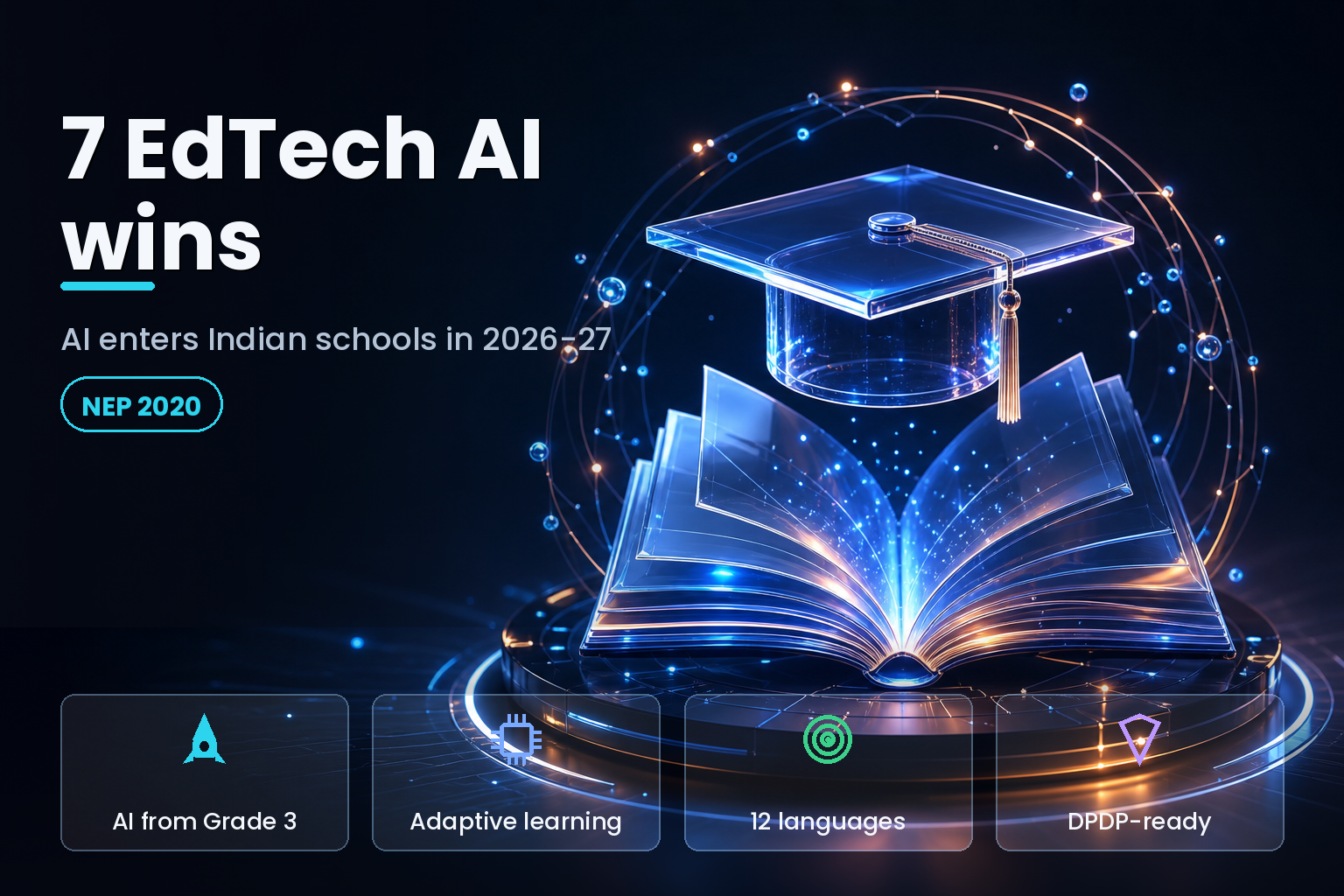
Summary. India is moving AI from elective to foundation. On October 30, 2025, the Ministry of Education confirmed that Artificial Intelligence and Computational Thinking will be taught from Grade 3 onwards, starting in the 2026-27 session, aligned with NEP 2020 and the National Curriculum Framework for School Education 2023. (There is no separate "NEP 2026"; the policy is NEP 2020, and 2026-27 is its school AI rollout year.) The scale is already real: more than 18,000 CBSE schools run a 15-hour "Skilling for AI Readiness" module for Classes 6 to 8, SWAYAM hosts 110+ AI courses with 4.1 million enrolments, and the government plans to train nearly 10 million teachers. In September 2025, NCERT launched DIKSHA 2.0 with AI features in 12 Indian languages. The market behind this grew to $3.63 billion in 2025 and is projected at $33.31 billion by 2034. "Education in AI should be treated as a basic universal skill linked to The World Around Us," said Sanjay Kumar, Secretary of the Department of School Education and Literacy. This article sets out seven concrete AI wins for Indian classrooms, and the one DPDP rule founders cannot skip.
This is written for school leaders deciding what to adopt and EdTech founders deciding what to build. Each win below names what is actually happening in 2026, with a government or market source.
What is changing in 2026, and what NEP 2020 actually says
NEP 2020 set the direction: computational thinking and digital literacy from the foundational stage, inside a 5+3+3+4 structure. The 2026-27 curriculum is how that reaches the classroom. Per the Ministry of Education, a stakeholder consultation on October 29, 2025 brought together CBSE, NCERT, KVS, and NVS, and CBSE formed an expert committee chaired by Prof. Karthik Raman of IIT Madras to design the AI and Computational Thinking curriculum. The approach is integrated rather than a standalone exam subject at first, with resource materials and teacher guides due by December 2025 and training delivered through NISHTHA.
The table maps the seven wins this article covers, each tied to a 2026 development.
| Win | What is happening in 2026 | Why it matters |
|---|---|---|
| AI in the curriculum | AI and CT from Grade 3, session 2026-27 | A universal skill, not an elective |
| Adaptive learning at scale | DIKSHA 2.0 with adaptive assessments | Personalised paths on a public platform |
| Regional-language access | DIKSHA 2.0 AI tools in 12 languages | Learning beyond an English barrier |
| AI skilling | 18,000+ schools, 4.1M SWAYAM enrolments | Early exposure to AI and CT |
| Teacher capacity | Plan to train ~10 million teachers | Adoption depends on trained teachers |
| Inclusion and access | Read Aloud, captions, "AI for Public Good" | Reaches more learners |
| Responsible growth | DPDP child-data rules by May 2027 | Trust becomes a market advantage |
Win 1: AI enters the curriculum from Grade 3
The headline win is structural. AI and Computational Thinking move into the core curriculum from Grade 3, starting in the 2026-27 academic session, as the Ministry of Education confirmed. Classes 3 to 5 learn through puzzles, games, and storytelling, and Classes 6 to 8 move into foundational AI concepts and structured computational thinking, with the subject becoming more specialised in the secondary grades, as Drishti IAS and STEMpedia detail.
Sanjay Kumar, Secretary of the Department of School Education and Literacy, framed the intent plainly: AI should be "a basic universal skill linked to The World Around Us." For a school leader, that reframes AI from an optional club to a timetable decision. For a founder, it signals durable demand for age-appropriate AI content mapped to NCF SE 2023, not just exam-prep apps.
Win 2: Adaptive learning reaches a national platform
Personalised learning stopped being a private-app promise and became public infrastructure. NCERT launched DIKSHA 2.0 on its 65th Foundation Day, September 1, 2025, with structured lessons, adaptive assessments, and performance feedback, as Adda247 reported. An "Ask DIKSHA" AI assistant lets students ask questions and get guided support inside the app.
Adaptive engines adjust difficulty in real time and generate practice dynamically, a shift from static video libraries. For schools, this means a free, curriculum-aligned platform that supports differentiated learning without a per-seat license. For founders, the lesson is that competing with DIKSHA on raw content is hard; the opening is in workflow, teacher tooling, and depth a national platform cannot tailor.
Win 3: Regional-language access closes a real gap
India's biggest classroom barrier is language, and AI is the most practical fix yet. DIKSHA 2.0 integrates AI features including Read Aloud, Closed Captioning, and multilingual translation across 12 Indian languages, per AMK Resource World, on a platform that already supports 36 Indian languages overall. National translation infrastructure of this kind is something EdTech products can build on.
For a school in a non-English-medium district, AI translation and read-aloud turn English-first content into something usable in the mother tongue. For founders, multilingual support is no longer a nice-to-have; a product that works only in English is competing against a free platform that does not.
Win 4: AI skilling is already at scale
The skilling pipeline is further along than most assume. More than 18,000 CBSE schools already run a 15-hour "Skilling for AI Readiness" module for Classes 6 to 8, and on SWAYAM, 110+ AI courses from institutions including the IITs and IISc have drawn 4.1 million enrolments, per techwireasia. The CBSE has also published AI subject material for senior classes through its academic resources.
For school leaders, this is a running start: the readiness module is a low-risk way to begin before the full Grade 3 rollout. For founders, the demand signal is early-stage AI literacy content and hands-on project kits that fit a 15-hour format, not just advanced coursework.
Win 5: Teacher capacity is the real bottleneck, and the plan is large
No curriculum survives without trained teachers, and India's plan is sized to the problem: training nearly 10 million teachers in AI, delivered through NISHTHA and other institutions, with grade-specific, time-bound modules, per the Ministry's statement. Video-based learning resources and teacher handbooks were set for completion by December 2025.
The honest read is that teacher readiness, not student interest, will decide whether this works. For schools, budgeting for teacher time and practice is the difference between a curriculum on paper and one in the room. For founders, teacher-facing tools, lesson generators, grading assistants, and training content, address the actual constraint rather than adding another student app.
Win 6: Inclusion moves from slogan to feature
The framing the Ministry used, "AI for Public Good," shows up as accessibility features. DIKSHA 2.0's Read Aloud and Closed Captioning help students who struggle with text or have hearing needs, and adaptive feedback supports learners working below grade level. NCERT paired the launch with other inclusive initiatives on the same Foundation Day, per AMK Resource World.
For schools serving mixed-ability classrooms, these are practical tools, not pilots. For founders, accessibility is both a public-good mandate and an underserved market: products designed for first-generation learners, regional languages, and assistive needs align with where policy is pushing.
Win 7: Responsible growth, where trust becomes the advantage
The market is large and growing fast. India's EdTech market reached $3.63 billion in 2025 and is projected to hit $33.31 billion by 2034, a 27.94% CAGR, per IMARC. The win for serious players is not just the size; it is that the Digital Personal Data Protection Act, 2023 raises the floor on how children's data is handled, and that floor rewards trustworthy products.
Under the DPDP Rules 2025, any user under 18 is a child, and an EdTech platform must obtain verifiable parental consent before processing their data, while behavioural tracking and targeted advertising aimed at children are restricted, as Consently and the ORF analysis set out. The win is that founders who build consent and data-minimisation in early earn the trust schools and parents now expect.
How the rollout actually works in the classroom
The mechanics matter as much as the announcement, and they explain why this is a multi-year process rather than a switch. The curriculum is integrated, not bolted on. Per the Ministry of Education, AI and Computational Thinking are woven into existing subjects under the National Curriculum Framework for School Education 2023, with time allocation and resources defined inside that framework rather than as a separate exam subject from day one. That choice lowers the burden on already-full timetables, but it raises the burden on teachers, who must carry AI concepts inside subjects they already teach.
Quality control runs through a coordination structure. The Ministry described a Coordination Committee between NCERT and CBSE under NCF SE to handle integration, structuring, and quality assurance, and CBSE's expert committee under Prof. Karthik Raman of IIT Madras is drafting the content. Resource materials, handbooks, and digital resources were set for completion by December 2025, ahead of the 2026-27 rollout, so the sequencing puts materials and training before classroom delivery.
For a school leader, three practical questions decide whether the curriculum lands. The first is teacher time: NISHTHA modules are grade-specific and time-bound, but a teacher still needs hours to absorb them, and that time has to come from somewhere in the calendar. The second is devices and connectivity, since AI activities for Classes 6 to 8 lean on digital content that uneven school infrastructure can stall. The third is assessment, because an integrated subject without its own exam needs a clear way to show that students actually learned the concepts.
None of these is a reason to wait. The "Skilling for AI Readiness" module already running in 18,000-plus schools is a low-stakes way to build teacher confidence and surface infrastructure gaps before the formal rollout. The candid view from the field is that teacher readiness, not curriculum design, is the variable to watch, which is exactly why the plan to train nearly 10 million teachers sits at the centre of it. Schools that start their own teacher practice now, rather than waiting for the session to begin, will be the ones where the 2026-27 curriculum works as intended.
India-specific considerations: the DPDP child-data rules
For any product touching school-age users, DPDP is the binding constraint, and the timeline is close. Substantive obligations become enforceable on May 13, 2027, and penalties for failing children's-data duties reach ₹200 crore, per EY India and K&S Partners. The common shortcuts, a self-declared age box or a blanket school permission, are unlikely to meet the verifiable-consent standard.
| DPDP child-data rule | What it requires | What EdTech must do |
|---|---|---|
| Child is anyone under 18 | Treat all K-12 users as children | Design for under-18 by default |
| Verifiable parental consent | Real consent before processing data | Build a consent flow, not a checkbox |
| No behavioural ad targeting | Restrict tracking and targeted ads at minors | Remove minor ad-tracking |
| Data minimisation | Collect only what is needed | Limit and retain less student data |
| Penalty up to ₹200 crore | Enforcement from May 13, 2027 | Start compliance now, no cure period |
The practical reading for a founder: treat verifiable parental consent and minimal data collection as launch features, not later add-ons. For schools choosing a vendor, asking how a platform meets DPDP child-data rules is now part of due diligence. For teams building AI products responsibly, our AI delivery lessons for 2026 cover privacy-by-design in more depth.
What this means for school leaders and founders
Read together, the seven wins describe a system moving fast on access and skilling, with a privacy guardrail arriving in parallel. The opportunities are concrete: adopt the free national tools, budget for teacher training, and choose vendors on their data handling. The build opportunities are just as concrete: multilingual and accessible content, teacher-facing tools, and DPDP-ready consent from day one. The losing move is to chase scale while treating children's data carelessly, because that is the one mistake the law now prices. To control the cost of the AI behind these products, founders can also review our guide to free AI cost tools.
FAQ
How eCorpIT can help
eCorpIT is a senior-led, CMMI Level 5 technology organisation in Gurugram that builds web and mobile products for global and Indian businesses, including education. We help schools and EdTech founders ship AI features that fit the 2026-27 curriculum direction and meet the DPDP child-data rules, from multilingual, accessible learning tools to consent flows designed for under-18 users. We design applications aligned with DPDP requirements rather than retrofitting them. To scope an EdTech build, contact our team.
References
- Ministry of Education (PIB), "Curriculum on AI to be introduced in all schools from Class 3 onwards," October 30, 2025.
- Drishti IAS, "Curriculum on AI and Computational Thinking for Class 3 Onwards," 2025.
- techwireasia, "India makes AI curriculum mandatory for primary schools," November 2025.
- CBSE Academic, "Artificial Intelligence (417), Class X curriculum," 2025.
- Adda247, "NCERT Launches Bal Vatika TV and DIKSHA 2.0 on Foundation Day," September 2025.
- AMK Resource World, "NCERT launches Bal Vatika TV Channel, DIKSHA 2.0 and Inclusive Learning Initiatives," September 2025.
- IMARC Group, "India EdTech Market Size, Share, Growth and Analysis," 2026.
- Observer Research Foundation, "Governing Learner Data Risks in India: The DPDP Act and EdTech," 2026.
- Consently, "Verifiable Parental Consent Under DPDP Rules 2025," 2025.
- K&S Partners, "DPDP Act Compliance for Schools and EdTech Platforms," 2026.
- EY India, "Decoding the Digital Personal Data Protection Act, 2023," 2026.
_Last updated: June 24, 2026._