On this page · 9 sections
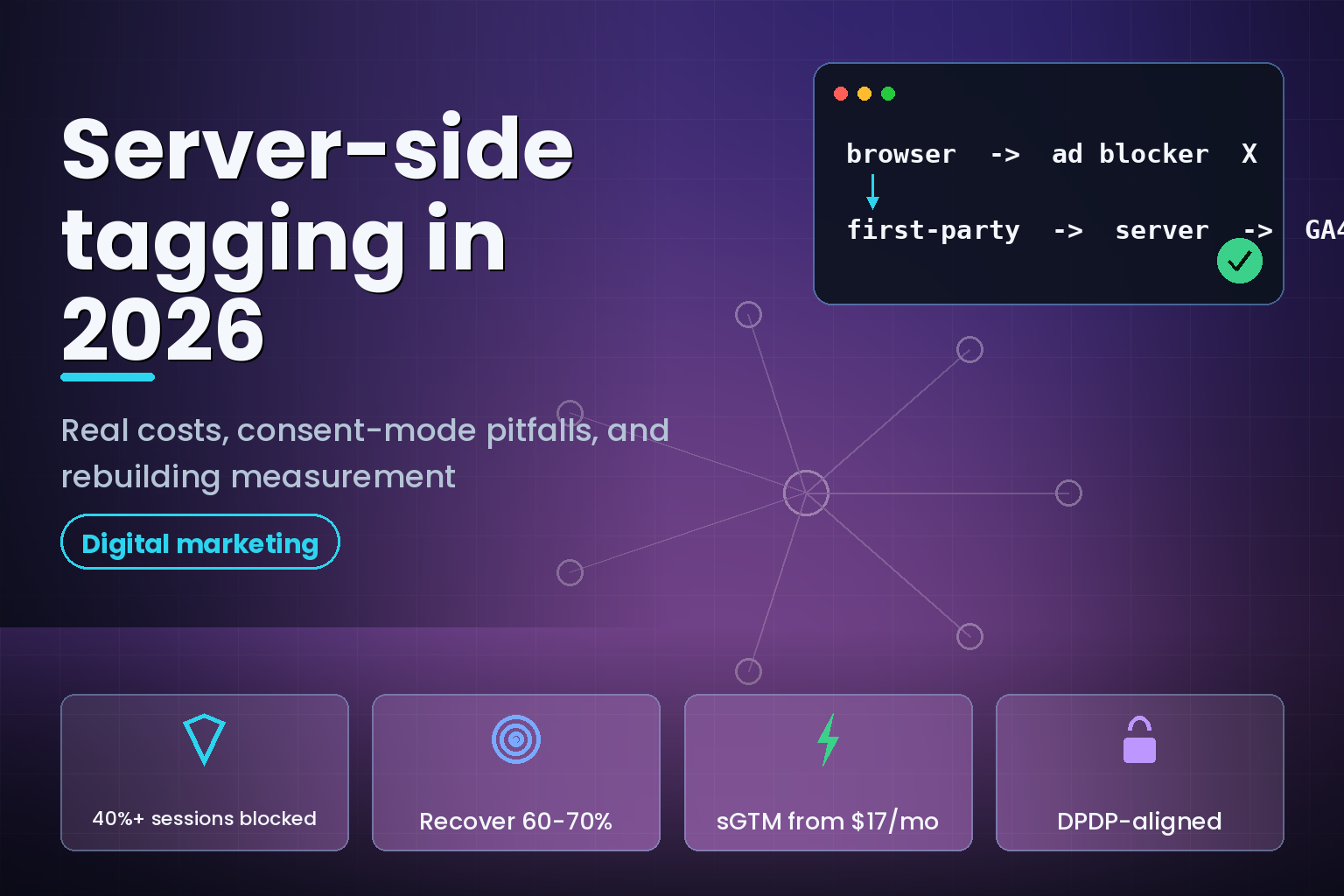
Summary. In 2026 the browser is no longer a reliable place to measure marketing. Ad blockers drop more than 40% of sessions in key markets, consent rejection rates run 50-60%, and third-party cookies are gone from Chrome — so a client-side pixel now loses a structural share of every campaign's conversions before your analytics ever sees them. Server-side tagging is the current baseline answer, and the economics are not what most vendor pages imply. Hosting on a managed provider such as Stape starts around $17 per month for 500,000 requests; running it yourself on Google Cloud Run looks cheaper on paper but has a realistic floor near $90 per month once you follow Google's own advice to run two always-allocated instances. The payoff is measurable: advanced Consent Mode combined with server-side tagging can recover 60-70% of the conversions lost to consent refusal, and teams typically report recovering their investment within 47 to 90 days. The trap is compliance. Google began automated enforcement on 21 June 2025 that disables conversion tracking, remarketing and demographics for EEA and UK traffic on sites without proper consent signalling, and for Indian businesses the Digital Personal Data Protection Act 2023 adds its own consent obligations. This article gives the real cost matrix, the consent-mode pitfalls, and how eCorpIT rebuilds measurement without tripping either regime.
Why client-side measurement broke
Three forces converged, and they are additive rather than alternative.
Ad blockers and privacy features now block a structural share of client-side pixels — more than 40% of sessions in some markets according to first-party data practitioners tracking the shift through 2026. Consent management adds a second layer: rejection rates of 50-60% mean that even for users whose browser loads your tags, a majority decline the tracking those tags depend on. And Chrome's removal of third-party cookies took away the cross-site identifiers that older conversion attribution relied on.
The combined effect is not a rounding error. When half your sessions never fire a pixel and a majority of the rest decline consent, client-side conversion counts drift far enough from reality that bid algorithms optimise against bad data. That is the real cost — not the missing dashboard rows, but the ad spend misallocated because the feedback loop is broken.
Server-side tagging moves the collection point from the user's browser to a server you control. As Simo Ahava, co-founder of the analytics training company Simmer, puts it in his reference guide on the technique, "Server-side tagging is all about control." The tag still fires, but from a first-party, same-origin context that ad blockers and cookie restrictions treat differently.
What it actually recovers
The recovery figures are specific and worth stating with their conditions attached, because "recover your lost conversions" is a claim that gets inflated.
| Mechanism | Documented recovery | Condition |
|---|---|---|
| Server-side tagging vs client-side | 23-40% of data blocked by browser privacy features | Depends on ad-blocker prevalence in your audience |
| Advanced Consent Mode + server-side | 60-70% of conversions lost to consent refusal | Requires correctly implemented Consent Mode v2 |
| Typical payback period | Investment recovered in 47-90 days | Via better budget allocation, not new spend |
The middle row is the one that matters most for paid media. Advanced Consent Mode lets Google model the conversions from users who declined consent, and pairing it with server-side tagging is what lifts the modelled recovery into the 60-70% band. Without server-side collection feeding it, Consent Mode modelling has far less signal to work from.
None of these are guarantees. The 23-40% figure scales with how many of your users run ad blockers, which varies enormously between a developer-tools audience and a mass-consumer one. Treat them as the documented range, then measure your own recovery after implementation rather than promising a number up front.
The real cost matrix
Here is where vendor pages mislead by quoting only the headline number. The honest comparison for 2026:
| Hosting option | Entry cost | Realistic cost at scale | Best for |
|---|---|---|---|
| Stape (managed) | $17/month, Pro tier, 500K requests | $83/month, Business tier, 5M requests | Teams wanting predictable, fixed pricing |
| Google Cloud Run (self-hosted) | $20-60/month under 500K sessions | ~$90/month floor for two always-allocated instances, before spikes | Teams with cloud engineering already in place |
| Cloud Run at high volume | — | $80-150/month at 1M+ sessions | High-traffic sites optimising per-request cost |
The Cloud Run floor is the number teams miss. A single instance at 1 vCPU and 0.5 GB in "CPU always allocated" mode — the configuration Google recommends for server-side to avoid cold starts — is roughly $45 per month, but Google also recommends a minimum of two instances for resilience, which doubles the floor to about $90 before a single traffic spike. Analyzify's October 2025 comparison found Google Cloud Run costing about €0.25 per 10,000 GA4 page_view requests even after heavy optimisation, against Stape's effective €0.083 for the same volume — roughly a 3x difference in per-request cost.
The decision is not "cheapest wins." Managed hosting trades a higher headline price for predictable billing and no infrastructure to maintain; self-hosting on Cloud Run trades operational overhead for per-request efficiency that only pays off at high, steady volume. For most D2C and SaaS teams without a dedicated cloud engineer, the managed route is cheaper once you price in the hours.
The consent-mode pitfalls that break the whole thing
Server-side tagging done wrong is worse than no change, because it can move you from visibly-broken to invisibly-non-compliant. Three pitfalls recur.
Consent Mode enforcement is already live. Google began automated enforcement on 21 June 2025: sites without proper consent signalling have conversion tracking, remarketing and demographic reporting disabled for EEA and UK traffic. Moving collection server-side does not exempt you — the consent signal still has to be correct, and if it is not, you lose the exact features you built server-side to protect.
Server-side does not mean consent-free. A common misread is that because the data now flows through your server, you no longer need consent. The opposite is true: you are now the party collecting first-party data, so your consent basis has to be explicit and your handling documented. This is precisely where the Digital Personal Data Protection Act 2023 applies for Indian audiences.
Advanced Consent Mode has to be implemented, not just switched on. The 60-70% recovery figure assumes Consent Mode v2 is correctly wired so Google receives the right consent states and can model denied-consent conversions. A half-configured setup gives you the compliance cost without the recovery benefit.
India-specific considerations
For Indian businesses the calculus has an extra dimension that most global guides skip.
The Digital Personal Data Protection Act 2023 governs how you collect and process personal data, and server-side tagging makes you a more active collector of it, not a less active one. Consent has to be free, specific, informed and unambiguous, and withdrawable as easily as it was given. A server container that quietly enriches events with identifiers the user did not consent to is a DPDP problem, not a measurement win. The right design collects the consent signal first, honours it in the server container, and keeps a record of the basis — the same discipline the EEA enforcement regime already demands, applied to an Indian legal frame.
There is also a cost angle specific to the market. Indian D2C and SaaS teams are more price-sensitive on tooling and more likely to run lean, which makes the Cloud Run floor trap sharper: a team that budgeted ₹4,000 a month for "just hosting a container" and then discovers the two-instance resilience floor near $90 has a real surprise. Price the resilient configuration, not the single-instance demo, before committing.
If your measurement problem sits alongside a wider data or consent build, our work on a first-party CDP and consent data platform covers the storage and consent-ledger side, while the DPDP consent manager framework readiness guide covers the legal-signal plumbing. On the paid-media side, the same server-side signal feeds directly into Google Ads AI Max control for D2C, and if organic and AI-search visibility is part of the same goal, our GEO and AEO content service sits in the same cluster.
How eCorpIT approaches a server-side tagging build
eCorpIT is a Gurugram technology company founded in 2021, working to CMMI Level 5 and ISO 27001:2022 practices, with senior-led engineering teams and a Google partnership. A server-side tagging engagement with us is scoped, not open-ended:
- Audit and baseline. Measure current conversion loss against ad-blocker prevalence and consent-rejection rates in your actual audience, so the recovery target is grounded in your data rather than a generic 40%.
- Hosting decision on real numbers. Choose managed versus self-hosted Cloud Run against your traffic profile, pricing the resilient two-instance floor, not the single-instance headline.
- Consent-first implementation. Wire Consent Mode v2 correctly, honour the signal inside the server container, and design the data handling aligned with Digital Personal Data Protection Act 2023 requirements and, where relevant, EEA and UK consent-signalling rules.
- Measure the recovery. Report actual recovered conversions after go-live, so the payback is a number you can see, not one we promised.
We design measurement aligned with DPDP and Consent Mode requirements; we do not claim your setup is "compliant" — that is a legal determination, and we build so your counsel can make it.
FAQ
How eCorpIT can help
eCorpIT rebuilds marketing measurement for D2C and SaaS teams losing conversions to ad blockers and consent refusal: we baseline your actual loss, choose managed or self-hosted server-side tagging on real numbers, implement Consent Mode v2 correctly, and design the data handling aligned with DPDP Act 2023 and EEA consent rules. Our senior-led teams work to CMMI Level 5 and ISO 27001:2022 practices as a Google partner. If your paid-media feedback loop is running on broken data, talk to us about a measurement rebuild.
References
- Server-side tracking 2026: privacy-first analytics — Digital Applied
- First-party data activation: 2026 server-side playbook — Digital Applied
- What does server-side tracking actually cost in 2026? — TrackingFixes
- Server-side tagging in Google Tag Manager — Simo Ahava
- First-party mode for Google tags — Simo Ahava
- Server-side tagging and how it will impact consent — Usercentrics
- Server-side analytics in 2026 and beyond — Bounteous
- Server-side GTM cost in 2026: Cloud Run, Stape, Addingwell — Alexis Vantal
Last updated: 6 August 2026.