On this page · 12 sections
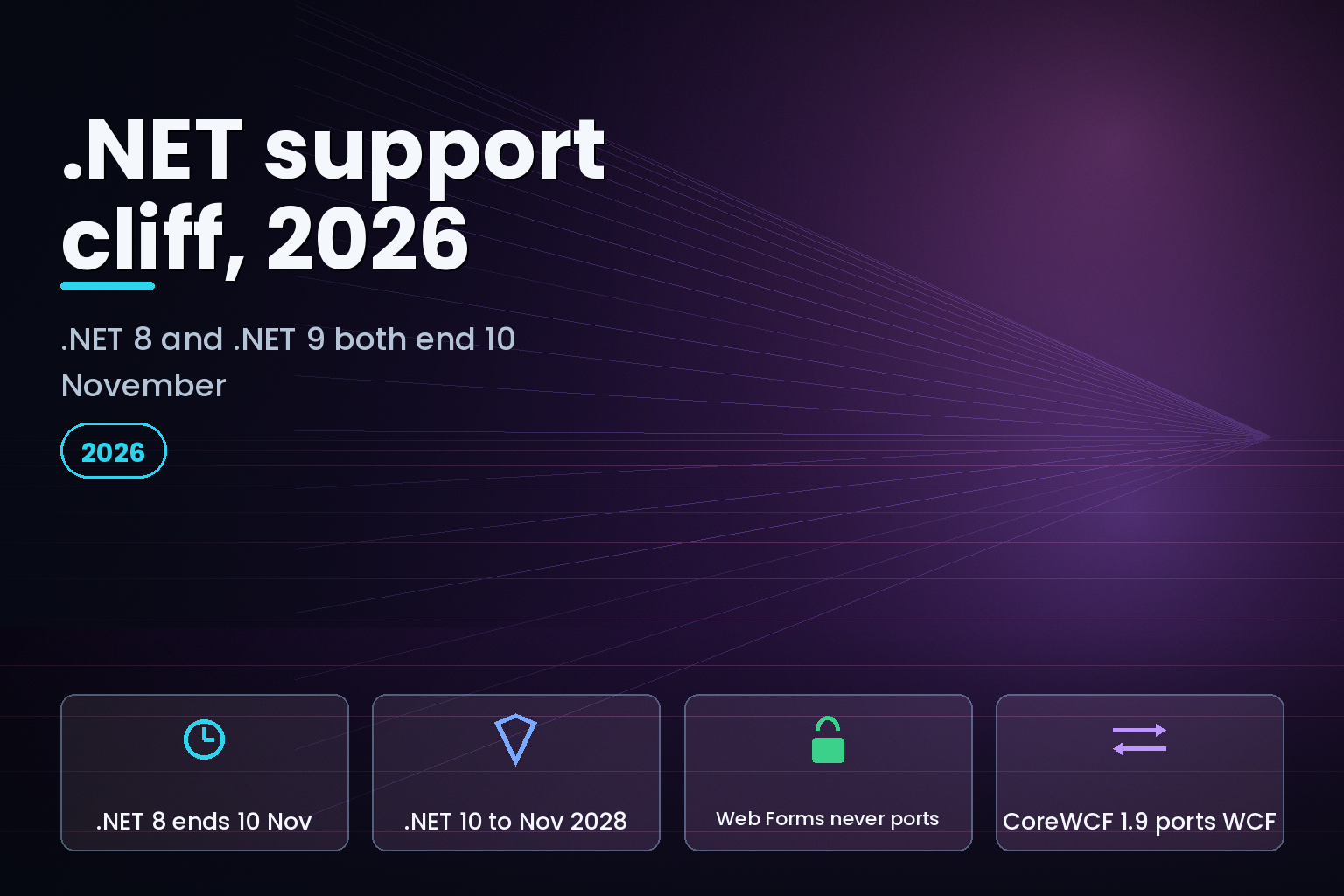
Summary. On 10 November 2026, 85 days from now, both .NET 8 and .NET 9 reach end of support on the same day. .NET 8 is the LTS release most enterprises standardised on; .NET 9 is the short-term release some teams jumped to. Microsoft's support policy page, updated 11 August 2026, shows both already in the Maintenance phase, which it defines as security fixes only and the final six months of any release. .NET 10, released 11 November 2025 with patch 10.0.11 shipped 11 August 2026, runs to 14 November 2028. Separately, .NET Framework 4.6.2 ends on 13 January 2027, and the .NET Upgrade Assistant was officially deprecated in a page dated 19 March 2026. Any .NET development company you engage between now and November should be able to say what those four dates mean for your codebase in the first conversation.
The dates that set the scope
| Version | Track | Status (17 Aug 2026) | End of support |
|---|---|---|---|
| .NET 10 | LTS | Active | 14 November 2028 |
| .NET 9 | STS | Maintenance | 10 November 2026 |
| .NET 8 | LTS | Maintenance | 10 November 2026 |
| .NET 7 | STS | Out of support | 14 May 2024 |
| .NET 6 | LTS | Out of support | 12 November 2024 |
| .NET Framework 4.6.2 | Windows component | Supported | 13 January 2027 |
| .NET Framework 4.8 / 4.8.1 | Windows component | Supported | No published end date |
| .NET Framework 3.5 SP1 | Standalone | Supported | 10 January 2029 |
The release cadence behind it: one major every November, even numbers LTS with three years of free support, odd numbers STS with two. That is why an LTS release and an STS release land on the same expiry date this year, and it is the detail most upgrade plans miss.
.NET Framework 4.8 is the exception that confuses people. Its end date is blank in Microsoft's lifecycle table, because from version 4.5.2 onward .NET Framework "is defined as a component of the Windows operating system" and "follows the lifecycle policy of the underlying Windows OS on which it is installed". Microsoft states there is no change to the 4.x lifecycle policy. So 4.8 is not dying, but it does not have its own clock either; it has the clock of the Windows Server underneath it.
The tooling answer changed in March 2026
If a prospective partner proposes running the .NET Upgrade Assistant across your solution, they are working from a stale playbook. The official overview page, dated 19 March 2026, opens with: ".NET Upgrade Assistant is officially deprecated. Use the GitHub Copilot modernization chat agent instead, which is included with Visual Studio 2026 and Visual Studio 2022 17.14.16 or later."
Two things follow. First, the tool that most upgrade quotes were priced against no longer exists as a supported path, so a quote built on it is a quote built on an assumption nobody has retested. Second, Microsoft's own caveat about the old tool still applies to the new one in spirit: "After running the tool, in most cases the app will require more effort to complete the upgrade." Automated conversion moves project files and package references. It does not move architecture.
Worth flagging as a live contradiction in Microsoft's own documentation: the .NET Framework porting overview still advises readers to "CONSIDER targeting .NET 8, which is a long-term support (LTS) release", while the support policy page has .NET 8 expiring on 10 November 2026. Both pages are current. Follow the support table.
What does not port at all
This is the part that separates a two-week upgrade from a nine-month project, and it is the first thing to establish before anyone quotes.
Per Microsoft's server-framework guidance, these exist only in .NET Framework and have no .NET Core or modern .NET equivalent:
- ASP.NET Web Forms. Microsoft's wording: "ASP.NET Web Forms are only available in .NET Framework. ASP.NET Core can't be used for ASP.NET Web Forms."
- ASP.NET Web Pages
- Windows Workflow Foundation and Workflow Services
- WCF Data Services
And from the unavailable-technologies list:
- Multiple app domains.
AppDomain.CreateDomainthrowsPlatformNotSupportedException, and Microsoft states there are "no plans to add this capability in the future".
- .NET Remoting, "identified as a problematic architecture". Delegate
BeginInvoke()andEndInvoke()also throwPlatformNotSupportedException.
- Code Access Security, security transparency,
System.EnterpriseServices(COM+), multi-module assemblies, and XSLT script blocks.
WCF is the one genuine escape hatch. CoreWCF is described by Microsoft as "a port of Windows Communication Foundation (WCF) to .NET and .NET Core", and the porting docs endorse it: WCF server "can be used in .NET 6+ by using the CoreWCF NuGet packages". CoreWCF 1.9 shipped 24 April 2026 with patch 1.9.1 on 16 June 2026, supporting .NET 10, .NET 9, .NET 8 and .NET Framework 4.6.2 and later. Packages: CoreWCF.Primitives, .Http, .NetTcp, .WebHttp and .ConfigurationManager.
A Web Forms application is a rewrite. A WCF service is a port. Those are different projects with different budgets, and a partner who quotes them at the same rate has not read your solution file.
Four migration paths, honestly compared
| Path | Best for | Effort | Support runway | Main risk |
|---|---|---|---|---|
| .NET 8 or 9 to .NET 10 | Apps already on modern .NET | Days to weeks | 14 Nov 2028 | Package ecosystem lag on transitive dependencies |
| .NET Framework to .NET 10, lift | MVC, Web API, WinForms, WPF, class libraries | Weeks to months | 14 Nov 2028 | Unavailable APIs surfacing late in testing |
| .NET Framework to .NET 10 with CoreWCF | SOAP service estates | Weeks to months | 14 Nov 2028 | Binding and behaviour gaps versus full WCF |
| Stay on .NET Framework 4.8 | Web Forms, WF, COM+-heavy apps | None now | Windows Server lifecycle | Deferred, larger, and eventually forced |
The fourth row is a legitimate choice, not a failure. .NET Framework 4.8 has no published end date, and if the application is a stable internal Web Forms system with three users and no roadmap, the honest recommendation is to leave it alone, patch the Windows Server under it, and spend the budget elsewhere. A .NET development company that cannot recommend doing nothing is selling, not advising.
The real cost is rarely the language migration. It is the unavailable API you find in week six.
Windows hosting versus Linux containers
Modern .NET is cross-platform; .NET Framework "is a Windows-only component". Microsoft's own position on which to target is direct: "The latest .NET version (currently .NET 10) is the preferred version of .NET to use for server development. The reasons to continue using .NET Framework are specific and limited."
On containers, Microsoft notes that while .NET Framework can run in Windows containers, "the modularity and lightweight nature of .NET make it a better choice for containers", and the image is much smaller. One operational difference that changes deployment design: modern .NET supports side-by-side runtime versions on one machine, whereas "only one version of .NET Framework 4 can exist on a machine at a time".
There is a published price consequence too. AWS charges T3 Unlimited-mode CPU credits at $0.096 per vCPU-hour on Windows against $0.05 per vCPU-hour on Linux, the same across all regions and purchase types. That is roughly a 92% premium on burst credits alone, before licence costs. AWS also publishes a $0.046 per vCPU-hour saving on Optimize-CPUs for Windows Server AMIs. Azure App Service publishes an IP SSL charge of $39 per month per certificate with SNI SSL at $0, and an App Service Domain at $11.99 per year; the compute-tier prices on that page render client-side and are not retrievable as static values, so ask for a written quote rather than accepting a screenshot.
What buyers should ask before signing
- Which projects in the solution reference Web Forms, WF, .NET Remoting or `AppDomain`? The answer should be a list with file paths, produced before the estimate.
- What is the transitive dependency graph on .NET 10? Not the direct packages, the transitive ones. This is where a "two-week" upgrade becomes a quarter.
- What is the plan for .NET Framework 4.6.2 components after 13 January 2027?
- Is the estimate built on the deprecated Upgrade Assistant? If nobody mentions the March 2026 deprecation unprompted, keep looking.
- Windows or Linux hosting after the migration, and what does that do to the bill?
- What does the regression suite look like on day one? An upgrade with no characterisation tests is a rewrite with extra steps.
Adoption context
For scale, ASP.NET Core was used by 19.7% of all respondents and 21.3% of professional developers in the 2025 Stack Overflow Developer Survey, which drew 49,009 responses from 177 countries between 29 May and 23 June 2025. Classic ASP.NET sat at 14.2% and 15%. The sentiment split is the interesting part: ASP.NET Core is admired by 61.3% of those who use it, classic ASP.NET by 34.1%. The .NET 8+ tag shows 19.2% usage with 67.1% admiration.
Read that as a hiring signal rather than a technology signal. The pool of engineers who want to work on classic ASP.NET is materially smaller than the pool who use it, which is a staffing risk on any codebase you intend to keep past 2028.
Our five-step delivery process
- Portfolio analysis, 1 week. Solution-level inventory: target frameworks, unavailable-API references, transitive dependency graph, and a per-project verdict of lift, port, rewrite or leave.
- Characterisation tests, 1 to 2 weeks. Tests that pin current behaviour before anything changes, because the upgrade's success criterion is "behaves the same", and that needs a baseline.
- Framework upgrade, 2 to 8 weeks. Project files, package references, API replacements, CoreWCF where SOAP endpoints exist. Sized by unavailable-API count, not by lines of code.
- Hosting and pipeline, 1 to 2 weeks. Windows or Linux decision with the cost model attached, container images, and CI/CD.
- Cutover and handover, 1 week. Parallel run, rollback plan, and documentation your team owns.
Engagements run on fixed-scope phases with a named senior engineer per phase. We scope from the solution file before quoting; anyone who quotes a framework migration without reading it is guessing.
Why eCorpIT
eCorpIT was founded in 2021 and is based in Gurugram. We are CMMI Level 5 appraised, MSME certified and ISO 27001:2022 certified, and a Microsoft partner. .NET modernisation is delivered by senior engineering teams, and phase one produces a written per-project verdict you can act on with or without us. We design applications aligned with DPDP Act 2023 and other framework requirements rather than claiming certifications we do not hold.
If you are also weighing the wider estate, our guides on application modernisation from monolith to microservices and the Microsoft October 2026 end-of-life wave cover the surrounding decisions, and the C# union types and .NET 11 migration guide covers what is coming after .NET 10. For hosting economics specifically, see our Azure App Service Isolated v4 cost analysis.
FAQ
How eCorpIT can help
eCorpIT runs .NET modernisation for teams in India, the UK and the US, and the first deliverable is always the per-project verdict rather than a migration plan, because roughly a third of the projects in a typical legacy solution turn out not to need moving at all. With 85 days until the 10 November cliff, a one-week portfolio analysis is enough to tell you what has to move before then and what can wait. See how we scope application modernisation and framework upgrades and API integration modernisation, then talk to us with your solution file.
References
- .NET and .NET Core official support policy — Microsoft, page updated 11 August 2026.
- Microsoft .NET Framework lifecycle — Microsoft Learn.
- .NET Framework lifecycle FAQ — Microsoft Learn.
- .NET Upgrade Assistant overview — Microsoft Learn, dated 19 March 2026, deprecation notice.
- Port from .NET Framework to .NET — Microsoft Learn.
- Choose between .NET and .NET Framework for server apps — Microsoft Learn.
- .NET Framework technologies unavailable on .NET — Microsoft Learn.
- CoreWCF support policy — Microsoft, updated 17 June 2026.
- Amazon EC2 On-Demand pricing — AWS, CPU credit pricing for Windows and Linux.
- Azure App Service pricing (Windows) — Microsoft Azure; compute-tier prices render client-side.
- 2025 Stack Overflow Developer Survey: technology — Stack Overflow.
- 2025 Stack Overflow Developer Survey: methodology — Stack Overflow, 49,009 responses from 177 countries.
Last updated: 17 August 2026.