On this page · 10 sections
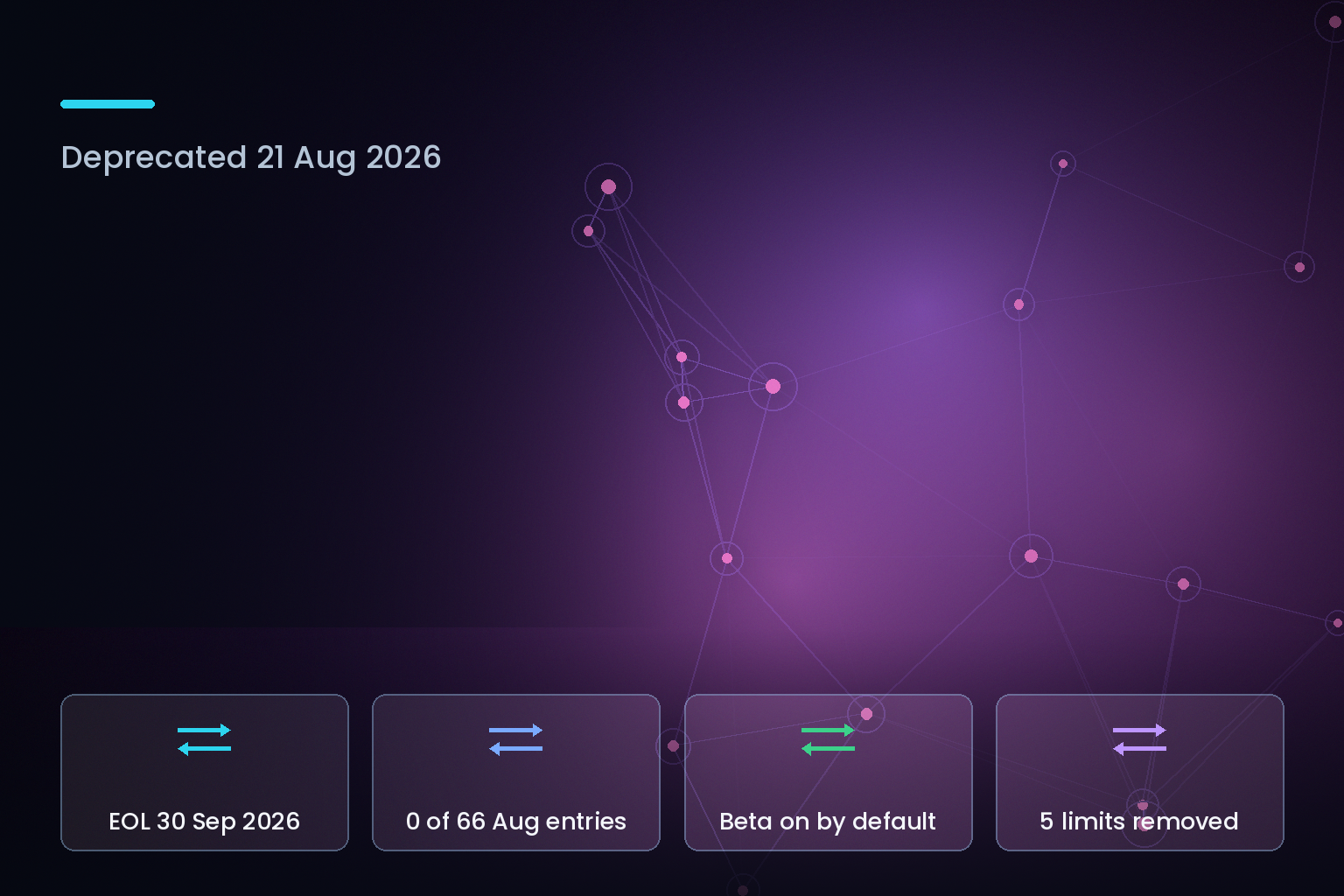
Summary. Databricks has deprecated the Supervisor API and set its end of life at 30 September 2026, roughly five weeks from 23 August 2026. Both documentation pages carrying the notice were updated on 21 August 2026. Neither the August 2026 platform release notes on docs.databricks.com nor the Azure Databricks mirror of the same month mentions the Supervisor API at all: across 66 entries covering 4 model additions, 11 connector changes and 4 separate ABAC entries, the one item with a hard shutdown date is absent. A team that reviews monthly release notes for breaking changes will not see this one. Worse, Databricks' own preview release policy says Beta features are "intended to advance to either Public Preview or GA" and that Beta is on by default for Premium customers, so some workspaces have the feature enabled without anyone having asked for it.
What actually changed
The Supervisor API is a managed agent loop. You define the model, the tools and the instructions in one request to an OpenResponses-compatible endpoint at POST ai-gateway/mlflow/v1/responses, and Databricks runs the loop for you: calling the model repeatedly, selecting and executing tools, and synthesising the final response. It shipped as a Beta gated behind the workspace Previews page and required AI governance with Unity AI Gateway plus OpenTelemetry trace storage in Unity Catalog.
Two documentation pages now carry a deprecation warning, both stamped 21 August 2026. The Supervisor API reference reads: "The Supervisor API is deprecated and reaches end of life on September 30, 2026. After that date, it will no longer be available. Databricks recommends migrating to custom agents on Databricks Apps." The tutorial page for building an app on top of it carries the same date but a different instruction: "To keep building custom agents on Databricks Apps, use a custom agent loop instead."
Those two sentences are not the same migration. The first reads as a platform move. The second is accurate: the replacement is code you write.
The part that will catch people
Three details decide whether this is a footnote or a five-week project.
The first is the naming. Supervisor API is not Supervisor Agent, the Agent Bricks product that coordinates Genie Agents, agent endpoints, Unity Catalog functions and MCP servers with human feedback optimisation. Supervisor Agent is not deprecated. The two products sit three clicks apart in the same documentation tree and share a word. Expect at least one engineer on the thread to check the wrong page and report that nothing is wrong.
The second is default-on exposure. Databricks' release-types table states that for Premium customers Beta features are on by default, and for Enterprise customers they are off by default. The previews management page confirms previews are managed at account and workspace scope. A Premium workspace can therefore have had the Supervisor API available without a deliberate opt-in, which is exactly the condition under which a proof of concept quietly becomes a dependency.
The third is that the authoring guide still points at it. The Databricks Apps agent authoring page, last updated 3 August 2026, carries a tip: if your agent uses only Databricks-hosted tools and needs no custom logic between tool calls, use the Supervisor API to let Databricks manage the agent loop. The label reads "(deprecated)" inline, but the recommendation itself has not been rewritten. Anyone following the current tutorial is being pointed at a feature with 5 weeks left.
What Databricks' own policy says about Beta
The release-types page is worth reading before anyone argues this was foreseeable.
| Release type | For production? | Interface stable | SLA | Stated trajectory |
|---|---|---|---|---|
| Private Preview | No | No | No | Invite only, often undocumented |
| Beta | No | No | No | "intended to advance to either Public Preview or GA" |
| Public Preview | Yes | Yes | Yes | Stable and intended to advance to GA |
| General Availability | Yes | Yes | Yes | Fully supported and production-ready |
Beta carries no production recommendation, no interface stability and no SLA, with support routed to the engineering team rather than the support team. On paper, nobody should have shipped against it. In practice, "on by default for Premium" plus an OpenAI-shaped endpoint plus a documented tutorial is how Beta code reaches production. The stated trajectory for Beta is promotion, not retirement, which is why a hard shutdown date deserved a release-note line and did not get one.
How to tell whether this is you
Check for the endpoint first. Any code that posts to ai-gateway/mlflow/v1/responses is on the deprecated path. Then check whether a Databricks App was built from the Supervisor API tutorial rather than the plain custom-agent template; the tutorial's agent.py makes a single API call instead of running a loop, which makes it easy to spot. Finally, check the Previews page at both account and workspace scope for the Supervisor API entry, and check the Unity AI Gateway inference tables for traffic against that endpoint.
Agent work that already runs its own loop is unaffected. So is anything built on Agent Bricks Supervisor Agent, on Genie Agents, or on the AI Gateway unified and native APIs, which Databricks lists as the third build approach and which is not touched by this notice.
What the migration actually costs
The replacement is a custom agent loop inside a Databricks App. Databricks Apps run on the serverless platform, are billed per hour of compute while running, and are capped by a per-workspace resource limit. That is a different cost shape from a per-request managed endpoint, and it needs a line in the budget rather than an assumption of parity.
The engineering cost is the loop itself: model call, tool selection, tool execution, response synthesis, plus error handling and streaming. The upside is that the tutorial page already documents what you get back by writing it yourself. Databricks lists five cases where the Supervisor API could not be used and a custom loop was required: client-side function tools, which the Supervisor API cannot mix with hosted tools in one request; agent endpoints other than Agent Bricks Knowledge Assistant endpoints; custom retrievers, custom inputs and outputs, or fine-grained streaming control; custom Python logic between tool calls such as conditional branching or state management; and control over inference parameters such as temperature.
Read that list in reverse and it is a feature comparison.
| Capability | Supervisor API (Beta, EOL 30 Sep 2026) | Custom agent loop on Databricks Apps |
|---|---|---|
| Agent loop | Managed by Databricks | You write it |
| Client-side function tools | Cannot mix with hosted tools | Supported |
| Inference parameters such as temperature | Not controllable | Controllable |
| Custom logic between tool calls | Not supported | Supported |
| Usage tracking | Not supported in the Beta | Standard Apps billing per compute hour |
A team that hit any of those five limits was already planning to leave. A team that hit none of them has a genuine rewrite in front of it. The real cost here is usually the loop's error handling and the trace plumbing, not the happy path.
India-specific considerations
Indian teams running Databricks on Premium workspaces should treat the default-on Beta setting as an inventory problem before it becomes a migration problem. Where agent traffic touches personal data, the move from a managed endpoint to a self-written loop changes who is responsible for logging and retention of prompts and tool outputs, which is a Digital Personal Data Protection Act 2023 question about purpose limitation and storage, not only an engineering one. The Supervisor API stored OpenTelemetry traces in Unity Catalog by design; a hand-written loop stores whatever you tell it to store. Decide that deliberately rather than inheriting it.
What is still unknown
Databricks has not published a September 2026 release-notes page as of 23 August 2026, so there is no confirmation yet of whether the deprecation will appear there retrospectively. The notice does not say what happens to in-flight requests on 30 September, whether the endpoint returns an error or is removed outright, or whether workspaces with the preview enabled receive an in-product warning. The release-types page says a UI notification appears when GA is approaching for a Beta feature; it says nothing about a notification when a Beta feature is retired.
FAQ
How eCorpIT can help
Our senior engineering teams run platform-deprecation inventories of this kind: finding the calls, sizing the rewrite, and rebuilding a managed agent loop as maintained code with its own tracing and error handling. We work across Databricks, AWS Bedrock and the Claude and OpenAI APIs, so the replacement loop is not written against a single vendor's assumptions. eCorpIT is CMMI Level 5 and ISO 27001:2022 certified, and we design applications aligned with DPDP requirements for prompt and trace retention. Book a Databricks agent migration review and we will map your endpoint usage against the 30 September date.
Related reading: enterprise AI agents in production, AI agent framework selection for production, enterprise AI agent governance layers, and Databricks Genie pay-as-you-go cost controls.
References
- Supervisor API (Beta) (deprecated), Databricks on AWS documentation — deprecation warning and 30 September 2026 end-of-life date, page updated 21 August 2026.
- Build a custom agent using the Supervisor API (Beta) (deprecated), Databricks on AWS documentation — same end-of-life date, custom agent loop as the replacement, and the five cases requiring a custom loop.
- August 2026 platform release notes, Databricks on AWS documentation — full month of entries with no mention of the Supervisor API.
- August 2026 release notes, Azure Databricks, Microsoft Learn — mirror of the same month, also with no mention.
- Databricks preview releases, Databricks on AWS documentation — Beta support terms, on-by-default behaviour for Premium, and the stated trajectory toward Public Preview or GA.
- Manage Databricks previews, Databricks on AWS documentation — account-level and workspace-level preview scopes.
- Author an agent and deploy it on Databricks Apps, Databricks on AWS documentation — the tip still recommending the Supervisor API, page updated 3 August 2026.
- Use Supervisor Agent to create a coordinated multi-agent system, Databricks on AWS documentation — the separate Agent Bricks product with no deprecation notice.
- Databricks Apps, Databricks on AWS documentation — serverless hosting, per-hour compute billing and per-workspace resource limits.
- AI governance with Unity AI Gateway, Databricks on AWS documentation — the governance layer the Supervisor API runs through, page updated 17 August 2026.
- Digital Personal Data Protection Act 2023, Ministry of Electronics and Information Technology — purpose limitation and storage obligations referenced in the India section.
Last updated: 23 August 2026.