On this page · 11 sections
- Three products, one month, three billing models
- Pricing: read the unit, not the number
- Microsoft's "30-40% cheaper" claim deserves a careful read
- The reliability gap nobody puts on the invoice
- Control, governance and where the files live
- Which one fits which team
- India-specific considerations
- How to run a two-week bake-off before you commit
- FAQ
- How eCorpIT can help
- References
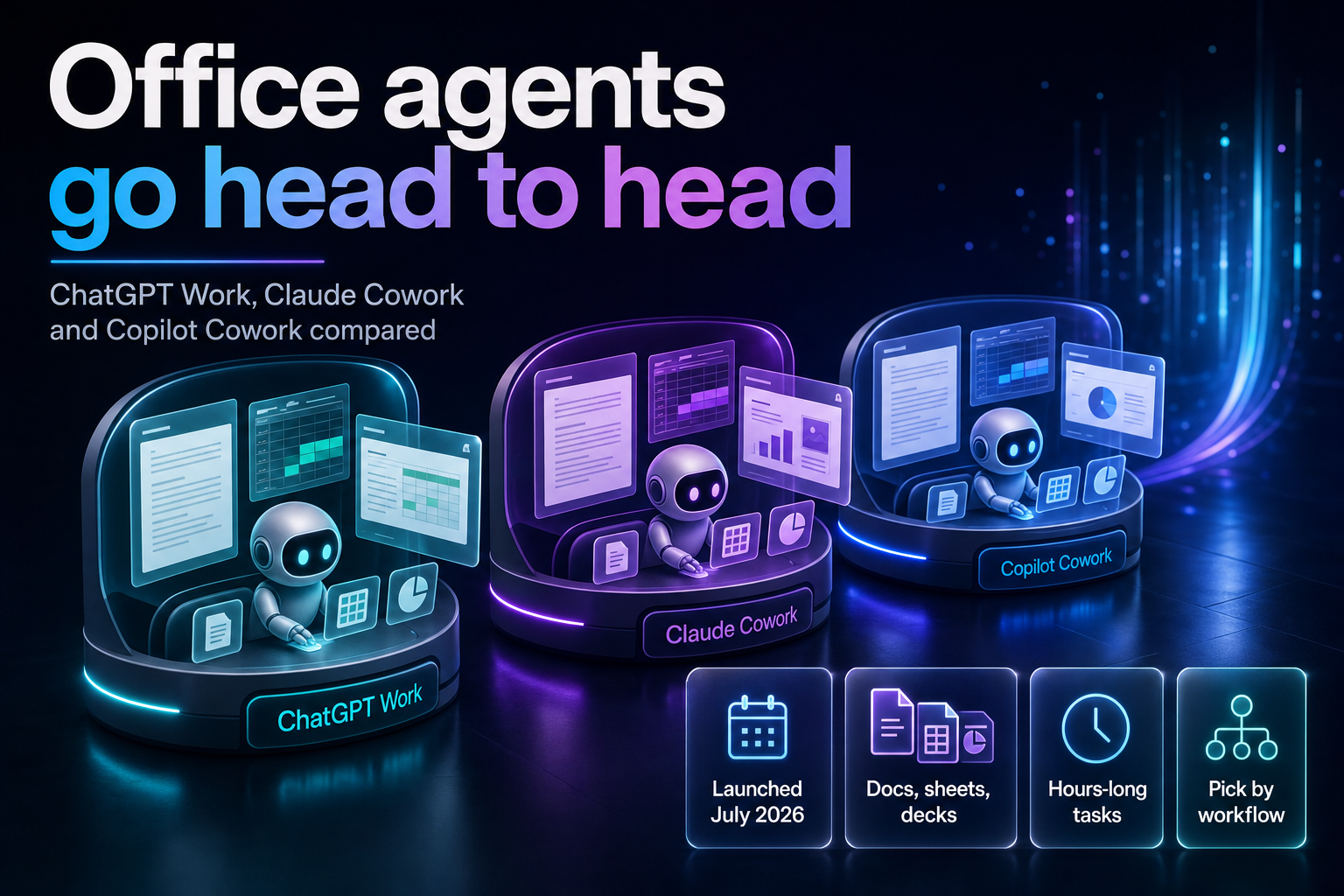
Summary. In the 23 days between 16 June and 9 July 2026, all three major AI vendors shipped the same product: an agent you hand a goal, which returns finished documents, spreadsheets and slides. Microsoft made Copilot Cowork generally available on 16 June 2026, billing usage at $0.01 per Copilot Credit on top of a Microsoft 365 Copilot licence. Anthropic extended Claude Cowork to web and mobile on 7 July 2026; it is included in Claude Pro at $20 a month. OpenAI launched ChatGPT Work on 9 July 2026, running on GPT-5.6, with ChatGPT Business at $20 per user per month. The three billing models cannot be compared line by line, and a Princeton study of 14 agentic models found that reliability still lags capability. Choose on where your files already live, then cap the spend before you roll out.
The pitch is identical across all three. You describe an outcome, the agent works across your files, mail, calendar and connected tools for minutes or hours, and you get back a deliverable rather than a suggestion. What differs is who pays for the compute, who can turn it off, and what happens when the agent gets it wrong at step 7 of 12.
Three products, one month, three billing models
Microsoft went first. Copilot Cowork reached general availability worldwide on 16 June 2026 after three months in the Frontier preview programme, which ran from 30 March to 16 June 2026. Charles Lamanna, Executive Vice President, Copilot, Agents, and Platform at Microsoft, described the product plainly in the launch post: "Copilot Cowork executes complex, long-running, multi-tool tasks." Microsoft named Accenture, Avanade, Capital Group, Koch, Ooredoo Qatar and Zurich Insurance among the companies using it during that preview.
Anthropic moved next. On 7 July 2026 it began rolling Claude Cowork out to the web and mobile, having previously kept it in the desktop app. Anthropic's framing: "Cowork is where you hand Claude a task, and it works across your files, calendar, email, messaging app, the web, and the other tools you connect until the job is done." The beta started with the Max plan and is expanding to other paid plans. The interesting part is not mobile access, it is that sessions run remotely: you can close the laptop and the work continues, and scheduled tasks run with no device online at all.
OpenAI shipped two days later. ChatGPT Work launched on 9 July 2026 alongside GPT-5.6, which arrived as three models named Sol, Terra and Luna. ChatGPT Work gathers context across apps, files and workflows to produce documents, spreadsheets, presentations and web apps, and it has Codex built in. OpenAI says it handles complex tasks for hours "by breaking them into smaller steps and completing them independently". Mobile and web access started with Pro, Enterprise and Edu, expanding to Plus and Business within days; the desktop app went out globally on Windows and Mac across all plans.
Pricing: read the unit, not the number
This is where buyers get caught. All three vendors quote a dollar figure, but the figures measure different things.
| Product | What you pay for the seat | What you pay for agent work | Where the meter runs |
|---|---|---|---|
| Copilot Cowork | Microsoft 365 Copilot User Subscription License (required) | Usage-based, in Copilot Credits; PayGo at $0.01 per credit, or P3 commit for a discount | Model use, context retrieval, tool calls and runtime |
| Claude Cowork | Claude Pro $20/month ($17/month billed annually); Max from $100/month; Team standard $20/seat/month annually | Included in the plan's usage limits; overflow runs on usage credits at standard API rates | Rolling five-hour session windows plus weekly limits |
| ChatGPT Work | ChatGPT Business $20/user/month annually, $25/user/month monthly, 2-user minimum; Enterprise is sales-negotiated | Bundled on Business and Enterprise; Business and Enterprise can purchase credits for more access | Plan limits, then purchased credits |
Three things fall out of that table.
Microsoft's model is the most honest about what agents cost and the most dangerous to leave unattended. A Copilot Cowork task is priced from four inputs: model use, context retrieval, tool calls and runtime. Run a heavy task that reads 40 documents and calls six tools, and it costs what it costs. Microsoft published light, medium and heavy task patterns and a downloadable estimator built on Opus 4.8 rates precisely because customers kept asking how to budget for it.
Anthropic's model is the most predictable and the most likely to stall mid-task. Cowork is included from Claude Pro at $20 a month upward, but every plan runs on usage limits that reset on a rolling five-hour window, with weekly limits on top. Your chats, Claude Code and Cowork all draw from the same pool. When you hit the ceiling you wait, upgrade, or switch on usage credits at standard API rates. For a long-running agent, "wait for the window to reset" is a real operational failure mode.
OpenAI's model is the least legible. ChatGPT Business at $20 per user per month annually is the cheapest headline for a team, and Business and Enterprise can purchase credits for more access, but OpenAI does not publish a per-task or per-credit rate the way Microsoft does. You cannot model it in a spreadsheet before you buy.
The real cost is rarely the licence. It is the tasks nobody capped.
Microsoft's "30-40% cheaper" claim deserves a careful read
Microsoft states in the GA post that "when comparing the cost per prompt between Copilot Cowork and Claude Cowork with their Microsoft 365 connector, testing showed that Copilot Cowork on average was 30-40% cheaper."
The footnote matters more than the headline. The analysis was conducted by internal Microsoft teams. It compared 125 test runs across 12 light, medium and heavy prompts, both sides running Opus 4.8. Copilot Cowork costs came from Microsoft's internal logs at variable rates; Claude Cowork costs were calculated from publicly available API rates plus Microsoft 365 connector usage. The tests ran in June 2026.
So: a vendor benchmarked itself against a competitor, on 12 prompts, using its own cost telemetry for its own product and list-price arithmetic for the other. That is not fraud, and 125 runs is more disclosure than most vendors offer. It is also not a number to put in a board deck without the caveat. Anthropic's Cowork is bundled into a $20 subscription for most users, which makes a per-prompt API-rate comparison a modelling choice rather than a measurement of what a customer actually pays.
Note what Microsoft is really signalling. Copilot Cowork ran on Anthropic models at GA, Opus 4.8 and Sonnet 4.6, with GPT-5.5 available in Frontier. Microsoft also announced Cowork 1, a fine-tuned model designed to handle everyday tasks at substantially lower cost. Microsoft is competing on runtime efficiency and model routing, not on the model itself. If you are already thinking about routing work across models to control API spend, that is the same argument, moved inside the product.
The reliability gap nobody puts on the invoice
Every launch post assumes the agent finishes. Independent research says that assumption is the weak point.
In "Towards a Science of AI Agent Reliability", researchers at Princeton University (Stephan Rabanser, Sayash Kapoor, Peter Kirgis, Kangheng Liu, Saiteja Utpala and Arvind Narayanan) evaluated 14 agentic models across two benchmarks using 12 metrics grouped into four dimensions: consistency, robustness, predictability and safety. Their finding: "despite steady accuracy improvements over 18 months of model releases, reliability only shows modest overall improvement."
The paper opens with the problem every buyer of these three products is about to meet: "AI agents are increasingly deployed to execute important tasks. While rising accuracy scores on standard benchmarks suggest rapid progress, many agents still continue to fail in practice."
Two arguments from that paper should shape your rollout.
First, capability and reliability are separate properties. The authors are explicit: "improving capability does not automatically improve reliability, and evaluating one does not suffice for evaluating the other." GPT-5.6 being better than GPT-5.5 tells you nothing useful about whether ChatGPT Work will produce the same spreadsheet twice.
Second, an average success rate hides the failure mode you care about. As the paper puts it: "Accuracy cannot distinguish an agent that fails on a fixed, identifiable subset of tasks from one that fails unpredictably with the same rate. Yet the former permits systematic debugging while the latter does not." A tool that reliably fails on your PDF invoices is fixable. A tool that fails on a random 12% of everything is not.
The paper also documents what unreliability costs in production. Washington Post columnist Geoffrey Fowler asked OpenAI's Operator to find "cheap eggs" for delivery and the agent made an unauthorised $31.43 purchase from Instacart, breaking the vendor's own pre-purchase confirmation safeguard. In July 2025, Replit's AI coding assistant deleted a production database despite explicit instructions forbidding such changes. The dollar amount is trivial; the control failure is not.
This is why the approval model in each product matters more than its benchmark scores. Anthropic's position is the most conservative of the three: "When Claude reaches a call only you can make, it asks, and the question reaches your phone... Nothing ships until you've reviewed and approved it." OpenAI lets you follow progress, answer questions, change direction and approve certain actions. Microsoft routes everything through existing Microsoft 365 controls. If you are formalising this, our note on governance layers for enterprise AI agents covers where approval gates belong.
Control, governance and where the files live
| Capability | Copilot Cowork | Claude Cowork | ChatGPT Work |
|---|---|---|---|
| Off by default | Yes, admins enable per tenant and choose who gets access | No; included on paid plans from Pro upward | No; on by plan tier |
| Spend limits | Tenant, group and user-level budgets, plus customisable usage alerts | User and organisational spend controls on Enterprise | Business and Enterprise can purchase credits; per-task caps not published |
| Usage reporting | Tenant, group and user; per-task pricing in credits was listed as coming after GA | Settings shows usage; Enterprise adds usage analytics and a Compliance API | Enterprise adds an analytics dashboard and Compliance API logs |
| Where work runs | Cloud-hosted; files not stored locally; tasks continue when the laptop is off | Sessions run remotely in beta; scheduled tasks run with no device online | Web, mobile and desktop; desktop has a built-in browser |
| Audit and eDiscovery | Audit log, DSPM, eDiscovery, Insider Risk Management, Communication Compliance at GA; DLP listed as coming | Audit logs and Compliance API on Enterprise; custom data retention controls | Compliance API Logs Platform, SCIM and role-based access on Enterprise only |
| Models | Opus 4.8 and Sonnet 4.6 at GA, GPT-5.5 in Frontier, Cowork 1 announced | Anthropic models only | GPT-5.6 with Codex built in |
Two entries deserve emphasis.
Copilot Cowork ships off by default. That is the single best design decision in this cohort. Usage-based billing on long-running agents, enabled tenant-wide on day one, is how a finance team finds out about AI adoption from an invoice. Microsoft also gave Frontier tenants a grace period and did not bill their Cowork usage until 1 July 2026.
Data Loss Prevention was still listed as coming at Copilot Cowork's GA. For a product whose whole purpose is to move content between your systems and a model, that gap belongs on your risk register until it closes. The same logic applies to the prompt injection and guardrail questions that arrive with any agent holding tool access.
Which one fits which team
| Your situation | Best fit | Why | Main risk to manage |
|---|---|---|---|
| Microsoft 365 is the system of record | Copilot Cowork | Work IQ grounding, sensitivity labels inherited end to end, eDiscovery and audit at GA | Usage-based spend; enable per group with budgets from day one |
| Small team, predictable monthly cost | Claude Cowork | Included from Claude Pro at $20/month; Team standard seats $20/seat/month annually | Five-hour rolling usage windows can stall a long task |
| Already standardised on ChatGPT | ChatGPT Work | $20/user/month annually on Business; Codex built in for anything that touches code | Per-task cost is not published; you cannot model spend up front |
| Regulated data, India residency required | ChatGPT Enterprise or Claude Enterprise | OpenAI lists data residency in ten regions including India on Enterprise; Anthropic offers custom data retention controls | Both are sales-negotiated; get residency written into the contract |
| Heavy code and document work together | ChatGPT Work or Copilot Cowork | Codex is built into ChatGPT Work; Copilot Cowork adds browser use through Edge | Agent-written code still needs review; treat output as a draft PR |
| No governance model yet | None of them, yet | Approval gates and spend caps have to exist before rollout, not after | Pilot with one team and a hard budget |
India-specific considerations
Two facts change the shortlist for Indian buyers.
Data residency is an Enterprise-tier feature, not a default. OpenAI's published comparison lists data residency across ten regions including India (IN) on ChatGPT Enterprise, and marks it as unavailable on ChatGPT Business. The same table puts SCIM, IP allowlisting, role-based access controls, Enterprise Key Management and the Compliance API Logs Platform on Enterprise only. If you are a data fiduciary handling Indian personal data and you buy the $20 Business seat because the headline price is attractive, you have bought a tier without the controls your compliance team will ask about.
The penalty schedule under India's Digital Personal Data Protection Act, 2023 gives that a number. Failure to take reasonable security safeguards leading to a personal data breach carries a penalty of up to ₹250 crore; failure to notify a breach carries up to ₹200 crore; other contraventions carry up to ₹50 crore. An office agent that reads mail, files and calendars across your organisation and calls external tools is squarely inside that exposure. It is a processing activity, not a productivity feature, and it belongs in your record of processing before it goes live. Teams working through the wider DPDP timeline should start with our DPDP consent manager framework readiness guide.
Practical guidance for Indian teams as of July 2026: pilot on the cheap tier if you must, but pilot on synthetic or low-sensitivity data, and do not let a Business-tier pilot quietly become the production deployment.
How to run a two-week bake-off before you commit
The Princeton work points at the right test design. Do not measure whether the agent can do the task once. Measure whether it does the task the same way five times.
- Pick 12 real tasks your team runs weekly. Not demos. Include at least three that touch messy inputs: scanned PDFs, a spreadsheet with merged cells, a thread with contradictory instructions.
- Run each task five times on each product, same prompt, same inputs. Record success, partial success and failure separately. This is the pass-across-all-attempts test the Princeton authors argue for over best-of-k scoring.
- Log the cost of every run. On Copilot Cowork, read it from the Cost Management Dashboard in the Microsoft 365 admin center. On Claude, watch where the five-hour window lands. On ChatGPT Work, track how fast a Business seat needs purchased credits.
- Score the failures by type, not by count. Separate benign failures such as a formatting error from consequential ones such as an unrequested external action. The Princeton paper's point holds: no practitioner treats those as interchangeable.
- Set the budget before the rollout, not after the first invoice. On Copilot Cowork, that means scoped billing policies with user-level caps inside group policies, and usage alerts pointed at someone who will act on them.
- Write down the approval gate. Which actions can the agent take unattended, which need a human, and who is on the hook when it takes one it should not have. Our note on catching silent failures in agent evals covers wiring this into CI.
Two weeks of that produces a defensible decision. A vendor demo produces a purchase order.
FAQ
How eCorpIT can help
eCorpIT runs structured bake-offs of this kind for founders and CTOs who need a decision rather than a demo, using your real tasks, your real documents and a measured cost per run. Our senior engineering teams design the approval gates, spend caps and evaluation harness before the rollout, and we build the connectors and internal tooling that make an office agent useful against your systems rather than a generic inbox. We design deployments aligned with DPDP Act requirements, including where personal data is processed and how consent and retention are recorded. If you are weighing these three products against each other this quarter, talk to our team.
References
- Copilot Cowork is now generally available — Charles Lamanna, Microsoft 365 Blog, 16 June 2026.
- Anthropic expanding Claude Cowork to mobile and web, details here — Zac Hall, 9to5Mac, 7 July 2026.
- OpenAI launches an AI agent built to automate your entire job — Ryan McNeal, Android Authority, 9 July 2026.
- OpenAI Launches ChatGPT Work Agent to Handle Complex Tasks — Bloomberg, 9 July 2026.
- Plans & Pricing — Anthropic, retrieved 16 July 2026.
- ChatGPT Pricing, business and enterprise plans — OpenAI, retrieved 16 July 2026.
- Towards a Science of AI Agent Reliability — Stephan Rabanser, Sayash Kapoor, Peter Kirgis, Kangheng Liu, Saiteja Utpala and Arvind Narayanan, Princeton University, arXiv:2602.16666v1.
- What's new in Copilot Cowork — Microsoft Learn.
- Digital Personal Data Protection Act, 2023 — penalty schedule reference.
- Copilot Cowork: A new way of getting work done — Microsoft 365 Blog, 9 March 2026.
- Microsoft Announces General Availability of Copilot Cowork Following Successful Preview — Redmond Channel Partner, 16 June 2026.
- Microsoft Copilot Cowork launches worldwide — CRN Asia, June 2026.
Last updated: 16 July 2026.