On this page · 11 sections
- What AWS actually shipped in July 2026
- G6 to G7, G6e to G7e: the numbers side by side
- Why 70B on one GPU is the real headline
- What it costs, and where the money actually moves
- G7 or G7e: choosing by workload
- The Mumbai question: what changes for Indian teams
- How to actually adopt G7 and G7e
- The honest limitations
- FAQ
- How eCorpIT can help
- References
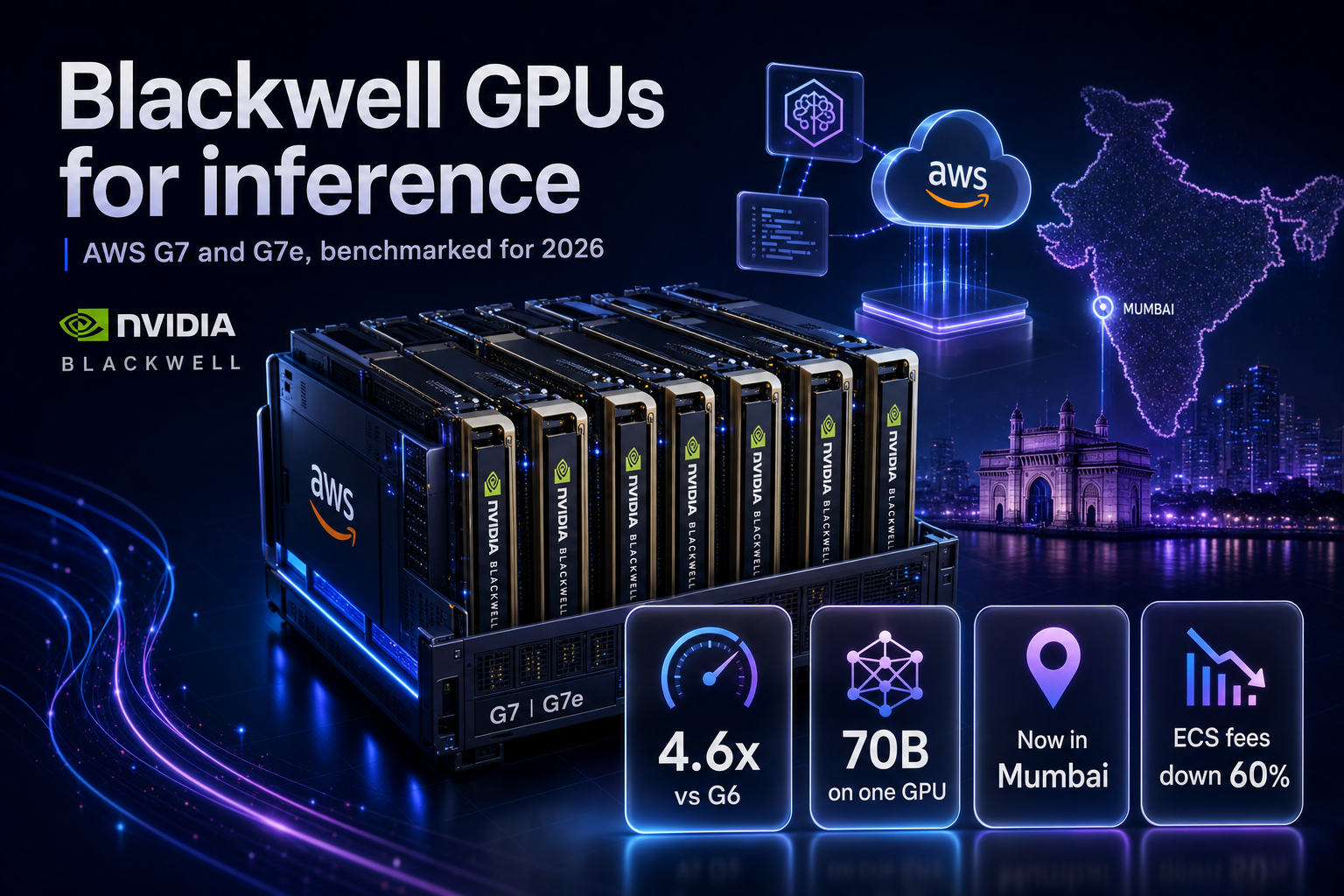
Summary. In July 2026 AWS put two NVIDIA Blackwell inference families into production. Amazon EC2 G7, powered by NVIDIA RTX PRO 4500 Blackwell GPUs, landed in US East (N. Virginia) on 10 July 2026 with up to 4.6x the AI inference of the previous G6 generation. G7e, powered by NVIDIA RTX PRO 6000 Blackwell GPUs, reached Asia Pacific (Mumbai) on 15 July 2026 and delivers up to 2.3x the inference of G6e while fitting a 70B-parameter model in FP8 on a single 96 GB GPU. On 1 July 2026 AWS also cut Amazon ECS Managed Instances GPU management fees by 35% for G-series and 60% for P-series and Trainium. For teams running inference on AWS, the question is no longer whether Blackwell is available; it is which family fits which workload, and what it costs. Current on-demand G6e rates sit near $2.24 per hour for a single GPU and $30.13 per hour for an 8-GPU box, so the memory and throughput gains change the tokens-per-dollar maths more than any list price alone.
This is a working guide for CTOs, ML platform engineers and FinOps leads: what shipped, how G7 and G7e compare on the numbers AWS actually published, where the cost really moves, and how the Mumbai launch changes the calculus for Indian teams.
What AWS actually shipped in July 2026
Three separate announcements matter, and the trade press tends to blur them.
Amazon EC2 G7 became available in US East (N. Virginia) on 10 July 2026, joining US East (Ohio) and US West (Oregon). G7 uses NVIDIA RTX PRO 4500 Blackwell Server Edition GPUs with 32 GB of memory per GPU and custom Intel Xeon 6 processors, and AWS quotes up to 4.6x the AI inference and up to 2.1x the graphics performance of G6. A full box carries up to 8 GPUs, 192 vCPUs, 768 GiB of system memory, up to 700 Gbps of Elastic Fabric Adapter networking, and up to 7.6 TB of local NVMe SSD.
Amazon EC2 G7e is the memory-heavy sibling. It uses NVIDIA RTX PRO 6000 Blackwell Server Edition GPUs with 96 GB per GPU and delivers up to 2.3x the inference of G6e. G7e reached general availability earlier in 2026 in US East, and on 15 July 2026 AWS extended it to Europe (Frankfurt, Stockholm) and Asia Pacific (Mumbai), on top of existing coverage in US West (Oregon), US East (N. Virginia, Ohio), Europe (Spain, London) and Asia Pacific (Tokyo, Seoul).
The third item is a price change, not a chip. From 1 July 2026, Amazon ECS Managed Instances reduced management fees by 35% for G-series instances and by 60% for P-series and AWS Trainium. Amazon EKS applied identical cuts for GPU instances on EKS Auto Mode. These reductions apply automatically, so any team already running GPU containers on ECS Managed Instances started paying less without touching a config file.
G6 to G7, G6e to G7e: the numbers side by side
AWS positions G7 as the throughput upgrade and G7e as the memory upgrade. The specifications make the split clear.
| Attribute (8-GPU box) | G6 (NVIDIA L4) | G7 (RTX PRO 4500 Blackwell) | G6e (NVIDIA L40S) | G7e (RTX PRO 6000 Blackwell) |
|---|---|---|---|---|
| GPU memory per GPU | 24 GB | 32 GB | 48 GB | 96 GB |
| Relative AI inference | baseline | up to 4.6x G6 | baseline | up to 2.3x G6e |
| Max GPU memory per node | 192 GB | 256 GB | 384 GB | 768 GB |
| vCPUs (max) | 192 | 192 | 192 | 192 |
| Network bandwidth (max) | 100 Gbps | up to 700 Gbps | 400 Gbps | 1,600 Gbps |
| CPU | AMD/Intel (gen dependent) | Intel Xeon 6 | Intel | 5th Gen Intel Xeon |
Two figures deserve attention. G7e doubles GPU memory versus G6e (96 GB against 48 GB) and adds 1.85x the memory bandwidth, which is why AWS says a medium-sized model of up to 70B parameters runs in FP8 precision on one GPU. G7e also quotes four times the inter-GPU bandwidth of the L40S GPUs used in G6e and four times the networking bandwidth, with NVIDIA GPUDirect P2P over PCIe and GPUDirect RDMA over Elastic Fabric Adapter for the multi-GPU sizes.
Nick Patience, VP and Practice Lead for AI Platforms at The Futurum Group, framed the release plainly in his analysis: G7e "targets workloads that benefit from higher memory density per GPU rather than solely raw compute throughput," and it "extends Amazon's EC2 GPU lineup with higher memory density and networking capacity rather than redefining its compute strategy." That is the right lens. This is a memory-and-bandwidth story as much as a raw-FLOPS story.
Why 70B on one GPU is the real headline
The single most useful number for a platform team is 96 GB per GPU. It removes a class of engineering pain.
On G6e, a 70B model in FP8 does not fit in a single 48 GB L40S, so you shard it across two GPUs. Sharding adds tensor-parallel communication, complicates autoscaling, and ties two GPUs to one replica. On G7e, that same model sits on one 96 GB GPU. You get a cleaner deployment unit, lower inter-GPU chatter, and a replica you can scale one GPU at a time. For a busy inference service, fewer moving parts usually beats a marginally faster kernel.
The g7e.2xlarge to g7e.48xlarge range gives six sizes, from one GPU with 8 vCPUs and 64 GiB of memory up to eight GPUs, 192 vCPUs, 2,048 GiB of memory and 15.2 TB of local NVMe. That spread lets you match instance size to model size rather than over-provisioning a large box for a small model. For models that genuinely exceed one GPU, GPUDirect P2P keeps latency low within a node, and the 768 GB of aggregate GPU memory on a full g7e.48xlarge covers most single-node inference targets short of frontier-scale models.
If you are weighing self-hosted inference against a managed API, the memory headroom changes the build-versus-buy line. Our note on private LLM deployment for Indian teams walks through when owning the serving stack pays off, and single-GPU 70B serving is exactly the case where it starts to.
What it costs, and where the money actually moves
AWS has not published a flat headline price for G7 or G7e; both are sold as On-Demand, Spot and Savings Plan instances, and you should confirm live rates on the EC2 pricing page. What we can anchor is the outgoing generation and the fee change.
Third-party pricing trackers list G6e on-demand in US East at roughly $2.24 per hour for a single-GPU g6e.2xlarge and about $30.13 per hour for the 8-GPU g6e.48xlarge, as of July 2026. Treat those as the reference band while G7e rates settle. The point is not the sticker: it is throughput per dollar. If AWS prices G7e near the G6e band, the quoted 2.3x inference gain lifts tokens-per-dollar by roughly the same factor, and the single-GPU 70B capability removes a second GPU from many deployments outright.
| Cost lever | Before (G6e / L40S) | After (G7e / Blackwell) | Effect on spend |
|---|---|---|---|
| 70B FP8 serving | 2 GPUs (sharded) | 1 GPU (96 GB) | Halves GPU count per replica |
| Inference throughput | baseline | up to 2.3x G6e | More tokens per GPU-hour |
| ECS Managed Instances G-series fee | standard | 35% lower (from 1 Jul 2026) | Automatic management-fee cut |
| ECS P-series / Trainium fee | standard | 60% lower (from 1 Jul 2026) | Automatic management-fee cut |
| Purchase model | On-Demand | Savings Plans / Spot | 30 to 60%+ off on-demand |
The ECS Managed Instances change is the one to action today because it needs no migration. If your GPU inference already runs on ECS Managed Instances or EKS Auto Mode, the 35% G-series and 60% P-series and Trainium fee cuts are already in your bill from 1 July 2026. The updated rate table lives on the ECS Managed Instances pricing page. This sits against a wider backdrop of rising accelerator costs on AWS; we covered the EC2 Capacity Blocks GPU price rise separately, and GPU spend remains, by a distance, the top FinOps concern for 2026.
G7 or G7e: choosing by workload
The families are not interchangeable. Pick by memory footprint and throughput profile, not by version number.
| Use G7 when | Use G7e when |
|---|---|
| Model fits comfortably in 32 GB per GPU | Model needs 48 to 96 GB per GPU |
| You want maximum inference throughput per dollar | You want to serve 70B-class models without sharding |
| Workloads: translation, speech, image and video analysis, RAG | Workloads: large LLMs, agentic and multimodal models, spatial computing |
| Graphics, game streaming, transcoding alongside AI | Mixed graphics-and-AI plus scientific and spatial computing |
| Regions: US East (N. Virginia, Ohio), US West (Oregon) | Regions include Mumbai, Tokyo, Seoul, Frankfurt, Stockholm, more |
A concrete rule of thumb: if your served model and its KV cache fit in 32 GB, G7 will usually give you the best throughput per dollar. Once you cross into 40B-plus parameters or long-context KV caches that spill past 32 GB, G7e's 96 GB per GPU stops you sharding and often wins on total cost even at a higher hourly rate, because it needs fewer GPUs per replica.
The Mumbai question: what changes for Indian teams
Until 15 July 2026, running Blackwell-class inference close to Indian users meant reaching for a US or Singapore region and eating the latency, or using older L40S-based G6e capacity. G7e in Asia Pacific (Mumbai) removes that trade-off. Indian product teams can now serve 70B-class models on 96 GB Blackwell GPUs inside the ap-south-1 region.
For regulated workloads, in-region inference matters beyond latency. Under the Digital Personal Data Protection Act 2023, keeping the serving path and any logged prompts inside an Indian region simplifies data-residency posture for fintech, health and public-sector deployments, and shortens the argument with a security reviewer. It does not by itself make a system compliant, but it removes a cross-border transfer from the design.
On price, Indian buyers should budget in dollars plus tax. AWS bills these instances in USD, and Indian customers also pay 18% GST on top. At roughly ₹85 to the dollar, the G6e reference band works out to about ₹190 per hour for a single-GPU box and around ₹2,560 per hour for an 8-GPU box before GST, which is the ballpark to hold in mind until G7e ap-south-1 rates are confirmed on the pricing page. For teams comparing providers, our India cloud-cost breakdown across AWS, Azure and GCP puts these numbers in context.
How to actually adopt G7 and G7e
The path to production is short, and the managed options are where most teams should start.
Launch instances through the AWS Management Console, CLI or SDKs, and use the AWS Deep Learning AMIs to skip driver and CUDA setup. For containerised inference, both families run on Amazon ECS and Amazon EKS, and G7e also supports AWS Parallel Computing Service, with Amazon SageMaker AI support noted as coming soon. If you run on ECS Managed Instances or EKS Auto Mode, you get GPU metrics for utilisation, memory and temperature through CloudWatch Container Insights, plus automatic health monitoring that detects GPU hardware failures and replaces unhealthy instances, and you get the reduced management fees automatically.
For multi-GPU serving, the g7e.12xlarge and larger sizes expose NVIDIA GPUDirect P2P and, on the bigger sizes, GPUDirect RDMA over EFA, so a tensor-parallel deployment keeps communication overhead low. Model loading benefits from GPUDirect Storage with Amazon FSx for Lustre, which AWS rates at up to 1.2 Tbps, so cold starts on large weights are less painful. If you are standardising GPU workloads on Kubernetes, our managed Kubernetes AI-platform service covers the autoscaling and scheduling patterns that keep these instances busy.
One caveat worth planning around: regional availability differs between the families. G7 is US-only at launch, while G7e spans more regions including Mumbai. If your architecture assumes a specific region, check the exact family before you commit a Savings Plan.
The honest limitations
Two things to keep in perspective. First, AWS frames the multi-node story as incremental: G7e improves small-scale multi-node inference, but this is not a large-scale distributed-training platform, and the P-series and Trainium families remain the tools for that. Second, the 4.6x and 2.3x figures are AWS's own "up to" numbers for inference and depend heavily on model, precision and batch size; benchmark your own workload before you size a Savings Plan around them. The single-GPU 70B claim is specific to FP8 precision, so a model you serve in BF16 will not fit the same way.
FAQ
How eCorpIT can help
eCorpIT is a Gurugram-based, senior-led engineering organisation that designs and runs AI inference on AWS for Indian and global teams. We size G7 and G7e capacity against your actual models, set up ECS or EKS autoscaling so the new management-fee cuts land in your bill, and benchmark tokens-per-dollar before you commit a Savings Plan. If you are moving inference into the Mumbai region or weighing self-hosted serving against managed APIs, talk to our cloud and AI infrastructure team.
References
- Amazon EC2 G7 instances are now available in the AWS US East (N. Virginia) Region - AWS What's New, 10 July 2026.
- Amazon EC2 G7e instances now available in additional regions - AWS What's New, 15 July 2026.
- Announcing Amazon EC2 G7e instances accelerated by NVIDIA RTX PRO 6000 Blackwell Server Edition GPUs - AWS News Blog.
- Amazon ECS Managed Instances reduces GPU management fees by up to 60% - AWS What's New, 7 July 2026.
- Amazon EC2 G7e instances - AWS instance page.
- Amazon EC2 G7e Goes GA With Blackwell GPUs. What Changes for AI Inference? - Nick Patience, The Futurum Group, 27 January 2026.
- Amazon EC2 On-Demand pricing - AWS.
- g6e.2xlarge pricing - Economize Cloud, July 2026.
- g6e.48xlarge pricing - Economize Cloud, July 2026.
- AWS Deep Learning AMIs - AWS.
- Elastic Fabric Adapter - AWS.
Last updated: 27 July 2026.