On this page · 10 sections
- Two databases, two billing units you cannot compare
- What is a DPU, and what is an ACU?
- The benchmark: same workload, both engines
- The monthly cost math
- Why DSQL is slower here, and when that reverses
- When to choose which for a 2026 build
- The commitment-discount and India angle
- FAQ
- How eCorpIT can help
- References
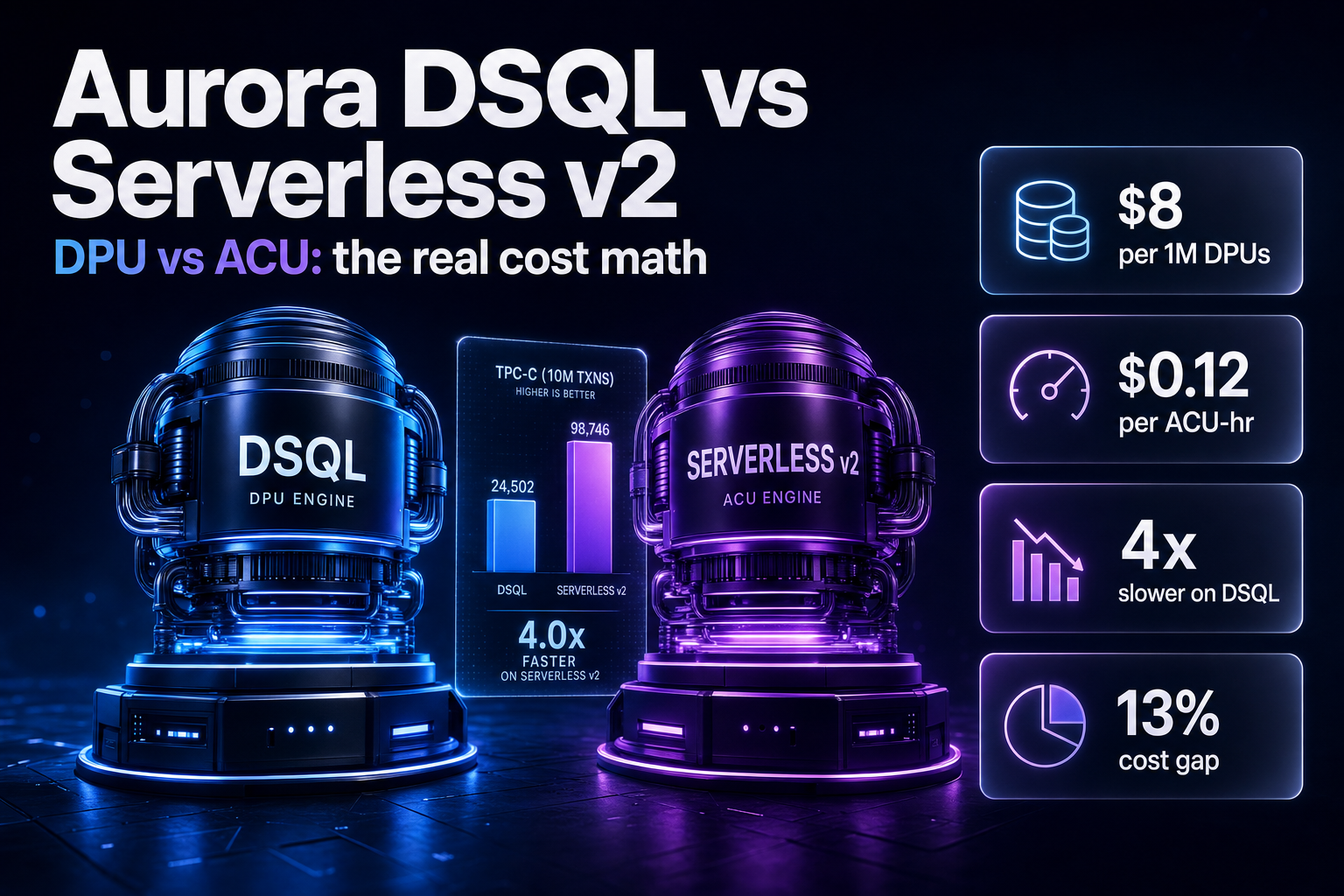
Summary. Amazon Aurora DSQL reached general availability on 28 May 2025 as a serverless, active-active distributed SQL database, and it bills on a unit almost nobody can estimate in advance: the Distributed Processing Unit, at $8 per 1 million DPUs. Aurora Serverless v2 bills per Aurora Capacity Unit at $0.12 per ACU-hour and scales down to 0 when idle. Because the two meters are not comparable on paper, the only honest test is to run the same workload on both. A DoiT engineer did exactly that with pgbench: the identical 100,000-transaction job consumed 8,327 DPU on DSQL versus 0.48 ACU on Serverless v2, ran roughly 4 times slower on DSQL (50.8 vs 206.8 transactions per second), and projected to $50.13 a month against $43.72 on Serverless v2, about 13% dearer. For most new builds in 2026, Serverless v2 is the cheaper and faster default. This guide explains why, and names the narrow cases where DSQL is worth its premium.
Two databases, two billing units you cannot compare
AWS positions Aurora DSQL against Google Spanner and AlloyDB: a PostgreSQL-compatible database with active-active writes across Regions, virtually unlimited horizontal scale, and no servers to manage. Aurora Serverless v2 is a different animal. It is a single-Region, auto-scaling version of standard Aurora that grows and shrinks capacity by the second.
The trap for anyone doing a 2026 build decision is that the price lists do not line up. DSQL meters compute in DPUs; Serverless v2 meters compute in ACU-hours. You cannot divide one into the other from the pricing page. As the DoiT analysis put it after trying: "the billing constructs differ between Aurora Serverless v2 and Aurora DSQL, so apart from storage, we cannot directly compare."
Storage is the one place they do compare, and DSQL is more expensive there: $0.33 per GB-month for DSQL against $0.10 per GB-month (Standard) or $0.225 per GB-month (I/O-Optimized) for Serverless v2. A large database with low transaction volume costs more on DSQL before compute even enters the picture.
What is a DPU, and what is an ACU?
A Distributed Processing Unit is Aurora DSQL's compute meter. Each DPU reflects the CPU time, memory, and read and write work required to process distributed queries across DSQL's parallel execution engine. DPUs are fractional and usage-based, so you pay only for what a query actually consumes. AWS normalises the meter: 1 million compute, read, write, or multi-Region DPUs each cost $8 in US East (N. Virginia).
An Aurora Capacity Unit is Serverless v2's compute meter. One ACU is roughly 2 GiB of memory with matching CPU and networking, billed per second at $0.12 per ACU-hour. Serverless v2 scales between 0.5 and 128 ACUs and can drop to 0 when the database is idle.
Both meters share the same problem: you cannot predict consumption before you run the workload. AWS added statement-level cost estimates to DSQL query plans in November 2025 to soften this, but the practical answer is still to test with your own queries.
| Pricing model (us-east-1, 2026) | Aurora DSQL | Aurora Serverless v2 |
|---|---|---|
| Compute meter | Distributed Processing Unit (DPU) | Aurora Capacity Unit (ACU) |
| Compute rate | $8 per 1 million DPUs | $0.12 per ACU-hour |
| Scales to zero when idle | Yes (serverless by design) | Yes (down to 0 ACU) |
| Storage | $0.33 / GB-month | $0.10 (Standard) or $0.225 (I/O-Optimized) / GB-month |
| Separate I/O charge | No | $0.20 per 1M I/Os (Standard only) |
| Free tier | 100,000 DPUs + 1 GB-month each month | None |
| Multi-Region active-active writes | Yes | No |
The benchmark: same workload, both engines
Published rates cannot answer the cost question, so the useful evidence is a controlled test. Kate Gawron, an engineer at DoiT International, ran the standard pgbench TPC-B workload with 100,000 transactions against each database, using a single client because DSQL's optimistic concurrency control caused multi-client runs to error out under conflict.
The raw pgbench output is the part worth reading twice.
| pgbench, TPC-B, 100,000 transactions, single client | Aurora DSQL | Aurora Serverless v2 |
|---|---|---|
| Average latency | 19.700 ms | 4.835 ms |
| Throughput | 50.76 tps | 206.83 tps |
| Compute consumed | 8,327 DPU | 0.48 ACU |
| Initial connection time | 243.453 ms | 16.942 ms |
Serverless v2 processed the same job at roughly 4 times the throughput of DSQL and about one quarter of the latency. That gap is not a tuning artefact. DSQL trades single-node speed for distributed, multi-Region write consistency, so a simple contended-write benchmark is close to its worst case.
The monthly cost math
Take the pgbench result and project it across a month, using the DoiT assumptions: the 100,000-transaction job runs every hour for 720 hours, a flat workload with no peaks, and 10 GB of stored data.
| Monthly projection (720 hrs, 10 GB, us-east-1) | Aurora DSQL | Aurora Serverless v2 (I/O-Optimized) |
|---|---|---|
| Compute | 8,327 DPU × 720 = 5,995,440 DPU, minus 100,000 free = 5,895,440 billable → $47.16 | 0.48 ACU × 720 = 345.6 ACU × $0.12 → $41.47 |
| Storage | (10 − 1 free) GB × $0.33 → $2.97 | 10 GB × $0.225 → $2.25 |
| Monthly total | $50.13 | $43.72 |
Serverless v2 comes out roughly 13% cheaper on a like-for-like transaction and storage basis, and the free tier on DSQL, worth about $1.13 a month, does not change the outcome for a production workload. So on this workload DSQL is both slower and more expensive. That is the base case a new build should start from, then look for a reason to deviate.
Why DSQL is slower here, and when that reverses
DSQL uses optimistic concurrency control. Instead of locking rows, it lets transactions proceed and checks for conflicts at commit time, retrying the losers. That design is what lets writes scale across Regions without a single coordinating node, but it punishes a contended single-key benchmark like pgbench TCP-B, where many transactions hit the same rows. Real applications with sharded, low-contention write patterns will see a very different curve.
The reversal comes at scale and across Regions. DSQL's throughput grows close to linearly as you add write concurrency, and its active-active multi-Region writes have no equivalent in Serverless v2, which is single-Region. For a workload with thousands of transactions and connections per second where a standard Aurora writer bottlenecks, or for an application that must accept writes in Mumbai and Virginia at the same time, DSQL's model is the point, not the penalty. For a normal single-Region web or mobile backend, it is overhead you pay for and do not use.
When to choose which for a 2026 build
| Decision vector | Choose Aurora DSQL | Choose Aurora Serverless v2 |
|---|---|---|
| Traffic shape | Massive, sustained, thousands of tps | Bursty or intermittent |
| Region model | Active-active multi-Region writes needed | Single Region is fine |
| Write scaling | Near-linear horizontal write scale | Vertical ACU scaling is enough |
| PostgreSQL surface | A compatible subset is acceptable | Full extensions and stored procedures needed |
| App code | Can implement commit-retry for conflicts | Wants standard locking semantics |
| Cost on ordinary workloads | Higher (see benchmark) | Lower default |
| Idle cost | Scales to zero | Scales to zero |
The plain reading, matching the DoiT conclusion, is that Serverless v2 is the right default for most teams, and you need a specific reason, global write distribution or write scale beyond a single Aurora writer, to justify DSQL today. If your app needs particular PostgreSQL extensions or stored procedures, Serverless v2 is also the safer choice, because DSQL exposes a compatible subset rather than the full surface.
The commitment-discount and India angle
Neither engine has to run at on-demand rates. Aurora Serverless v2 is eligible for AWS Database Savings Plans, which take up to 35% off serverless database usage for a 1-year commitment. Before you pick an engine on sticker price, read our companion breakdown of the AWS Database Savings Plans cost math, because a committed discount can move the comparison. For teams weighing a broader move off older engines first, our MySQL 8.0 end-of-life and RDS migration guide covers the upgrade economics that usually come before this decision.
For Indian teams, the multi-Region question is the one to answer honestly. Aurora DSQL is now available in several AWS Regions including Asia Pacific, and its active-active writes are genuinely useful if you serve users across continents. But most Indian product companies and Global Capability Centres run single-Region in Mumbai (ap-south-1), where Serverless v2 is cheaper, faster and simpler. Teams handling personal data under the Digital Personal Data Protection Act 2023 also tend to pin storage to a single Indian Region, which removes DSQL's headline advantage. Our cloud FinOps playbook for Indian teams covers how to model these choices against a real bill.
FAQ
How eCorpIT can help
eCorpIT is a CMMI Level 5 and ISO 27001:2022 certified engineering organisation in Gurugram that designs and runs data platforms on AWS for product teams and Global Capability Centres. Our senior engineers benchmark candidate databases against your real workload, model the cost across DSQL, Serverless v2 and provisioned Aurora, and build the retry and multi-Region logic a distributed database needs. If you are choosing a database for a new build, talk to us or read about our data platform engineering service.
References
- Amazon Aurora DSQL is now generally available — AWS News Blog, 28 May 2025.
- Amazon Aurora DSQL pricing — AWS.
- How billing works in Aurora DSQL — AWS Aurora DSQL User Guide.
- Amazon Aurora DSQL FAQs — AWS.
- Comparing Aurora DSQL vs Aurora Serverless v2: a practical cost analysis — Kate Gawron, DoiT International, June 2025.
- Amazon Aurora pricing — AWS.
- Amazon Aurora DSQL is now available in five additional AWS Regions — AWS What's New.
- What is Amazon Aurora DSQL? — AWS Aurora DSQL User Guide.
- Introducing Database Savings Plans for AWS Databases — AWS News Blog, 2 December 2025.
- Aurora DSQL uncovered: the future of scalable databases — DoiT Engineering.
_Last updated: 27 July 2026._