On this page · 12 sections
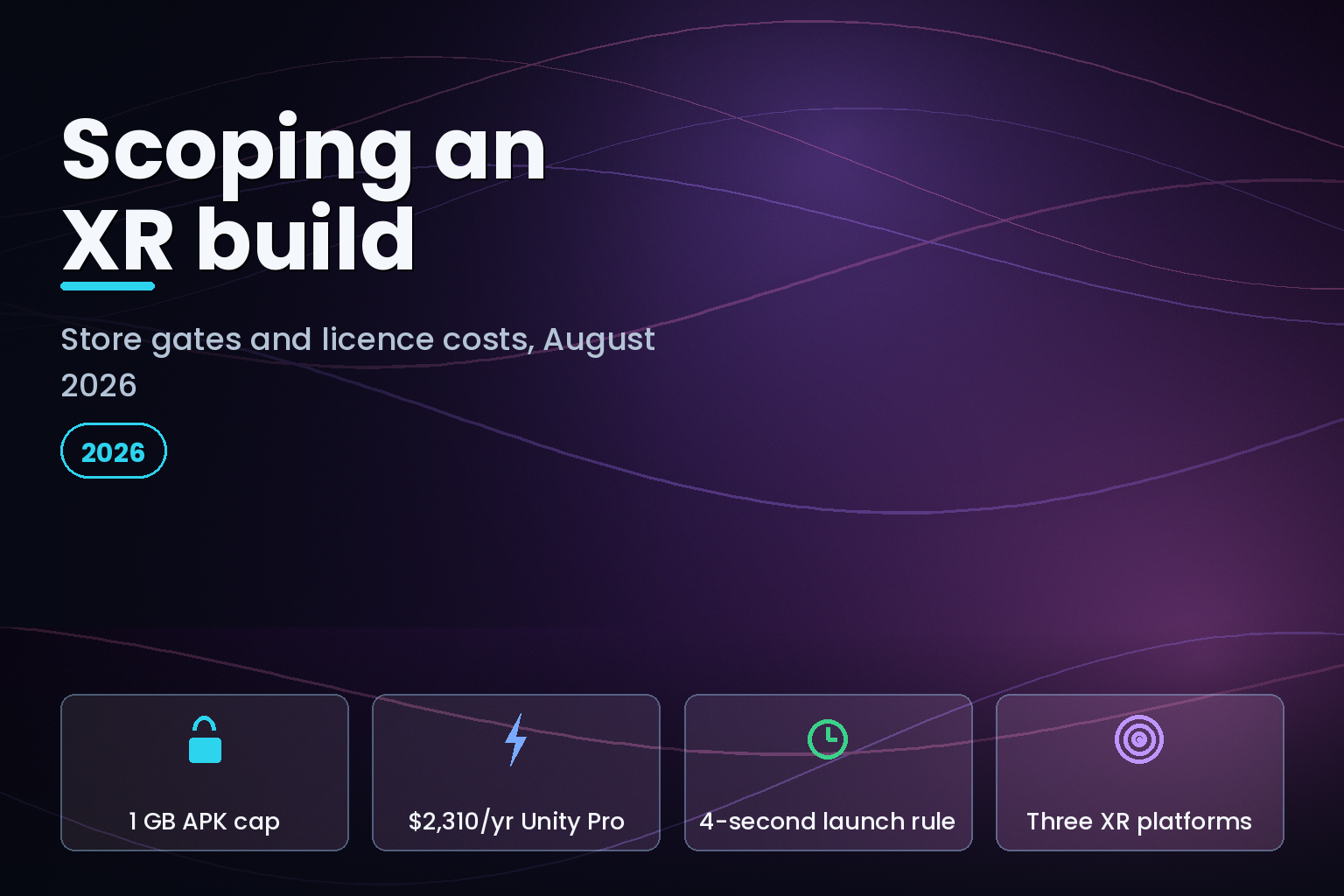
Summary. Most AR and VR projects are scoped from a demo video and priced from a guess. The constraints that actually decide the budget are published, dated and specific. Meta's Virtual Reality Check guidelines, updated 3 August 2026, require Quest APKs under 1 GB with OBB files under 4 GB, 64-bit binaries only, APK signature scheme v2, and head-tracked graphics in the headset within 4 seconds of launch or a loading indicator in VR. Unity charges $2,310 per seat per year prepaid, or $210 per month, for the Pro plan that is required to publish to Apple Vision Pro at all, and Pro became mandatory above $200,000 of annual revenue and funding. Unity Pro and Enterprise prices rose 5% on 12 January 2026. Three target platforms now matter, not one: Meta Horizon OS, Apple visionOS and Android XR, and they do not share a runtime. eCorpIT scopes AR and VR work against those gates first, because a build that cannot pass them is not a build.
The three platforms, and why the count matters
There is no single XR target any more. Picking two instead of one roughly doubles the integration surface, and the decision belongs at week zero.
| Platform | Primary runtime | Distribution | Notable constraint |
|---|---|---|---|
| Meta Horizon OS (Quest) | Unity, Unreal, native Android | Meta Horizon Store | APK under 1 GB, OBB under 4 GB, 64-bit only |
| Apple visionOS | SwiftUI, RealityKit, ARKit | App Store | Unity publishing requires a Pro seat |
| Android XR | Jetpack XR SDK, Unity | Google Play | minSdk 24, must compile to SDK 34 or higher |
| Mobile AR (iOS/Android) | ARKit, ARCore | App Store, Google Play | Ships inside an existing app, no new store listing |
| WebXR | Browser | Any URL | No store review, weakest device access |
Android XR is the newest arrival. Google's Jetpack XR SDK covers Jetpack Compose for XR, Material Design for XR, Jetpack SceneCore for the scene graph, and ARCore for Jetpack XR for perception. It requires a minSdk of 24 and must compile against SDK 34 or higher. The Samsung Galaxy XR is the first shipping device on the platform, and the SDK reached Developer Preview 4, which unified development across headsets, wired XR glasses, audio glasses and display glasses.
Apple's stack is separate again. On visionOS, ARKit exposes Plane Estimation, Scene Reconstruction, Image Anchoring, World Tracking and Skeletal Hand Tracking, but only after the app moves into a Full Space and the user grants permission. RealityKit handles rendering and now draws 3D Gaussian Splats directly, which changes how photorealistic scans get into a scene. visionOS 27 adds high-frame-rate object tracking that updates pose as a physical object moves.
The engineering point buried in that table: a Quest build and a visionOS build share concept art and almost nothing else.
What eCorpIT builds
Industrial and enterprise training simulations, where the value is measurable time-to-competence rather than novelty. Mixed-reality maintenance and assembly guidance that runs in passthrough on Quest. Product configurators and try-before-you-buy AR that ships inside an existing iOS or Android app rather than as a new download. Spatial data visualisation for teams that already have the data and no way to walk through it. Virtual showrooms and property walkthroughs. WebXR experiences for campaigns where an app install would kill the funnel.
We also do the unglamorous half: store submission and VRC remediation for builds that already exist and keep failing review, performance optimisation to hit the refresh-rate requirement, and porting a Quest title to visionOS or Android XR.
What we will not sell you is a headset pilot with no second phase. If nobody has agreed what happens after the demo, the demo is the whole project and the budget is wasted.
The store gates, stated plainly
Meta publishes its acceptance criteria as a checklist, and the checklist is the scope. From the VRC guidelines as of 3 August 2026:
Packaging is hard-limited. The APK must be under 1 GB and OBB files under 4 GB. Every Quest app must be submitted as a 64-bit binary and signed with APK signature scheme v2. You must use a supported SDK and engine version, which quietly rules out the abandoned Unity version a prototype was built in two years ago.
Performance is measured, not estimated. The app must run at the specified refresh rates, and must either display head-tracked graphics within 4 seconds of launch or show a loading indicator inside VR. Running at no less than 85% render scaling for the majority of the experience is a recommendation rather than a requirement, which is where most "it looks fine on my machine" builds fall over.
Function and input carry real requirements. Apps must be focus-aware: they keep rendering when they lose focus, hide hands and controllers, and ignore input. Single-player apps must pause when Horizon OS asks them to. Hand-tracking apps must respect the reserved system gesture and handle switching between hands and controllers. Apps that launch into passthrough should show passthrough loading screens.
Streaming is the constraint teams miss entirely. Applications that stream stereoscopic, head-tracked or immersive content may only do so from a local PC the customer has physical access to, unless Meta expressly approves otherwise. A cloud-rendered architecture is a business-model decision that needs Meta's sign-off, not an implementation detail.
Privacy and assets are reviewed too. The privacy policy must explain what data is collected, how it is used and how a user requests deletion. Store cover art must not carry extraneous text or banners, screenshots must not show other VR platforms' hardware, and the trailer must not exceed 2 minutes. Asset failures are among the most common reasons a submission bounces.
One more clause belongs in every enterprise contract: under Meta's developer policies, ending support for an app on a device in a way that costs users access requires a minimum of 180 days' prior written notice to Meta and to users.
What the tooling costs before anyone writes code
Engine licensing is a real line item on an XR budget and it is often discovered late.
| Unity plan | 2026 revenue and funding threshold | 2026 price |
|---|---|---|
| Personal | Up to $200,000 | Free |
| Pro | Over $200,000 | $2,310/yr per seat, or $210/mo |
| Enterprise | Over $25 million | Custom, minimum may apply |
Unity Pro is what unlocks publishing to game consoles and Apple Vision Pro. A studio under the $200,000 threshold can build on Personal, but a company with real revenue that wants a Vision Pro build needs a Pro seat per developer, and Pro and Enterprise prices went up 5% on 12 January 2026.
Two more Unity changes land inside a 2026 project plan. Havok Physics for Unity stops being included with Pro, Enterprise and Industry from Unity 6.3 LTS; it remains supported for the rest of Unity 2022 LTS and Unity 6.0 LTS, after which it becomes a third-party question for the Microsoft Havok team. And Unity DevOps moved to unlimited cloud seats with 25 GB of free storage, up from 5 GB, plus 100 GB of free egress per month, with egress beyond that billed at $0.10 per GB.
Budget the licences and the build farm before the sprint plan, not after.
How we run an AR or VR engagement
1. Decide the platform in week zero. One target, chosen against where the users and the devices already are. Adding a second platform is a phase, not a checkbox.
2. Prove the interaction, not the art. A grey-box build that tests the core interaction on the actual device, in the actual room, with the actual users. Comfort problems and tracking problems surface here or they surface in review.
3. Build to the checklist. VRC requirements go into the definition of done from sprint one: package size budget, 64-bit target, focus-awareness, the 4-second launch behaviour, refresh-rate headroom. Retrofitting these costs more than designing to them.
4. Optimise against the device, continuously. Draw calls, texture budgets and render scaling are tracked on hardware every sprint, not profiled once at the end. This is the step that decides whether the app passes performance review.
5. Submit, then maintain. Store assets prepared to spec, privacy policy reviewed against the five privacy VRCs, and a support window agreed in writing, including the 180-day notice obligation if the app is ever retired.
Our stack
Unity 6 for cross-platform headset work, with Unreal where a project is already there. Native SwiftUI, RealityKit and ARKit for visionOS, because the Apple path is materially better when the app is Apple-only. Jetpack XR SDK with Jetpack Compose for XR and SceneCore for Android XR. ARKit and ARCore for mobile AR that ships inside an existing app. WebXR where reach beats fidelity. Blender and standard DCC tooling for asset pipelines, with hard polygon and texture budgets set per platform. Backend and account systems on AWS or Azure, both partners of ours, so an XR client is not the only piece of the system that has to be built.
For teams whose XR component is one feature of a larger product, the mobile app development company in India page covers how that fits into a wider build, and the Flutter app development company and React Native app development company pages cover the 2D application shell an AR feature usually lives inside. Streaming-heavy immersive content overlaps with the work described on our video streaming app development company page.
Why eCorpIT
eCorp Information Technologies Private Limited builds software from Gurugram and has done since 2021. We are CMMI Level 5 appraised, ISO 27001:2022 certified and MSME registered, and we partner with AWS, Microsoft, Google, Shopify, Kaspersky and Desktime. Engagements are senior-led and the engineer who scopes the build runs it.
The reason to bring in a partner for XR specifically is that the failure modes are unfamiliar. A competent mobile team can learn Unity. What takes longer to learn is that 85% render scaling, a 1 GB package cap and a reserved system gesture are the things that decide whether the app ships, and that all three are cheaper to design for than to fix.
What drives the price
Four things, in order of impact. The number of target platforms, because each one is a separate runtime and a separate submission. The fidelity of the 3D assets, which is usually the largest single cost and the one clients underestimate most. Whether the app needs multi-user sessions, which adds networking, presence and state reconciliation. And whether it must integrate with existing enterprise systems, which turns an XR project into an integration project with a headset attached.
We scope in three shapes: a fixed-price discovery that ends with a platform recommendation, an interaction prototype and a written estimate; a milestone-based build; and a retained engagement covering store submissions, SDK upgrades and platform changes. Which fits is a short conversation.
India-specific considerations
Headset penetration in India is thin, which pushes most commercially sensible AR work here towards mobile AR through ARCore and ARKit inside an app the user already has, and towards WebXR for campaigns. Enterprise VR is the exception: training and simulation buyers purchase headsets as capital equipment, so the device question answers itself.
Bandwidth and asset weight matter more here than in the markets these SDKs were designed in. A 1 GB Quest package is a hard cap everywhere, but on Indian mobile networks a 300 MB AR asset bundle is a business problem before it is an engineering one, and streaming assets on demand is usually the right call.
On privacy, XR applications capture spatial data about physical rooms, and hand and body tracking data. Under the Digital Personal Data Protection Act 2023 that is personal data when it can identify a person, and Meta's privacy VRCs already require a policy that states what is collected, how it is used and how deletion is requested. We design applications aligned with DPDP requirements and treat the store privacy checklist as the floor rather than the ceiling. Teams building a wider India delivery footprint can start from our software development company in India page.
FAQ
How eCorpIT can help
We start AR and VR engagements with a discovery that picks one platform, tests the core interaction on real hardware and returns a written estimate against the published store requirements rather than against a demo reel. From there we build to the VRC checklist from sprint one, optimise on-device every sprint, and handle submission and the SDK upgrade cycle afterwards. Senior engineers run the work end to end. Tell us what you want people to do in the headset, and by when, at /contact-us/.
References
Last updated: 17 August 2026.