On this page · 10 sections
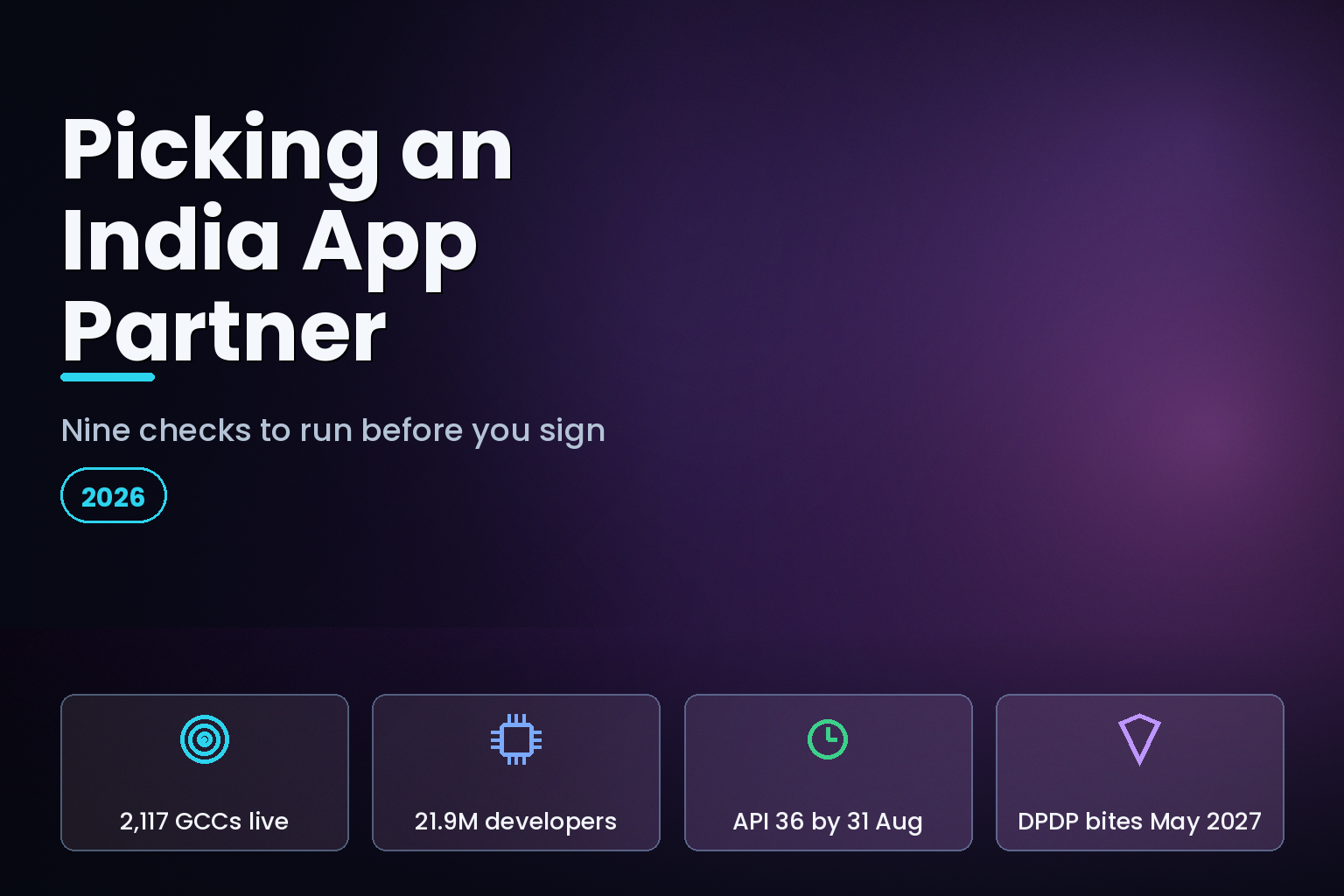
Summary. India ran 2,117 Global Capability Centres across 3,728 units in FY2026, employing 2.36 million people on $98.4 billion of revenue, according to the Nasscom-Zinnov GCC Landscape Report released in July 2026 with data as of March 2026. GitHub counted 21.9 million Indian developers in its Octoverse report of 28 October 2025, second only to the United States, after India added 5.2 million developers in a single year. The wider tech industry booked $282.6 billion in FY2025E on a headcount of 5.8 million, per Nasscom's Strategic Review of 24 February 2025. Those numbers explain why you are shortlisting an Indian partner. They do not tell you which one to pick. This guide covers the nine checks that separate a delivery organisation from a resourcing desk, and two hard 2026 deadlines that will land on your build whichever partner you choose: Google Play's 31 August 2026 cutover to Android 16 (API level 36), and the 14 May 2027 date when the substantive obligations of India's DPDP framework bite.
What the India market actually looks like in 2026
Most vendor pages open with a market-size figure and no source. Here is the sourced version, with the fiscal year each figure belongs to, because mixing FY2025E and FY2026E numbers in one sentence is how buyer guides end up contradicting themselves.
| Metric | Figure | Source and date |
|---|---|---|
| Indian tech industry revenue | $282.6 billion, FY2025E, up 5.1% | Nasscom Strategic Review, 24 Feb 2025 |
| Industry headcount | 5.8 million after 126,000 net adds, FY2025E | Nasscom Strategic Review, 24 Feb 2025 |
| GCCs operating in India | 2,117 across 3,728 units, FY2026E | Nasscom-Zinnov, data as of Mar 2026 |
| GCC revenue and talent | $98.4 billion, 2.36 million people, FY2026E | Nasscom-Zinnov, data as of Mar 2026 |
| Developers on GitHub | 21.9 million, ranked second globally | GitHub Octoverse, 28 Oct 2025 |
| GCC hiring projected for 2026 | 510,452 roles, 64% needing AI or data skills | foundit Insights Tracker via Business Today, 1 Jul 2026 |
Two derived figures are worth carrying into a budget conversation, and both should be labelled as derived rather than quoted as market rates. Nasscom's FY2025E totals imply roughly $48,700 of revenue per employee across the industry. The Nasscom-Zinnov GCC data implies roughly $41,700 per person. Neither is a salary and neither is a rate card. They are the ceiling your money passes through, which is a more honest anchor than any hourly figure you will find on a vendor blog.
Rajesh Nambiar, President of Nasscom, framed the FY2026 outlook this way on 24 February 2025: "India's tech skill intensity will be a critical driver of future growth. While the CEO outlook for FY2026 remains measured yet positive, with increased tech and AI spending, sustaining the growth momentum requires a strategic vision. However, upskilling in niche and core tech areas will continue to remain of paramount importance for the industry."
The nine checks
1. Ask what evidence supports their rate
There is no published, methodology-backed hourly rate card for Indian app development. Every "$18 to $65 an hour" figure in circulation traces back to a company selling app development, and those pages disagree with each other by more than five times for the same job title. The nearest thing to a neutral signal is Clutch's directory pricing data, updated 14 August 2026, which places India-based firms in a sub-$25 per hour band against $25 to $49 for United States firms, and reports an average project cost of $90,780 over an 11-month timeline with a typical band of $10,000 to $49,999. Those are self-reported, bucketed ranges from listed firms, not an audited rate card. Treat a partner who cites a precise ratio with no methodology as a partner who will estimate your build the same way.
2. Check attrition, not headcount
Headcount tells you a firm can staff your project. Attrition tells you whether the same people will finish it. The foundit Insights Tracker, reported on 1 July 2026, put engineering attrition in Tier-1 Indian cities at 18 to 22% against 8 to 12% in Tier-2 cities including Coimbatore, Jaipur, Kochi, Ahmedabad and Indore. On an 11-month project at 20% attrition, roughly one in five of the people who start your build will not be there at handover. Ask for attrition on the specific delivery team, not the company average.
3. Confirm who owns the code and the IP
Ask for the assignment clause before you discuss the commercial terms. Ownership of commissioned software should be assigned to you expressly in the contract rather than inferred from the fact that you paid for it, and the clause should cover the repository, the build configuration and any generated assets. A partner who cannot produce a clean assignment clause on request has not thought about it.
4. Test whether they have read the DPDP timeline
The Digital Personal Data Protection Act was enacted on 11 August 2023 and the DPDP Rules were notified in November 2025 on a staggered, eighteen-month schedule. Consent Manager obligations land on 14 November 2026 and the substantive provisions on 14 May 2027. If your app collects personal data from users in India, those dates are engineering work: consent capture that is specific and itemised, retention and deletion logic, breach detection, and audit logging. A partner who treats DPDP as a privacy policy update has not read it.
5. Ask about the 31 August 2026 Play Store deadline
From 31 August 2026, new Google Play apps and all app updates must target Android 16, API level 36, with extensions available to 1 November 2026 through Play Console. Apps below API 35 stop being discoverable to users on newer Android versions. On the Apple side, since 28 April 2026 every build uploaded to App Store Connect must be compiled with Xcode 26 and the iOS 26 SDK. Both are unbudgeted engineering work for anything already live, and both are the kind of item a resourcing desk discovers in September.
6. Look at the overlap maths, honestly
India runs a single time zone at UTC+05:30 and does not observe daylight saving, so the gap to your office widens by an hour each autumn when your own clocks change. A 09:00 to 18:00 IST day maps to 23:30 to 08:30 US Eastern during EDT, which is effectively no live overlap with a 9-to-5 Eastern day. The same day gives roughly four and a half hours of overlap with a UK working day. Neither is a problem. Both are a staffing decision that has to be made deliberately, through a shifted shift or a genuine follow-the-sun handover, rather than discovered in week three.
7. Separate product mandate from staff augmentation
The Nasscom-Zinnov data found that 96% of GCCs established after FY2021 launched with a product or portfolio mandate from day one. The same distinction applies to vendors. A team that takes a backlog and burns it down is a different purchase from a team that owns outcomes, and the second costs more for a reason. Decide which you are buying before the first call, or you will pay for one and receive the other.
8. Ask to see the release pipeline, not the portfolio
Screenshots prove someone shipped a screen. Ask instead for the CI configuration, the crash-free-sessions figure on a live app, the code review policy, and how long a one-line change takes to reach production. The answers are hard to fake and they describe the thing you are actually buying.
9. Price the platform costs into the budget
The fixed costs are small and knowable to the rupee, which makes them a good test of whether an estimate has been thought through. The Apple Developer Program is $99 per membership year. Google Play registration is a one-time $25. Google Play's service fee in India is 15% on the first $1 million of annual earnings and 30% above it, with a flat 15% on auto-renewing subscriptions, and a 4 percentage point reduction where alternative billing is offered to users in India. Apple's Small Business Program cuts commission to 15% for developers under $1 million in prior-year proceeds. GST on IT services in India is 18%, and export of services is zero-rated with input tax credit retained.
What we build
eCorpIT builds production mobile and web applications for companies that already have a business and need software that carries load. That covers native iOS and Android, cross-platform work in Flutter and React Native, the backend and API layer underneath, and the data and integration work that usually turns out to be the real project. We do the vertical builds most often asked for in this market: ecommerce app development, food delivery and on-demand platforms, and real estate applications. Where the decision is a stack decision rather than a vertical one, the Flutter and React Native pages set out the trade-offs in more detail. For work that is not app-shaped, the custom software development page covers the broader engineering engagements.
How delivery runs
- Discovery and scope. Two to three weeks. We write down what the application must do, what it must integrate with, and what the compliance surface is. The output is a scoped backlog and an architecture note, both of which are yours whether or not you continue.
- Architecture and design. Data model, API contracts, authentication, and the interface. Compliance constraints are designed in here, not retrofitted, because retrofitting consent and retention logic into a shipped schema is the expensive version.
- Build in two-week increments. Working software at the end of each increment, on a real device, in a real environment. Not a status deck.
- Hardening. Performance, security review, accessibility, store-readiness against the current API level and SDK requirements, and load testing against the traffic you actually expect.
- Launch and run. Store submission, monitoring, and an agreed support model. Most builds need a maintenance engagement afterwards, and it is better to price that at the start than to negotiate it during an incident.
The stack
Swift and SwiftUI on iOS, Kotlin and Jetpack Compose on Android, Flutter and React Native where a shared codebase earns its keep. Node.js, Python and .NET on the backend, PostgreSQL and MongoDB for storage, and AWS, Azure or Google Cloud for hosting. We are partners with AWS, Microsoft, Google, Shopify and Kaspersky. The stack choice follows the product, the team you will have after handover, and the integration surface. It is not a house preference.
India-specific considerations
If your users are in India, three things change the build rather than the paperwork. Payments run through UPI and the NPCI rails, which have their own design constraints and their own reconciliation behaviour. Personal data is governed by the DPDP framework on the timeline set out above, and consent has to be captured as a first-class object in the data model rather than a checkbox in the signup form. Device and network conditions vary far more than in a single-market Western build, which makes offline data synchronization and payload size real engineering decisions rather than optimisations. For regulated builds, the constraints are heavier still, and we design applications aligned with the relevant regulatory requirements rather than claiming certification we do not hold.
Why eCorpIT
eCorpIT is eCorp Information Technologies Private Limited, founded in 2021 and headquartered in Gurugram, Haryana. We are assessed at CMMI Level 5, certified to ISO 27001:2022, and MSME registered. Teams are senior-led and multi-disciplinary rather than staffed from a bench, which is the single biggest determinant of whether the attrition figure in check 2 becomes your problem. If you are evaluating partners by location as well as capability, the Gurugram engineering practice page covers the local delivery model, and the software development company in India page covers engagements beyond mobile.
FAQ
How eCorpIT can help
We scope, build and run production mobile and web applications from Gurugram, with senior-led teams and a delivery model designed around the overlap and compliance constraints described above. If you are partway through a vendor evaluation, we are happy to review a scope document or an existing estimate and tell you what it is missing, whether or not you engage us. Tell us what you are building and who it is for at contact us, and we will come back with a scoped view rather than a brochure.
References
- Nasscom-Zinnov India GCC Landscape Report 2026: The GCC Value Orbit — data as of March 2026, released July 2026.
- Nasscom Strategic Review press release — FY2025E figures and the Rajesh Nambiar quote, 24 February 2025.
- GitHub Octoverse 2025: a new developer joins GitHub every second — 28 October 2025.
- Clutch mobile application developers pricing data — updated 14 August 2026.
- Target API level requirements for Google Play apps — 31 August 2026 deadline for API level 36.
- DPDP Act and DPDP Rules 2025 notification and phased compliance period — 17 November 2025.
Last updated: 15 August 2026.