On this page · 11 sections
- What a grocery delivery app actually has to solve
- How big the market actually is, and why the published numbers disagree
- What we build
- Routing: what it costs, and what the free tiers hide
- India-specific considerations
- The unit economics you are actually building for
- How we run the build
- Why eCorpIT
- FAQ
- How eCorpIT can help
- References
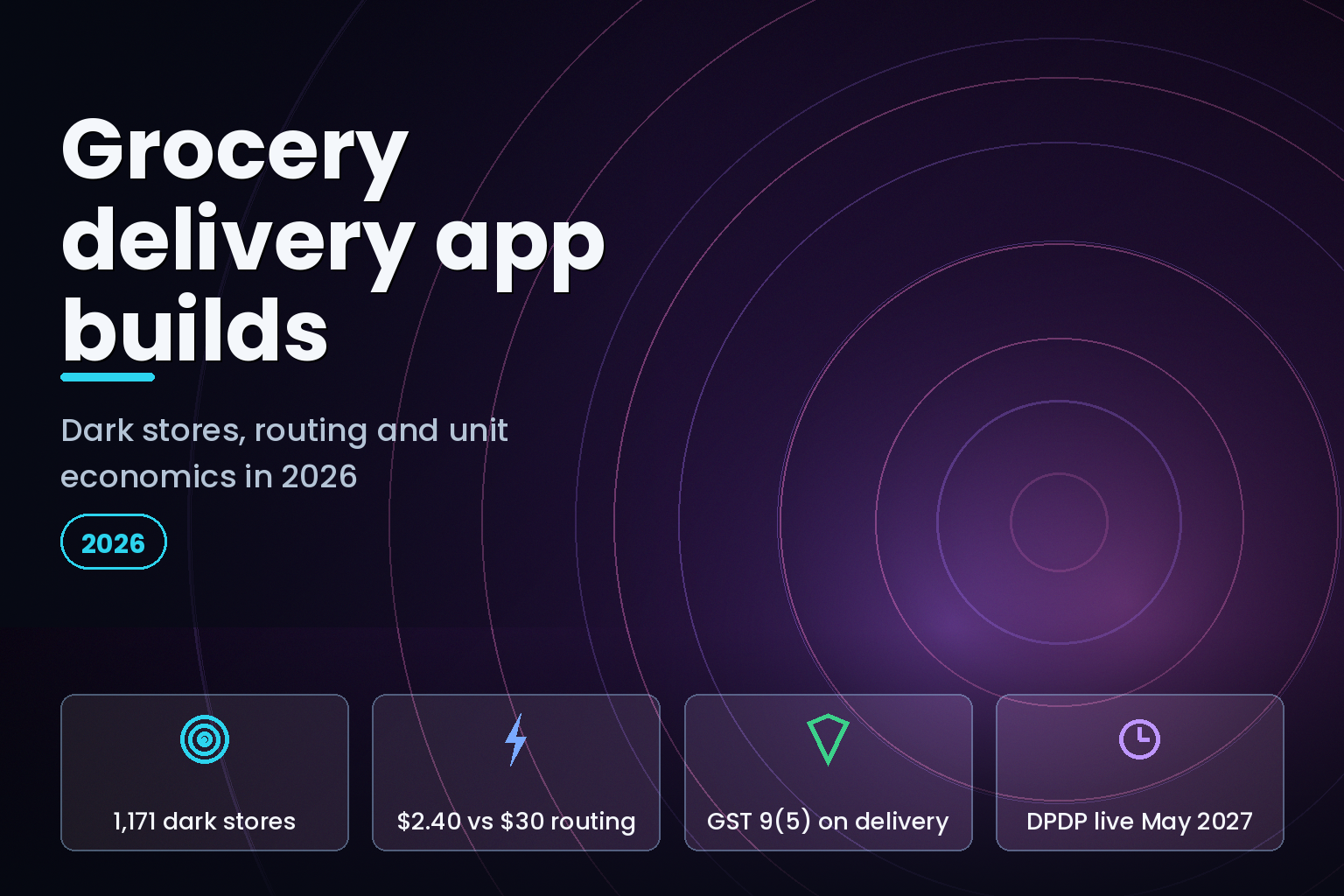
Summary. Swiggy Instamart closed the quarter ended 30 June 2026 with 1,171 dark stores across 131 cities, 4.92 million sq ft of active store area and 1,089 orders per store per day, on gross order value of ₹7,907 crore, up 39.8% year on year (Swiggy Q1 FY2027 shareholders' letter). Blinkit ended March 2026 with 2,243 stores and 17 million sq ft of warehousing and dark store space (Eternal Q4 FY26 shareholders' letter). Those two numbers set the engineering problem: a grocery delivery app is an inventory and routing system with a storefront attached, and the storefront is the cheap part. This page covers what we build, how the routing maths prices out on Google Maps Platform and Mapbox, the FSSAI, GST and DPDP obligations that land on the platform rather than the seller, and how eCorpIT runs the engagement.
What a grocery delivery app actually has to solve
The consumer app is a solved problem. Catalogue, cart, checkout, order tracking: a competent team ships that in a quarter. The parts that decide whether the business works sit behind it.
Store-level inventory truth. Blinkit's own disclosure shows why per-store catalogue logic is not optional. Albinder Singh Dhindsa, Chief Executive Officer of Eternal Limited, told the Q4 FY26 results that "In Delhi NCR, we now offer close to 80k SKUs, versus about 50k+ in the next seven cities and 20k beyond the top eight." A single national catalogue served to every pin code produces a cart full of items the nearest store does not stock. Availability has to be computed per store, per slot, against live stock.
Serviceability before search. Coverage is uneven by design. The same letter reports that the top eight cities are "approaching coverage maturity, with 80-90% of pin codes already serviceable", while beyond the top eight "average pin code coverage is lower than 30%". The app has to resolve a customer location to a serving store before it renders a single product tile, and fail gracefully when there is none.
Shelf space as a hard constraint. Akshant Goyal, Chief Financial Officer of Eternal Limited, put the architectural difference plainly on the Q1 FY27 earnings call: "In quick commerce, you're working off smaller store sizes, so you have limited shelf space... In e-commerce, you have large warehouses... Here, the constraint is the store size and that's why it's different in the case of quick commerce." Assortment ranking, substitution logic and replenishment triggers all inherit that constraint.
Rider assignment under load. Rahul Bothra, Group Chief Financial Officer of Swiggy Limited, described the ceiling on the Q1 FY27 earnings call: "some of these stores start hitting 2,500 to 3,000 orders per day, which necessarily means that we have to open more stores. Though as an overall network level, we are obviously 40% utilized." Batching and dispatch have to hold up at peak on a store that is running at four times the network average.
How big the market actually is, and why the published numbers disagree
Sizing figures for Indian quick commerce differ by multiples because they count different things. Putting them in one column is how a business plan ends up wrong by a factor of three.
| Figure | What it counts | Period | Source |
|---|---|---|---|
| $10-11 billion | Quick commerce gross merchandise value, all retail categories, at ₹87/USD | CY2025 | Bain and Flipkart, How India Shops Online 2026 |
| $13-14 billion, about 17% of online retail GMV | Gross merchandise value at ₹85/USD, up roughly 120% year on year | FY26 | Redseer, 6 May 2026 |
| ₹11,000 crore in January 2026 alone | Monthly GMV, on 7.8 million orders per day at ₹460 average order value | Jan 2026 | Redseer, 12 Feb 2026 |
| $3.65 billion in 2026, to $6.64 billion in 2031 | Platform-side market revenue, not basket value | CY2026 | Mordor Intelligence |
| $12.16 billion in 2025, to $77.72 billion in 2030 | Online grocery gross sales, 2024 base year | 2024 base | Grand View Research |
Mordor's own report page concedes that rival estimates use gross order value "because it includes the full basket value and not just platform-side economics". Bain's calendar-2025 number and Redseer's FY26 number reconcile once you adjust for the three-month shift and the exchange rate. The three compound growth rates in circulation span 12.74% to 44.9%, a 3.6x range for a nominally similar market. Treat aggregator forecasts as evidence that the category is hard to measure, not as a forecast.
One number worth avoiding: the widely-cited "4,081 dark stores as of March 2026" is a three-platform subtotal from a scraped tracker, not a national total, and the same page now reports a different figure for a later month. Use dated company disclosures instead.
What we build
We build the full stack for a grocery or quick commerce platform, or the parts of it you are missing.
Customer app, native or cross-platform, with store-scoped catalogue, serviceability resolution at app open, slot selection, substitution handling, and live order tracking. We ship on Flutter or React Native where a shared codebase makes sense, and native Swift or Kotlin where the location and background-tracking behaviour justifies it. The trade-offs are covered on our React Native app development company and Flutter app development company pages.
Store and picker app, which is where most grocery builds are underspecified. Pick lists ordered by physical aisle sequence, barcode or QR scanning, weight capture for loose items, short-pick and substitution flows, and batch handover to the rider. The store app determines pick time, and pick time determines delivery time far more than routing does.
Rider app with offline data synchronization, background location, batched multi-drop sequencing, proof of delivery, and cash-on-delivery reconciliation.
Merchant and operations console for inventory, pricing, promotions, store hours, serviceability polygons, and the exception queue.
Backend services: catalogue, inventory ledger, order orchestration, dispatch, pricing and promotions, payments, notifications, and reporting. Inventory is the service that decides everything else, and it is the one to get right first.
Routing: what it costs, and what the free tiers hide
Multi-drop sequencing is the line item founders underestimate. Prices below are list prices from the vendors' own pages, retrieved 16 August 2026.
| Capability | Google, global list | Google, India list | Mapbox | Open source |
|---|---|---|---|---|
| Route computation, per 1,000 | $5.00 first paid tier, 10,000 free | $1.50, 70,000 free | $2.00, 100,000 free | OSRM, free |
| Multi-vehicle optimisation, per 1,000 | $30.00 FleetRouting, 1,000 free | $2.40, 7,000 free | $2.00 Optimization API, 100,000 free | VROOM, free |
| Single-vehicle sequencing, per 1,000 | $10.00, 5,000 free | $0.80, 35,000 free | $2.00, 100,000 free | Valhalla, free |
| Billable unit | Per shipment | Per shipment | Per request | Self-hosted compute |
| Distance matrix | $5.00 per 1,000 | $1.50 per 1,000 | Per element | OSRM Table service |
Two things in that table change a cost model materially.
The first is that Google Maps Platform's India price list (last updated 11 August 2026) is not a small discount on the global list (last updated 7 August 2026). Fleet Routing is $2.40 per 1,000 in India against $30.00 globally at the first paid tier, and the free allowance is seven times larger. A platform serving Indian addresses that models its costs off the global page will overstate routing spend by an order of magnitude.
The second is the billable unit. Google bills Route Optimization per shipment, not per request: "The per-request charge is based on the number of shipments in the optimization request, times the shipment unit price per SKU." Mapbox bills its Optimization API per request, with the first 100,000 requests each month free. Batch fifty drops into one call and the two vendors bill you very differently for identical work.
HERE deserves a specific warning. Its self-serve tiers contractually exclude the use case: the base plan restrictions page lists "Optimization", defined as "utilizing software or application(s) to calculate the order of destinations and or routes", as an excluded use case, with a carve-out only for HERE Tour Planning. Mappls publishes no price for its routing or optimisation APIs at all, though its documentation states routing supports up to 98 stop points and waypoint optimisation up to 200 stops.
On the open-source side, be precise about what each project does. OSRM v26.5.0 and Valhalla 3.7.0 solve the travelling salesman problem with a heuristic and give you a distance matrix. Neither handles vehicle capacity, time windows or multiple vehicles. VROOM v1.15.0 is the solver that does: capacitated routing, time windows, multi-depot heterogeneous fleets, pickup and delivery, driver breaks and skills matching, running on top of OSRM or Valhalla for the matrix. Google OR-Tools covers the same problem classes and states its own limitation directly: "Vehicle routing problems are inherently intractable... As a result, OR-Tools sometimes returns solutions that are good, but not optimal." Self-hosting removes the per-shipment bill and replaces it with compute and an on-call rotation. That is a reasonable trade above a few hundred thousand drops a month and a bad one below it.
India-specific considerations
Four rules land on the platform, not on the seller, and each of them changes the data model.
FSSAI licensing. E-commerce food business operators need a central licence, not a state one. The FSSAI direction operationalising the 2021 licensing amendment states that "E-commerce FBOs shall obtain central license from the concerned central licensing authority" and that entities facilitating orders on their website "shall require FSSAI licenses" (FSSAI direction). Two clauses in the same document are product requirements, not paperwork: any food article delivered to a consumer must have "shelf life of 30 percent or 45 days before expiry at the time of delivery", and last mile delivery must be undertaken by trained delivery personnel. The first one means expiry dates have to be tracked per batch at store level and enforced at pick time, which is a schema decision made on day one or paid for later.
GST section 9(5) on local delivery. Since 22 September 2025, where a delivery partner is not liable to register under section 22(1), the e-commerce operator carries the GST liability on the local delivery service at 18%, per the Ministry of Finance clarification (PIB, 16 September 2025). The nuance most write-ups miss is that liability shifts only where the delivery partner is unregistered; if the partner is registered, it stays with the supplier. Your billing system has to know each delivery partner's registration status and apply the right treatment per order. For restaurant service supplied through an operator, CBIC Circular 167/23/2021-GST is explicit that the operator "shall pay the entire GST liability in cash", with no input tax credit available (CBIC circular). Grocery goods themselves were never brought under section 9(5); only the delivery service was.
DPDP Act 2023. A grocery delivery app collects precise location continuously, which is the highest-sensitivity data most consumer apps touch. Sections 3 to 17, covering notice, consent and data fiduciary obligations, come into force on 13 May 2027, eighteen months after the commencement notification of 13 November 2025 (MeitY notification). Verifiable children's consent under section 6(9) starts earlier, on 13 November 2026. Section 6(1) requires consent to be "limited to such personal data as is necessary for such specified purpose", which is the clause that makes always-on location collection hard to defend when the order is complete. The penalty ceiling for a security-safeguards breach is ₹250 crore. We design applications aligned with DPDP Act requirements, including purpose-scoped location retention and consent withdrawal that actually deletes.
Recurring billing for memberships. Most grocery platforms sell a membership tier. The RBI rewrote the rules on 21 April 2026: the Digital Payments E-mandate Framework, 2026 repeals eight prior circulars and sets the additional-factor-free ceiling at ₹15,000 per transaction across cards, prepaid instruments and UPI. It also requires a pre-debit notification at least 24 hours before the charge, carrying merchant, amount, date, mandate reference and reason. Membership pricing sits far below the ceiling, but the 24-hour notification is a scheduled job you have to build, and the framework makes the acquirer responsible for merchant compliance. Our RBI e-mandate engineering checklist goes through the clauses.
On payment rails generally, UPI carried 2,271.61 crore transactions worth ₹28,92,139 crore in June 2026 alone, per the RBI payment system indicators. For an Indian grocery app, UPI is the primary rail and card acceptance is the fallback.
If you plan to sell through the ONDC network as well as your own app, the retail specifications are published as versioned schemas on the ONDC retail specifications repository, built on the Beckn protocol. We have covered the channel trade-off in ONDC versus quick commerce for D2C brands.
The unit economics you are actually building for
Two disclosed figures are worth designing against.
Blinkit's Q1 FY26 letter put store capex in context: "a store generates ~INR 26 crore of NOV annually. This implies a cumulative capex requirement of ~4% of NOV... (INR 1 crore of capex divided by INR 26 crore of annual NOV)" (Eternal Q1 FY26 letter). On the Q1 FY27 call, management addressed a higher figure of roughly ₹2.5 crore per store, with Akshant Goyal noting that "a large part of the capex is in warehousing" and that measured over six to nine months the per-store number is lower.
Swiggy reported adjusted revenue per order of ₹108 in Q1 FY2027, up from ₹83 in Q4 FY25, with Instamart contribution margin at -0.2% of GOV and 45% of the store network contribution-positive. The company's stated path to break-even is "5-6% Contribution margin equating to INR ~30 per order" at roughly ₹60,000 crore of annualised net order value.
The engineering read on those numbers is blunt. At ₹30 per order of target contribution, a routing decision that adds one extra kilometre per drop, or a picking flow that adds ninety seconds, is not a minor inefficiency. It is the margin. That is why we push clients to instrument pick time and drop density from launch rather than after the first funding round.
How we run the build
1. Discovery and constraint mapping, two to three weeks. Serviceability model, catalogue depth per store format, delivery promise, payment rails, and which of the FSSAI, GST and DPDP obligations apply on day one. Output is a written architecture decision record and a build plan, not a slide deck.
2. Inventory and order core, six to eight weeks. The store-scoped inventory ledger, order orchestration and dispatch skeleton, built and load-tested before any UI polish. Getting this wrong is the only failure that cannot be patched later.
3. Apps in parallel, eight to twelve weeks. Customer, picker and rider apps built against the same core, with the picker app treated as a first-class product rather than an internal tool.
4. Routing, pricing and integrations, four to six weeks. Route optimisation with a documented cost model, payment gateway with e-mandate support if memberships are in scope, and ONDC adapters where relevant.
5. Pilot, instrument, iterate. Launch on a single store or cluster, instrument pick time, drop density, substitution rate and cancellation reasons, and tune before adding stores. Store two should be cheaper than store one, or the model is not ready to scale.
Why eCorpIT
eCorp Information Technologies Private Limited has built software from Gurugram since 2021. We hold CMMI Level 5, ISO 27001:2022 and MSME certification, and we are partners of AWS, Microsoft, Google and Shopify. Teams are senior-led and multi-disciplinary, which for a grocery build means the engineer designing the inventory ledger is in the same room as the one designing the picker flow.
We are direct about what we do not claim. We do not publish a rate card, because a grocery platform's cost turns almost entirely on catalogue depth, store count and whether you are running your own fleet or a third-party one. Engagements typically run as a fixed-scope discovery followed by a dedicated squad on a monthly retainer, sized to the delivery plan agreed in step one. Ask us for a band against your specific scope and we will give you one in writing.
Related build pages: food delivery app development company, on demand app development company, ecommerce app development company, and the cluster hub at mobile app development company in India.
FAQ
How eCorpIT can help
We build grocery and quick commerce platforms end to end, from the store-scoped inventory ledger through the picker and rider apps to routing, payments and ONDC integration. We start with a paid discovery that produces an architecture decision record, a compliance map covering FSSAI, GST section 9(5) and DPDP obligations, and a costed routing model against your expected drop volume rather than a vendor's headline price. Teams are senior-led and work from Gurugram, with delivery run to CMMI Level 5 process. Tell us your store count, catalogue depth and delivery promise at /contact-us/ and we will come back with a scoped plan and a price band.
References
- Swiggy Limited, Q1 FY2027 shareholders' letter, July 2026.
- Swiggy Limited, Q1 FY2027 earnings call transcript, 30 July 2026.
- Eternal Limited, Q4 FY26 shareholders' letter, 28 April 2026.
- Eternal Limited, Q1 FY27 earnings call transcript, 22 July 2026.
- Redseer, Speed in metro, scale in Bharat, 6 May 2026.
- Redseer, Quick commerce finds its new normal, 12 February 2026.
- Mordor Intelligence, quick commerce industry in India, updated 11 August 2026.
- Google Maps Platform pricing, India, last updated 11 August 2026.
- Google Maps Platform pricing, global, last updated 7 August 2026.
- Google Route Optimization usage and billing, last updated 7 August 2026.
- Project OSRM, osrm-backend, v26.5.0, 5 May 2026.
- Valhalla routing engine, 3.7.0, 29 April 2026.
- VROOM vehicle routing open-source optimization machine, v1.15.0, 12 March 2026.
- Ministry of Finance, GST on local delivery through e-commerce operators, 16 September 2025.
- CBIC Circular No. 167/23/2021-GST, 17 December 2021.
- MeitY, DPDP Act commencement notification G.S.R. 843(E), 13 November 2025.
Last updated: 16 August 2026.