On this page · 10 sections
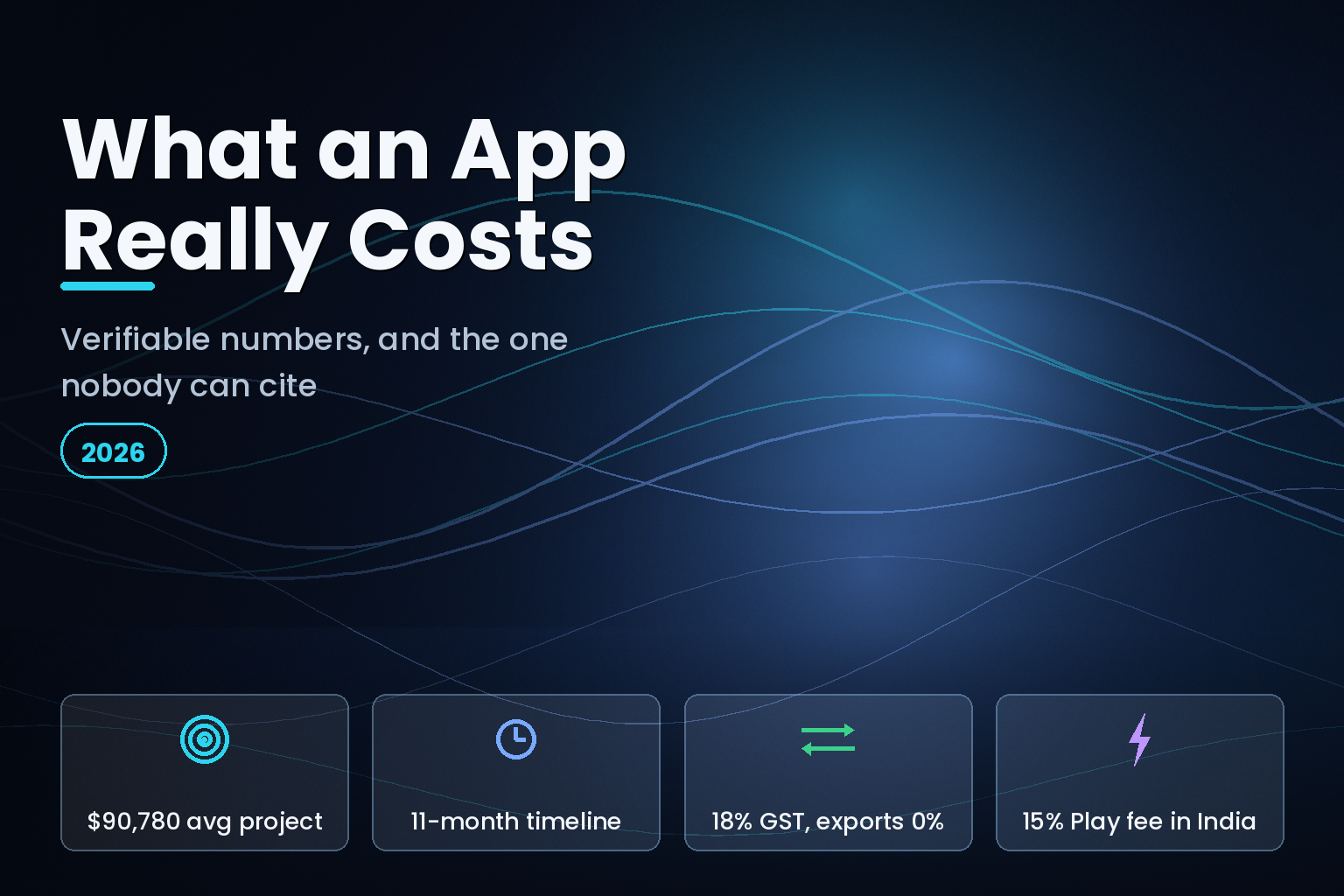
Summary. There is no methodology-backed hourly rate card for Indian app development, and the figures that dominate search results are published by companies selling app development. Those pages disagree with each other by more than five times for the same job title. What is verifiable: Clutch's directory data, updated 14 August 2026, places India-based firms in a sub-$25 per hour band against $25 to $49 for United States firms, with an average project cost of $90,780 across an 11-month timeline and a typical band of $10,000 to $49,999. Stack Overflow's 2025 Developer Survey puts the median total annual compensation of a mobile developer in India at $10,462, from 1,093 India respondents. Nasscom's FY2025E totals of $282.6 billion across 5.8 million people imply roughly $48,700 of revenue per employee. The Apple Developer Program costs $99 a year, Google Play registration is a one-time $25, GST on IT services is 18% with exports zero-rated, and Google Play takes 15% on the first $1 million of annual earnings in India. This page separates the costs you can check from the ones you cannot.
The honest structure of an app budget
An app development quote has four components. Three of them are knowable to the rupee. The fourth is the one every published cost guide pretends to know and does not.
| Component | How knowable | 2026 anchor |
|---|---|---|
| Platform and store fees | Exactly, published by the vendor | $99/year Apple, $25 one-time Google Play |
| Rate of take on revenue | Exactly, published by the vendor | 15% on first $1M in India, 30% above |
| Tax treatment | Exactly, published by government | 18% GST, exports zero-rated with input tax credit |
| Deadline-driven engineering | Exactly, published as a dated requirement | Target API 36 by 31 August 2026 |
| Labour | Only as a range with a stated sample | $10,462 median mobile developer comp, n=1,093 |
| Cloud running costs | Closely, from published list prices | $40/month for a worked multi-tier example |
The differentiator of an honest estimate is that it names its own weakest number. Labour is that number. Everything else on this page can be checked against a vendor or government page in under a minute.
What the verifiable cost anchors actually say
Platform fees
Apple charges $99 per membership year for the Apple Developer Program, priced in local currency at enrolment, with fee waivers available to nonprofits, accredited educational institutions and government entities. Google Play charges a one-time US$25 developer registration fee, payable by credit or debit card, with prepaid cards refused. These are the entire fixed platform cost of shipping to both stores. Any estimate that cannot state them has not been built from the bottom up.
The rate of take, which is larger than the build cost over time
In India and all markets outside the EEA, UK and US, Google Play's service fee is 15% on the first $1 million of annual earnings and 30% above that, with a flat 15% on auto-renewing subscriptions regardless of revenue. Where a developer offers an alternative billing system to users in India, the applicable service fee is reduced by 4 percentage points, so an India developer on the 15% tier pays 11%. Apple's App Store Small Business Program cuts commission to 15% for developers with $1 million or less in proceeds in the prior calendar year, with new developers qualifying automatically.
One change worth watching even though it does not apply to India yet: from 30 June 2026 Google Play is restructuring fees for EEA, UK and US transactions, splitting rates by whether the user's install is new or existing. Auto-renewing subscriptions move to 10% plus a 5% billing fee, and other transactions to 20% plus 5% for new installs or 25% plus 5% for existing ones. If your revenue is Western and your build is Indian, that restructure changes your unit economics more than any development rate does.
Tax
GST on IT services in India is 18%, per the GST Council's sectoral FAQ for IT and ITeS. Export of software services is zero-rated with full input tax credit retained, subject to five conditions covering supplier location, recipient location, place of supply, payment in convertible foreign exchange, and the parties not being establishments of a distinct person. The 56th GST Council meeting on 3 September 2025 collapsed the four-slab structure into a two-rate structure with a standard rate of 18% and a merit rate of 5%, effective 22 September 2025, so 18% remains the applicable standard rate for software services.
Deadline-driven engineering, which is the cost people forget
From 31 August 2026, new Google Play apps and all app updates must target Android 16, API level 36, with extensions available to 1 November 2026 through Play Console. Apps targeting below API 35 stop being discoverable to users on newer Android versions. Since 28 April 2026, every build uploaded to App Store Connect must be compiled with Xcode 26 and the iOS 26 SDK. Apple's updated age rating system took effect on 31 January 2026, and apps that did not answer the new questions faced interruption when submitting updates. None of this is discretionary, none of it adds a feature, and all of it consumes engineering time that a first-year budget rarely contains.
Cloud running costs
AWS Lightsail publishes flat list prices that anchor a small backend, on a page last updated 7 August 2026: a $5 per month Linux instance, a $15 per month standard managed database or $30 with high availability, an $18 per month load balancer, a $2.50 per month CDN distribution covering 50 GB, and $1 per month object storage. AWS's own worked example of a multi-tier application, combining a Nano container service, a load balancer and a 1 GB managed database, totals $40 per month. Two India-specific details matter: the Asia Pacific (Mumbai) bundles include half the data transfer allowance of other regions, and Mumbai object-storage transfer overage runs $0.1093 per GB against $0.09 in us-east-1.
Labour: the number nobody can cite cleanly
Stack Overflow's 2025 Developer Survey is the only compensation source in this space that publishes its methodology and its sample size. For India it reports median total annual compensation of $10,462 for a mobile developer, $13,949 for a full-stack developer, $22,086 for a back-end developer, $46,496 for a software or solutions architect and $52,308 for an engineering manager. The India compensation question drew 1,093 respondents, 2.2% of the survey. It is self-selected and self-reported, and the mobile developer figure is among the lowest bands in the India list, so it should be read as one signal rather than a market rate. The 2026 survey opened on 23 June 2026 and has not published results, which makes the 2025 edition the most recent released data.
Two industry totals bound the range from above. Nasscom's Strategic Review of 24 February 2025 puts FY2025E revenue at $282.6 billion across 5.8 million employees, implying about $48,700 of revenue per employee. The Nasscom-Zinnov GCC Landscape Report, with data as of March 2026, puts 2,117 GCCs at $98.4 billion revenue across 2.36 million people, implying about $41,700 per person. Both are derived figures, and both measure billing output rather than cost. They are the ceiling your money passes through, not a salary.
That is the entire honest evidence base. Anyone quoting you a precise blended hourly rate for Indian app development is quoting a number with no published source behind it.
What each band actually buys
The bands below are Clutch's own project-cost buckets from directory data updated 14 August 2026, with what that budget realistically covers given the platform and deadline costs above. They are ranges reported by listed firms, not an audited price list.
| Budget band | What it realistically buys | What it will not cover |
|---|---|---|
| Under $10,000 | A single-platform prototype or a thin wrapper over an existing backend, one designer-developer pair, no meaningful QA | Two platforms, custom backend, compliance work, or post-launch support |
| $10,000 to $49,999 | Clutch's typical band. One platform done properly, or two through a shared codebase, a simple backend, basic analytics and store launch | Complex integrations, regulated onboarding, or sustained iteration after launch |
| $50,000 to $99,999 | Two platforms, a real backend, third-party integrations, QA as a discipline rather than a phase, and a first year of maintenance priced in | Bespoke infrastructure, high-compliance verticals, or heavy offline data synchronization |
| $90,780 average, 11 months | Clutch's reported average project and timeline across its directory | — |
| $100,000 and above | Regulated builds, payment or lending flows, multi-role products, and the compliance engineering that comes with them | — |
The single most useful reframing: Clutch's own numbers put India one pricing band below the United States, not four to eight times below. If a quote implies an eight-times saving, the saving is coming from somewhere other than geography, and it is usually seniority or QA.
India-specific considerations
If your users are in India, three cost drivers are structural rather than negotiable. Personal data falls under the DPDP framework, whose Rules were notified in November 2025 with an eighteen-month phased compliance period placing substantive obligations in May 2027, and consent capture, retention and deletion are engineering line items. Payments run on UPI and the NPCI rails, which carry their own integration and reconciliation work. Device and network variance is far wider than in a single-market Western build, which makes offline data synchronization and payload size real engineering decisions. For a fuller treatment of the regulated case, the fintech build requirements page covers the RBI constraints, and the India versus US cost comparison goes deeper on the geography question.
How we estimate
- Scope before price. We write down what the application must do, what it integrates with, and what its compliance surface is. An estimate produced before this exists is a guess with a decimal point.
- Separate the knowable from the estimated. Platform fees, tax, cloud list prices and deadline-driven work go in as fixed lines. Labour goes in as a range with the assumptions stated.
- Price the first year, not the build. Maintenance, store requirement changes like the API 36 cutover, and the run cost of the backend belong in the number you approve.
- Name the risks with cost attached. Integrations you do not control and regulatory dates are where estimates move, so they are called out separately rather than buried in a contingency percentage.
- Re-estimate at the end of discovery, against the scoped backlog rather than the original brief.
If you are choosing between partners rather than pricing a scope, the India buyer guide covers the checks worth running first, and the Flutter and React Native pages cover where a shared codebase changes the cost shape.
Why eCorpIT
eCorpIT is eCorp Information Technologies Private Limited, founded in 2021 and based in Gurugram, Haryana. We are assessed at CMMI Level 5, certified to ISO 27001:2022, and MSME registered, and we are partners with AWS, Microsoft, Google, Shopify and Kaspersky. We quote against a scoped backlog with the assumptions written down, which is slower to produce than a rate multiplied by a guess and considerably harder to argue with later.
FAQ
How eCorpIT can help
We scope and price app builds from Gurugram with the fixed costs itemised and the labour assumptions written down, so you can see which parts of the number are checkable and which are judgement. If you have an estimate from someone else, we will review it and tell you what it has left out, most often the first-year run cost and the store deadline work. Send us the scope at contact us.
References
- Clutch mobile application developers pricing data — updated 14 August 2026.
- Stack Overflow 2025 Developer Survey, work and compensation section — India median compensation by role, n=1,093.
- Target API level requirements for Google Play apps — API level 36 from 31 August 2026.
- AWS Lightsail pricing — page updated 7 August 2026.
- Nasscom Strategic Review press release — FY2025E figures, 24 February 2025.
- Nasscom-Zinnov India GCC Landscape Report 2026 — data as of March 2026.
- DPDP Rules 2025 notification and phased compliance period — 17 November 2025.
Last updated: 15 August 2026.