On this page · 11 sections
- What "CUDA lock-in" actually means
- The application layer is already portable
- Where CUDA still holds you
- The four escape routes
- The honest state of ROCm-CUDA parity
- Should you move off CUDA? a decision framework
- How to run a CUDA-to-ROCm migration
- India-specific considerations
- FAQ
- How eCorpIT can help
- References
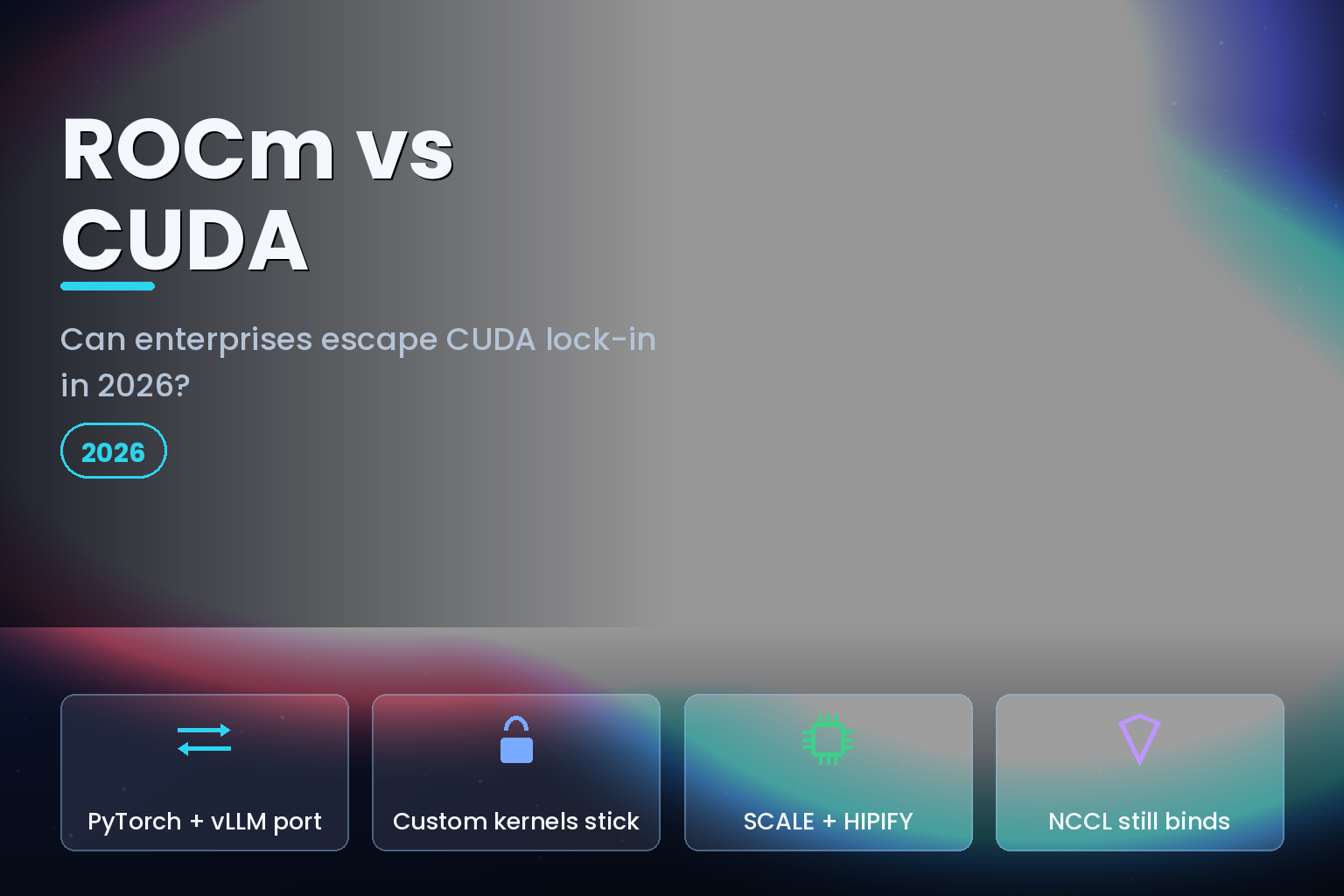
Summary. CUDA has been NVIDIA's real moat for 18 years, and 2026 is the first year that moat has visible cracks. AMD's ROCm 7, released in September 2025, brought day-zero PyTorch and vLLM support, and AMD extended it at Advancing AI 2026 with an AI-assisted tool called ROCm.ai. Independent options widened too: Spectral Compute's SCALE compiles unmodified CUDA to run on AMD GPUs and claims roughly 6x the performance of AMD's own HIPIFY conversion path. The honest answer for a CTO is layered. Standard inference and training on PyTorch, vLLM or SGLang with no custom kernels is portable to AMD now. Custom CUDA kernels, TensorRT-LLM, FlashAttention 3 and NCCL-based distributed training are not. AMD is chasing a market it values near $2 trillion by 2030, and Anthropic has committed up to 2 gigawatts of AMD Instinct MI455X capacity, so the pressure to make ROCm work is real. This guide separates the layer that is already free from the layers that still lock you in.
Vendor lock-in is not a yes-or-no property of your stack. It is a property of specific dependencies, and most teams have never audited which ones actually bind them. Below is the senior-engineer breakdown: what CUDA lock-in means at each layer, what genuinely ports to AMD in 2026, what does not, and how to decide whether moving is worth the engineering bill.
What "CUDA lock-in" actually means
CUDA is not one thing. It is a compiler (nvcc), a runtime, a set of math libraries (cuBLAS, cuDNN), a communications library (NCCL), and a decade of tuned kernels and tooling that assume NVIDIA hardware. You are not locked into "CUDA" in the abstract; you are locked into whichever of those layers your code touches. That distinction decides how hard leaving will be.
Split your stack into three layers and the picture gets clear. The application layer is your model code, usually PyTorch plus a serving engine. The kernel layer is any custom GPU code or performance library you depend on. The networking layer is how GPUs talk to each other during distributed training. Each layer has a different lock-in strength in 2026.
| Lock-in layer | What binds you to CUDA | Portability to AMD in 2026 | Escape route |
|---|---|---|---|
| Application (PyTorch, vLLM, SGLang) | Framework defaults built on CUDA | High: ROCm 7 has day-zero support | Reinstall on ROCm build |
| Custom kernels | Hand-written CUDA, cuBLAS, cuDNN | Medium: needs porting or a shim | HIPIFY or SCALE |
| Specialized libraries | TensorRT-LLM, FlashAttention 3 | Low: no ROCm equivalent yet | Stay on CUDA or rewrite |
| Distributed training | NCCL collective communications | Low: RCCL exists but mixed clusters bind | RCCL, single-vendor cluster |
| Tooling and profilers | Nsight, CUDA-only debuggers | Medium: ROCm tools maturing | ROCm profiler, rocgdb |
The application layer is already portable
For most companies, the workload that matters is inference, and inference is the layer that has already moved. AMD's ROCm 7 shipped in September 2025 with native support for the MI350 and MI325X, low-precision FP4 and FP8 formats, and day-zero integration for PyTorch and vLLM. AMD confirmed at Advancing AI 2026 that PyTorch, Hugging Face, vLLM and SGLang all run on the new MI455X, and OpenAI is optimizing GPT-class workloads on AMD hardware using its Triton framework through ROCm.
The practical test is blunt: if your serving stack is PyTorch plus vLLM or SGLang and you wrote no custom CUDA, moving to AMD is closer to a reinstall than a rewrite. You change the base image to a ROCm build, validate numerics, and benchmark. Triton matters here because it sits inside PyTorch 2.x and generates GPU code without your team writing CUDA, so a lot of portability arrived without anyone asking for it. This is the layer AMD has spent its credibility on, and for standard transformer inference it largely holds.
Dr. Lisa Su, AMD's chair and CEO, put the strategy plainly at the launch: "AMD is partnering across the ecosystem to deliver leadership compute and open platforms that give customers the performance, flexibility and choice to scale AI from the data center to the edge." Open platforms are the pitch, and for PyTorch inference the pitch is now mostly true.
Where CUDA still holds you
The lock-in that survives sits below the framework. Three dependencies keep enterprises on NVIDIA in 2026, and it is worth naming them precisely because they are the ones that break a migration plan.
Custom kernels come first. If your team hand-wrote CUDA for a hot path, or you depend on tuned libraries like cuBLAS and cuDNN, that code does not run on AMD without conversion. AMD's HIPIFY tool automatically converts almost all CUDA runtime code to HIP, and most device code keeps the same function signatures, but AMD's own documentation admits that small differences "often require manual intervention." A large custom kernel base is weeks of engineering, not an afternoon.
Specialized inference libraries come second, and they are the hard stop. TensorRT-LLM and FlashAttention 3 have no drop-in ROCm equivalent, so a stack tuned around them stays on CUDA. Distributed training is third. NCCL, NVIDIA's collective communications library, is the default fabric for multi-GPU training. AMD ships RCCL as its answer, but the moment you run a mixed-vendor cluster, the networking layer pulls you back toward NVIDIA. The ecosystem moat is not the compiler; it is the accumulated tuning, the profilers, and the fact that every tutorial assumes CUDA.
The four escape routes
There are now four credible ways off CUDA, and they suit different teams. Picking the right one is the actual decision, more than picking the GPU.
| Route | How it works | Best for | Trade-off |
|---|---|---|---|
| ROCm native | Reinstall PyTorch/vLLM on a ROCm build | No-custom-kernel inference and training | Limited to supported frameworks |
| HIPIFY | Convert CUDA source to HIP C++ | Teams with modest custom CUDA | Manual fixes on edge cases |
| SCALE (Spectral Compute) | Compile unmodified CUDA for AMD GPUs | Large CUDA bases you cannot rewrite | Third-party toolchain, newer |
| Triton / PyTorch 2.x | Write portable kernels from the start | Greenfield projects | Not every kernel expresses in Triton |
SCALE is the most interesting new entrant. Built over seven years by the UK firm Spectral Compute, SCALE is a clean-room CUDA implementation that acts as a drop-in replacement for nvcc and a runtime that impersonates the NVIDIA CUDA Toolkit, so existing CUDA compiles for AMD without code changes. Spectral Compute's own benchmarks, reported by Tom's Hardware, claim close to 6x the performance of HIPIFY-converted code, though that is a vendor figure you should test on your own kernels. HPCwire covered the wider push in July 2026. AMD's own ROCm.ai adds a fifth wrinkle: it lets coding agents such as Claude, Codex and Cursor understand ROCm natively, which lowers the human cost of a port.
The honest state of ROCm-CUDA parity
Marketing says parity; the engineering record says "close, on specific workloads, and not yet proven end to end." Both are true, and a buyer needs the second version. SemiAnalysis reported that AMD was pushing toward at least 90% parity with CUDA on vLLM merge-gating tests ahead of Advancing AI 2026, then saw that effort disrupted when internal development clusters were reassigned and hit stability problems. Its read is measured: this does not mean ROCm has caught CUDA, but it shows AMD's software iteration rate can accelerate sharply when hardware, software teams and optimization cycles line up.
The gaps that remain are specific. Public regression dashboards, accuracy gates, end-to-end disaggregation continuous integration, and automatic performance gating are still roadmap items rather than shipped guarantees. AMD only stood up a dedicated developer-relations function in January 2025, an admission that developers, not benchmarks, are what made CUDA win. SiliconANGLE framed the 2026 contest as engineering velocity, not a spec sheet, and that is the right frame. The MI455X hardware is competitive; whether ROCm closes the last 10% of software parity is the open question, and it is a question about execution speed.
Should you move off CUDA? a decision framework
Reduce the decision to your dominant dependency and your reason for moving. Cost and supply are usually the reasons; the dependency decides feasibility.
| If your stack is... | Verdict | Why |
|---|---|---|
| PyTorch + vLLM/SGLang, no custom kernels | Portable now | ROCm 7 day-zero support covers it |
| Modest custom CUDA kernels | Portable with effort | HIPIFY or SCALE handles most of it |
| Built on TensorRT-LLM or FlashAttention 3 | Stay on CUDA | No ROCm equivalent in 2026 |
| Large multi-vendor training clusters | Mostly stuck | NCCL networking pulls you back |
| Greenfield, no code yet | Write portable | Use Triton and PyTorch from day one |
The economic case only appears once feasibility clears. Migration cost is engineering time, not license fees, so it is a one-time capital cost you weigh against a recurring saving. AMD claims a Helios rack delivers up to 30% more inference tokens per dollar than an NVIDIA Vera Rubin NVL72 on its own benchmark, which is the kind of recurring gain that can justify a port. Whether it clears your hurdle depends on scale. For the hardware side of this decision, see our guide to the AMD MI455X and MI430X GPU choice and the AMD Helios versus NVIDIA Vera Rubin rack comparison, and for per-token economics the B200 versus H100 inference cost breakdown.
How to run a CUDA-to-ROCm migration
If the decision clears, the migration itself follows a repeatable order, and doing it in that order keeps risk contained. Start with an honest dependency audit before you move a line of code, because the audit decides whether the rest is days or months.
First, inventory your GPU dependencies: grep the codebase for custom CUDA kernels, note every use of cuBLAS, cuDNN, TensorRT-LLM, FlashAttention and NCCL, and flag anything that is not stock PyTorch or vLLM. That list is your migration risk. Second, stand up a ROCm environment on rented AMD capacity and reinstall the framework stack, so the no-custom-kernel paths run first and prove the baseline. Third, port the flagged kernels: run HIPIFY on hand-written CUDA, evaluate SCALE for anything too large to convert by hand, and use ROCm.ai with a coding agent to speed the mechanical edits. Fourth, validate numerics, not just that the code runs; low-precision FP8 and FP4 paths can diverge subtly, so compare outputs against the CUDA reference before trusting them.
Fifth, benchmark throughput and cost on your own models rather than vendor slides, then decide per workload. Some paths will move cleanly and save money; others will stay on NVIDIA because TensorRT-LLM or NCCL make the port uneconomic. A split fleet is a valid outcome, not a failure. The teams that get burned are the ones that treat the migration as all-or-nothing and skip the numerics-validation step.
India-specific considerations
For Indian teams, CUDA lock-in shows up as a supply-and-cost problem before it is a software one. NVIDIA H100 and B200 capacity is expensive and often waitlisted, and we track the rental bands in the India GPU cloud rental pricing guide. If ROCm lets you run the same PyTorch inference on cheaper or more available AMD capacity, the tokens-per-dollar gain lands harder in a budget denominated in rupees, where a 20-30% inference saving changes unit economics for an AI product.
Two caveats apply locally. First, most Indian teams should pilot on rented AMD capacity as it appears through 2026-2027 rather than commit on-premises racks, because the migration risk is real until ROCm parity is proven on your workload. Second, for sovereign or regulated deployments under the Digital Personal Data Protection Act 2023, the open ROCm stack is a genuine advantage: it avoids single-vendor software lock-in over long procurement cycles, which matters for IndiaAI Mission and public-sector buyers. Pair this decision with the cloud FinOps playbook for Indian teams and validate on a local vLLM production setup before switching a revenue path.
FAQ
How eCorpIT can help
eCorpIT helps Indian and global teams audit exactly where their AI stack is locked to CUDA and cost the move to AMD before anyone touches production. Our senior engineering teams map your dependencies layer by layer, pilot PyTorch and vLLM workloads on ROCm, scope any HIPIFY or SCALE porting for custom kernels, and model the tokens-per-dollar payback against the migration bill. If you are weighing ROCm against CUDA for a 2026-2027 build, talk to us and we will pressure-test the plan on your real workloads.
References
_Last updated: 29 July 2026._