On this page · 11 sections
- What Microsoft actually announced
- Where the GPU story came from
- The hardware list settles the argument
- The preview constraints that will stop you first
- The part that is genuinely good
- AKS on bare metal against the alternatives
- India-specific considerations
- What to do about it
- FAQ
- How eCorpIT can help
- References
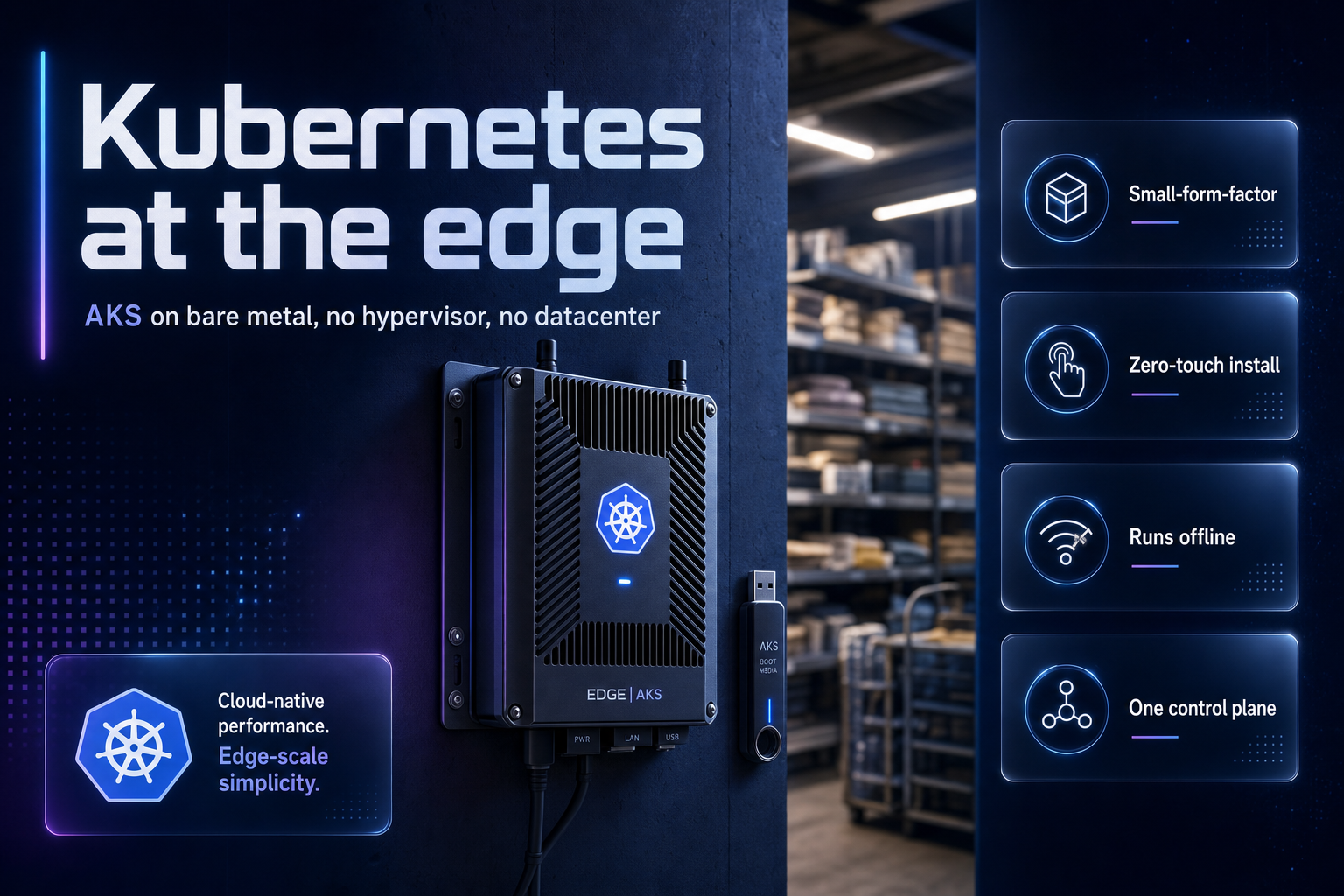
Summary. Microsoft put AKS on bare metal into public preview on 2 June 2026, and a good deal of the coverage that followed described it as a way to strip the hypervisor off GPU servers so large language model training can reach NVLink and RDMA directly. Microsoft's own announcement says none of that. The AKS Engineering Blog post is titled around one idea, "AKS runs everywhere, now on bare metal at the edge", and the six validated devices are mini PCs and rugged edge boxes: the ASUS NUC 14 Pro, ASUS NUC 15 Pro, Lenovo ThinkEdge SE30, Lenovo ThinkEdge SE100, OnLogic HX521 and OnLogic K521. The K521 sells for $2,762 with up to 96 GB of DDR5 and a fanless case rated to 70°C. The preview runs in exactly 1 Azure region, East US, on documentation dated 1 June 2026 and last updated 12 June 2026. The NVLink claim entered the record through a roundup published on 23 June 2026. If your plan was to move a training cluster onto it, there is nothing here for you. If you run Kubernetes in 200 retail back rooms, there is quite a lot.
This one is worth getting right, because the misreading points teams at the wrong roadmap.
What Microsoft actually announced
The AKS Engineering Blog post of 2 June 2026, written by AKS Product Manager Summer Cefalu and AKS Product Manager Lead Schumann Ge, states the scope in one sentence: "AKS now runs directly on bare-metal, small-form-factor devices at the edge, available today in public preview."
The problem it solves is stated just as plainly. Customers asked Microsoft to "run real Kubernetes directly on the hardware, with no hypervisor underneath and no virtualization layer to license or maintain; do it on lightweight edge hardware rather than datacenter-class servers; and let it keep operating through intermittent connectivity."
Read the middle clause twice. Microsoft explicitly rules out datacenter-class servers as the target. The hypervisor is being removed because a retail back room should not pay for a virtualization licence to run three containers, not because a training job needs a few percent more throughput.
The edge sites named in the post are the retail back room, the factory floor, the quick-service restaurant, the branch office and the remote site. Space, power and budget are constrained. Connectivity drops.
Where the GPU story came from
The confusion is understandable, and it has a specific origin. Microsoft made several Kubernetes announcements around Build 2026 at once, and only one of them is about the edge.
InfoQ's 23 June 2026 write-up grouped them into a single narrative and reported that AKS on Bare Metal "gives workloads direct access to hardware without a hypervisor", providing "direct access to technologies such as NVLink, RDMA, and high-performance networking, capabilities that are increasingly important for large language model training and latency-sensitive inference workloads". Downstream coverage repeated it. The same InfoQ piece links "AI Runway", a Kubernetes-native model deployment framework from Microsoft, to runwayml.com, an unrelated company, which is a fair signal of how carefully the roundup was assembled.
The Build announcements are real, and they do include datacenter AI infrastructure. They are simply different features.
| Build 2026 announcement | What it is | Where it runs |
|---|---|---|
| AKS on bare metal (public preview) | AKS with no hypervisor on validated mini PCs | Edge sites, small-form-factor devices |
| Managed System Node Pools in AKS Automatic (GA) | Azure runs the system node pool separately from app workloads | Azure regions |
| Azure Container Linux (GA) | Minimal container-optimised host OS | Azure regions |
| Azure Kubernetes Fleet Manager for Arc-enabled clusters (GA) | Central policy, RBAC and staged rollout across a cluster estate | Azure, on-premises, multicloud |
| Anyscale on Azure (public preview) | Managed Ray for distributed AI on AKS | Azure regions, CPU and GPU |
| AI Runway with KAITO | Model selection, GPU validation, cost estimate, production endpoint | Azure regions |
If you want the hypervisor gone from GPU nodes for training throughput, none of the above is that announcement. The AI infrastructure work at Build sits in Anyscale on Azure and AI Runway, both of which run in Azure regions on ordinary GPU node pools.
The hardware list settles the argument
Microsoft validates AKS on bare metal only on supported devices for small form factor deployments of Azure Local. As of the June 2026 documentation, that list has six entries.
| Validated device | Class | Notable spec |
|---|---|---|
| ASUS NUC 14 Pro | Mini PC | Compact desktop form factor |
| ASUS NUC 15 Pro | Mini PC | Compact desktop form factor |
| Lenovo ThinkEdge SE30 | Edge appliance | Ruggedised edge device |
| Lenovo ThinkEdge SE100 | Edge server | Compact edge server |
| OnLogic HX521 | Industrial computer | Validated for Azure Local |
| OnLogic K521 | Rugged low-profile computer | $2,762; Intel Core Ultra; up to 96 GB DDR5; fanless, -40°C to 70°C |
Microsoft's note on that list is blunt: other hardware might work, but validation, documentation and troubleshooting guidance for the preview apply only to these devices.
A fanless mini PC with 96 GB of system RAM and no discrete accelerator is not a training node, and no reading of the spec sheet makes it one. The $2,762 price tag is the tell. Teams comparing this against an eight-GPU server are comparing against a machine two orders of magnitude away.
The preview constraints that will stop you first
The documentation, dated 1 June 2026 and last updated 4 June 2026, carries limits worth knowing before you plan a pilot.
The preview is available in East US only. That is one region, and for an edge product whose whole premise is distributed sites, it is the constraint most likely to end a proof of concept in India, Europe or APAC before it starts. Preview coverage is best-effort and only partial under customer support.
Permissions are stricter than teams expect. You need Owner, or Contributor plus User Access Administrator, on the resource group, and the role assignment must be both Active and Permanent. Just-in-time elevation through PIM will fail the deployment, which the docs acknowledge by telling you to temporarily elevate first.
Networking is simple but exact. You plan one IP address, the control plane IP for the Kubernetes API server, and it must sit in the same subnet as the host or match the host IP. The host needs outbound access to six endpoints.
            # Outbound endpoints the bare metal host must reach
# *.arc.azure.net                     Azure Arc connectivity
# management.azure.com                Azure Resource Manager
# login.microsoftonline.com           Microsoft Entra authentication
# mcr.microsoft.com                   Container image pulls
# *.data.mcr.microsoft.com            Container image data
# guestnotificationservice.azure.com  Arc guest notifications

# Register the four required resource providers
az provider register --namespace Microsoft.HybridCompute
az provider register --namespace Microsoft.HybridContainerService
az provider register --namespace Microsoft.Kubernetes
az provider register --namespace Microsoft.ExtendedLocation

# Install the extension needed to reach the cluster after deployment
az extension add --name connectedk8s

# Connect to the cluster once it is provisioned
az connectedk8s proxy --name <cluster> --resource-group <rg>
You also cannot start with AKS. A small form factor Azure Local device must be set up first, following the Azure Local documentation, before an AKS cluster can be deployed onto it. AKS on bare metal is a layer on Azure Local SFF, not a standalone install.
The part that is genuinely good
Strip out the misreporting and the feature is a competent answer to a real problem.
Provisioning is the strongest piece. Someone on site plugs in a USB drive carrying an OS image from the Azure portal, powers on the device, waits a couple of minutes and removes the drive. A device voucher is written back to the USB drive during that zero-touch provisioning step, and every other configuration decision moves to Azure. Nobody at the store needs infrastructure skills. Azure Local's zero-touch provisioning uses an FDO-compliant supply chain to push consistent software across large device fleets.
Disconnection handling is honest about what survives. The Kubernetes control plane runs locally on the device, so deployed workloads keep operating normally through connectivity loss. What you lose is portal visibility and Azure management actions until the link returns. That is the correct split for a factory floor, where the line must keep running whether or not the WAN is up.
The operational model is the real prize. The cluster is a first-class AKS cluster running on Azure Linux, and it appears in Azure Kubernetes Fleet Manager beside cloud clusters, with the same controls and tooling. There is no edge-specific console and no separate operational model. Teams that have run edge Kubernetes on a bespoke stack know exactly how much that is worth.
Azure Local SFF also ships Docker in the base image, supports the open-source K3s distribution as an alternative to AKS, runs a signed Microsoft kernel, and validates Azure IoT Operations and Foundry Local per release.
AKS on bare metal against the alternatives
| Dimension | AKS on bare metal (preview) | AKS on Azure Local with hypervisor | K3s on your own hardware |
|---|---|---|---|
| Virtualization layer | None; runs directly on the device | Hypervisor to license and maintain | None |
| Hardware freedom | 6 validated devices only | Broader Azure Local catalogue | Anything you like |
| Azure-side management | Full; appears in Fleet Manager | Full | You build it |
| Offline operation | Workloads keep running; portal control pauses | Workloads keep running | Fully independent |
| Region availability | East US only during preview | Generally available | Not applicable |
| Support | Preview, best-effort, partial | Standard support | Community or vendor |
The honest reading: if you are already an Azure shop with a fleet of sites and you want one control plane over cloud and edge, this is the first version of that story worth piloting. If you want hardware freedom, K3s still wins, and Microsoft ships K3s support on the same SFF platform anyway.
India-specific considerations
The East US restriction is the whole story for Indian teams right now. An edge Kubernetes platform whose management plane is pinned to a single US region is not something to build a manufacturing rollout on in July 2026, and data residency conversations under the Digital Personal Data Protection Act, 2023 get harder when the control and management path terminates outside India. Pilot it, do not plan a plant around it, and re-check the region list when it reaches general availability.
The use cases fit India well when the regions arrive. Retail back rooms, factory floors and branch offices with unreliable connectivity describe a large share of the country's distributed estate. Teams already doing this work will find our field notes on AI on the Indian factory floor and smart manufacturing with IoT and AI in Indian factories closer to the ground than a preview announcement. For the datacenter side of the same estate, our Kubernetes AI platform managed service covers what actually runs the models.
What to do about it
Do not re-plan GPU capacity around this. The training and inference work at Build 2026 is Anyscale on Azure and AI Runway, and both run on ordinary Azure GPU node pools. Our Microsoft Build 2026 enterprise AI takeaways separates those threads.
Pilot it only if edge is already a problem you have. A fleet of sites, an Azure estate, and a hypervisor licence you resent are the three conditions that make this interesting.
Buy one validated device. At $2,762 for an OnLogic K521, the cost of finding out is a rounding error against the engineering time you would spend arguing about it.
Check the region before anything else. East US only, during preview, decides most pilots outside North America on its own.
FAQ
How eCorpIT can help
eCorpIT runs Kubernetes and edge infrastructure work for manufacturing, retail and distributed teams from Gurugram, with senior engineering teams who read the release notes before the roadmap. We help clients separate a genuine platform shift from a repackaged announcement, size an edge pilot against the constraints that actually bind, and design deployments aligned with DPDP requirements when the management plane sits offshore. If you are weighing AKS on bare metal, Azure Local or K3s for a multi-site estate, talk to us before you buy the fleet.
References
- Announcing the public preview of AKS on bare metal - AKS Engineering Blog, Summer Cefalu and Schumann Ge, 2 June 2026.
- System requirements and prerequisites for AKS on bare metal (preview) - Microsoft Learn, dated 1 June 2026, updated 4 June 2026.
- Overview of small form factor deployments of Azure Local (preview) - Microsoft Learn, validated device list, updated 12 June 2026.
- Zero-touch provisioning for small form factor deployments of Azure Local (preview) - Microsoft Learn.
- Microsoft expands Azure Kubernetes Service with bare metal, fleet management and AI infrastructure - InfoQ, 23 June 2026. Source of the NVLink and RDMA framing discussed above.
- What's new in Azure Kubernetes Service at Microsoft Build 2026 - Microsoft Community Hub.
- OnLogic Karbon 521 rugged computer validated for Azure Local - OnLogic store listing, price and specifications.
- Introducing small form factor infrastructure: embed intelligence into physical systems - Microsoft Azure Arc blog.
- Announcing public preview: simplified machine provisioning for Azure Local - Microsoft Azure Arc blog, zero-touch provisioning.
- Azure Kubernetes Service documentation - Microsoft Learn.
- Supplemental terms of use for Microsoft Azure previews - Microsoft Azure.
- How to deploy Azure Local small form factor (SFF) - Thomas Maurer, June 2026.
Last updated: 17 July 2026.