On this page · 12 sections
- The policy backdrop a CTO should use
- Where India actually is on AI adoption
- Why 2026 is the inflection point
- The factory-floor use cases that pay
- The economics: what it costs and returns
- The barriers that actually stop projects
- From pilots to repeatable capability
- The CTO playbook
- India-specific considerations
- FAQ
- How eCorpIT can help
- References
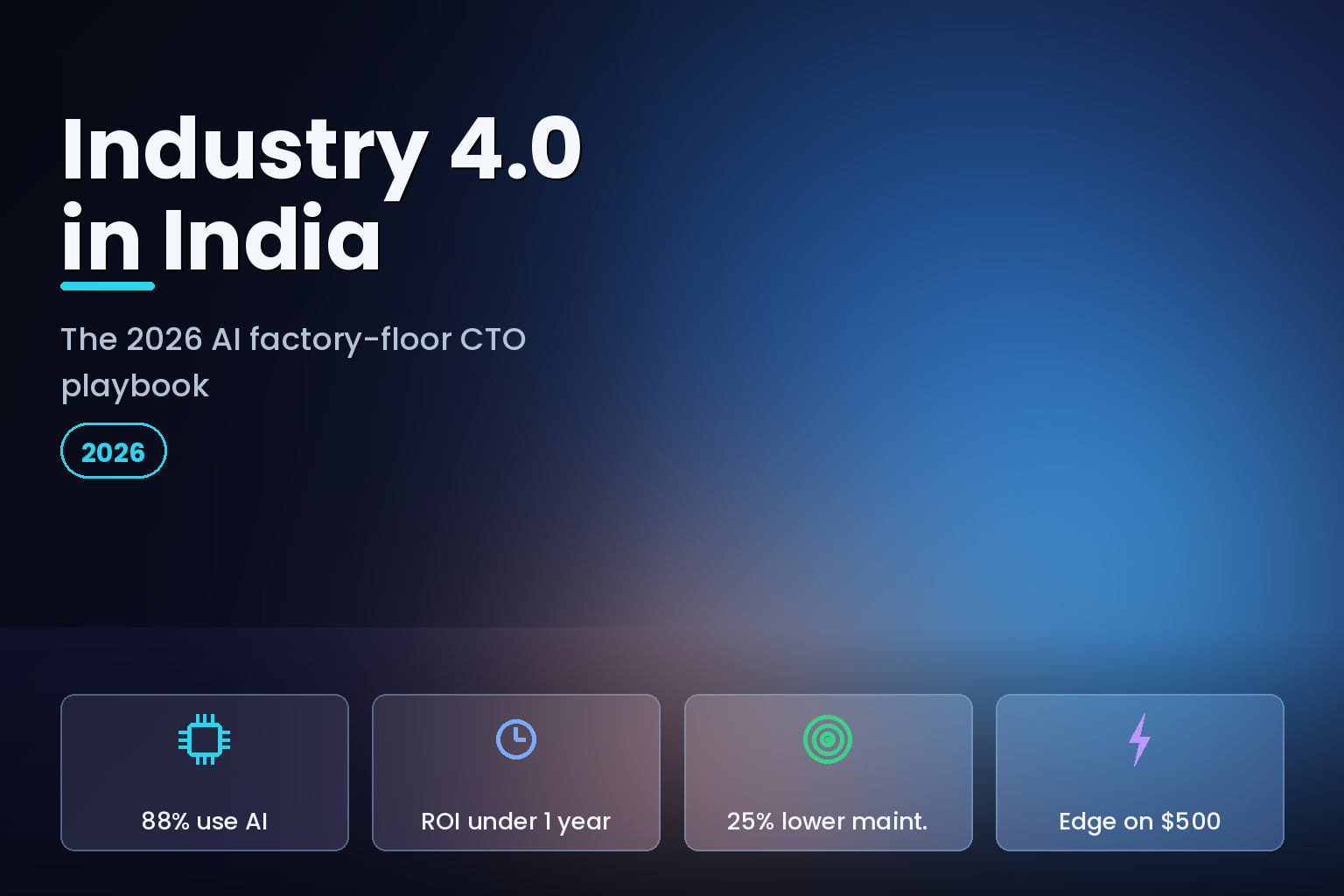
Summary. India's factory floor is the live edge of its AI ambition, and the numbers now back the rhetoric. Manufacturing is about 17% of GDP today, and the National Manufacturing Mission announced in Budget 2025-26 targets 25% by 2035, 143 million jobs and $1.2 trillion in merchandise exports, backed by a Production Linked Incentive scheme carrying ₹2.16 lakh crore in committed investment across 14 sectors. On the ground, 88% of Indian manufacturers already use AI or machine learning in operations and 41% of operations are AI-augmented. The returns are real: factory digital twins typically cut maintenance costs 25%, lift uptime 10 to 20%, and pay back in 12 to 24 months, with one Indian pharma deployment reporting 18 to 28% lower operating costs and ROI in under a year. PwC and ORF estimate AI could add $135.6 to $149.9 billion of value in Indian MSMEs alone by 2035. This refreshed playbook tells a manufacturing CTO what to deploy, what it returns, and what still blocks adoption.
Two years ago, AI on the Indian factory floor was mostly pilots and slideware. In 2026 it is a budget line with measurable payback. Dilip Sawhney, managing director of Rockwell Automation India, put the shift bluntly: "The 2026 findings confirm that India is not only keeping pace with global smart manufacturing - it is often leading it." For a plant-modernisation lead, the question has moved from whether to adopt to where to start and how to prove return.
The policy backdrop a CTO should use
The state is actively subsidising this transition, and the schemes are tools a CTO can pull on, not just background.
| Scheme | What it offers manufacturers |
|---|---|
| National Manufacturing Mission (2025-26) | 25%-of-GDP target by 2035, focus on ease of doing business and tech access |
| Production Linked Incentive | ₹2.16 lakh crore across 14 sectors, incentives tied to output |
| SAMARTH Udyog Bharat 4.0 | Demo and experience centres, common engineering facilities to try before buying |
| Semiconductor Mission 2.0 (Budget 2026-27) | Equipment and materials, full-stack Indian IP, training centres |
The National Manufacturing Mission renews the decade-old Make in India push with a more implementation-focused agenda spanning ease and cost of doing business, workforce readiness, MSME growth, deregulation, technology access and quality manufacturing. Budget 2026-27 layered on Semiconductor Mission 2.0, which targets semiconductor equipment and materials, full-stack Indian intellectual property, sturdier supply chains and industry-led research and training centres.
The most practical of these for a hesitant team is SAMARTH Udyog Bharat 4.0 under the Ministry of Heavy Industries, which runs experience and demo centres where you can trial smart-manufacturing technology before committing capital. The Central Manufacturing Technology Institute operates a Smart Manufacturing Demo and Development Cell as a common engineering facility for exactly this purpose. Use them to de-risk the first deployment.
Where India actually is on AI adoption
The adoption data is striking and worth grounding your business case in.
| Metric | Figure | What it signals |
|---|---|---|
| Manufacturers using AI or ML | 88% | Adoption is already mainstream |
| Operations that are AI-augmented | 41% | Depth still has room to grow |
| Manufacturers calling digital transformation essential | 97% | Near-universal intent |
| Using AI or ML to address labour gaps | 48% | AI as a workforce multiplier |
| Rating AI an important hiring skill | 81% | Skills demand is now structural |
These figures, drawn from 2026 industry surveys, describe a sector past the early-adopter phase. The gap between 88% using AI somewhere and only 41% of operations being AI-augmented is the real opportunity: most plants have started, few have gone deep. That is where a focused CTO can create advantage.
Why 2026 is the inflection point
Three shifts turned smart manufacturing from a capital-heavy gamble into a tractable project this year. Edge AI matured to the point where inference runs on roughly $500 devices instead of $50,000 servers, so the hardware bill for a first deployment dropped by two orders of magnitude. Pre-built models cut the development time that used to make every project bespoke. And the spread of the OPC UA standard eased the data-connectivity bottleneck that historically sank factory IT projects, because machines from different vendors can finally speak a common language. On top of that, roughly three-quarters of companies have already adopted digital-twin technology of at least medium complexity, so the tooling and talent ecosystem is no longer nascent. For an Indian CTO, the practical effect is that the cost and risk of a first project in 2026 are a fraction of what they were even two years ago, which is precisely why adoption has crossed into the mainstream.
The factory-floor use cases that pay
Not every AI use case earns its keep on a plant floor. These four consistently do, and they are the right place to start.
| Use case | What it does | Reported result |
|---|---|---|
| Predictive maintenance | Predicts equipment failure before it happens | 25% lower maintenance cost, 50% fewer downtime incidents |
| Digital twins | Live virtual model of a machine or line | 20-40% downtime reduction, ROI in 12-24 months |
| Vision quality control | AI inspects parts, stops the line on defects | Instant defect detection, less scrap |
| Private 5G plus edge AI | Real-time sensing and control on the floor | Robotic arms detect strain and self-adjust |
Predictive maintenance is the standard entry point because the metric already exists: unplanned downtime is something every plant tracks and hates. Digital twins extend that into a live model of the asset. As ROI analysis shows, roughly three-quarters of companies have already adopted digital-twin technology of at least medium complexity. Vision-based quality control is the other quick win, since AI quality checks can stop a machine instantly when something goes wrong. The discipline behind these wins is the same we cover in AI predictive maintenance on the Indian factory floor.
The economics: what it costs and returns
The 2026 inflection is partly an economics story. Edge AI inference now runs on roughly $500 edge devices instead of $50,000 servers, pre-built models cut development time, and OPC UA standardisation eases the data-connectivity bottleneck that used to sink these projects. That collapses the entry cost.
Concretely, an asset-level digital twin covering 10 to 20 critical machines runs about $50,000 to $200,000 and can return its cost in three to six months. A leading Indian pharmaceutical manufacturer's digital-twin deployment reduced operating costs 18 to 28%, accelerated root-cause analysis by nearly 50%, and reached ROI in under a year. At the smaller end, MSMEs using edge AI and IoT report saving 12 to 15% on running costs. For a CTO, the message is that the first project no longer needs a moonshot budget; it needs a well-chosen line and a tracked metric. Costs and returns should be modelled with the same rigour as any capital project, much as in our India FinOps guide.
The barriers that actually stop projects
Adoption is mainstream, but failure is still common, and the reasons are predictable. PwC and ORF's March 2026 readiness work identifies the recurring blockers.
| Barrier | Why it bites | The fix |
|---|---|---|
| Skills gap | Few people understand both machines and data | Train existing staff, do not chase scarce hires |
| Unclear ROI | Projects start without a tracked metric | Pick one line with a measurable baseline |
| Data quality gaps | Sensor and MES data is messy or missing | Fix the data foundation before the model |
| Worker anxiety | Fear of replacement slows rollout | Frame AI as augmentation, involve operators |
| Tiny or no IT team | No capacity to run new systems | Use demo centres and managed partners |
The skills gap is the one that surprises teams most. Running an IoT-enabled factory needs people who understand both manufacturing processes and data systems, and those people are scarce. The plants that succeed train their existing workforce rather than trying to hire specialists from an empty talent pool. There is also a uniquely Indian friction the same research flags: a shortage of Hindi and regional-language tools, which matters on shop floors where English is not the working language.
From pilots to repeatable capability
The depth gap, 88% of manufacturers using AI somewhere but only 41% of operations actually AI-augmented, is a maturity-curve problem, not a technology one. Invest India frames the journey through PwC's 3A2I model: Access, Acceptance, Assimilation, Implementation and Institutionalisation. Most Indian plants are stuck between access and acceptance, with a successful pilot that never became a standard. The move that matters is institutionalisation: turning a proven line-level win into a repeatable template, with the data pipelines, dashboards and operator training that let the next line adopt it in weeks rather than months. That is the difference between a plant that has done AI and one that runs on it. A CTO should treat the first project not as the goal but as the prototype for a playbook the whole plant can reuse.
The CTO playbook
Putting it together, a sequence that works in the Indian context. Start with one production line and one tracked metric, usually unplanned downtime, because predictive maintenance gives the clearest before-and-after. Use a SAMARTH demo centre to trial the technology before you buy. Fix the data foundation first: clean sensor and machine data beats a clever model on dirty data every time. Deploy edge AI on low-cost devices to keep the entry cost down, and connect the floor with private 5G where real-time control matters. Invest in upskilling your existing operators and engineers in parallel, not after, because the skills gap is the binding constraint. Then expand line by line, carrying the proven pattern forward, the same sequencing logic in our Industry 4.0 factory-floor analysis. The firms that institutionalise this, in the language of PwC's 3A2I framework, move from one-off pilots to a repeatable capability.
India-specific considerations
Two India-specific realities shape the build. First, the MSME base is enormous and under-digitised, which is exactly why the government routes incentives and demo centres toward smaller manufacturers; a mid-size plant can access SAMARTH facilities and PLI-aligned incentives that lower the entry cost. Second, the workforce question is sharper here. With 48% of manufacturers already using AI to address labour gaps and 81% rating AI an important hiring skill, the winning approach treats AI as a way to make existing jobs more productive and engaging rather than a headcount-reduction tool. That framing also eases the worker-anxiety barrier that stalls rollouts. The economics favour starting small and local: a $500 edge device and one well-instrumented line prove the case far faster than a plant-wide programme.
FAQ
How eCorpIT can help
eCorpIT is a Gurugram-based technology organisation with senior-led engineering teams that help Indian manufacturers put AI on the factory floor with measurable return. We scope the first line, fix the sensor and data foundation, deploy predictive maintenance and digital twins on cost-efficient edge hardware, and connect the floor where real-time control matters. Founded in 2021 and assessed at CMMI Level 5, we pair plant-modernisation engineering with the upskilling that makes it stick. To plan an Industry 4.0 roadmap for your plant, contact our team.
References
_Last updated: 26 June 2026._