On this page · 10 sections
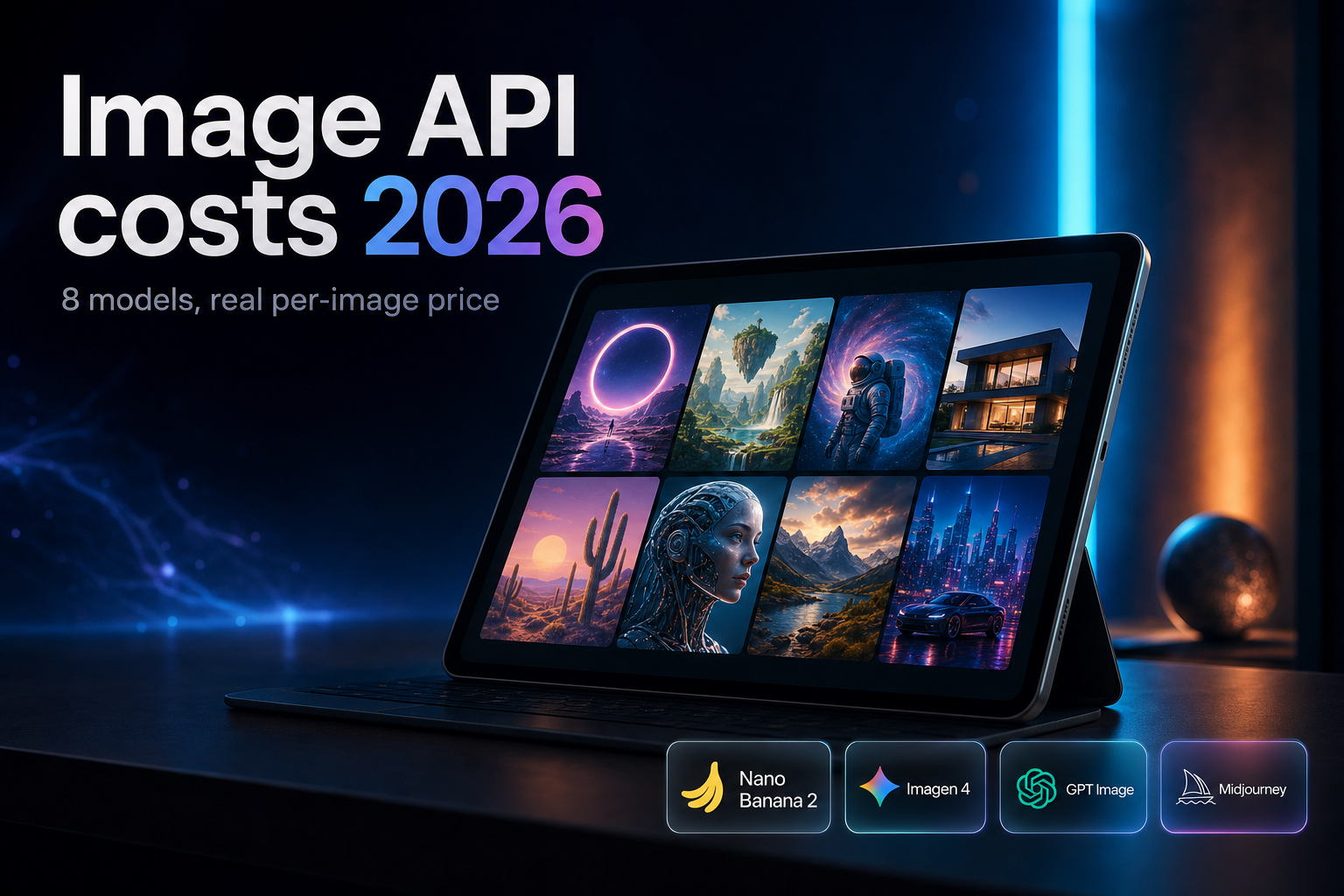
Summary. As of July 2026, a single 1024-pixel image costs $0.02 on Google Imagen 4 Fast, $0.034 on Nano Banana 2 Lite, about $0.04 on OpenAI GPT Image 1.5, and $0.134 on Google's Nano Banana Pro (Gemini 3 Pro Image), a 6.7x spread across four mainstream providers. OpenAI meters images as output tokens: GPT Image 2 bills $30.00 per 1M output tokens, GPT Image 1.5 bills $32.00, and the cheaper GPT Image 1 Mini bills $8.00, so a low-quality mini draft lands near $0.005 while a high-quality 1.5 render approaches $0.13. Midjourney still ships no official API in 2026 and sells four subscription tiers from $10 to $120 per month. This guide compares eight production endpoints on real per-image cost, shows the token math behind each headline number, and gives a decision table for teams choosing where to spend.
The price you see on a pricing page is rarely the price you pay. Three variables move the real number: output resolution, quality tier, and whether you run requests through a batch queue. Google applies a flat 50% discount to batch image jobs that finish inside a 24-hour window, which drops Nano Banana Pro from $0.134 to $0.067 per image. OpenAI's Batch API applies the same 50% cut. Get those three variables wrong and a "cheap" model can cost more than a premium one.
This matters because image volume scales fast. A single product-catalog refresh for a mid-sized Indian direct-to-consumer brand can mean 5,000 to 20,000 renders, and professional creative work runs 3 to 10 iterations before a usable final. At ₹96.4 to the US dollar in mid-July 2026, the difference between $0.02 and $0.13 per image is the difference between ₹1.9 and ₹12.9 per render, and it compounds into a real line item at volume.
The 2026 image-model price list, per image
The table below lists eight endpoints most teams actually evaluate, with the per-image cost at roughly 1024x1024 standard quality and the native billing unit each vendor uses. Figures are current as of July 2026 and link to the source in the references.
| Model (API string) | Vendor | Per image (~1024px) | Native billing |
|---|---|---|---|
| Imagen 4 Fast | $0.02 | Per image | |
| Nano Banana 2 Lite (gemini-3.1-flash-lite-image) | $0.034 | $0.25 in / $1.50 out per 1M tokens | |
| Gemini 2.5 Flash Image (Nano Banana v1) | $0.039 | Per image (batch $0.0195) | |
| Imagen 4 Standard | $0.04 | Per image | |
| GPT Image 1.5 | OpenAI | ~$0.04 | $32.00 per 1M output tokens |
| Nano Banana 2 (gemini-3.1-flash-image) | ~$0.055 | $0.50 in / $3.00 out per 1M tokens | |
| Nano Banana Pro (gemini-3-pro-image) | $0.134 | Per image (batch $0.067) | |
| GPT Image 1 Mini | OpenAI | $0.005 to $0.052 | $8.00 per 1M output tokens |
Two entries sit outside per-image billing. Midjourney has no official API in 2026, so its real cost is a subscription: Basic $10, Standard $30, Pro $60, and Mega $120 per month, each dropping 20% on an annual plan. Third-party wrappers resell Midjourney output at roughly $0.04 to $0.17 per image, but they run against Midjourney's terms and can break without notice. OpenAI's newest GPT Image 2 bills image output at $30.00 per 1M tokens, between the Mini and 1.5 tiers on a per-image basis depending on quality.
How the token math works, so you can predict a bill
Google's Imagen line and Midjourney quote a flat per-image price, which is easy to model. OpenAI and Google's Gemini image models bill by tokens, which is where teams get surprised.
OpenAI converts each image into a fixed block of output tokens set by resolution and quality tier, then charges that block at the model's output rate. On the official pricing page, GPT Image 1 Mini bills image output at $8.00 per 1M tokens, GPT Image 1.5 at $32.00, and GPT Image 2 at $30.00. A low-quality 1024-pixel draft on GPT Image 1 Mini works out to roughly $0.005, and a high-quality render on the same model to about $0.052, a 10x range from one model just by changing the quality flag. That single flag, not the model choice, is often the biggest lever on your bill.
Google's Nano Banana 2 Lite bills $0.25 per 1M input tokens and $1.50 per 1M output tokens, which the team translates to about $0.034 per standard image and an under-four-second render. Nano Banana 2 (the full Gemini 3.1 Flash Image) bills $0.50 input and $3.00 output per 1M tokens. Naina Raisinghani, a product manager at Google DeepMind, described the Lite model in Google's launch post as "state of the art," adding, "You get the advanced world knowledge, quality and reasoning you love in Nano Banana Pro, at lightning-fast speed." The practical read: Lite is the volume workhorse and Pro is the flagship you reserve for hero shots.
Cost at volume: a 1,000-image month
Per-image numbers hide how fast spend accumulates. The table below models a team generating 1,000 standard images per month on each endpoint, at list price and, where offered, at the batch rate.
| Model | List, 1,000 images | Batch (50% off) | ₹ at list (₹96.4/$) |
|---|---|---|---|
| GPT Image 1 Mini (low) | $5 | n/a | ₹482 |
| Imagen 4 Fast | $20 | n/a | ₹1,928 |
| Nano Banana 2 Lite | $34 | n/a | ₹3,278 |
| Gemini 2.5 Flash Image | $39 | $19.50 | ₹3,760 |
| GPT Image 1.5 (standard) | ~$40 | ~$20 | ₹3,856 |
| Nano Banana 2 | ~$55 | n/a | ₹5,302 |
| Nano Banana Pro | $134 | $67 | ₹12,918 |
Three things stand out. First, the cheap tier is genuinely cheap: draft-quality mini output at $5 for 1,000 images is close to free relative to the labor around it. Second, batch halves the bill wherever a 24-hour turnaround is acceptable, which covers most catalog, thumbnail, and back-office work. Third, the premium tier is 27x the cheap tier, so routing every request to your best model is the most common way teams overspend.
Quality is not linear with price
Higher price does not guarantee a better image for your use case. Google positioned Imagen 4 as its dedicated photography and text-rendering engine, while the Nano Banana line generates images inside a conversational, reasoning-capable model, which helps with complex edits and instruction following. Nano Banana 2 Lite ranked fifth in public text-to-image arena rankings at launch, competitive with models several times its price.
For most production pipelines the honest test is a bake-off on your own prompts, not a benchmark score. A logo-heavy banner, a photoreal product shot, and a stylized social tile stress different models. The real cost is usually the iteration count, not the sticker price: a model that needs two attempts at $0.02 beats one that needs five at $0.04. Measure images-to-acceptance on a sample of 50 real prompts before you commit an API.
The Midjourney question
Midjourney remains a favorite for art direction and stylized work, and in 2026 it still runs on Discord with no official API. That is a deliberate product choice, not an oversight. For a team that needs programmatic generation inside an app or a content pipeline, the absence of a supported API is disqualifying on its own: the third-party wrappers that bridge the gap violate Midjourney's terms, carry no uptime guarantee, and can be shut off. If your workflow is a human designer iterating in a chat window, a $30 Standard plan is excellent value. If your workflow is a server calling an endpoint, choose a provider that ships one.
India-specific considerations
For teams building in India, three factors change the math beyond the per-image rate. The rupee traded near ₹96.4 to the US dollar in mid-July 2026, so a $0.134 Nano Banana Pro render is about ₹12.9, and a 20,000-image catalog run on it is roughly ₹2.6 lakh before batch discounts, versus about ₹38,600 on Imagen 4 Fast. Currency alone justifies routing volume work to the cheapest acceptable tier.
Data protection is the second factor. If a prompt or reference image contains a real person or customer data, India's Digital Personal Data Protection Act, 2023 applies, and where you send that image and how the vendor retains it become compliance questions, not just cost ones. Teams shipping consumer apps should read our DPDP engineering playbook for Indian startups before wiring a generation feature to customer data.
Third, image generation rarely lives alone. Marketing teams pairing it with video should compare the media economics together; we broke down Google's video side in Gemini Omni Flash video costs for marketing teams. Product teams weighing broader model spend can cross-read our GPT-5.6 inference cost analysis for enterprise AI, since the same batching and tiering discipline applies across text and image.
A decision guide
The right answer depends on volume, quality bar, and whether you need an official API.
For high-volume, cost-sensitive work such as thumbnails, catalog variants, and A/B creative, use Imagen 4 Fast at $0.02 or Nano Banana 2 Lite at $0.034, and run everything you can through a batch queue. For flagship, instruction-heavy renders where quality decides revenue, Nano Banana Pro at $0.134 (or $0.067 batched) earns its price on the images that matter. For teams already standardized on OpenAI, GPT Image 1 Mini covers drafts at roughly $0.005 and GPT Image 1.5 covers finals near $0.04, keeping one vendor and one bill. For human-led art direction with no API requirement, a Midjourney subscription from $10 to $120 per month is the cleanest option.
Most mature teams end up with a two-model stack: a cheap default for the 90% of images that are functional, and a premium model reserved for the 10% that are seen by customers first. Set the routing rule once, meter it, and the per-image spread stops being a cost problem.
FAQ
How eCorpIT can help
eCorpIT builds and integrates image-generation pipelines into web and mobile products for teams across ecommerce, fintech, and media. We run provider bake-offs on your real prompts, design the routing and batching rules that keep per-image cost predictable, and wire generation into your app with DPDP-aligned handling of any customer data in prompts or reference images. If you are choosing an image API or trying to cut a runaway generation bill, talk to our engineering team and we will map the options to your volume and quality bar.
References
_Last updated: 19 July 2026._