On this page · 10 sections
Summary. On July 22, 2026 Cursor turned on Cursor Router, a request-level classifier that picks the model for every coding request instead of leaving that choice to the developer. In Cursor's own online A/B tests across millions of requests it delivered frontier-quality output at 60% lower cost; in two weeks of early access with dozens of enterprises the figure was 30-50% versus routing everything to Opus 4.8. Cursor measured a cost per commit of $4.63 in Balance mode and $6.76 in Intelligence mode, against $7.34 for Opus 4.8 and $12.69 for Fable 5. The router is generally available on Teams and Enterprise plans across desktop, web, iOS, CLI, and the SDK. This piece breaks down how it works, the exact numbers, and where a senior engineer should be skeptical.
The timing is not an accident. Enterprise spending on AI coding tools jumped from $550 million to $4 billion in a single year, according to Menlo Ventures' 2025 State of Generative AI in the Enterprise report, which put total enterprise AI investment at $37 billion. Half of developers now use AI coding tools daily. When the bill grows that fast, the question stops being "which model is best" and becomes "which model is enough for this request." Cursor Router is Anysphere's answer, and it is built on data most buyers do not have: Cursor says it moves hundreds of millions of coding requests a week across every major model and provider.
How Cursor Router works
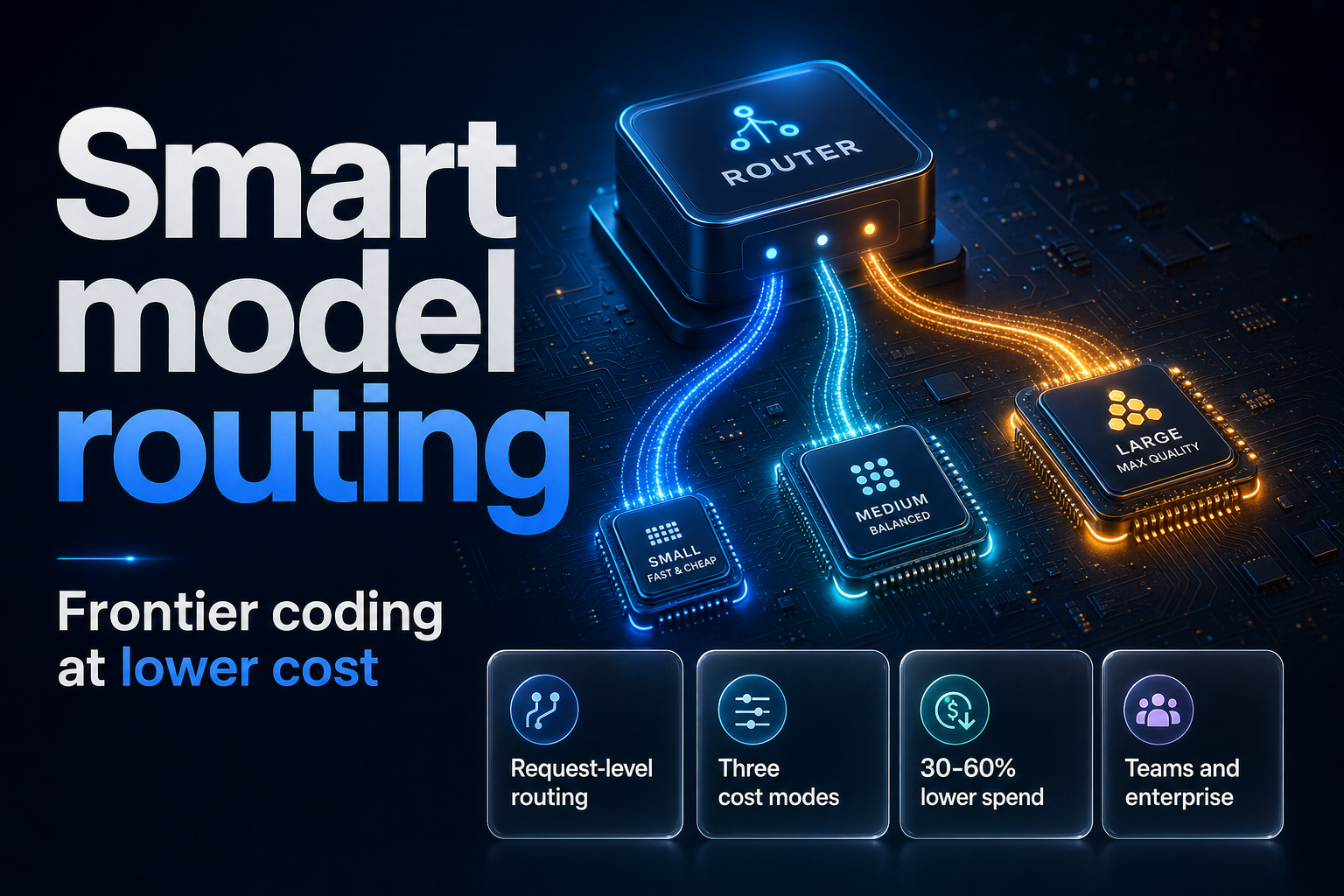
Cursor Router is a classifier that inspects each request before any model runs and sends it to the model that fits. It reads four things: the query, the surrounding context, task complexity, and domain, then combines that with what Cursor has learned about each model's strengths. Simple edits go to price-efficient models, interface work goes to the model with the best visual judgement, and long-horizon reasoning goes to frontier models. Cursor trained the classifier on more than 600,000 live requests and tuned it against user satisfaction as the reward signal, not an offline benchmark.
The problem it targets is a spending pattern, not a capability gap. Cursor reports that roughly 60% of its developers pick one model as a daily driver and run everything through it. That means routine work gets done at frontier prices, and spend climbs faster than output. Routing breaks that habit at the request level rather than asking each engineer to switch models by hand. The same trap shows up in our own field notes on the AI coding productivity paradox and ROI plateau: more model spend rarely buys proportionally more shipped code.
One detail matters more than it looks. The router is cache-aware. Switching models mid-conversation throws away the prompt cache and forces a cache miss, which costs real money. Cursor says it trained the classifier on data where routing causes cache misses and measured savings in production that already include that cache-miss cost. A lot of naive routing demos quietly ignore this, which is why their savings do not survive contact with a real codebase.
The numbers: cost per commit
Cursor measured efficacy with large online A/B tests rather than offline evals, arguing that a router only proves itself across real conversations where engineers ask follow-ups, hit errors, and keep going. It tracked two output-quality metrics: user satisfaction, inferred from whether a developer moves on or corrects the agent, and keep rate, how much agent-written code stays in the codebase over time.
Cost per commit is the number engineering leaders should anchor on, because it ties spend to shipped work rather than raw tokens.
| Model or router mode | Cost per commit (Cursor test) | Versus Opus 4.8 at $7.34 |
|---|---|---|
| Auto Balance | $4.63 | about 37% cheaper |
| Auto Intelligence | $6.76 | about 8% cheaper |
| GPT-5.6 Sol | matched Intelligence at about $6.76 | similar cost, lower satisfaction |
| Opus 4.8 | $7.34 | baseline |
| Fable 5 | $12.69 | about 73% more expensive |
The percentage columns are our arithmetic on Cursor's published figures. Read together they explain the headline: Balance mode produced a commit for $4.63 against $7.34 on Opus 4.8 and $12.69 on Fable 5, while Intelligence mode stayed close to frontier quality. Cursor's framing is that Intelligence lands near Fable on user satisfaction at about 60% lower cost for teams and lifts satisfaction about 15% over Opus 4.8 at nearly the same price, while Balance sits above Opus 4.8 on satisfaction at about 36% lower cost.
The three modes let an admin or a developer choose where to sit on the cost-versus-intelligence curve.
| Mode | What it optimizes for | Cursor's measured result |
|---|---|---|
| Intelligence | Frontier quality | Near Fable satisfaction at about 60% lower cost for teams |
| Balance | Quality and cost together | Above Opus 4.8 satisfaction at about 36% lower cost |
| Cost | Token efficiency | Highest available intelligence while trimming token spend |
Why this launched now
The spending backdrop is the story. Gartner expects worldwide AI spending to grow 47% in 2026 to reach $2.59 trillion, and it expects enterprises to more than double what they spend on generative AI models and AI agents this year. "Up to this point, AI spending has primarily been driven by technology companies and hyperscalers. Enterprises have yet to really flex their spending potential. That is coming and 2026 will be the inflection year," said John-David Lovelock, a distinguished vice president analyst at Gartner.
For a platform or finance lead, "flex their spending potential" reads as a warning. AI coding is the fastest-moving line item in that budget, and left alone it defaults to the most expensive model on every task. A router is a lever finance can pull without slowing engineers down, which is why Cursor, Ramp, and Meta are all building one, as The New Stack reported. If you want the decision framework rather than one vendor's product, we walk through it in LLM hybrid routing and the API-spend decision.
What early customers saw
Cursor ran a two-week early access with a set of enterprise customers and compared what they actually paid against the same traffic priced entirely at Opus 4.8 API rates. Three high-volume accounts, each with thousands of users, saved 30-50% on auto-routed requests with no drop in quality. That is a narrower and more honest claim than the 60% A/B headline, because it is measured against a real bill from real teams rather than an experimental split.
The gap between the two figures is worth holding onto. The 60% number comes from a controlled A/B test; the 30-50% number is what paying enterprises observed. When you model your own saving, use the customer range, not the lab number. On a $7.34 Opus 4.8 baseline, a 40% cut is roughly $2.94 saved per commit, and across a few thousand commits a quarter that compounds into a line item a CFO will notice. Teams already rationing model access with tools like GitHub Copilot AI credit pools are the ones most likely to feel it.
The catch a senior engineer should name
Routing is a real saving, but it is not free of trade-offs, and the launch glosses over three of them.
First, opacity. Auto mode hands the model choice to Cursor's classifier. You gain simplicity and lose the ability to say "this request ran on that model." For most routine work that is fine; for a regulated change or a security-sensitive path, some teams will want the audit trail of a fixed model, which is why the allow and block controls matter.
Second, incentive alignment. Cursor is model-neutral in its messaging, yet it also ships its own house model, Composer, and keeps improving it on the everyday path. A router that decides when your requests go to a first-party model versus a third-party one is a router whose incentives you should read carefully. The counterweight is that Cursor also folds in outside models such as Grok 4.5 for harder work, and publishes the cost-per-commit comparisons above.
Third, plan gating. Cursor Router is available only on Teams and Enterprise plans. Solo developers and Pro users do not get it, so the saving is aimed squarely at organizations with a real monthly bill. If you are sizing seats, our note on the Cursor Teams premium and standard seat mix covers how the plan tiers interact.
None of this makes routing a bad idea. It makes it a decision to evaluate rather than a switch to flip on faith.
How to evaluate a model router for your team
Whether you adopt Cursor Router or build routing into your own AI gateway, the same questions apply. Use this as a checklist before you commit.
| What to check | Why it matters | Question to ask |
|---|---|---|
| Model transparency | Audit and reproducibility | Can we see which model served each request? |
| Cache awareness | Hidden cost of switching | Do reported savings include cache-miss cost? |
| Admin controls | Governance and risk | Can we set defaults and block specific models per team? |
| Data handling | DPDP and residency | Where is request data processed and retained? |
| Measurement | Proving the saving | Is cost tracked per commit, not just per token? |
| Model-pool freshness | Longevity | How quickly are new models added to the router? |
The honest summary: a good router pays for itself on volume, but only if you can measure the saving in shipped work and keep control of where sensitive requests run. Measuring that saving is its own discipline, and we cover it in our guide to measuring AI coding agent productivity with DORA and CloudWatch.
India-specific considerations
For Indian engineering teams and the global capability centres in Bengaluru, Hyderabad, Pune, and Gurugram, model spend is often billed in dollars while budgets are held in rupees, so a 30-50% cut on routed traffic lands directly against a hard currency line. A router is one of the few AI cost levers that does not require slowing delivery or cutting seats.
Two cautions apply locally. Data residency and consent under the Digital Personal Data Protection Act, 2023 (DPDP) mean you should confirm where routed requests are processed before enabling auto mode on code that touches personal data. And because the router decides which provider sees a given request, teams with strict data-handling policies should use the admin allow and block lists to keep regulated work on approved models. Treat routing as a cost and governance decision together, not just a billing tweak.
FAQ
How eCorpIT can help
eCorpIT (eCorp Information Technologies Private Limited), founded in 2021 and based in Gurugram, is a CMMI Level 5 and MSME-certified software engineering organisation with senior-led teams and partnerships across AWS, Microsoft, and Google. We help engineering and platform teams cut AI spend without slowing delivery: evaluating tools like Cursor Router, building your own model-routing gateway with cache-aware cost tracking, and setting the admin and data-handling controls that keep regulated work on approved models. If you want a routing and AI-cost strategy sized to your codebase and budget, talk to us.
References
_Last updated: July 26, 2026._