On this page · 13 sections
- Win 1: AI literacy starts in Class 3
- Win 2: learning in the mother tongue, at last
- Win 3: foundational literacy and numeracy that adapts
- Win 4: teachers get capacity back
- Win 5: one system that reaches every board and state
- Win 6: hands-on AI in the tinkering lab
- The NEP 2020 digital stack, by the numbers
- CBSE AI curriculum: the rollout timeline
- India-specific considerations
- What school leaders should do in 2026
- FAQ
- How eCorpIT can help
- References
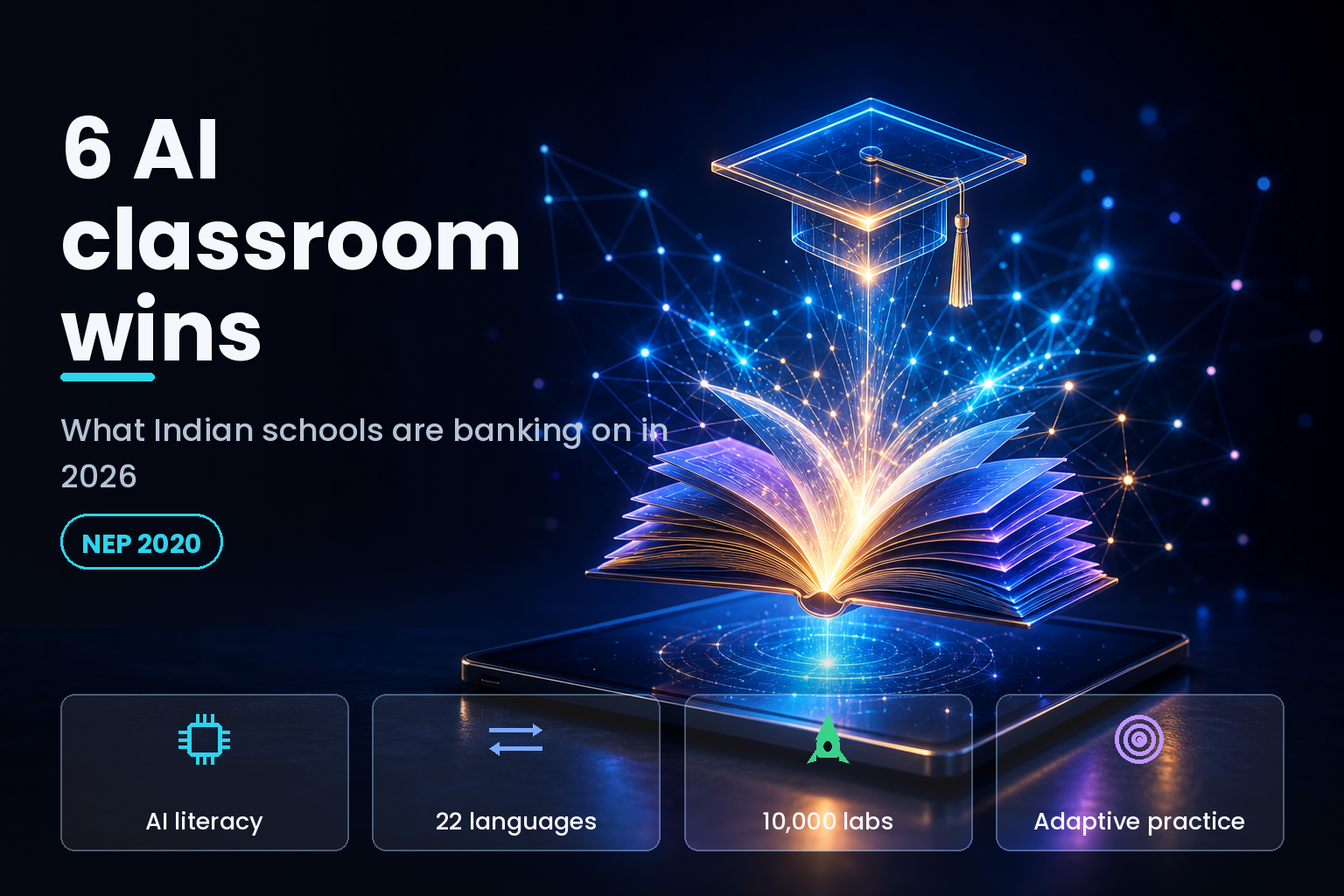
Summary. On 1 April 2026, the CBSE began rolling out a computational thinking and AI curriculum for Classes 3 to 8, launched by Union Education Minister Dharmendra Pradhan under the theme "AI for Education, AI in Education." That is the most visible of six AI classroom wins arriving this year, all of them flowing from the National Education Policy 2020 rather than any "NEP 2026," which does not exist as a separate policy. The supporting rails are already at national scale: DIKSHA has crossed 2 crore registered users and 182.3 million enrolments across 36 Indian languages, SWAYAM has logged 5.80 crore enrolments as of January 2026, and Bhashini translates across 22 scheduled languages with more than 300 AI models. India has also crossed 10,000 Atal Tinkering Labs reaching 1.1 crore students, with 50,000 more funded in the Union Budget 2025-26. The EdTech market behind all this is worth about ₹64,875 crore (US$7.5 billion). Here are the six wins, and the numbers behind each.
A word on framing before the list. AI in an Indian classroom in 2026 is not one product; it is a stack. The policy layer is NEP 2020 and the missions it spawned, such as NIPUN Bharat for foundational learning. The infrastructure layer is PM e-Vidya, which ties DIKSHA, SWAYAM, and television channels into a single public system. The application layer is where AI now sits: translation, adaptive practice, teacher tools, and a curriculum that teaches the technology itself. This article is written for school leaders, education-group founders, and EdTech product teams who need to see where the real, funded progress is, and where the gaps still are. Every win below is paired with a sourced number, and one of them comes with a sobering data point.
| Win | What it changes in the classroom | The 2026 lever |
|---|---|---|
| 1. AI literacy from Class 3 | Students learn how AI works, early | CBSE CT and AI curriculum, 2026-27 |
| 2. Mother-tongue learning | Content in a child's own language | Bhashini, 22 languages; DIKSHA, 36 |
| 3. Foundational literacy and numeracy | Practice adapts to each child's level | NIPUN Bharat, PARAKH 2026 data |
| 4. Teacher capacity | Less admin, better-trained teachers | NISHTHA training on DIKSHA |
| 5. Reach and equity | One system serves every board and state | PM e-Vidya, DIKSHA at 2 crore users |
| 6. Hands-on innovation | Project-based AI and tinkering | Atal Tinkering Labs, 10,000 plus |
Win 1: AI literacy starts in Class 3
The headline change is that Indian children now meet AI as a subject, not a buzzword. The CBSE curriculum on computational thinking and AI started with the 2026-27 session for Classes 3 to 8. The design is staged by age. Classes 3 to 5 build computational thinking through activity-based learning, puzzles, games, and storytelling, without screens dominating the room. Classes 6 to 8 move into foundational AI concepts alongside that thinking. The plan extends upward: Classes 9 and 10 take it as a compulsory subject from 2027-28, AI becomes a board-examined subject in 2029, and Classes 11 and 12 can choose it as an elective specialisation covering machine learning.
What makes this a win rather than a press release is the integration approach. CBSE is weaving AI and computational thinking into existing subjects, linking the concepts to mathematics, science, and the humanities, instead of bolting on a standalone period. As Dharmendra Pradhan, Union Minister of Education, said at the launch, "This curriculum will infuse new energy into the education sector. It will build logical thinking, fresh perspectives, and a culture of innovation among children." For a school, the practical task in 2026 is teacher readiness and lab access, not deciding whether to teach AI at all. That decision has been made centrally.
Win 2: learning in the mother tongue, at last
NEP 2020 put the mother tongue at the centre of early education, and AI translation is what finally makes that affordable at national scale. Bhashini, India's National Language Translation Mission launched in 2022, offers real-time translation across 22 scheduled languages and several tribal languages, with more than 300 pre-trained AI models exposed through open APIs. DIKSHA already serves its content in 36 Indian languages. Together they let a child in a Marathi-medium or Assamese-medium school reach the same material as a child in an English-medium one.
The gain here is concrete: language has long been the quiet filter that decides who keeps up. AI translation and speech tools, including work from AI4Bharat on Indian-language STEM content, shrink that filter. For an EdTech team, the lesson is that building English-first and translating later is now the slower path. The public language infrastructure exists, and parents increasingly expect content in the language spoken at home. This is also where the most visible classroom improvement shows up first, because comprehension rises the moment a student reads in a language they think in. With DIKSHA already serving content in 36 languages, the distribution problem is largely solved; the remaining work is quality translation of subject material, which is exactly what Bhashini and AI4Bharat are built to do.
Win 3: foundational literacy and numeracy that adapts
This is the win with a reality check attached. NIPUN Bharat, the national mission for foundational literacy and numeracy, was launched in 2021 under NEP 2020 and folded into Samagra Shiksha, with a target of basic reading and arithmetic by Class 3 by 2026-27. To see whether it is working, PARAKH ran the Foundational Learning Study in 2026, testing more than 1,00,000 Class 3 students across 10,000 schools in 776 districts, using tablets for real-time data capture.
The result is mixed, and worth stating plainly. The national average sat at 64%, and FLN levels had not improved beyond the 2017 scores, with wide gaps between states such as Kerala and Punjab on one side and Bihar and Jharkhand on the other. In several states, rural government schools outperformed urban private schools, a sign the targeted work helps where it reaches. AI adaptive practice is the tool schools are banking on to close that gap: software that meets each child at their level and gives the teacher a live view of who is stuck. The honest framing is that AI is a lever here, not a cure. The PARAKH data shows the problem is real and unsolved, which is exactly why personalised practice matters.
Win 4: teachers get capacity back
No classroom AI works if the teacher is overloaded, and the 2026 push pairs new tools with training. CBSE and the wider system run teacher development through NISHTHA on the DIKSHA platform, with free, structured modules that for the AI curriculum cover fundamentals, classroom activities, and assessment methods, and that are mandatory for teachers in CBSE-affiliated schools. On the FLN side, NISHTHA FLN training is one of the indicators by which NIPUN Bharat is tracked.
The second half of this win is workload. AI tools that draft lesson plans, generate practice sets, and speed up grading return time to teachers who are stretched across large classes. The measurable effect schools look for is simple: hours moved away from paperwork and back toward teaching. A school evaluating AI in 2026 should ask a vendor for the time saved per teacher per week, not the feature count, because that number is what determines whether the tool survives past the pilot.
Win 5: one system that reaches every board and state
The quiet structural win is that AI personalisation now rides on public rails that already reach the whole country. PM e-Vidya, built on the principle of "One Nation, One Digital Education Infrastructure," ties DIKSHA, SWAYAM, 48 SWAYAM Prabha television channels, radio, and podcasts into one system aligned with NEP 2020. DIKSHA alone reports more than 2 crore registered users, 19,698 courses, 182.3 million enrolments, and 145.7 million course completions, spanning NCERT, CBSE, NIOS, and state boards from foundational grades to senior secondary. SWAYAM, the MOOC platform in the same system, adds 5.80 crore enrolments across 4,400 courses built by ten national coordinators including NPTEL, NCERT, and IGNOU, so a learner can move from a school topic to a university one without leaving the public stack.
The reason this matters for AI is distribution. A new adaptive-learning feature does not need a separate app store or a marketing budget to reach a village school; it can ride the platform students and teachers already open. For founders, the build-or-integrate decision tilts toward integration with DIKSHA and the India stack, because the alternative is rebuilding reach that the public system already has. Equity improves when the same tool serves a private metro school and a rural government one through the same pipe.
Win 6: hands-on AI in the tinkering lab
The last win is physical and project-based. India has crossed 10,000 Atal Tinkering Labs, engaging more than 1.1 crore students, and many now integrate AI modules to build computational thinking through real projects rather than slides. The programme is scaling hard: under the Atal Innovation Mission 2.0, extended to March 2028 with a ₹2,750 crore budget, and the Union Budget 2025-26 target of 50,000 more labs in government schools over five years, each funded at ₹20 lakh.
The classroom effect is the kind of learning that sticks: a student who builds a small model, breaks it, and fixes it understands AI differently from one who only reads about it. For school leaders, the tinkering lab is also the most natural home for the new CBSE curriculum's practical side, so the two reforms reinforce each other. The win is depth, turning AI from a topic into something students make.
The NEP 2020 digital stack, by the numbers
| Initiative | Scale as of 2026 | What it enables |
|---|---|---|
| DIKSHA | 2 crore users; 182.3M enrolments; 36 languages | Curriculum-linked content for every board |
| SWAYAM | 5.80 crore enrolments; 4,400 courses | Online courses from school to higher ed |
| Bhashini | 22 scheduled languages; 300-plus AI models | Real-time translation of learning material |
| Atal Tinkering Labs | 10,000-plus labs; 1.1 crore students | Hands-on AI and computational thinking |
| PARAKH FLS 2026 | 1,00,000 students; 10,000 schools; 776 districts | Evidence on foundational learning |
CBSE AI curriculum: the rollout timeline
| Academic stage | Classes | What happens |
|---|---|---|
| 2026-27 | Classes 3 to 5 | Computational thinking via games and stories |
| 2026-27 | Classes 6 to 8 | Foundational AI concepts introduced |
| 2027-28 | Classes 9 to 10 | AI as a compulsory subject |
| 2029 | Class 10 | AI becomes a board-examined subject |
| Senior secondary | Classes 11 to 12 | AI elective, including machine learning |
India-specific considerations
Two India-specific realities shape every one of these wins. The first is money and scale. The Indian EdTech market is worth about ₹64,875 crore (US$7.5 billion) and is projected to reach roughly US$29 to 30 billion by 2030-31, while the global AI in education market is projected to reach more than US$130 billion by 2035. That capital is real, but so is the unevenness the PARAKH study exposed: a national FLN average of 64% with sharp state gaps means a tool that works in Kerala may need different support in Bihar. The same study found rural government schools outperforming urban private ones in several states, which should make any buyer wary of assuming the priciest tool wins. The signal for procurement is to test a tool against your own students' baseline before scaling it, because the national average hides who is ahead and who is behind.
The second reality is student data privacy, which is sharper here because learners are minors. The Digital Personal Data Protection Act 2023 and the DPDP Rules 2025 require verifiable parental consent before a child's personal data is processed, plus data minimisation and secure handling. A school or vendor deploying AI that touches student records has to build consent and protection in from the start, not retrofit it. For the broader view on running AI responsibly in an organisation, see our note on generative AI enterprise strategy for 2026.
What school leaders should do in 2026
Treat the six wins as a sequence, not a shopping list. Get teachers trained on the CBSE curriculum and the NISHTHA modules first, because the curriculum is mandatory and the calendar has already started. Lean on the public stack, DIKSHA and Bhashini, before buying parallel tools, since reach and language support already exist there. Use AI adaptive practice where the PARAKH data says the need is greatest, in foundational literacy and numeracy, and measure it against learning outcomes rather than logins. Pair the new curriculum with the tinkering lab so theory and practice meet. And put DPDP-aligned consent in place before any tool touches a child's data. The schools that win in 2026 are the ones that treat AI as part of teaching practice, not a separate technology project.
FAQ
How eCorpIT can help
eCorpIT is a CMMI Level 5, senior-led technology organisation in Gurugram that builds education and EdTech software for schools and learning groups. We build multilingual, DPDP-aligned learning platforms that integrate with the India stack, including DIKSHA-style content delivery and Bhashini-powered translation, and we design AI adaptive-practice and teacher tools around real classroom workflows. If you run a school group or an EdTech product and want AI that fits NEP 2020 and protects student data, talk to our team or read more about how we work.
References
_Last updated: 25 June 2026._