On this page · 10 sections
Summary. Predictive maintenance forecasts that a bearing will fail; agentic maintenance orders the part, schedules the technician and opens the work order. Deloitte expects agentic AI adoption in manufacturing to quadruple in 2026, from 6% to 24%, and names predictive maintenance the strongest first use case because the sensor data already exists and the downside is manageable. The prize is well established: McKinsey research links predictive maintenance to 30% to 50% less unplanned downtime, 18% to 25% lower maintenance costs, and 20% to 40% longer machine life, with per-facility savings of $1.5 million to $7.5 million and 10:1 to 30:1 returns inside 12 to 18 months. The risk is governance: 73% of enterprises rank data security as their top AI concern, yet only 21% have a mature model for governing autonomous agents. This guide covers the difference, the ROI, and how to roll it out without handing a machine an unsupervised chequebook.
Predictive tells you; agentic acts
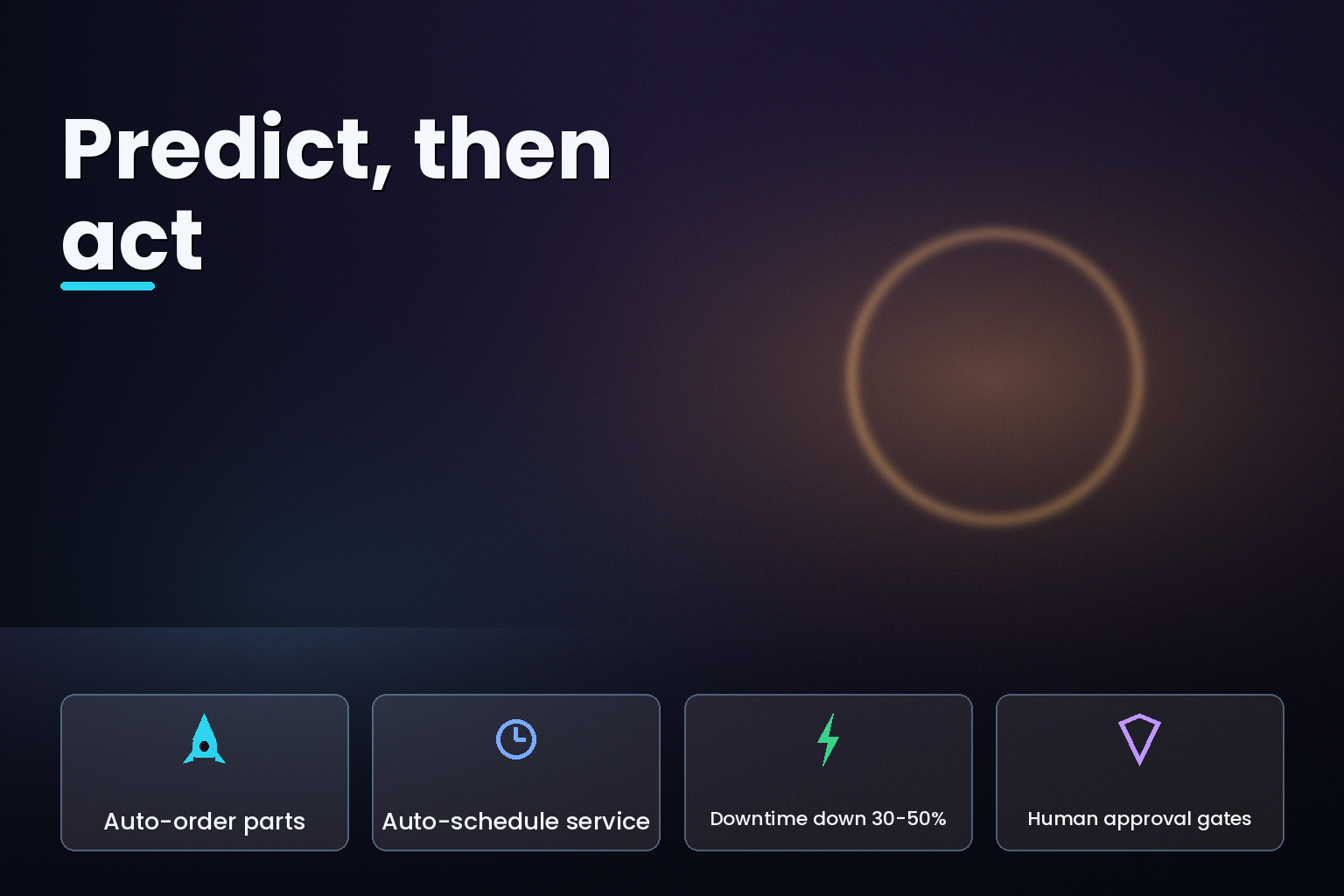
The line between the two is who does the next step. A predictive model reads vibration, temperature and current data and outputs a forecast: this pump has roughly two weeks left. A human then decides what to do. An agentic system closes that loop. With human oversight, it can detect the component wear, order the replacement part, schedule the service window, and adjust production quantities around the downtime, as Deloitte describes it. The model still makes the prediction; the agent turns the prediction into coordinated action across the maintenance, inventory and planning systems.
That is why Deloitte calls predictive maintenance the strongest candidate for agentic AI. The data infrastructure is already in place in most instrumented plants, the return is measurable, and the failure modes are contained: a wrongly ordered bearing is a recoverable mistake, not a safety event. The shift from predicting to acting is where the next wave of value sits, and it is also where the governance work begins.
| Capability | Predictive maintenance | Agentic maintenance |
|---|---|---|
| Detects wear from sensor data | Yes | Yes |
| Forecasts time to failure | Yes | Yes |
| Orders the replacement part | Human does it | Agent does it, with approval |
| Schedules the service window | Human does it | Agent coordinates it |
| Adjusts production around downtime | Separate planning step | Agent proposes the change |
| Human role | Decides every action | Sets limits, audits, approves exceptions |
The loop on one machine
Make it concrete with a conveyor drive motor. Vibration sensors feed a model that flags a rising imbalance and forecasts bearing failure in about twelve days. In a predictive setup, that alert lands in a maintenance planner's queue, and whether it gets actioned depends on how busy the planner is. In an agentic setup, the agent reads the same forecast and moves: it checks the spare-parts system, sees the bearing is in stock, reserves it, and books a technician into the next scheduled changeover so the line does not stop twice. Because the motor drives a non-critical line and the part is inexpensive, the order auto-executes; the agent logs every step and notifies the planner rather than asking permission.
Now change one detail. The same forecast on a safety-critical press does not auto-execute. The agent prepares the identical order and schedule, then routes it to a human for sign-off, because the criticality threshold says a person must approve. The difference between the two cases is not the model or the data; it is the authority the agent has been granted, and that authority is a governance decision, not a technical one.
The ROI is established, not speculative
The financial case does not rest on agentic hype; it inherits decades of predictive-maintenance evidence. McKinsey's analysis puts the operational gains at 30% to 50% lower unplanned downtime, 18% to 25% lower maintenance cost, and 20% to 40% longer machine life, and estimates the technology could be worth up to $630 billion a year to manufacturers worldwide. Leading adopters report 10:1 to 30:1 returns within 12 to 18 months, and per-facility savings of $1.5 million to $7.5 million when they move from reactive to predictive practice.
Agentic execution adds to that base by removing the human latency between a prediction and the action. When the agent files the parts order and the service ticket the moment the forecast crosses a threshold, the plant captures more of the theoretical downtime reduction, because fewer predictions sit in an inbox until the machine has already failed. The gain is not a new number; it is a larger share of the number McKinsey already documented.
| Metric | Documented range | Source |
|---|---|---|
| Unplanned downtime reduction | 30% to 50% | McKinsey |
| Maintenance cost reduction | 18% to 25% | McKinsey |
| Machine life extension | 20% to 40% | McKinsey |
| ROI within 12 to 18 months | 10:1 to 30:1 | McKinsey |
| Savings per facility | $1.5M to $7.5M | McKinsey |
| Agentic adoption in manufacturing, 2026 | 6% rising to 24% | Deloitte |
The governance gap is the real blocker
The technology is ahead of the controls. Deloitte's 2026 survey found that 73% of enterprises rank data privacy and security as their most concerning AI risk, while only about 21%, roughly one in five, have a mature governance model for autonomous agents. Nearly three in four plan to deploy agentic AI within two years, so most are about to give agents authority they are not yet equipped to supervise. On a factory floor that gap is concrete: an agent with a purchasing API and a scheduling API can spend money and move labour, so the controls around it are not paperwork, they are the safety system.
This is the same discipline that decides whether any AI agent reaches production. An agentic maintenance system is an AI agent with tools, so the scoping, least-privilege access and human-approval steps in our guide to getting AI agents to production apply directly on the plant floor.
A rollout checklist
Move in stages, and give the agent authority only as it earns trust.
1. Confirm the sensor and data foundation
Agentic maintenance needs a reliable stream of condition data: vibration, temperature, acoustic, current. If the instrumentation is patchy the predictions are noise and the agent will act on noise. Start with the assets that already have sensors and a failure history, which is also where Deloitte notes the data infrastructure is most mature.
2. Prove the prediction before you automate the action
Run the predictive model in advisory mode first and measure it against real failures. Track precision and recall on the forecasts. Only when the prediction is trustworthy do you let an agent act on it, because an autonomous action built on a bad forecast multiplies the error across ordering and scheduling.
3. Give the agent least-privilege tools with approval gates
Scope the agent to the specific systems it needs, a parts-ordering endpoint and a scheduling endpoint, and require human approval for anything above a cost or criticality threshold. A refurbished-bearing order under a set value can auto-execute; a spare for a safety-critical line goes to a person. This is the control layer the 79% without mature governance are missing.
4. Keep a human on the loop and log every action
Every agent decision, the forecast that triggered it, the part ordered, the slot booked, must be logged and auditable, with a named owner accountable for the agent's behaviour. Human oversight is not optional; Deloitte frames the entire agentic maintenance pattern as running under it.
5. Roll out asset by asset, then widen
Start on one line or one class of machine, measure the downtime and cost movement against the McKinsey ranges, and expand only when the numbers hold. Treat each expansion as a new deployment with its own approval limits, rather than switching the whole plant to autonomy at once.
What can go wrong
Four failure modes deserve attention before you switch on autonomy. The first is acting on a weak model: if the prediction has poor precision, the agent orders parts and books technicians for failures that were never coming, and the cost of those false positives eats the savings. Prove the forecast first. The second is alert fatigue turned into action fatigue, where an over-eager agent floods purchasing and scheduling with low-value orders; tight thresholds and batching keep it disciplined. The third is operational-technology security. An agent that reaches from the plant network into ordering and scheduling systems widens the attack surface, so the segregation between those networks is part of the design, not an afterthought. The fourth is over-automation: giving the agent authority over safety-critical assets before it has earned trust on ordinary ones. Deloitte's framing of human oversight exists precisely to prevent this, and the 21% figure for mature agent governance is a warning that most plants are not yet ready for broad autonomy.
India-specific considerations
Indian manufacturers sit at an earlier point on this curve, which is an advantage: plants adding instrumentation now can design the data foundation and the agent controls together, rather than retrofitting governance later. The economics travel well, because unplanned downtime is expensive in any currency, and a shift from reactive to predictive practice that saves a mid-size plant even the lower end of the McKinsey range is a strong rupee return on a modest sensor and software spend. Two cautions apply locally. Operational-technology security matters more once an agent can place orders and move schedules, so the network segregation between the plant floor and the ordering systems is part of the safety case. And any agent that touches worker or supplier personal data falls under the Digital Personal Data Protection Act, 2023, so the audit log and access controls serve compliance as well as safety. For the broader picture, see our work on AI on the factory floor and smart manufacturing with IoT and AI.
How eCorpIT can help
eCorpIT is a Gurugram-based technology company, founded in 2021, with CMMI Level 5 and ISO 27001:2022 certification and senior-led engineering teams across data, cloud and AI. We help manufacturers move from predicting failures to acting on them safely: validating the sensor and data foundation, proving the predictive model before automation, and building the least-privilege tool access and approval gates an agentic system needs. Our work on predictive maintenance ROI on the factory floor and the wider predictive maintenance for Indian manufacturing guide set the baseline. If you are scoping an agentic maintenance rollout, contact us for a costed plan.
FAQ
References
- Deloitte: How AI will redefine manufacturing competitiveness in 2026 — AI Magazine, citing Deloitte.
- Agentic AI is scaling in manufacturing, but infrastructure gaps remain — Manufacturing Dive.
- Agentic AI has the potential to rattle the manufacturing status quo: Deloitte — Manufacturing Dive.
- 2026 Manufacturing Industry Outlook — Deloitte Insights.
- The State of AI in the Enterprise, 2026 — Deloitte.
- Agentic AI strategy — Tech Trends 2026 — Deloitte Insights.
- Predictive maintenance cost savings: case studies — IIoT World.
- India DPDP compliance timeline and enforcement 2026-27 — India Briefing.
_Last updated: 1 August 2026._