On this page · 12 sections
- The six wins at a glance
- 1. Cut unplanned downtime by 30 to 50%
- 2. Lower maintenance cost by 18 to 25%
- 3. Extend equipment life by 20 to 40%
- 4. Bank a fast, high ROI
- 5. Move from reactive to a condition-based operating model
- 6. Ride India's policy and data tailwinds
- India-specific considerations
- A short adoption checklist
- FAQ
- How eCorpIT can help
- References
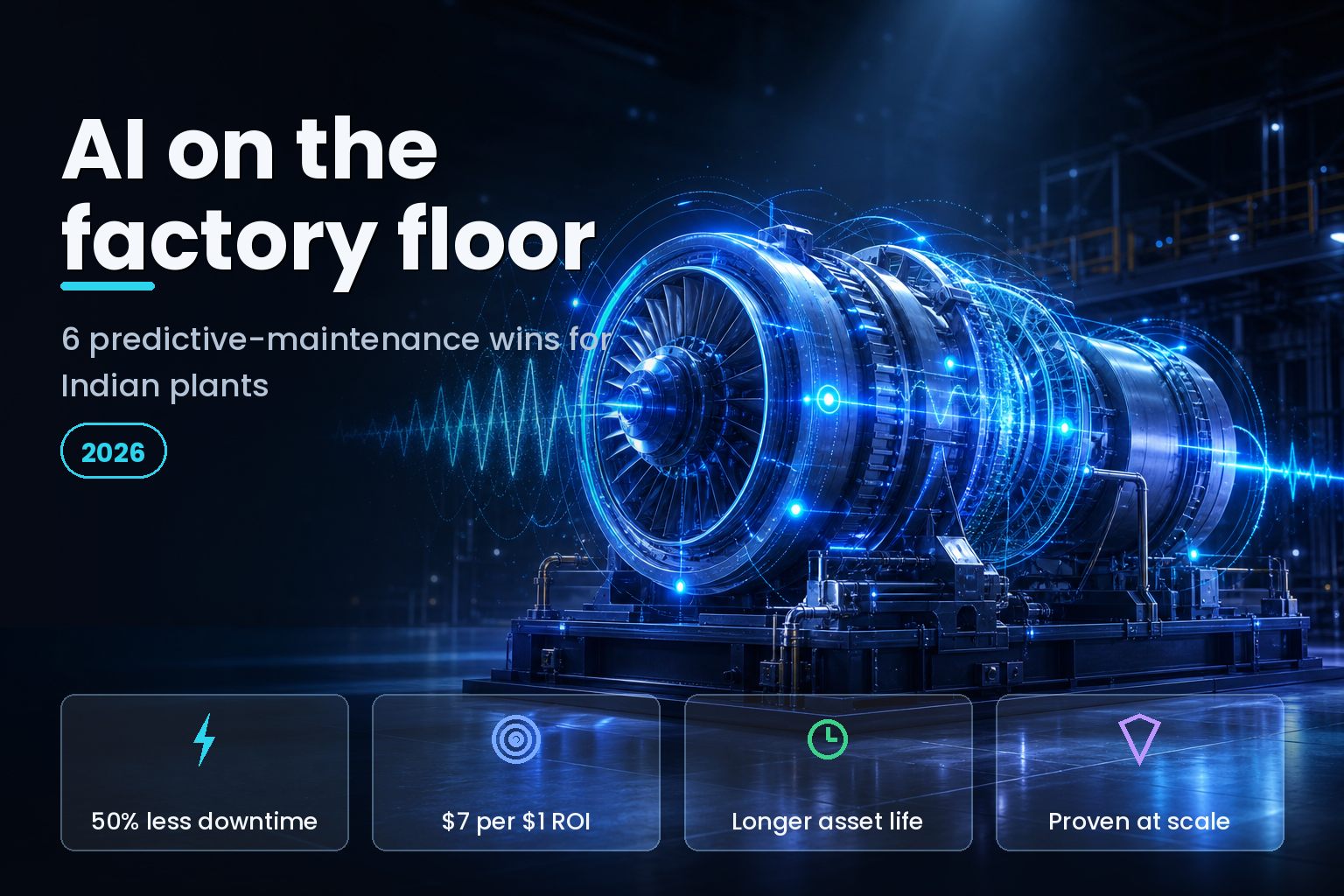
Summary. Predictive maintenance is the use case where factory AI pays back fastest, and the numbers are concrete. PwC documents a $7 return for every $1 invested, AI-driven programmes typically cut unplanned downtime 30 to 50% and maintenance costs 18 to 25%, with payback usually inside a year. India is moving on it: about 54% of Indian manufacturers have adopted AI and analytics, the government's ₹10,300 crore IndiaAI mission (approved 2024) is funding the base, and real plants show the payoff. Tata Steel reports a 50% cut in unplanned downtime and roughly ₹40 crore a year in savings from one programme, at a 1:10 cost-benefit ratio. A top-10 Indian cement producer saved ₹8 crore in the first year. This guide lays out 6 predictive-maintenance wins for Indian plant heads and CTOs in 2026, with the ROI math and the named results behind each.
The shift on the shop floor in 2026 is from fixing what breaks to predicting what will. For a plant head, the appeal is not the technology; it is the line item. Every prevented stoppage is output kept, and on a continuous line the cost of one unplanned stop dwarfs the cost of the sensors that would have caught it. The six wins below are the ones Indian plants are actually banking.
The six wins at a glance
| Win | Typical result | Proof point |
|---|---|---|
| 1. Less unplanned downtime | 30 to 50% reduction | Tata Steel: 50% cut |
| 2. Lower maintenance cost | 18 to 25% reduction | Cement plant: emergency spend down |
| 3. Longer asset life | 20 to 40% extension | Tata Steel: +25% equipment life |
| 4. Fast, high ROI | $7 per $1; payback under a year | PwC; Tata Steel 1:10 |
| 5. A new operating model | Reactive to condition-based | JSW Steel: 2,900+ assets monitored |
| 6. Policy and data tailwinds | National funding and incentives | ₹10,300 crore IndiaAI mission |
1. Cut unplanned downtime by 30 to 50%
This is the headline win and the one that funds the rest. AI-driven predictive maintenance reduces unplanned downtime 30 to 50% by reading vibration, temperature, and load data and flagging a failing bearing or motor before it stops the line. The Indian proof is strong: at Tata Steel, IoT sensors and AI models monitoring temperature, vibration, and energy cut unplanned downtime by 50%, with alerts arriving as much as two weeks before mechanical failure.
The reason this matters more in 2026 is cost. On a continuous-process Indian plant, in steel, cement, chemicals, or paper, one unplanned stop can run into crores: in the cement case below, each prevented stop was valued at about ₹2.4 crore. A single avoided stop can pay for the monitoring on a whole line.
2. Lower maintenance cost by 18 to 25%
Predictive maintenance is cheaper than both extremes it replaces. It runs 18 to 25% below scheduled preventive maintenance and far below reactive repair, because parts get changed when data says they need it rather than on a calendar or after they fail. A top-10 Indian cement producer that deployed IoT sensors with a maintenance system saved ₹8 crore in the first year, of which ₹2.2 crore came from lower emergency repair spend as its planned-maintenance ratio rose from 58% to 81% over eleven months.
The mechanism is the planned-to-unplanned ratio. Every repair you move from emergency to scheduled costs less in parts, in overtime, and in collateral damage to the equipment around it. That ratio is the single number a plant head can track to see predictive maintenance working.
3. Extend equipment life by 20 to 40%
Catching wear early does not only avoid the stop; it lengthens the life of the asset. Programmes report 20 to 40% longer equipment lifespan because machines run inside their healthy envelope instead of being driven to failure. Tata Steel's programme improved average equipment lifespan by about 25%, deferring capital replacement on expensive assets.
For an Indian plant carrying imported machinery, this is a balance-sheet win as much as a maintenance one. Stretching a high-value asset's life by a quarter pushes out a large capital outlay and improves return on the equipment already installed, which matters when replacement parts and machines often carry import cost and lead time.
4. Bank a fast, high ROI
The economics are unusually clear for an AI project. PwC documents a $7 return for every $1 invested in predictive maintenance, programmes commonly show 10:1 to 30:1 ROI within 12 to 18 months, and most plants reach payback in under a year. Tata Steel's programme reports a 1:10 cost-benefit ratio, meaning every rupee invested returned ten in value.
This is why predictive maintenance is the usual entry point for factory AI rather than a later phase. The investment is bounded, the savings are measurable on existing line items, and the payback period is short enough to clear a conservative capital committee. Start where the ROI is provable, then fund the next use case from the savings.
| Metric | Typical range | Source |
|---|---|---|
| Unplanned downtime reduction | 30 to 50% | Industrial reliability data |
| Maintenance cost reduction | 18 to 25% | vs scheduled preventive |
| Equipment life extension | 20 to 40% | Reliability programmes |
| ROI ratio | $7:$1 to 30:1 | PwC and industry data |
| Payback period | Under 12 months | Most deployments |
5. Move from reactive to a condition-based operating model
The deeper win is a change in how the plant runs. Predictive maintenance moves the operation from reactive repair and fixed-calendar servicing to condition-based intervention driven by live data from IoT sensors, ERP, and historian systems. In 2026 that increasingly means AI agents that watch asset data continuously and surface the few signals that matter, rather than dashboards a person has to read.
The scale this enables is the point. JSW Steel's predictive-maintenance platform spans 10 plants and more than 2,900 assets, a reach no manual inspection regime could match. Tata Steel's Kalinganagar plant became the first Indian facility recognised as a World Economic Forum Industry 4.0 Lighthouse, which signals that the model, not just the tool, has matured. Building this well is where an enterprise AI strategy and clean sensor-data plumbing earn their keep, a theme we expand in our guide to IoT and AI in Indian factories.
6. Ride India's policy and data tailwinds
The sixth win is timing. India's smart-factory market was valued at about $7.7 billion in 2025 and is projected to reach $17 billion by 2032, and the wider Industry 4.0 market is forecast to grow from roughly $5.5 billion in 2024 to $26.7 billion by 2033. Policy is pushing the same way: the ₹10,300 crore IndiaAI mission funds compute, datasets, and skilling, while Make in India and the Production Linked Incentive schemes reward domestic manufacturing investment.
For a plant head, the tailwind means cheaper inputs and more local talent than even two years ago, plus peers, Tata Steel, JSW Steel, Holcim, ACC, UltraTech, and Ambuja among them, who have already proven the playbook. Moving in 2026 means buying into a maturing ecosystem rather than pioneering alone.
India-specific considerations
Two India realities shape how to deploy. First, the data foundation: many Indian plants run a mix of older machinery and newer lines, so the first step is often retrofitting low-cost IoT sensors to legacy assets rather than ripping and replacing. Second, governance: predictive-maintenance systems pull operational and sometimes personal data, so deployments should be designed in line with the Digital Personal Data Protection Act (DPDP) 2023 where worker or vendor data is involved. We design industrial AI and data pipelines aligned with DPDP requirements rather than claiming any system is automatically compliant. The realistic Indian starting point is a single high-value line, instrumented and proven, then scaled, exactly the path the cement and steel cases above followed.
A short adoption checklist
Pick one high-value, high-downtime line as the pilot, not the whole plant. Retrofit sensors to capture vibration, temperature, and load on its critical assets. Track one headline metric, the planned-to-unplanned maintenance ratio, and one financial metric, downtime cost avoided. Set a payback target inside twelve months, which predictive maintenance usually clears. Then reinvest the proven savings into the next line and the next use case, computer-vision quality control or energy optimisation. Build the data governance in from the start so scaling does not mean re-architecting later.
FAQ
How eCorpIT can help
eCorpIT is a senior-led technology consulting organisation in Gurugram that helps Indian manufacturers put predictive maintenance into production. We instrument a high-value line with IoT sensors, build the data pipeline from machine to model, stand up the analytics and AI-agent layer, and track the planned-to-unplanned ratio and downtime-cost-avoided so the ROI is visible, with data governance aligned to DPDP. If you want to prove predictive maintenance on one line before scaling it across the plant, contact us to scope a pilot with a payback target inside a year.
References
_Last updated: June 22, 2026._