On this page · 10 sections
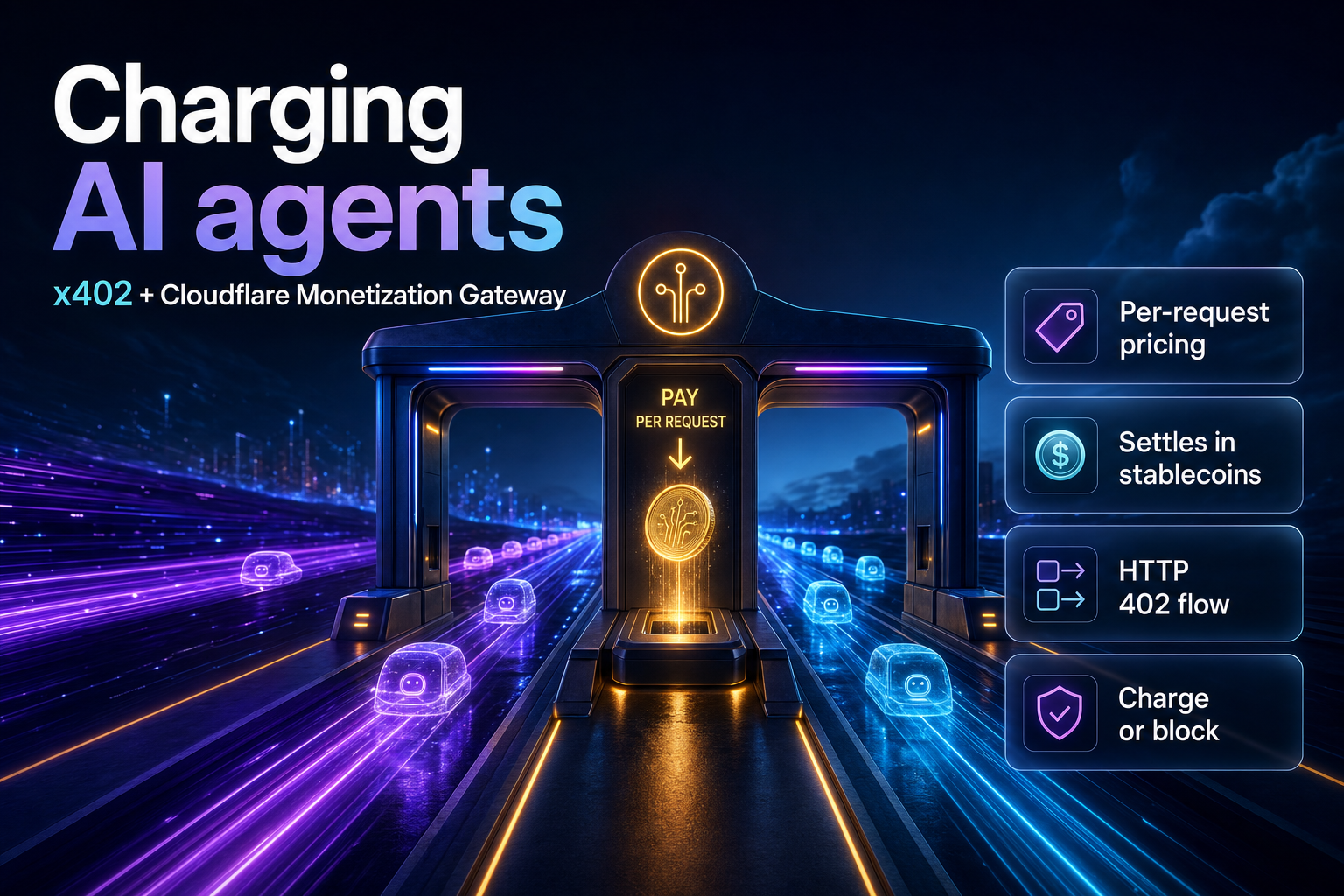
Summary. On 1 July 2026 Cloudflare opened the waitlist for its Monetization Gateway, an engine that lets you charge for any asset behind Cloudflare, web pages, datasets, APIs or MCP tools, with charges settling in stablecoins over the x402 open protocol and no payments stack of your own to build. You can price a call at $0.01 per GET or POST, charge up to $2 for a compute-heavy task like image generation, or add a $0.001 base fee plus $0.01 per MB for uploads. Two weeks later, on 14 July 2026, the x402 Foundation began operations under the Linux Foundation with 40 members, including AWS, Google, Cloudflare, Coinbase, Stripe, Visa and Mastercard. The pitch is simple: AI agents now browse, call APIs and invoke tools at machine speed, and most of what they consume is unmonetized. This guide explains how x402 works, how to price and configure the Monetization Gateway, and the harder question, whether you should charge an agent, block it, or leave the door open so AI answer engines keep citing you.
What the Monetization Gateway does, and what it does not
The Monetization Gateway is Cloudflare's move from blocking AI traffic to billing it. Its predecessor, Pay Per Crawl, let publishers charge AI crawlers for fetching content. The Monetization Gateway widens that idea to any Cloudflare-protected resource: a REST API, a dataset download, a single web page, or a Model Context Protocol (MCP) tool call that an agent makes. When a request matches a rule you set, the gateway verifies payment before letting the request reach your origin.
The part that matters for engineering teams is what moves off your servers. Cloudflare states that the metering, the payment exchange and the settlement all happen at the edge, so you do not onboard the buyer or stand up a billing system. In Cloudflare's words, "you will write a rule and agentic buyers will pay for what they use." What stays with you is your rules, your prices and your revenue.
What it is not, yet, is generally available. As of the 1 July 2026 announcement the Monetization Gateway is an early-access waitlist for Cloudflare customers, not a shipped product with a public price sheet. Treat the pricing examples below as the shape of the feature, and plan a proof of concept rather than a production rollout until it reaches general availability. It also is not a way to charge human visitors: the target is machine traffic, the agents and crawlers that already account for a large and growing share of requests.
How x402 works: the HTTP 402 flow
x402 revives a status code that has sat unused since the early web: HTTP 402 Payment Required. The protocol, contributed by Coinbase and now stewarded by the Linux Foundation, embeds payment into an ordinary HTTP request and response, so an agent can pay for a resource in the same round trip it uses to fetch it.
Two properties make it a fit for machine payments, per Cloudflare's description. Amounts can be tiny, down to fractions of a cent, because the protocol adds almost no overhead. And the buyer needs no account with the seller, because the payment itself is the credential. x402 is rail-agnostic but pairs naturally with stablecoins, which settle in under a second for a fraction of a cent with no chargebacks. A simplified exchange looks like this, following the x402 specification:
            GET /api/premium/report HTTP/1.1          # 1. agent requests a paid resource
Host: api.example.com

HTTP/1.1 402 Payment Required             # 2. server answers with a price
{
  "accepts": [{
    "scheme": "exact", "network": "base",
    "maxAmountRequired": "10000",          # 0.01 USDC (6 decimals)
    "asset": "USDC", "payTo": "0xabc...",
    "resource": "/api/premium/report"
  }]
}

GET /api/premium/report HTTP/1.1          # 3. agent retries with payment proof
X-PAYMENT: <base64 signed payment payload>

HTTP/1.1 200 OK                           # 4. facilitator verifies, origin responds
A facilitator, a service that checks the payment on-chain, sits between the buyer and the seller so neither side runs blockchain infrastructure. With the Monetization Gateway, Cloudflare plays that role at the edge. Google's Agent Payments Protocol (AP2) has adopted x402 as its default stablecoin rail through a published A2A extension, per Coinbase's developer documentation, which means the same payment envelope works whether the buyer is a Cloudflare-fronted crawler or an agent built on Google's stack.
Pricing models you can set
Cloudflare's announcement gives concrete examples of the rules you will be able to define. The useful mental model is that pricing follows the request, not the user, so you attach a price to a route, a verb, or a payload size.
| Pricing rule | Example from Cloudflare | Good for |
|---|---|---|
| Flat per-request | $0.01 for every GET or POST to /api/premium/* | Predictable read or write APIs |
| Per megabyte | $0.001 base fee plus $0.01 per MB on an upload endpoint | Data uploads and large downloads |
| Variable by compute | Up to $2 for a task such as image generation, by cost | Compute-heavy or model-backed endpoints |
| Unauthenticated only | Intercept a 401 from your origin, return 402 instead | Free for logged-in users, paid for agents |
| Per MCP tool call | A price on each tool invocation an agent makes | Monetizing an MCP server |
The unauthenticated-only rule is the quiet workhorse. Your human users and paying customers keep their existing login and pay nothing extra, while anonymous machine callers hit a 402 with a price. That lets you monetize scraping and agent traffic without touching the experience of the people who already pay you. If you run an MCP server, the same mechanism turns each tool call into a metered unit, which is a cleaner commercial model than a flat subscription for tools an agent may call thousands of times or never. We cover the build side of that in our guide to MCP server development.
How to set it up
The Monetization Gateway is configured the way the rest of Cloudflare is: rules in the dashboard, or the same rules as code through the Cloudflare API and Terraform, so a paid endpoint becomes part of your infrastructure config rather than a bolt-on. Conceptually, the rule you define reads like this:
            # Illustrative only. The Monetization Gateway is in early access;
# exact field names will follow Cloudflare's released schema.
route:   "/api/premium/*"
methods: ["GET", "POST"]
price:   { amount: "0.01", asset: "USDC", network: "base" }
applies_to: unauthenticated   # let logged-in users through free
Three implementation notes matter before you switch a rule on. First, you need somewhere for the money to land: an address or account that your facilitator settles to, which for stablecoins means a wallet and the operational care that comes with holding one. Second, decide your default for non-paying agents, either a hard 402 or a degraded free tier, because a blanket 402 on public content can remove you from places you want to be seen. Third, log and monitor agent traffic first. You cannot price what you have not measured, so run in observe-only mode and look at which routes agents actually hit before you attach a number. For teams that want to keep controlling, rather than charging, crawler traffic, Cloudflare's existing AI crawler controls remain the tool to reach for, and the two can be combined.
Charge, block, or stay free: the real decision
The technical setup is the easy part. The commercial question is whether charging is the right move for a given resource at all, and the answer is different for a private API than for the marketing content you want AI answer engines to quote.
| Your resource and goal | Recommended stance | Why |
|---|---|---|
| High-value API or proprietary dataset | Charge | Direct value an agent consumes; metered pricing fits usage |
| Compute-heavy or model-backed endpoint | Charge (variable) | Recovers real per-call cost; discourages abusive scraping |
| MCP tools you expose to agents | Charge per call | Aligns revenue with actual tool usage |
| Marketing or thought-leadership content | Stay free | Being cited in AI answers drives demand; a paywall removes you |
| Content you do not want trained on | Block | Pricing invites access; a block denies it |
The trap for content publishers is charging the very crawlers that feed the AI answers now sending them traffic. Cloudflare itself frames a parallel product around paying creators when an answer engine uses their content, which is the opposite instinct to walling everything off. If your growth depends on visibility in ChatGPT, Perplexity, Gemini and Google's AI Overviews, charging or blocking their crawlers can cut your citations and your referral traffic. The sharper strategy is segmentation: charge for the high-value APIs, datasets and tools an agent genuinely consumes, and keep the content you want quoted open and well structured. That is the same logic behind generative-engine optimisation, and it does not conflict with monetizing your machine-facing surfaces.
The standards picture, and why it is moving fast
x402 stopped being a single-vendor project on 14 July 2026, when the Linux Foundation took over stewardship with 40 member organisations. The Premier tier alone spans Adyen, AWS, American Express, Circle, Cloudflare, Coinbase, Fiserv, Google, Mastercard, MoonPay, Ripple, Shopify, Stripe and Visa, a roster that covers card networks, stablecoin issuers, cloud providers and commerce platforms at once.
"Moving the protocol to the Linux Foundation, with dozens of members spanning every corner of internet payments and infrastructure, is how open technology earns lasting trust across an industry," said Lincoln Murr, Head of AI Product at Coinbase, in the launch announcement. The neutral-governance framing is the point: card networks and stablecoin issuers rarely agree to a shared rail, and vendor-neutral standards are what make a payment layer safe to build on. For a team deciding whether to invest engineering time now, the breadth of that membership is the strongest signal that x402 is not a passing crypto experiment. It sits beside the broader agentic-commerce standards, which we cover in the agentic commerce standards guide for merchants and in the wider web platform developer guide.
India-specific considerations
For Indian teams there are two extra layers. First, payments here run through UPI, and the agentic version of that story is NPCI's own work on an agent protocol for UPI payments, which we walk through in agentic UPI payments in India. An Indian business monetizing agent traffic will likely straddle both worlds: x402 and stablecoins for global machine buyers, UPI rails for domestic ones. Second, the regulatory ground under stablecoins is not settled in India, and holding or settling in crypto assets carries tax and compliance questions that a rupee-denominated UPI flow does not. Under the Digital Personal Data Protection Act 2023, remember that metering agent traffic still means processing request data, so log retention and purpose limitation apply to your monetization pipeline as they would to any other. The practical path for most Indian API businesses in 2026 is to pilot x402 for international agent revenue while keeping settlement conservative, and to design aligned with DPDP requirements from the first rule you write.
FAQ
How eCorpIT can help
eCorpIT is a Gurugram-based, CMMI Level 5 and ISO 27001:2022 certified engineering organisation that builds and monetizes APIs, MCP servers and content platforms for global and Indian businesses. Our senior engineers can measure your agent and crawler traffic, model which routes are worth charging for, and implement x402 pricing through Cloudflare while keeping the content you want cited in AI answers open. We design the settlement, logging and DPDP-aligned data handling around it so monetization does not create a compliance gap. To scope charging AI agents for your API or content, tell us your workload at /contact-us/.
References
- Cloudflare, Announcing the Monetization Gateway: charge for any resource behind Cloudflare via x402, 1 July 2026.
- Linux Foundation, Linux Foundation announces operational launch of the x402 Foundation, 14 July 2026.
- x402 Foundation, Operational launch announcement, 14 July 2026.
- Coinbase, x402 protocol specification and typical flow (GitHub), 2026.
- Coinbase, Coinbase and Cloudflare will launch the x402 Foundation, 2026.
- Coinbase Developer Platform, Google Agentic Payments Protocol plus x402, 2026.
- The Defiant, Coinbase's x402 payment protocol moves to Linux Foundation, July 2026.
- Cloudflare, Making AI search smarter: paying creators when an answer engine uses their content, 2026.
- CFOtech, Linux Foundation launches x402 Foundation with 40 members, July 2026.
- Open Source For You, Linux Foundation operationalises x402 Foundation for automated machine payments, July 2026.
- FourWeekMBA, Cloudflare's Monetization Gateway turns HTTP 402 and stablecoins into the tollbooth of the agentic web, July 2026.
Last updated: 27 July 2026.