On this page · 13 sections
- The headline announcements
- The Siri AI rebuild
- The architecture: AFM 3, System Orchestrator, expanded PCC
- iOS 27: speed, design, and safety
- iPadOS 27, watchOS 27, visionOS 27, macOS Golden Gate
- Compatibility and availability — the unprecedented support promise
- The EU and China carve-out
- What it means for businesses and developers
- Tim Cook's farewell
- A note on our pre-keynote coverage
- FAQ
- How eCorpIT can help
- References
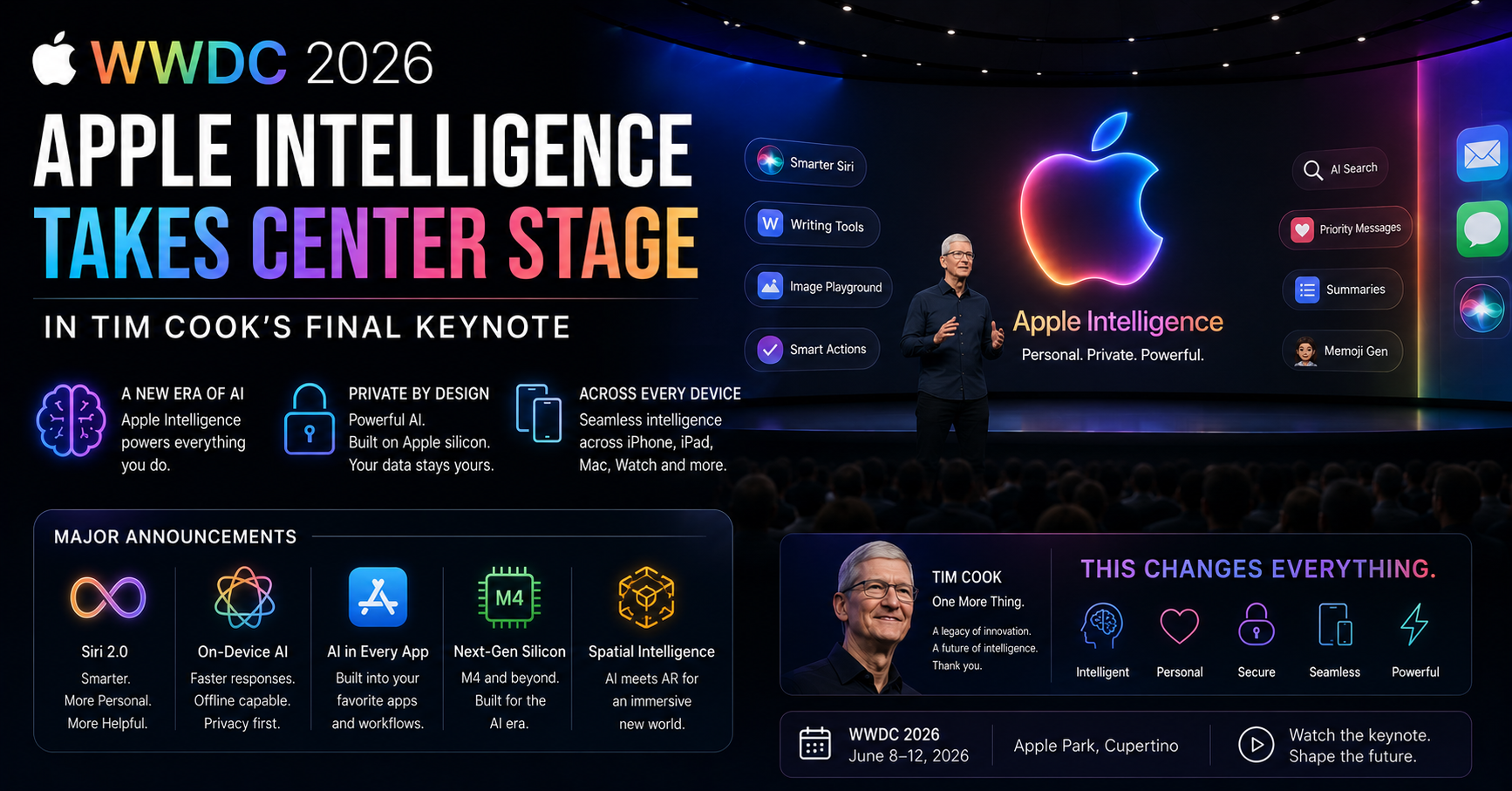
Summary. Apple's WWDC 2026 keynote on Monday, June 8, was the most consequential event the company has held in years — and the last one Tim Cook will deliver as CEO. Cook hands the title to John Ternus on September 1, 2026 and moves to Executive Chairman, ending a fifteen-year run as Apple's chief executive. The keynote centred on Siri AI, a re-architected assistant built on the third generation of Apple Foundation Models (AFM 3) and a Private Cloud Compute expansion that now uses Google Cloud infrastructure running on Nvidia GPUs. iOS 27 confirmed compatibility with the iPhone 11 series and every newer device — Apple dropped no iPhone from support this year, which is unprecedented in the company's history. The new Siri AI will not be available in the European Union or China at launch because of regulatory disputes, particularly around the EU's Digital Markets Act. This article walks through what was actually announced, what changed from the pre-keynote rumours, and what enterprises and developers should now plan for.
The keynote did three things at once: it formalised the company's AI architecture after eighteen months of public disappointment over the original 2024 Siri promises, it confirmed the long-rumoured leadership succession, and it set a deliberate "Snow Leopard" tone — performance and stability over headline new features. Cook closed with a personal message to the developer community, thanking them for fifteen years of partnership and saying the company is in good hands as the transition completes.
This guide is built for iPhone and Mac users, iOS and Mac developers, IT teams planning fleet upgrades, and business leaders building on Apple platforms. The research draws on Apple's own newsroom, MacRumors, TechCrunch, CNBC, Tom's Guide, TechRadar, Variety, AppleInsider, MacObserver and Apple Machine Learning Research, with primary verification against Apple's keynote stream and the AFM 3 technical paper.
The headline announcements
Six items dominated the keynote. Each one matters for different audiences.
Siri AI rebranded. Siri is now Siri AI — Apple's first formal renaming of its assistant in its fifteen-year life. The change reflects how different the new assistant is from the voice-command tool it replaces: conversational, multi-turn, on-screen aware, with personal context, and an iMessage-style dedicated app for the first time.
AFM 3 architecture confirmed. Apple Machine Learning Research published the AFM 3 technical paper alongside the keynote. The on-device model — AFM 3 Core Advanced — is a 20-billion-parameter multimodal sparse model. AFM Cloud Pro, the largest cloud model, is described by Apple as "similar in quality to Gemini Frontier models" and runs on Nvidia GPUs hosted in Google Cloud.
iOS 27 supports iPhone 11 and newer. Apple's compatibility list confirmed at the keynote includes every iPhone running iOS 26 — no device was dropped from support this year. MacObserver reported this is unprecedented in Apple's iPhone history. Our earlier pre-keynote coverage had reported the rumoured iPhone 12+ cutoff based on pre-WWDC reporting; the actual announcement is more generous.
Apple Intelligence features remain gated by hardware. Siri AI itself requires iPhone 15 Pro or newer (or an M1 Mac or M-series iPad). Advanced voices and dictation features require iPhone 17 Pro, iPhone Air, or the latest M-series hardware with at least 12GB of memory. The two-tier compatibility (every iPhone gets iOS 27; only newer iPhones get Apple Intelligence) lets older devices participate in the OS without the cost of upgrading.
Public release confirmed for September 14, 2026. The developer beta is available today; the public beta arrives in mid-July; the general release lands on September 14, 2026 alongside the iPhone 17 launch. This matches our pre-keynote release-date analysis.
Tim Cook's farewell and the Ternus succession. Apple announced the CEO transition on April 20, 2026, naming Senior Vice President of Hardware Engineering John Ternus as Cook's successor. Cook transitions to Executive Chairman on September 1, 2026 — meaning the WWDC 2026 keynote is, as widely reported across Fox Business and others, his final WWDC as CEO. Cook closed the keynote with a personal message thanking the developer community for fifteen years of partnership.
The Siri AI rebuild
The keynote spent its largest single block on Siri AI. The capabilities Apple confirmed match the architecture observers had been mapping since the 2024 preview was delayed.
Conversational intelligence. Siri AI maintains a back-and-forth conversation, remembers personal context from prior interactions, and handles multi-step requests across applications. Apple's framing: "Siri is now a profoundly more capable assistant that helps you find what you need and gets more done. It's also more conversational, so you can go back and forth like never before and get detailed, engaging answers."
A dedicated Siri app. For the first time, Siri has its own app — users can view past conversation history, pin important chats, and continue interactions across iPhone, iPad and Mac via iCloud. The interface uses iMessage-style conversation bubbles and rich cards for results.
Visual awareness via the camera. A new "Siri mode" in the camera app lets Siri understand and act on what the user sees — identifying landmarks, retrieving nutritional information from a plate of food, reading and translating text on signs, or pulling product information from a barcode. This is the most concrete consumer use case for Apple Intelligence's on-screen awareness work.
System integration. Siri AI now lives in the Dynamic Island on iPhone and is integrated into Spotlight on the Mac, where users can right-click files to initiate AI-driven actions — summarising a long document, generating a draft response to an email thread, classifying photos by content type, or extracting structured data from a spreadsheet.
The pieces match what our pre-keynote coverage on the iOS 27 Siri overhaul anticipated. The execution lands cleanly against the architecture sketched in pre-keynote reporting from Bloomberg, MacRumors and 9to5Mac.
The architecture: AFM 3, System Orchestrator, expanded PCC
For developers, engineers and business buyers, the more important detail is the architecture beneath Siri AI.
Three generations of foundation models. Apple Machine Learning Research describes AFM 3 as the third generation, organised into three model tiers — Core, Core Advanced, and Cloud. AFM 3 Core handles the lightest on-device tasks. AFM 3 Core Advanced is the 20-billion-parameter sparsely activated model that handles heavier on-device reasoning. AFM 3 Cloud and AFM Cloud Pro handle the heaviest workloads in Private Cloud Compute.
AFM 3 Core Advanced as a 20B sparse model. The technical achievement worth understanding: a 20-billion-parameter model running on a smartphone is unprecedented. Apple uses what it calls Instruction-Following Pruning to activate only 1 to 4 billion parameters per request, with the full model stored in flash memory (NAND) rather than DRAM. Routing decisions are made per prompt. The result is a 20B-class model that fits in the thermal and memory envelope of an iPhone 15 Pro or newer.
System Orchestrator. A new component coordinates requests across the model tiers — deciding whether to process a task on-device (using AFM 3 Core or Core Advanced) or in the cloud (using AFM 3 Cloud or AFM Cloud Pro). The decision logic considers task complexity, privacy sensitivity, latency requirements and device thermal state. Users do not see the routing decision; the Orchestrator hides the complexity.
Expanded Private Cloud Compute on Google Cloud + Nvidia. This is the most architecturally significant detail. Private Cloud Compute — Apple's verifiable-privacy cloud architecture introduced in 2024 — now extends to Google Cloud infrastructure running on Nvidia GPUs. AFM Cloud Pro, described by Apple as comparable in quality to Gemini Frontier models, runs on this stack. Despite using third-party data centres, Apple maintains cryptographically verifiable control over the software stack: the device encrypts requests directly to attested PCC nodes, no user data is stored or accessible to anyone (Apple, Google, or anyone else), and the boot images are published for security researcher inspection.
The implications for enterprise AI architecture work are substantial — this is the most mature working example to date of a "verifiable privacy" cloud AI stack hosted on a hyperscaler's infrastructure. Engineers designing comparable systems should study what Apple published.
For more on the underlying memory and partnership architecture, see our coverage of the SK Hynix-Nvidia AI factories deal.
iOS 27: speed, design, and safety
Beyond Apple Intelligence, iOS 27 introduces refinements aligned with the "Snow Leopard" positioning Apple's leadership signalled in the run-up to WWDC.
Performance. Apple focused heavily on responsiveness. Apps launch up to 30% faster on supported hardware. A redesigned CPU scheduler is designed to make older devices — particularly iPhone 11, iPhone 12 and iPhone SE 3 — feel more agile under iOS 27 than they do under iOS 26.
Liquid Glass refinements. The Liquid Glass interface introduced in the previous cycle has been refined for better readability and contrast. A new system-wide transparency slider lets users adjust the intensity of the glass effect from clear to fully tinted, addressing accessibility feedback from the first generation of the design.
Parental controls and child safety. Apple introduced "Ask to Browse," requiring children using devices in family-shared accounts to request permission before visiting new websites. Communication Safety tools have been expanded — they now proactively monitor for and blur depictions of gore or violent content in addition to the existing nudity detection. These updates respond to ongoing public-policy pressure in multiple jurisdictions around child safety in messaging and browsing.
Smarter Photos. The Photos app gains Spatial Reframing — an AI feature that lets users shift the angle of a shot after it has been taken, useful for correcting awkward selfies or group shots — and an Extend tool that uses generative fill to create new edges for an image, useful for fixing crooked horizons or extending compositions. Both features run on-device using AFM 3 Core Advanced on supported hardware.
Other system changes. Spotlight gains semantic search across all on-device content. Focus modes integrate with Siri AI's context awareness. Mail introduces AI-assisted reply drafting that uses prior conversation context. Messages adds bridge support for RCS, completing the cross-platform messaging transition that started in iOS 18.
iPadOS 27, watchOS 27, visionOS 27, macOS Golden Gate
The wider ecosystem updates land alongside iOS 27.
iPadOS 27. Features the same dedicated Siri app, AI-powered tab organisation in Safari, and the long-requested ability to resize all iPhone apps on the iPad. iPad-specific Apple Intelligence features take advantage of the larger screen and the M-series Neural Engine.
watchOS 27. Brings Siri AI to the wrist for Apple Watch Series 10, Series 11 and Apple Watch Ultra (recent generations). A dynamic app grid highlights Siri-suggested apps based on time of day and context. Siri AI on watchOS leans on iPhone-side processing for heavier workloads while maintaining device-only handling for sensitive queries.
visionOS 27. Introduces the ability to turn standard panoramas captured on iPhone into immersive spatial scenes viewable on Vision Pro. Visual Intelligence in visionOS lets Siri identify objects in the wearer's physical space and provide contextual information. The platform's third generation continues to refine the spatial computing model Apple introduced in 2024.
macOS 27 — codenamed "Golden Gate." Brings Apple Intelligence parity with iOS and iPadOS, plus the Spotlight right-click AI actions, the dedicated Siri app, and a refined Liquid Glass implementation tuned for desktop display sizes. Apple confirmed compatibility extending broadly across Mac models from late 2020 onward, with M-series Macs receiving the full Apple Intelligence feature set.
Compatibility and availability — the unprecedented support promise
The compatibility story this year is unusual.
iOS 27 supports every iPhone that runs iOS 26. That includes iPhone 11, iPhone 11 Pro, iPhone 11 Pro Max, iPhone SE (2nd generation), iPhone SE (3rd generation), every iPhone 12 through iPhone 17 model, and the new iPhone Air. Per AppleInsider's confirmation and MacObserver, this is the first year in iPhone history that Apple has dropped no device from support.
Siri AI requires newer hardware. Siri AI itself requires iPhone 15 Pro, iPhone 15 Pro Max, any iPhone 16 model, any iPhone 17 model, iPhone Air, an M1 Mac or newer, or an iPad with M1 or newer. The hardware floor is set by the requirement to run AFM 3 Core Advanced — the 20B-parameter sparse model — and the memory needed to support it.
Advanced voices and dictation features. The most demanding Apple Intelligence features — advanced expressive voices, the higher-accuracy dictation models — require iPhone 17 Pro, iPhone Air, or the latest M-series hardware with at least 12GB of memory.
The split lets every existing iPhone owner get the performance and design refinements of iOS 27 while reserving the heaviest AI workloads for hardware that can actually run them. For Indian and emerging-market buyers in particular, the iPhone 11 and iPhone SE family staying on iOS 27 extends device life and reduces the pressure to upgrade.
The EU and China carve-out
The most consequential geographic detail: Siri AI will not be available in the European Union or in China at launch. The decision and its reasoning matter for any European or Chinese organisation planning Apple AI deployment.
The EU position. Per MacRumors' coverage of Apple's statement and PhoneArena's analysis, the EU's Digital Markets Act would require Apple to give any AI system "nearly unlimited access to a user's device, as well as the ability to act on that access autonomously without a user's ongoing visibility and control" — including reading and sending messages, making purchases, accessing files, and executing actions across any app. EU regulators did not accept any of Apple's proposed solutions to bring Siri AI to the EU while safely supporting other virtual assistants.
When iOS 27 and iPadOS 27 launch this autumn, Siri AI will not be available on those platforms in the EU. This includes the new app for revisiting conversations, expanded Visual Intelligence capabilities, integrated writing tools, Siri mode in the Camera app on iPhone, and other Siri AI features introduced at WWDC 2026. macOS 27, visionOS 27 and watchOS 27 will, however, get Siri AI in the EU.
The China position. Siri AI is also unavailable in China at launch as Apple works through Chinese regulatory requirements. Apple has not provided a specific timeline. The China hold is driven by separate considerations from the EU situation, including content review and data-handling requirements.
The India position. India is not subject to the EU or China carve-outs. Siri AI launches in India alongside the global rollout, subject to language support and Apple's standard regional roll-out schedule.
What it means for businesses and developers
Five takeaways for businesses building on Apple platforms.
App Intents adoption is now essential. The Siri AI capabilities surfaced today depend on App Intents — the framework that lets apps publish structured actions Siri AI can call. Apps that have not adopted App Intents will become functionally invisible to Siri AI's agentic workflows. Engineering teams should treat App Intents adoption as a 2026-Q3 or Q4 priority.
On-screen awareness changes UX design. Apps whose interfaces are accessible to Siri AI (clear text, semantic structure, well-formed accessibility metadata) will surface in AI-led workflows. Apps with opaque interfaces will not. Accessibility quality and Siri AI legibility are now the same engineering problem.
The Extensions story remains alive. Pre-keynote reporting suggested an "Extensions" system letting users add ChatGPT, Gemini and Claude into Siri. The keynote confirmed ChatGPT continues to be available as a hand-off destination; the Gemini integration is internal (AFM Cloud Pro uses Gemini quality on Nvidia in Google Cloud); broader third-party integration remains a developer-facing roadmap item.
EU and China users need an alternative plan. Businesses building consumer products for EU markets cannot rely on Siri AI for the AI-mediated user experience that will be available elsewhere. Engineering teams serving EU users should plan around the carve-out — third-party AI assistants, web-based AI workflows, or non-AI alternatives for EU-region users.
Indian businesses should plan for the full Apple Intelligence feature set. India is not subject to the EU/China carve-out, so Indian businesses can build the full Apple Intelligence experience for Indian Apple users. For deeper context on enterprise AI strategy across regions, see eCorpIT's generative AI enterprise strategy guide.
Tim Cook's farewell
The keynote closed with a personal message from Tim Cook. After fifteen years as CEO — succeeding Steve Jobs in 2011 and presiding over Apple's growth from a $300 billion company to roughly $4 trillion — Cook acknowledged the developer community's role in that success: "Over the years, you have helped people connect, create, learn, and experience the world in extraordinary new ways."
John Ternus, currently Senior Vice President of Hardware Engineering, becomes CEO on September 1, 2026. Ternus has led much of Apple's hardware engineering through the iPhone, Apple Silicon, Vision Pro and Apple Watch programs. Cook moves to Executive Chairman, where he will continue to chair the board and participate in long-range strategy.
The transition matters operationally because much of Apple's near-term roadmap — the AI architecture rolled out today, the foundation model series, the PCC expansion, the Siri AI work — was approved under Cook's leadership and will execute under Ternus's. The succession is internal continuity rather than a strategic break.
A note on our pre-keynote coverage
Our pre-keynote iOS 27 release-date article reported the rumoured iPhone 12 minimum based on pre-WWDC reporting. The actual announcement is more generous — Apple has kept the iPhone 11 series in support. We have updated that article to reflect the keynote-confirmed compatibility, and we flag the change here because transparent corrections are part of how we cover live news. The release-date prediction of Monday, September 14, 2026 was confirmed.
Our pre-keynote iOS 27 Siri analysis anticipated the dedicated Siri app, on-screen awareness and Google Gemini partnership. All three confirmed today.
FAQ
How eCorpIT can help
eCorpIT builds AI-aware iOS and Mac applications for clients across India, the United States and the United Kingdom. Our work covers App Intents integration, on-screen awareness UX, Apple Intelligence-aware feature design, Private Cloud Compute architecture review for regulated industries, and engineering teams ready to ship for the September 14 iOS 27 release.
If your business needs to be iOS 27 and Siri AI ready by September, our iOS engineering team can help. Reach us at ecorpit.com/contact-us/ or contact@ecorpit.com.
References
- Apple Newsroom — "Apple unveils next generation of Apple Intelligence, Siri AI, and more": apple.com
- Apple Machine Learning Research — "Introducing the Third Generation of Apple's Foundation Models": machinelearning.apple.com
- CNBC — "Apple WWDC 2026 live updates": cnbc.com
- TechCrunch — "WWDC 2026: Everything announced on Siri AI, iOS 27, Apple Intelligence and more": techcrunch.com
- MacRumors — "New Siri AI Features Won't Be Available in EU Later This Year": macrumors.com
- PhoneArena — "Apple says Siri AI will be delayed in the European Union because of regulations": phonearena.com
- MacObserver — "iOS 27 Supported Devices Confirmed at WWDC26, and iPhone 11 Makes the Cut": macobserver.com
- AppleInsider — "iOS 27 keeps iPhone 11 and newer compatibility": appleinsider.com
- Tom's Guide — "Apple WWDC 2026 live updates": tomsguide.com
- TechRadar — "Apple WWDC 2026 as it happened": techradar.com
- Fox Business — "Live updates: Apple's Tim Cook delivers WWDC26 keynote in his farewell as CEO": foxbusiness.com
- TheStreet — "Tim Cook's final act as Apple CEO is now officially underway": thestreet.com
- Variety — "Apple Unveils Siri AI": variety.com
- eCorpIT — "When Is iOS 27 Dropping? The Full 2026 Release Timeline": ecorpit.com
- eCorpIT — "iOS 27 Siri at WWDC 2026: Everything We Know About Apple's AI Overhaul": ecorpit.com
- eCorpIT — "SK Hynix–Nvidia Multi-Year AI Factories Deal": ecorpit.com
Last updated 8 June 2026 by the eCorpIT Editorial team. This is post-keynote analysis written within hours of the WWDC 2026 keynote. We will refresh this article as additional technical detail and Apple's developer-session content become available through the WWDC 2026 week.