On this page · 13 sections
- What was actually announced
- What an "AI factory" actually is
- The four product lines: Vera Rubin, Vera CPU, RTX Spark, Jetson Thor
- The HBM market in 2026: who has what share
- Why this matters now: the HBM crunch
- The Kkanbu Chicken backstory
- What it means for the global AI memory supply chain
- What it means for enterprise GPU buyers
- What it means for businesses building AI products
- Risks: what could still go wrong
- FAQ
- How eCorpIT can help
- References
Summary. On June 7, 2026 SK Hynix and Nvidia announced a multi-year technology partnership to co-develop next-generation memory for the global AI factory buildout — covering Vera Rubin AI supercomputers, the new Vera CPUs, RTX Spark PCs and Jetson Thor robotics platforms, with additional collaboration on semiconductor simulation, fab digital twins and autonomous manufacturing. No dollar value was disclosed. The deal does not change who supplies what today; it locks in who supplies what for the rest of the decade. Here is what was confirmed, why it matters, and what it means for enterprise AI buyers in India, the United States and the United Kingdom.
The announcement landed in Seoul on the evening of Sunday, June 7 (June 8 local time), after a now widely reported casual dinner between Nvidia CEO Jensen Huang, SK Group Chairman Chey Tae-won and SK Hynix CEO Kwak Noh-jung at a Kkanbu Chicken restaurant — Korea's "chimaek" tradition of fried chicken and beer. Within twenty-four hours both companies had published a joint press release codifying the partnership.
The deal matters for three audiences. For enterprise buyers, it confirms that the HBM memory feeding Nvidia AI accelerators will continue to be available — supply concerns have been one of the most cited reasons for delayed AI build-out plans through 2026. For investors and macroeconomists, it reinforces South Korea's position as a foundational part of the global AI value chain. For software companies and AI product builders, it sketches what Nvidia's product roadmap looks like across the next two product cycles, which determines what hardware their software needs to run on.
This article surveys what was actually announced, what was already underway, what the market implications are, and what businesses building on AI infrastructure should take away.
What was actually announced
The official SK Hynix newsroom press release confirms five specific commitments under the multi-year agreement. Each one is worth understanding individually because together they sketch Nvidia's product strategy for the rest of the decade.
A multi-year supply commitment for advanced memory. The agreement supports memory supply across what SK Hynix describes as "the extended development cycles, advanced fabrication and capital investments to sustain the global buildout of AI factories." In plain language: Nvidia has secured priority access to SK Hynix's HBM (high bandwidth memory) production for years, not quarters.
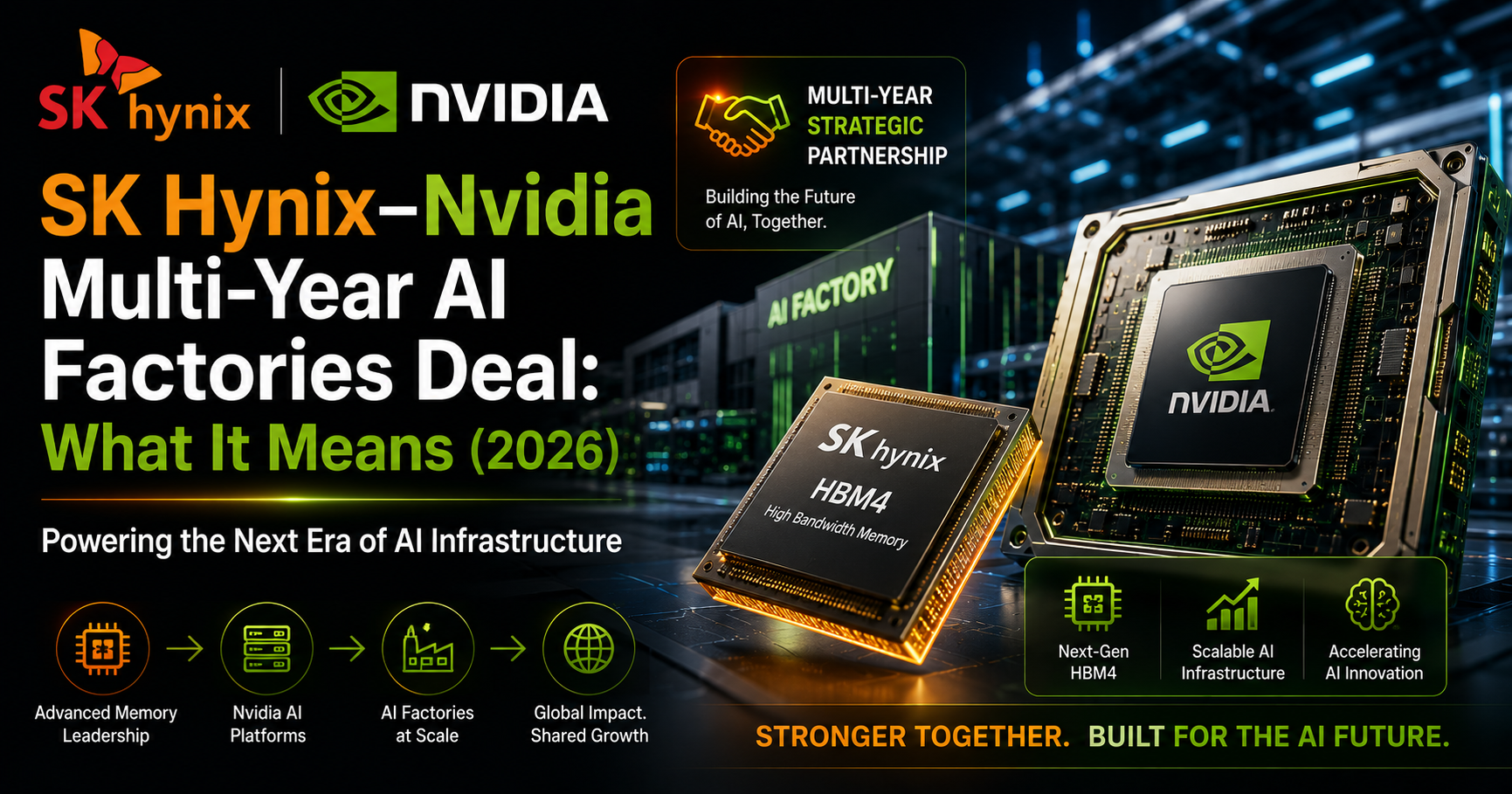
Co-development of memory for four named Nvidia product lines. SK Hynix will diversify into what the press release calls "new markets Nvidia is creating" — AI infrastructure, personal AI and physical AI. The four named products are Nvidia's Vera Rubin AI supercomputers (next-generation data center accelerators), Nvidia Vera CPUs (Nvidia's data-centre CPU push), Nvidia RTX Spark powered PCs (a desktop AI category) and Nvidia Jetson Thor robotic computing platforms (embedded systems for physical AI).
Acceleration of semiconductor design and manufacturing using Nvidia software. SK Hynix is now using Nvidia CUDA-X libraries to speed semiconductor simulation work — Technology Computer-Aided Design (TCAD) and computational lithography — and the Nvidia PhysicsNeMo framework for its in-house simulation codes and AI physics workflows. This is meaningful: SK Hynix is using Nvidia GPUs to design the memory that goes on Nvidia GPUs.
Three-way ecosystem collaboration with electronic design automation (EDA) vendors. The press release explicitly mentions opening up the simulation toolchain to a wider chip-design-software ecosystem, signaling that Nvidia is positioning CUDA-X and PhysicsNeMo as standard infrastructure for semiconductor design — not just for SK Hynix.
Fab digital twins driving autonomous manufacturing. SK Hynix will build 3D digital twins of its fab operations using Nvidia Omniverse and the OpenUSD standard, combined with Nvidia cuOpt for optimisation and the Nvidia Metropolis platform. The deeper play is connecting the digital twin to legacy fab software and agentic AI, so AI agents can reason over fab data, automate tasks and improve manufacturing decisions.
The press release contains direct quotes from both principals. Chey Tae-won, Chairman of SK Group, framed the deal as the formalisation of years of collaboration: "SK Hynix and Nvidia have been building toward this for years, and this partnership reflects the depth of that collaboration. Together, we are co-developing the next generation of memory for AI factories and applying AI to how we design and manufacture semiconductors — work that will shape the future of AI infrastructure."
Jensen Huang, founder and CEO of Nvidia, named what the partnership is for: "AI factories are the engines of the next industrial revolution, and advanced memory is essential to their performance. SK Hynix has been an extraordinary partner to Nvidia, playing a central role in delivering advanced memory technologies for Nvidia AI computing platforms. Together, we will co-develop the next generation of memory for AI factories and support the accelerating global expansion of AI infrastructure — from frontier model training to agentic and physical AI."
What was not in the press release is also worth noting. No dollar value was disclosed. No specific HBM4 or HBM4E unit volumes were quoted. No exclusivity language was included. No timeline beyond "multi-year" was committed. This is normal for a partnership of this kind — both companies disclose direction without locking in the operational details public investors and competitors would use to anticipate moves.
What an "AI factory" actually is
The phrase "AI factory" appears throughout the announcement and is now Nvidia's preferred framing for the new generation of AI data centres. It is worth understanding because the term is doing real work in how Nvidia is positioning its hardware.
A traditional cloud data centre is a facility that runs many small workloads for many customers — websites, databases, business applications. An AI factory is a facility (or a portion of a facility) purpose-built to run one specific kind of workload at very high scale: training and serving large AI models. The economics, electrical, cooling, networking and software stack are all optimised for that single purpose.
The "factory" metaphor is deliberate. Just as a steel mill takes iron ore and coal in one end and produces steel out the other, an AI factory takes electricity, data and parameters in one end and produces tokens — the predictions, completions, embeddings and outputs that power consumer and enterprise AI products — out the other. Nvidia is positioning itself as the company that designs and supplies the production line for this new category of factory.
The memory inside those factories is critical. AI models live in HBM during training and inference, and the bandwidth of that memory directly limits how fast a GPU can produce tokens. Without enough HBM — and enough HBM bandwidth — Nvidia's most powerful chips sit underutilised. The SK Hynix partnership exists because memory has become the operational bottleneck of the AI buildout, and Nvidia needs guaranteed access to the next several generations of advanced HBM to ship the product roadmap.
The four product lines: Vera Rubin, Vera CPU, RTX Spark, Jetson Thor
Each product Nvidia named in the partnership maps to a specific go-to-market move. Together they describe a Nvidia that is no longer just a discrete GPU company.
Vera Rubin AI supercomputers are the successor to the current Blackwell generation of data centre accelerators. Vera Rubin is the platform that hyperscalers (Microsoft, Google, Meta, Amazon, Oracle and a growing number of sovereign and private operators) will buy to expand their AI capacity through 2027 and into 2028. The memory inside Vera Rubin is the high-volume HBM business that defines the partnership.
Vera CPUs are Nvidia's data centre CPU play, which has been widely reported and which targets the AMD and Intel server-CPU business. Vera CPUs are designed to work as a tightly integrated system with Nvidia GPUs. SK Hynix supplying memory for Vera CPUs means SK Hynix is now embedded in Nvidia's full data-centre stack, not just the accelerator portion.
RTX Spark powered PCs is Nvidia's name for the desktop AI category — workstations and high-end PCs designed to run substantial AI workloads locally, rather than calling out to cloud APIs. This is Nvidia's bet on what it calls "personal AI": local AI assistants, local code generation, local creative tooling and local agentic workflows. Memory choice here is different from data-centre HBM; it covers the on-board memory architecture for the new generation of AI-aware PCs.
Jetson Thor robotic computing platforms is Nvidia's flagship platform for "physical AI" — robotics, autonomous machines, industrial automation. Jetson Thor sits inside robots, drones, autonomous fork-lifts, surgical systems and AGVs (automated guided vehicles), running models that perceive the world and act in it. The memory inside Jetson Thor needs different characteristics from HBM — lower power, more rugged, longer lifecycle.
In aggregate, the SK Hynix partnership covers cloud AI, personal AI and physical AI. The geographical and economic reality is that almost all of the inference and most of the training happening in 2026 either depends on SK Hynix memory directly or on memory the partnership now influences.
The HBM market in 2026: who has what share
The deal sits inside a tight market that has shifted noticeably in the past 12 months. According to industry tracker analyses summarised at Presence AI's HBM research and DataCenter Dynamics' supplier coverage, the global HBM market in 2026 is split roughly as follows.
SK Hynix holds approximately 62% of the global HBM market — the largest single position in advanced AI memory. Micron has overtaken Samsung to take second place at around 21%. Samsung sits at approximately 17%, having stumbled on HBM3E qualification with Nvidia and now racing to recover on HBM4.
The picture on Nvidia's specific HBM4 allocation is sharper. Reports indicate SK Hynix has secured roughly the mid-50% of Nvidia's HBM4 supply, Samsung is at the mid-20% range as a recovery position, and Micron is around 20%. This is the operational distribution that underlies the headline market share numbers.
Two technology shifts are accelerating through this market. First, the transition from HBM3E (the current high-volume product, expected to dominate 2026 shipments at roughly two-thirds of volume) to HBM4, which will ramp through the year but not displace HBM3E by volume. Second, Nvidia has reportedly signalled interest in 16-layer HBM for delivery as early as late 2026, pushing all three suppliers into a race that will partially define HBM5.
For the broader memory market, the SK Hynix-Nvidia announcement creates a fascinating second-order question: how much room does it leave for Samsung and Micron? Both will continue to win allocation; both are too important for Nvidia to lock out. But the gravitational centre of Nvidia's HBM stack now sits explicitly inside the SK Hynix relationship.
Why this matters now: the HBM crunch
Three structural forces explain why both companies are formalising a relationship that, on paper, was already operating.
HBM demand is growing roughly twice as fast as supply. Demand is growing at approximately 80-100% per year. Supply is growing at approximately 50-60%. The gap means HBM is the binding constraint on Nvidia's revenue, and on enterprise AI buyers' ability to build at the scale they have committed to.
Adding HBM capacity takes 18-24 months. New HBM fabs are not built in weeks. Capacity expansions require new wafer fabrication facilities or major retooling of existing ones, and the lead time runs into multiple years. That is why a multi-year partnership matters: it locks in supply against a known capacity ramp.
TSMC's CoWoS packaging is fully allocated through mid-2027. TSMC's Chip on Wafer on Substrate packaging is the assembly step that bonds HBM stacks onto Nvidia GPU substrates. CoWoS is the choke point at the end of the supply chain — without it, even fully-produced HBM cannot be turned into shipping GPUs. CoWoS capacity has been allocated through at least mid-2027 to existing customers.
Jensen Huang told reporters in early June that the AI memory shortage will last "quite a few years." The SK Hynix partnership is the operational answer to that statement: lock in supply on the longest possible horizon, force capacity expansion through committed demand, and align the memory roadmap to the GPU roadmap so that neither side waits on the other.
The Kkanbu Chicken backstory
The closing detail of the deal — the casual Sunday-evening dinner at a Seoul Kkanbu Chicken restaurant over fried chicken and beer — is worth recording because it captures something true about how this scale of partnership now gets done.
According to Korean press coverage, Huang met SK Group Chairman Chey Tae-won and SK Hynix CEO Kwak Noh-jung at a Seoul location over Korea's beloved "chimaek" combination. The image was widely shared in Korean media. The setting was deliberately informal — a public signal that the SK-Nvidia relationship is now structured at the chairman-and-CEO level, not just at the procurement level.
Huang's recent travel pattern shows the same intent at a global level. He attended GTC Taipei 2026 on June 1, met SK and TSMC leadership at COMPUTEX Taipei on June 2, sat for three-way talks with Chey Tae-won and Kwak Noh-jung the same week, and committed to the Seoul agreement by June 7. That is not the schedule of a CEO managing a supply contract; it is the schedule of a CEO managing a coordinated industrial alliance.
For the Indian, US and UK enterprise buyer this matters because it means the supply chain underneath the GPU you are renting from your hyperscaler is now governed by relationships at the principal level. Pricing, allocation and roadmap stability flow from that.
What it means for the global AI memory supply chain
Five second-order implications stand out for the memory ecosystem.
Samsung's recovery path narrows but does not close. Samsung still ships HBM. Samsung still has Nvidia allocation. But the partnership formalises a primacy that puts pressure on Samsung's HBM4 qualification, particularly for the heaviest workloads. Samsung's HBM4 push in 2026 — including reportedly aggressive pricing for early allocation — is part of the response to this dynamic.
Micron's mid-tier position becomes more defensible. Micron has taken the second slot on Nvidia HBM4 allocation by executing well on HBM3E qualification and ramping HBM4 in time. The SK Hynix deal does not threaten Micron's slot in the same way it threatens Samsung's, because Micron's positioning is less about absolute leadership and more about reliable second-source supply.
The Korean won and the Korean stock market get a second wind. SK Hynix's share price moved sharply on the headline, dragging Korea's broader stock indices with it. South Korea's position as one of the indispensable nodes in the global AI value chain — alongside Taiwan (TSMC), Japan (advanced materials and equipment) and the Netherlands (ASML) — gets a public reinforcement that matters for foreign investment flows.
Chinese alternatives become more strategically urgent for Chinese AI companies. The deal does not affect Chinese semiconductor strategy directly — Chinese HBM suppliers (CXMT, Wuhan Xinxin) are not part of the partnership — but it raises the bar on what the Chinese alternative needs to deliver to keep Chinese AI buildout competitive. Expect Chinese state-backed HBM capacity to keep expanding through 2026 and 2027.
EDA software vendors are now inside an Nvidia-led ecosystem. The press release explicitly names "three-way collaborations among chipmakers, Nvidia and electronic design automation software vendors." Synopsys, Cadence and Siemens EDA (the three big names in chip design software) are now operating inside an Nvidia toolchain that is partially defined by what SK Hynix and Nvidia are co-developing. That is an architectural shift in who controls the future of chip design.
What it means for enterprise GPU buyers
Five takeaways for engineering leaders evaluating their AI infrastructure costs and capacity in 2026.
Hyperscaler GPU availability should remain tight but predictable. The partnership reduces the risk that an HBM shortage forces hyperscalers to cancel or delay GPU pre-orders. It does not increase GPU availability. Enterprise buyers should not expect a sudden surge in AWS, Azure, GCP or Oracle Cloud H100/B200/H200 inventory. They should expect the existing supply commitments to be honoured on schedule.
GPU rental pricing should stabilise rather than fall. The bottleneck is structural, not transient. Even with formal SK Hynix supply, the imbalance between HBM demand growth and supply growth means GPU rental prices on the major clouds are unlikely to fall in 2026. Enterprises that budgeted on the assumption of falling GPU prices in late 2026 should revisit those assumptions.
Vera Rubin should be available on hyperscalers from H1 2027. With supply locked in, Nvidia's next-generation accelerator should ship to hyperscaler customers on the announced timeline. For enterprises planning multi-year AI infrastructure roadmaps, the Vera Rubin generation is increasingly worth designing around.
Nvidia Vera CPUs change the data-centre CPU procurement decision. For workloads that combine CPU and GPU intensively, Vera CPU plus Vera Rubin GPU may be the first time in many years that an alternative to Intel Xeon or AMD EPYC plus Nvidia GPU becomes operationally sensible. Procurement teams should add Vera to their 2027 RFP processes.
Physical AI becomes a credible enterprise category. Jetson Thor inside robots and embedded systems means enterprises in manufacturing, healthcare, logistics, retail and energy can plan industrial AI deployments with a known underlying compute platform. The procurement decision shifts from "can we get the chips" to "what is the application case."
What it means for businesses building AI products
For founders and product leaders building AI products — whether in India, the US, the UK, or elsewhere — the SK Hynix-Nvidia partnership changes the planning horizon.
The cloud AI supply chain is now stable enough to plan against. Two years ago, the risk that you could not get GPU capacity to serve your customers was real and material. Today, that risk is much lower. Hyperscaler capacity is constrained but predictable, and the constraint is moving from "shortage" to "high but managed prices."
The physical AI category becomes investable. Jetson Thor's named inclusion in the partnership signals Nvidia's commitment to robotics, embodied AI and industrial automation as a strategic product line. Startups and enterprises building robotics products have a clearer underlying compute roadmap than they did a year ago.
The personal AI category becomes investable on the same terms. RTX Spark PCs running serious AI locally is a thesis that needs hardware availability. The partnership signals that hardware is coming. For Indian businesses building AI products targeting consumer or prosumer markets, the device-level AI category is now worth taking seriously as a distribution channel.
The agentic AI workflows Huang's quote referenced — "from frontier model training to agentic and physical AI" — frame Nvidia's commercial thesis for the next 24 months. Agentic AI is the category most likely to generate the highest-value enterprise software wins through 2027. Businesses building in that category should align their compute and memory assumptions to what this partnership signals.
eCorpIT's enterprise AI work — building AI-aware applications, RAG systems and agentic workflows for clients in India, the US and the UK — increasingly depends on the underlying GPU supply chain being predictable. The SK Hynix-Nvidia agreement makes that supply chain materially more predictable for the next several years.
Risks: what could still go wrong
Three risks are worth tracking.
Geopolitical disruption to the Korea supply chain. Korea's position is now strategically central to global AI. Any major escalation involving North Korea, Taiwan or US-China tensions that constrains exports from Korea would have outsized effects on AI infrastructure availability. Enterprises with multi-year AI roadmaps should at least name this as a risk register item.
Execution risk on HBM4 and HBM5 yields. HBM stacks are technically difficult to manufacture. Yield problems on HBM4 — whether at SK Hynix, Samsung or Micron — would push Nvidia's GPU roadmap right. Yield problems on the 16-layer HBM Nvidia wants for late 2026 are a real possibility.
Antitrust and trade-policy attention. As Nvidia's dominance of the AI hardware stack deepens, regulator attention sharpens. The European Union, the US Federal Trade Commission, the UK Competition and Markets Authority, and Korea's own competition regulator have all expressed interest in AI hardware competitive dynamics. Future enforcement actions could affect the terms of partnerships like this one.
FAQ
How eCorpIT can help
eCorpIT builds AI-native applications, RAG systems, agentic workflows and enterprise AI integrations for clients across India, the United States and the United Kingdom. Our work spans the full stack — from cloud architecture decisions (AWS, Azure, GCP, on-prem) and GPU sizing through model selection, retrieval design, evaluation, observability and deployment.
If you are planning AI infrastructure roadmaps that depend on Nvidia hardware availability through 2026 and 2027, or building physical AI / personal AI products that need to work on the Vera Rubin and Jetson Thor generation, our engineering team can help with the underlying design choices. Reach us at ecorpit.com/contact-us/ or contact@ecorpit.com.
References
- SK Hynix Newsroom — "SK hynix and NVIDIA Announce Multi-year Technology Partnership to Advance Memory for AI Factories" (June 7, 2026): news.skhynix.com
- Korea Times — "SK, Nvidia deepen AI alliance at another Kkanbu Chicken meetup" (June 7, 2026): koreatimes.co.kr
- UPI — "Nvidia CEO urges SK hynix to make more HBM chips" (June 2, 2026): upi.com
- Korea Herald — "Nvidia's 16-layer HBM push raises stakes for memory chip-makers": koreaherald.com
- TrendForce — "SK hynix Reportedly to Supply About Two-Thirds of NVIDIA HBM4; Samsung Targets Early Delivery" (January 28, 2026): trendforce.com
- TrendForce — "SK hynix, Samsung Reportedly Deliver Paid HBM4 Samples to NVIDIA Ahead of 1Q26 Contracts" (December 16, 2025): trendforce.com
- Presence AI — "HBM Market Share 2026: SK hynix 62%, Micron Overtakes Samsung": presenc.ai
- DataCenter Dynamics — "Samsung and SK Hynix to scale up memory production capacity in 2026": datacenterdynamics.com
- Astute Group — "SK hynix holds 62% of HBM, Micron overtakes Samsung, 2026 battle pivots to HBM4": astutegroup.com
- GPUnex — "GPU Shortage 2026: The HBM Memory Crisis Explained": gpunex.com
- Wccftech — "NVIDIA & SK Hynix Sign Blockbuster Multi-Year Technology Partnership" (June 8, 2026): wccftech.com
- Parameter — "SK Hynix Shares Surge After Nvidia's Vera CPU Partnership Reveal": parameter.io
- NVIDIA — Vera Rubin platform page: nvidia.com
- NVIDIA — Vera CPU page: nvidia.com
- NVIDIA — Jetson Thor robotics page: nvidia.com
Last updated 8 June 2026 by the eCorpIT Editorial team. We will refresh this article when Nvidia's GTC Washington or SK Hynix Q2 2026 results disclose further detail on the partnership.