On this page · 13 sections
- The headline: a dedicated Siri app, Gemini in the cloud, and "World Knowledge Answers"
- The 2024-2025 backstory: why Siri was delayed
- Six features to watch for during today's keynote
- The Google Gemini deal: $1 billion a year for a custom 1.2T-parameter model
- Multi-chatbot Extensions: Gemini, ChatGPT, and probably Claude
- Privacy: Private Cloud Compute, now on M5
- The "Snow Leopard" framing: what gets cut from iOS 27?
- What this means for iOS developers
- What this means for businesses building on iOS
- What to watch for during the WWDC 2026 keynote
- FAQ
- How eCorpIT can help
- References
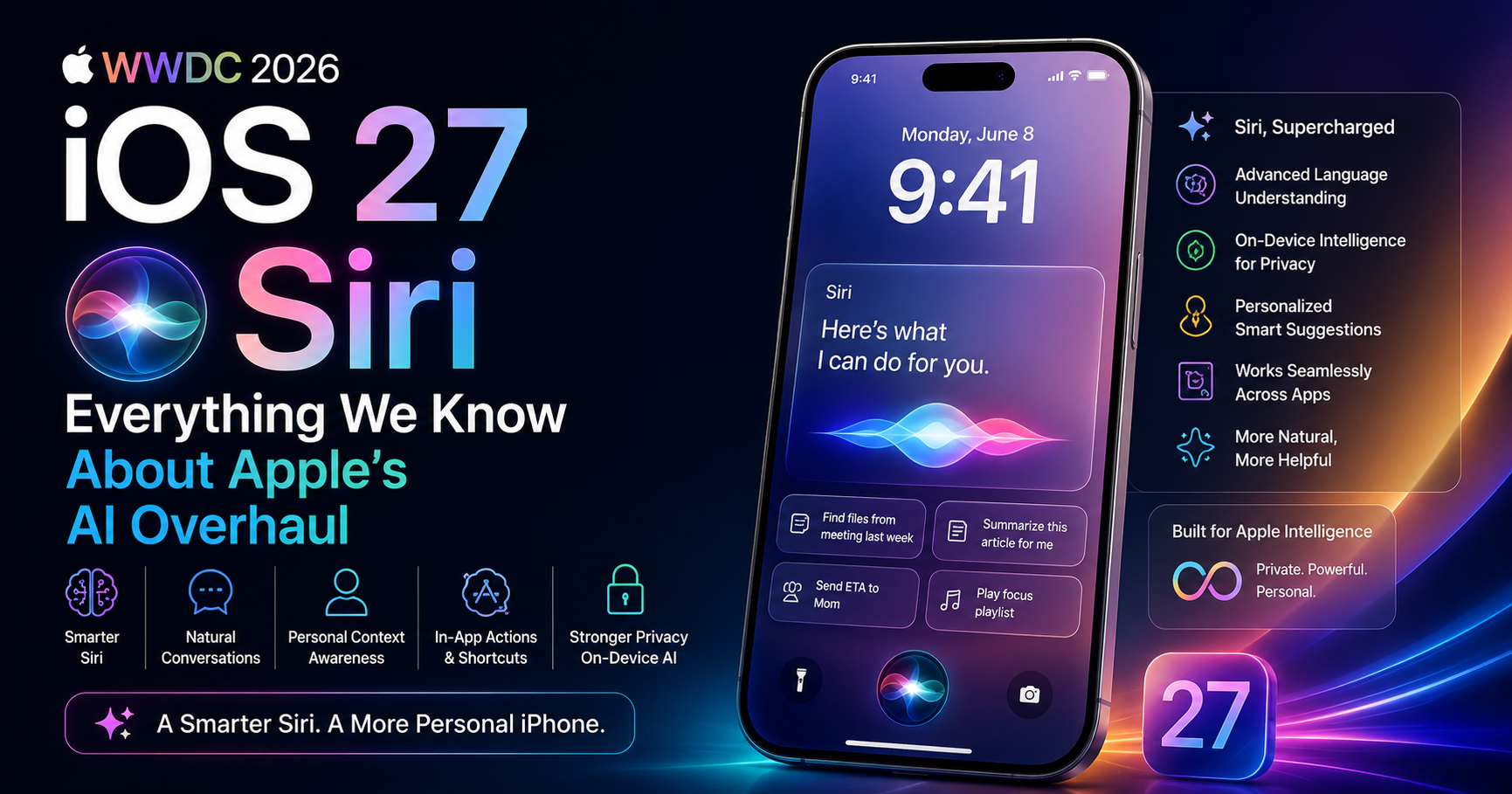
Summary. Apple's WWDC 2026 keynote today (June 8, 10:00 AM Pacific / 10:30 PM IST) is expected to be the formal debut of the rebuilt Siri — eighteen months after the original preview, after a leadership reshuffle, after a public delay, and after a roughly $1 billion-per-year deal to bring a custom Google Gemini model into Apple's privacy stack. Here is what the reporting has confirmed, what is still rumour, and what to watch for during the keynote.
The two-year wait between Apple's first preview of a smarter Siri (WWDC 2024) and the version arriving in iOS 27 has been unusually public. Reports from Bloomberg's Mark Gurman, MacRumors, 9to5Mac, AppleInsider and others have laid out an exhaustive picture of what Apple is expected to ship — including the kind of architectural decisions Apple normally keeps under wraps until the keynote itself.
This article surveys the pre-keynote landscape: the features, the new architecture, the Google partnership, the privacy posture, the management changes behind the scenes, and the practical implications for iOS developers and businesses building on Apple's platforms.
If you are reading this after the keynote, treat each "expected" claim as a hypothesis Apple either confirmed, modified or skipped — and check the WWDC 2026 keynote stream for what actually shipped.
The headline: a dedicated Siri app, Gemini in the cloud, and "World Knowledge Answers"
Three changes anchor the WWDC 2026 Siri story, according to Bloomberg's pre-keynote preview and the MacRumors WWDC 2026 guide.
First, Siri gets a dedicated app for the first time in its history. MacRumors reported in May 2026 that Apple is building an iMessage-style chat interface with persistent conversation bubbles, rich cards for results, and iCloud-synced history across iPhone, iPad and Mac. Users will be able to keep conversations in memory for a limited time — a deliberate privacy-aware design choice.
Second, Siri's cloud-side reasoning will be powered by a custom Google Gemini model. Multiple outlets, citing Gurman, have reported that Apple has agreed to pay Google approximately $1 billion per year for access to a roughly 1.2-trillion-parameter Gemini variant built specifically for Apple's privacy architecture. Apple's own on-device foundation models continue to handle local intent, personal context and on-screen awareness, with Gemini stepping in for heavier reasoning.
Third, Apple is preparing an AI-powered web search called "World Knowledge Answers" — an internal codename first reported by Search Engine Land in September 2025. The feature is positioned as a direct response to Perplexity, ChatGPT Search and Google's AI Overviews. Apple plans to extend it to Safari and Spotlight, giving the company multiple footholds in the everyday search query stack.
Each of these moves is bigger than a single feature. Taken together they reframe Siri as an answer engine and a multi-provider AI hub rather than the voice command tool people grew up tolerating.
The 2024-2025 backstory: why Siri was delayed
Apple previewed a smarter Siri at WWDC 2024 — the same event that introduced Apple Intelligence. The promised features were specific: personal context awareness (so Siri could reason over your emails, photos, calendar and messages), on-screen awareness (so it could understand what you were looking at), and in-app actions that worked across first- and third-party apps using the App Intents framework.
What followed was the most public delay in recent Apple history. In March 2025, Apple confirmed to Daring Fireball's John Gruber that the smarter Siri would not ship on the announced timeline. The same month, Bloomberg reported that Mike Rockwell — the Vision Pro lead — was being named head of Siri, while John Giannandrea remained the overall AI lead.
A month later, MacRumors reported in April 2025 that Rockwell had replaced multiple Siri managers with members of the Vision Pro software group, restructuring the teams responsible for speech, understanding, performance and user experience. In September 2025, 9to5Mac reported that the former Siri boss responsible for the delay was leaving Apple.
AppleInsider's account of the meeting that prompted the reshuffle describes a senior-leader session where Rockwell volunteered to be Apple's AI fixer. He initially believed he would replace Giannandrea outright and report directly to Tim Cook. Craig Federighi pushed back; the eventual arrangement put Rockwell over Siri reporting to Federighi, kept Giannandrea on AI research, and brought in Amar Subramanya as a second AI leader.
The shorthand version: Apple Intelligence was overpromised in 2024, the delivery team was reorganised in early 2025, and the team that has been rebuilding Siri for the past fifteen months draws heavily from the Vision Pro group's discipline around shipping high-stakes hardware-software products on time.
Six features to watch for during today's keynote
Pulling together the reporting from Bloomberg, MacRumors, 9to5Mac, AppleInsider and others, the new Siri is expected to lead with six features. None has been officially announced — these are what credible analysts and Apple watchers have lined up.
1. Personal context awareness
Siri is expected to understand what is in your inbox, calendar, photos, files and messages, and use that context when answering questions. Ask "what time is my flight tomorrow," and Siri pulls the time from a booking confirmation in Mail. Ask "did Priya send me the brief yet," and Siri checks Messages and Mail. This was the headline of the 2024 preview and remains the headline today.
The technical mechanism behind this is the App Intents framework, which lets first- and third-party apps publish structured actions and data that Siri can read with explicit user consent. Apple's machine-learning research blog has previously described the on-device model architecture that ingests this context.
2. On-screen awareness
This feature lets Siri reason about whatever is currently on your screen. Looking at a recipe? "Add the ingredients to my grocery list." Looking at a press release? "Summarise this and email the summary to my team." On-screen awareness is the second of the two big 2024 promises — and the one most observers expect to ship in full at WWDC 2026 after eighteen months of refinement.
3. Deep app integration via App Intents
The 2024 preview promised that Siri would be able to perform multi-step actions across third-party apps — for example, "Find the photos Priya sent me on Sunday, make a poster from them, and AirDrop it to Mom." The mechanism is App Intents, the developer-facing framework that lets apps register actions Siri can call. Apple's developer documentation describes App Intents as a structured action layer that connects apps to Siri, Spotlight, Shortcuts, widgets and controls.
Expect Apple to spend significant keynote time on App Intents in the State of the Union and platform sessions, because deep app integration is essentially worthless unless developers wire up their apps.
4. A dedicated Siri app with chat-style UI
MacRumors' May 2026 report describes the dedicated Siri app in detail. The interface uses persistent conversation bubbles like iMessage, syncs chat history across iPhone, iPad and Mac via iCloud, and displays rich cards (images, maps, structured cards) inside the conversation. An "Ask Siri" bar accepts typed input. Users can keep conversations in memory for a limited time, with a privacy-aware retention model.
This is the closest Apple will come to shipping its own ChatGPT-style app — and the reason analysts call it Apple's belated standalone-app entry into the consumer AI race.
5. Dynamic Island and Lock Screen controls
The Dynamic Island — the pill-shaped cutout on iPhone 14 Pro and later — is expected to get new Siri-aware controls. Persistent conversations, quick actions, and routing options (Siri vs ChatGPT vs Gemini) are all rumoured to surface there. Tom's Guide's WWDC 2026 live coverage and TechRadar's preview both list Dynamic Island changes among the expected announcements.
6. AI-powered web search ("World Knowledge Answers")
Search Engine Land's report describes Apple's in-house AI search engine, built on web crawling, a search index and an LLM, generating summaries that mix text, images, video and local results. The system is expected to ship as part of the Siri overhaul, with extensions to Safari and Spotlight planned later.
Apple's positioning is direct: this is a Perplexity and ChatGPT Search competitor, not a polite enhancement to Google search. Bloomberg has previously reported Apple considered acquiring Perplexity AI before deciding to build internally.
The Google Gemini deal: $1 billion a year for a custom 1.2T-parameter model
The most discussed pre-keynote story is the Google partnership. Bloomberg's reporting, cited across MacRumors, AppleInsider and TechTimes, describes a roughly $1 billion-per-year deal under which Google provides Apple with a custom version of Gemini sized at approximately 1.2 trillion parameters.
A few details matter for understanding what this is and what it is not.
The Gemini variant is custom-trained for Apple's Private Cloud Compute environment. It runs on infrastructure Apple controls, not on Google Cloud. The data path is Apple's — Google does not see the user requests.
It complements rather than replaces Apple's own foundation models. The on-device model continues to handle local intent recognition, personal context retrieval and on-screen awareness. Gemini steps in for harder reasoning tasks, web search summarisation and the more open-ended conversational queries that have historically tripped Siri up.
It is not exclusive. Apple is letting users choose external AI providers — ChatGPT, Gemini, and reportedly Claude — through a new Extensions system inside Settings. The Gemini deal is about who powers Siri's cloud reasoning by default; the Extensions system is about who users can route specific queries to.
The economics also matter. $1 billion per year is substantial but small relative to the ~$20 billion Google has historically paid Apple per year for default search placement in Safari. The Gemini deal is, in part, Apple reframing its relationship with Google from "you pay us to be the default search engine" to "we pay you for AI infrastructure we use to compete with you in search."
Multi-chatbot Extensions: Gemini, ChatGPT, and probably Claude
Apple already lets users hand off queries from Siri to ChatGPT (introduced in iOS 18 in 2024). The WWDC 2026 announcement is expected to expand this to multiple providers via an "Extensions" system in the Apple Intelligence and Siri section of Settings on iOS 27, iPadOS 27 and macOS 27.
The expected provider list, per MacRumors and other outlets:
- ChatGPT (existing): handles general knowledge queries when Siri hands off.
- Google Gemini (new): public-facing extension, distinct from the cloud-side Gemini that powers Siri's own reasoning.
- Anthropic's Claude (rumoured): repeatedly mentioned as a likely third extension, though not officially confirmed at the time of writing.
Inside the dedicated Siri app, a microphone toggle is expected to let users route queries directly to one of these providers, effectively converting the iPhone's primary search and assistant layer into a multi-provider AI marketplace. Apple is reportedly providing download links from inside Settings to install whichever chatbot apps a user wants to add.
For businesses building consumer-facing chatbots and AI assistants, this is the most significant distribution change in the iPhone ecosystem since the App Store launched. If Apple positions Extensions in a similar way to the default browser and email picker — surfaced cleanly in Settings, with no friction — it materially lowers the cost of acquiring iOS users for any AI assistant company that ships an extension.
Privacy: Private Cloud Compute, now on M5
Apple's privacy architecture for cloud AI is called Private Cloud Compute (PCC), introduced in 2024. The architecture is unusual: requests are encrypted directly to cryptographically verified PCC nodes, meaning Apple cannot read user requests even if it wanted to. Apple has published the boot images and made the system available for security researcher inspection.
9to5Mac reported in February 2026 that Apple is upgrading PCC to M5-based infrastructure. The performance jump is significant — both for Apple's own foundation models and for the custom Gemini model running on Apple silicon (with reports indicating Gemini may also run on Nvidia chips inside PCC for the heaviest workloads).
The privacy story has two practical consequences worth highlighting.
For users, it means a smarter Siri that does not surrender personal context to Google. Apple's pitch is that Gemini becomes Apple's reasoning model inside Apple's privacy walls, not a hand-off to Google servers.
For businesses building on Apple platforms — particularly in healthcare, finance, education and regulated industries — PCC continues to be one of the only credible "cloud AI with verifiable privacy" options on the market. For Indian regulated industries operating under DPDP and sector-specific frameworks, and for US healthcare app developers operating under HIPAA, PCC is increasingly the architecture engineering leadership wants to anchor to.
The "Snow Leopard" framing: what gets cut from iOS 27?
Bloomberg's Gurman has described iOS 27 as a "Snow Leopard" release — a reference to Apple's 2009 macOS update that skipped headline features in favour of codebase cleanup, bug elimination and performance. The framing has been picked up by Macworld, MacRumors and AppleInsider.
The implication is that beyond Siri, iOS 27 may be relatively quiet in headline features. Expect Apple to spend keynote time on:
- Liquid Glass UI refinements (the design language introduced in iOS 26)
- Battery life and performance gains on existing devices
- The supported-device cut (TechTimes reports iPhone 11 may be dropped from the iOS 27 support list, which would make iPhone 12 the new floor)
- Software-side fixes for issues that piled up during the iOS 26 cycle
For users on older iPhones, the Snow Leopard framing is good news — performance and battery improvements ship to existing hardware. For users buying a new iPhone in late 2026, the Snow Leopard framing means the headline AI features are the primary draw rather than a long checklist of new apps and toggles.
What this means for iOS developers
The shift from "Siri as a voice command surface" to "Siri as a multi-context AI agent" reorders the priority list for iOS development teams. Three concrete implications.
First, App Intents becomes a first-class API. Apps that publish well-designed App Intents will be discoverable inside Siri, Spotlight, Shortcuts, the Lock Screen, and the new dedicated Siri app's rich-card display. Apps that do not will become functionally invisible to the assistant layer. Expect Apple to spend significant State of the Union and session time on App Intents updates for iOS 27.
Second, on-screen awareness creates a new design dimension. Apps need to consider what Siri sees and what it understands. A messaging app whose conversation thread Siri can read can offer "summarise this conversation" or "draft a reply" intelligently. An app whose UI is rendered in custom views that ignore accessibility APIs may be opaque to Siri. Accessibility quality and Siri legibility are converging.
Third, the Extensions system creates a new distribution channel for AI assistants. Companies building consumer AI products now have a credible iOS distribution path that does not require winning the App Store charts.
For iOS development teams at agencies and product companies — including eCorpIT's iOS development team — the immediate post-keynote work is auditing existing App Intents implementations, identifying the gaps where on-screen awareness can light up new flows, and prototyping Extensions integrations if the product is in the AI assistant space.
What this means for businesses building on iOS
Three implications for product and engineering leaders evaluating their iOS roadmap after WWDC 2026.
The Siri layer becomes a customer acquisition surface. Users will increasingly ask Siri to find a product, place an order, or summarise a document — and Siri will route those requests through whichever apps have published the relevant App Intents. Apps that ignore this layer will lose traffic to apps that embrace it.
Privacy-first AI is finally shippable at scale on iOS. Healthcare, financial services, and education products that previously hesitated to use cloud AI (because of patient data, customer data, or student data concerns) now have Private Cloud Compute as a credible architecture. Combined with Apple's on-device foundation models, businesses can ship AI features without exporting sensitive data to third-party servers.
The AI assistant business model is being redrawn. If you are building an AI assistant for consumers, the Extensions distribution channel may matter more than any individual App Store optimisation. If you are building enterprise software for iOS, Siri's deep app integration changes how users will expect to interact with your product — voice-first and context-aware as a default, not as an accessibility feature.
For Indian businesses building consumer products with global ambitions, the WWDC 2026 announcements raise the bar on what users will consider a normal iOS experience. Apps that feel old-fashioned by the time iOS 27 ships (expected September 2026) will lose users to AI-native competitors. Apps that publish App Intents and integrate cleanly with Siri's new agent capabilities will benefit from a distribution boost without paid acquisition spend.
What to watch for during the WWDC 2026 keynote
If you are tuning into the keynote today at 10:00 AM PT (10:30 PM IST), here are the eight things worth tracking.
- Does Apple ship the dedicated Siri app on day one? Or is it announced as "coming this fall" with iOS 27 GA?
- What is the actual Gemini deal announcement? Apple may frame the partnership very differently from Bloomberg's reporting.
- Does on-screen awareness ship for all iOS 27-compatible iPhones, or is it gated to newer hardware?
- How is the Extensions system surfaced? A dedicated picker in Settings, a system-level prompt the first time you ask Siri a long question, or something else?
- What is the App Intents update? Specifically, what new intent types are added, and how does the developer experience change?
- Does AI search ship under the name "World Knowledge Answers," or does it get a consumer-facing brand?
- Which iPhones lose iOS 27 support? The iPhone 11 drop is rumoured but not confirmed.
- What is the rollout timeline? Apple has been burned by promising too much too early — expect a more conservative shipping timeline this year, with some features arriving in iOS 27.1 or iOS 27.2 rather than the September GA.
Watch the Apple Newsroom and the WWDC 2026 event page for the official confirmations as they happen.
FAQ
How eCorpIT can help
eCorpIT's iOS development team builds native iOS, iPadOS and macOS applications for clients in India, the United States and the United Kingdom. Our work includes App Intents-based assistant integrations, Apple Intelligence-aware UX, and privacy-architecture reviews for regulated industries.
If your product needs to be ready for the iOS 27 Siri rollout — whether that means publishing App Intents, prototyping an Extensions integration, redesigning on-screen flows to be Siri-legible, or auditing a Private Cloud Compute-based AI feature for HIPAA, DPDP or PCI DSS alignment — our team can help. We work with founders, product leaders and enterprise teams from discovery through delivery and post-launch support.
To start a conversation, visit our contact page or email contact@ecorpit.com. We respond within one business day.
References
- Bloomberg — "WWDC 2026 Preview: iOS 27, Siri, AI Features, macOS 27, More Apple Will Announce" (Mark Gurman, June 5, 2026): bloomberg.com
- MacRumors — "What to Expect From WWDC 2026: Gemini-Powered Siri, iOS 27, macOS 27 and More": macrumors.com
- MacRumors — "iOS 27 Getting Major Siri Redesign With Chat Interface and Dedicated App" (May 12, 2026): macrumors.com
- Bloomberg — "Apple Vision Pro Chief Mike Rockwell Named Siri Head; Giannandrea Keeps AI Role" (March 20, 2025): bloomberg.com
- MacRumors — "Siri Management Team Gets Overhaul After Apple Intelligence Failure" (April 22, 2025): macrumors.com
- 9to5Mac — "Former Siri boss behind delayed Apple Intelligence features leaving the company" (September 12, 2025): 9to5mac.com
- AppleInsider — "One fateful meeting in 2025 put Apple Intelligence and Siri on the right course" (June 7, 2026): appleinsider.com
- AppleInsider — "iOS 27, macOS 27, Siri: What to expect to launch at WWDC 2026" (June 5, 2026): appleinsider.com
- Search Engine Land — "Apple to launch AI search for Siri in 2026" (September 2025): searchengineland.com
- 9to5Mac — "Apple plans M5-based Private Cloud Compute architecture for Apple Intelligence" (February 17, 2026): 9to5mac.com
- Apple Security Research — "Private Cloud Compute: A new frontier for AI privacy in the cloud": security.apple.com
- Apple Machine Learning Research — "Introducing Apple's On-Device and Server Foundation Models": machinelearning.apple.com
- TechTimes — "WWDC 2026 Opens Monday: Gemini Powers Rebuilt Siri, iPhone 11 Faces iOS 27 Cut" (June 6, 2026): techtimes.com
- Tom's Guide — "Apple WWDC 2026 Live: New Siri, iOS 27, Apple Intelligence and all the last-minute rumors": tomsguide.com
- TechRadar — "5 things to expect at WWDC 2026 — from Siri 2.0 to Tim Cook's Apple farewell": techradar.com
- Macworld — "iOS 27: Release Date, supported iPhones, Siri upgrades and Apple Intelligence rumors": macworld.com
- Apple Developer Documentation — App Intents framework: developer.apple.com
Last updated 8 June 2026. eCorpIT will refresh this article after the WWDC 2026 keynote with confirmed announcements and a 'what shipped vs. what was rumoured' breakdown.