On this page · 10 sections
- What SAHI actually is
- What BODH actually is, and why the architecture is the story
- What this changes for your product
- A readiness checklist you can run this quarter
- What is still unpublished, and how to plan around it
- How this fits with the rest of India's health AI stack
- India-specific considerations
- FAQ
- How eCorpIT can help
- References
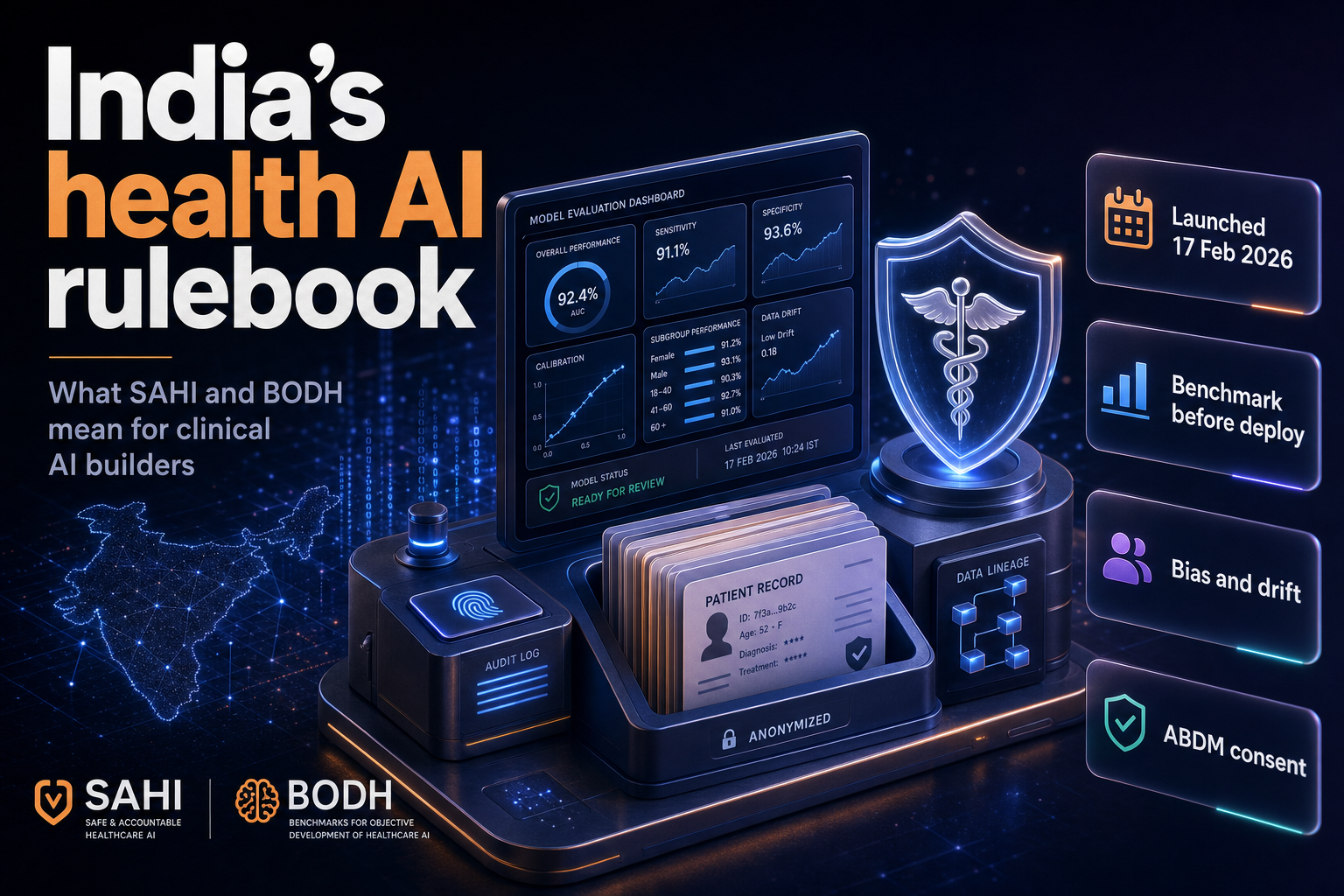
Summary. On 17 February 2026, Union Minister for Health and Family Welfare J.P. Nadda launched two initiatives at the India AI Impact Summit 2026: SAHI, the Strategy for Artificial Intelligence in Healthcare for India, and BODH, the Benchmarking Open Data Platform for Health AI. BODH was built by IIT Kanpur with the National Health Authority under a memorandum of understanding, and it runs on the Ayushman Bharat Digital Mission framework launched in 2020. The design is the part that matters to engineers: developers train models on-site against real patient data they never see, and get back only model weights. Dr. Catharina Boehme of the World Health Organization South-East Asia Regional Office said at the launch that India is among the first countries to adopt a national AI strategy for health. Grand View Research valued India's AI-in-healthcare market at about $758.8 million in 2023 with a projection near $8.73 billion by 2030, so the governance layer arrived roughly a decade after Digital India began in 2015 and while the commercial layer is still forming.
Neither SAHI nor BODH is a licence. That confusion has already cost teams time. The Central Drugs Standard Control Organisation still regulates Software as a Medical Device; SAHI is a governance framework and policy roadmap, and BODH is an evaluation platform. What changes is the evidence bar. Once a national benchmarking platform exists, "we validated it on our own held-out set" stops being a persuasive answer to a hospital procurement committee.
What SAHI actually is
SAHI is the Strategy for Artificial Intelligence in Healthcare for India. At the launch, Nadda described it as a governance framework, policy compass and national roadmap for the responsible use of AI in healthcare, going beyond a technology strategy, according to the Press Information Bureau release issued on 17 February 2026.
Union Health Secretary Punya Salila Srivastava put the operational meaning more plainly at the same event: SAHI represents a long-term policy commitment of the Government and provides a common framework for the Union and State Governments, as well as private partners, to guide AI evaluation, adoption, and integration within the healthcare ecosystem.
Read that as three things a builder should plan around. It is a common framework across Union and State governments, which matters because health is a state subject in India and state-level procurement has historically been the fragmentation problem. It explicitly includes private partners, so it is not confined to public-sector tools. And it is framed around evaluation, adoption and integration rather than approval, which is why it sits alongside CDSCO rather than replacing it.
The PIB release describes SAHI as a framework to promote secure, interoperable and trustworthy AI in the health sector, coordinating healthcare institutions, technology developers, researchers and policymakers so that tools meet standards of safety, efficacy and ethical compliance before large-scale adoption, and as a knowledge-sharing and governance hub with safeguards for patient data protection and algorithmic accountability.
What BODH actually is, and why the architecture is the story
BODH is the Benchmarking Open Data Platform for Health AI, a joint venture between IIT Kanpur and the National Health Authority developed under a strategic memorandum of understanding to create a secure consent framework and federated learning environment for health research, per IIT Kanpur's press release dated 19 February 2026.
Prof. Manindra Agrawal, Director of IIT Kanpur, described it as "a secure, federated ecosystem where developers can train AI models on-site without ever accessing raw patient data—returning only refined model weights to ensure total privacy."
That single sentence resolves the problem every Indian health AI team has hit. You need diverse, representative Indian clinical data to build something that works on Indian patients. You cannot get it, because moving identifiable health records out of a hospital is a consent, contracting and DPDP problem that takes longer than the model does. BODH inverts the flow: the model goes to the data.
IIT Kanpur frames the design goal as resolving the "AI Quality Testing Trilemma", the traditional trade-off between reliability, openness and coverage. The platform combines central private test sets with the ABDM framework to get all three at once.
| Evaluation approach | Data access for the developer | Coverage | Independence of the result |
|---|---|---|---|
| Internal held-out test set | Full, developer controls the split | Limited to the data you could license | None, developer runs the test |
| Site-by-site hospital pilots | Full within each site, under contract | Grows slowly, one contract at a time | Partial, the site observes results |
| Randomised controlled trial | Governed by protocol | Narrow by design, expensive | High, but slow and costly |
| BODH federated benchmarking | None, model trains on-site and returns weights | Nationwide via ABDM datasets | Third-party evaluation against private test sets |
Prof. Nisheeth Srivastava of IIT Kanpur, under whose guidance the platform was developed, stated that the platform "is expected to replace Randomized Controlled Trials as the default third-party algorithmic auditing tool for health AI models", and set that ambition globally rather than only for India. That is a strong claim, and it is worth reading as a statement of intent rather than a settled outcome. The direction is clear enough to plan against.
The PIB release adds the evaluation dimensions: BODH assesses performance, robustness, bias and generalisability of AI systems before deployment at population scale.
What this changes for your product
Four practical consequences follow, and none of them require waiting for further notification.
First, bias and generalisability become first-class metrics, not appendix material. A platform designed to test bias across diverse nationwide datasets will surface the failure mode Indian health AI is most prone to: a model trained on data from two metro tertiary hospitals that degrades in a district hospital. If your evaluation harness does not already slice performance by site type, region and patient demographic, build that before you are benchmarked on it.
Second, third-party evaluation becomes the procurement default. A hospital CIO comparing two vendors will ask which one has been benchmarked independently. That question is cheap to ask and expensive to answer badly.
Third, the federated pattern changes your engineering, not just your compliance posture. Training on-site and returning weights means your training pipeline has to run somewhere you do not control, against data you cannot inspect. Debugging is different when you cannot look at a failing example. Teams that have only ever trained on data sitting in their own bucket should expect real work here: deterministic preprocessing, defensive handling of schema drift, and logging that is useful without leaking anything.
Fourth, none of it removes the CDSCO path. Software as a Medical Device classification and the licensing route still apply, and we covered how that maps to product design in our guide to clinical AI under CDSCO and DPDP.
| Regime | What it governs | Who runs it | What it produces |
|---|---|---|---|
| CDSCO Medical Device Rules | Whether you may sell a medical-purpose software product | Central Drugs Standard Control Organisation and state authorities | A licence, by risk class |
| SAHI | How AI is evaluated, adopted and integrated across health systems | Ministry of Health and Family Welfare | A governance framework and national roadmap |
| BODH | How model quality is measured before population-scale deployment | IIT Kanpur with the National Health Authority | A third-party benchmark result |
| DPDP Act 2023 | How personal data, including health data, is processed | Data Protection Board of India | Consent and processing obligations |
A readiness checklist you can run this quarter
Treat this as engineering work with a deadline you set yourself, because the procurement question arrives before any mandate does.
Start by writing down your evaluation slices. List every axis on which your model could plausibly degrade: hospital tier, state, urban against rural, age band, sex, comorbidity load, device or scanner make where imaging is involved. Then measure performance on each. Most teams discover at this step that they cannot, because the metadata was never captured.
Next, make your training pipeline portable. If it only runs against your own storage layout, it will not run in a federated environment. Containerise it, pin the dependencies, remove anything that reaches out to a network at training time, and make preprocessing deterministic given the same inputs. Assume you will never see the data and never get an interactive session on the training host.
Then instrument for the questions BODH is designed to ask. Performance, robustness, bias and generalisability each need a metric you have already agreed internally, computed the same way every run. Deciding what "robustness" means during an external evaluation is too late.
Get the consent and data path right in parallel. Records under the Ayushman Bharat Digital Mission tie to a patient's ABHA identity, which centralises consent and access. Design so identifiable data stays inside the consent boundary and every access is logged. Our DPDP engineering playbook covers the record-keeping, and our healthcare AI deployment guide for India covers the data architecture that survives a hospital's legal review.
Finally, plan the clinical workflow, not just the model. The failure mode we see most often in Indian hospital deployments is not accuracy; it is alert fatigue and workflow mismatch. We wrote that up separately in healthcare AI deployment mistakes Indian hospitals keep making.
What is still unpublished, and how to plan around it
Being specific about the gaps is more useful than pretending the framework is fully documented. As of 20 July 2026, several operational details are not in the public record.
Onboarding is the first. The launch materials describe what BODH does and who built it, but neither the PIB release nor IIT Kanpur's announcement sets out an application route, eligibility criteria or a fee structure for a private developer who wants a model benchmarked. Until that lands, the sensible move is to have the artefacts ready rather than to wait: a containerised training pipeline, a written evaluation protocol, and slice-level results you produced yourself.
Dataset scope is the second. BODH draws on ABDM data, and ABDM coverage is uneven by state and by facility type. A benchmark is only as representative as the records behind it, so expect the first cohort of results to carry caveats about which populations were actually covered.
The relationship between a BODH result and a CDSCO submission is the third, and it is the one worth watching. A benchmark from a platform the National Health Authority co-owns is obviously useful evidence, but nothing published so far says a regulator will accept it in place of any part of the existing licensing route. Treat it as procurement evidence today and as possible regulatory evidence later.
Plan on the assumption that the evaluation bar rises before the paperwork changes. Hospitals and state health departments can start asking for a third-party benchmark the moment one exists, and they will ask long before any rule requires it.
How this fits with the rest of India's health AI stack
SAHI and BODH did not arrive in isolation. The digital foundation is older: the National Health Policy of 2017 set out an interoperable, inclusive and scalable digital health ecosystem, and the Ayushman Bharat Digital Mission launched in 2020 to build the public architecture for it. Both were referenced at the launch as the groundwork SAHI sits on.
The deployment layer is moving at the same time. India's National Health Authority is rolling out an AIIMS-built clinical decision support system across nearly 70,000 hospitals under ABDM, which we covered in India's 70,000-hospital AI clinical rollout. Read the three together and the shape is coherent: ABDM is the rail, SAHI is the governance layer, BODH is the quality gate, and the national CDSS is the first large tenant.
For a private product, the strategic read is that the rail and the gate are public infrastructure. Building against them is cheaper than building around them, and a benchmark result from a platform the National Health Authority co-owns is a procurement asset no internal validation can match.
India-specific considerations
Health being a state subject is the practical constraint that SAHI addresses and that builders still have to live with. A common Union and State framework reduces the number of different evaluation conversations you have, but state health departments remain the buyers for public deployments, and their procurement calendars and formats differ.
Data diversity is the technical constraint. The reason BODH's nationwide coverage matters is that a model validated in one metro is not validated for India. IIT Kanpur's framing is explicit about this: ABDM access is what lets the next generation of medical AI be tailored to the healthcare needs of the Indian population.
Language and documentation quality are the quiet ones. Clinical notes across Indian hospitals vary in structure, language and completeness far more than in the datasets most published models are trained on. If your pipeline assumes clean, structured English notes, a nationwide benchmark will find that out.
And the DPDP Act 2023 runs under all of it. Health data is sensitive, consent must be specific, and the design rule is unchanged: keep identifiable data inside the consent boundary, log every access, and be able to show the record later.
FAQ
How eCorpIT can help
eCorpIT builds clinical software for teams that have to satisfy a hospital's legal review and a regulator's evidence bar at the same time. Founded in 2021 and based in Gurugram, our senior-led CMMI Level 5 engineering teams design ABDM- and ABHA-native applications, build portable training and evaluation pipelines suited to federated benchmarking, and structure data paths aligned with DPDP Act requirements. If you are shipping clinical AI in India and want the evaluation story ready before procurement asks, talk to us about a readiness review.
References
- Union Minister Shri Jagat Prakash Nadda launches SAHI and BODH initiatives at the India AI Impact Summit 2026 - Press Information Bureau, Ministry of Health and Family Welfare, 17 February 2026.
- Shri Jagat Prakash Nadda launches Benchmarking Open Data Platform in Health AI (BODH) at India AI Impact Summit 2026 - IIT Kanpur press release, 19 February 2026. Federated architecture, the AI Quality Testing Trilemma, named quotes.
- Union Health Minister to launch SAHI and BODH at the India AI Summit - Press Information Bureau.
- Launch of the Strategy for AI in Healthcare for India (SAHI)) - World Health Organization, South-East Asia Regional Office.
- What do SAHI and BODH initiatives mean for AI use in healthcare? - MediaNama, February 2026.
- India AI Impact Summit 2026: Centre sets AI healthcare guardrails with SAHI, BODH rollout - Analytics Insight.
- India AI in healthcare market size and outlook - Grand View Research. India market size and projection.
Last updated: 20 July 2026.