On this page · 10 sections
- Mistake 1: deploying a Western-trained model without validating it on Indian patients
- Mistake 2: designing for the lab, not the ward
- Mistake 3: treating patient data privacy and consent as paperwork
- Mistake 4: skipping medical-device regulation
- Mistake 5: no governance, monitoring, or training after go-live
- India-specific considerations
- What a safe 2026 deployment looks like
- FAQ
- How eCorpIT can help
- References
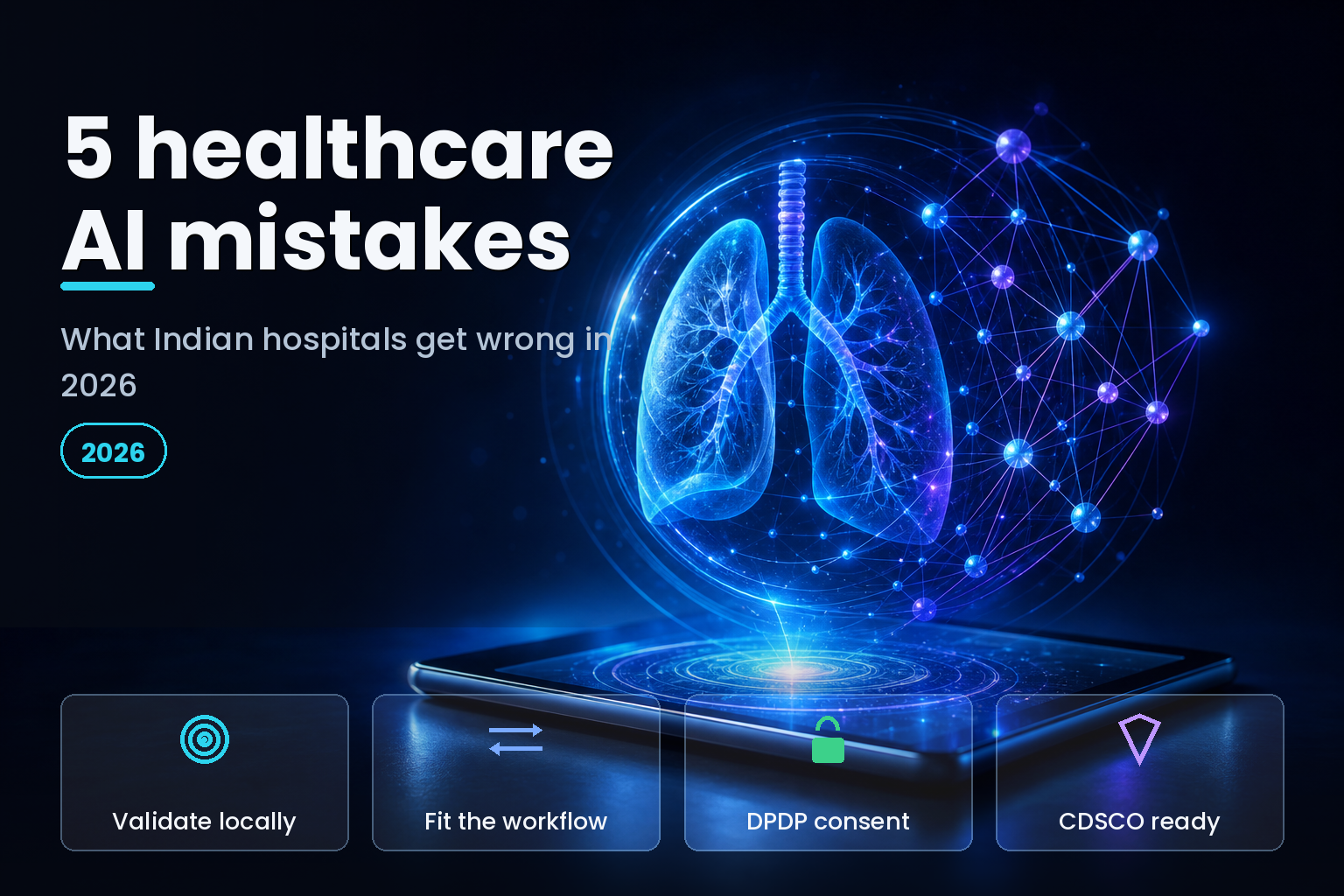
Summary. AI use among Indian clinicians tripled to 41% in 2025, up from 12% a year earlier, according to Elsevier's Clinician of the Future 2025 survey of 2,200 doctors across 109 countries. That puts India ahead of the United States at 36% and the United Kingdom at 34%. Yet most of that use is administrative and documentation work, not bedside diagnosis. The distance between buying AI and running it safely on a ward is where most 2026 deployments break. India's market for AI in healthcare is projected to reach US$8.73 billion by 2030 at a 41.8% compound annual growth rate, and the government has put roughly ₹10,372 crore behind national AI compute and health-dataset work. Regulators moved in step: in January 2026 the Central Drugs Standard Control Organisation (CDSCO) reclassified AI diagnostic software as a Class C medical device, and the DPDP Rules, 2025 were notified on 13 November 2025, wiring patient consent and 72-hour breach reporting into every hospital that touches personal data. Here are the five mistakes that waste those budgets, each with a fix.
The headline number is encouraging and misleading at the same time. A 41% adoption rate sounds like Indian medicine has crossed the AI chasm. Look closer and the pattern tells the real story: most of that adoption is documentation and administrative work, not bedside decisions. The clinical work, the part that changes outcomes and carries liability, is where rollouts stall, get quietly shelved, or fail an audit. This guide is written for hospital CTOs, clinical AI leads, and health-tech founders shipping into Indian hospitals in 2026. Every figure below is dated and sourced, because in this field an unverifiable claim is worse than no claim.
The five mistakes are not exotic. They are the same operational gaps that sank early imaging pilots, repeated at larger scale and now under a tighter regulatory regime. Read them as a pre-mortem for any project you are about to fund.
| Mistake | What it costs you | The fix in one line |
|---|---|---|
| 1. Buying a Western-trained model with no local validation | Quiet accuracy loss on Indian patients; failed CDSCO testing | Demand Indian-dataset accuracy data; run a shadow test first |
| 2. Designing for the lab, not the ward | Rejected scans, slow throughput, clinician revolt | Map the real workflow; pilot at your worst site, not your best |
| 3. Treating DPDP consent as paperwork | Invalid consent, breach exposure, stalled data access | Build consent and data-processing terms in before go-live |
| 4. Skipping medical-device regulation | An unlicensed "clinical" tool and patient-safety liability | Confirm CDSCO class and licence before procurement |
| 5. No governance or training after go-live | Model drift, low clinician trust, unused licences | Fund monitoring, audit cadence, and staff training from day one |
Mistake 1: deploying a Western-trained model without validating it on Indian patients
The most expensive line in a healthcare AI project is not the licence. It is the accuracy you lose silently when a model trained mostly on European or North American patients meets an Indian case mix. Disease prevalence, presentation, skin tone, body composition, and even how scans are captured all differ. A model that reports 95% sensitivity in its origin market can drop well below that on your patients, and you will not see it on the vendor's data sheet.
India's regulator has now turned model bias into a compliance problem on top of a clinical one. When CDSCO brought AI diagnostic and cancer-detection software under Class C control in January 2026, it required developers to prove diagnostic accuracy on Indian datasets, hold an ISO 13485 quality system, and report diagnostic errors as adverse events. A tool validated only on foreign data is no longer something you can quietly run in a diagnostic centre.
The national strategy points the same way. The first pillar of the Strategy for AI in Healthcare for India (SAHI) is governance and evidence-based validation: AI must clear credible evaluation before it enters clinical practice. Alongside SAHI, the government launched BODH, the Benchmarking Open Data platform for Health AI, to give models a common Indian yardstick to be measured against.
The fix is procedural and cheap relative to the risk. Before you sign, ask the vendor for accuracy figures on Indian patients, broken out by the conditions you actually treat. If they only have Western trial data, treat the tool as unproven for your setting. Then run a shadow evaluation: feed the model your own recent, de-identified cases and compare its output against the clinical ground truth before a single live decision depends on it. Check it against the BODH benchmark where one exists. This is the cheapest insurance you will buy on the whole project.
Mistake 2: designing for the lab, not the ward
The clearest cautionary tale in clinical AI is not a model failure. It is a workflow failure, and it has been documented in detail. Google Health built a deep-learning system to detect diabetic retinopathy from retinal photographs that scored over 90% accuracy in the lab. When the team deployed it across 11 clinics in Thailand between late 2018 and mid-2019, the real world pushed back hard.
The system rejected about 21% of the roughly 1,840 images that nurses captured, judging them too low-quality to read, mostly because clinic lighting was nothing like the controlled conditions the model expected. Where internet was slow, each image took 60 to 90 seconds to upload, so a tool meant to speed triage created a queue. Nurses ended up screening only around 10 patients in a two-hour session. The model was excellent. The deployment was built for a lab, and nurses, not ophthalmologists, were the ones operating it.
Indian wards have the same failure surface: variable lighting, intermittent connectivity, shared devices, and staff who already run at capacity. A model's reported accuracy says nothing about whether your data-entry operator can capture a usable image at 6 pm in a district hospital.
| What you measure | In the controlled study | In a real Indian clinic |
|---|---|---|
| Image accept rate | Near 100% on curated scans | 21% rejected for quality in the Thailand field test |
| Result latency | Sub-second inference | 60 to 90 seconds per image upload on slow links |
| Throughput | Hundreds of clean cases | About 10 patients per two-hour session |
| Operator | Specialist or researcher | Nurse, technician, or data-entry staff |
| Lighting and devices | Standardised | Whatever the OPD room and shared tablet provide |
The fix is to map the real workflow before procurement, not after. Walk the path the tool will sit in: who captures the input, on what device, over which connection, and what they stop doing to use it. Then pilot at your worst-connected, busiest site rather than your flagship one. If it survives there, it will survive everywhere. Our own rule on these projects is plain: the real cost is almost always the workflow, not the model.
Mistake 3: treating patient data privacy and consent as paperwork
Healthcare AI runs on patient data, and in India that data is now governed by a law with teeth. The DPDP Act, 2023 was given operational force when the DPDP Rules, 2025 were notified on 13 November 2025. For a hospital, the obligations are specific. Consent to collect and use patient data must be free, specific, informed, and revocable; blanket or implied consent does not count. That consent has to be captured and managed through registered consent managers, with plain-language notices that say what is collected and why.
The breach rules are equally concrete. A reportable data breach must be notified to the Data Protection Board within 72 hours, and affected patients informed. Hospitals treated as significant data fiduciaries have to appoint a data protection officer and run continuous auditing. The Rules carry an 18-month phased rollout, so the time to build for them is now, not when enforcement bites.
This matters for AI in a way that is easy to miss. Training or fine-tuning a model on patient records is a processing purpose in its own right. If your original consent covered treatment but not model development, using those records to train a vendor's model can put you outside the purpose you collected the data for. Sending identifiable data to a third-party AI vendor without a proper data-processing agreement is the kind of gap a breach turns into a headline.
The fix is to design the consent and data architecture before the model arrives. Minimise what you collect and share, de-identify wherever the clinical use allows, and write DPDP-aligned data-processing terms into every vendor contract. Decide explicitly whether patient data may be used for training, and capture consent for that purpose separately. eCorpIT designs applications aligned with DPDP requirements rather than promising a compliance certificate, because the obligation sits with the hospital as the data fiduciary, and the architecture has to reflect that.
Mistake 4: skipping medical-device regulation
Until recently a hospital could buy a piece of "AI clinical software" much like any other IT product. That window has closed. The October 2025 CDSCO draft guidance on medical device software set out a risk-based test for Software as a Medical Device, and by January 2026 AI diagnostic and cancer-detection tools were formally Class C devices, the moderate-to-high-risk band.
The practical effect: a vendor selling a tool that diagnoses or screens patients needs CDSCO approval before clinical use, a quality system to ISO 13485, accuracy evidence on Indian data, and a process to report adverse events. If you procure an unapproved tool and use it on patients, the regulatory and patient-safety exposure lands on you as much as on the vendor.
| Framework | What it requires of a hospital | Status as of June 2026 |
|---|---|---|
| CDSCO SaMD rules | Buy only approved AI diagnostic tools; report adverse events | AI diagnostics are Class C since January 2026 |
| DPDP Rules, 2025 | Valid consent, 72-hour breach reporting, a DPO if significant | Notified 13 November 2025; 18-month phased rollout |
| SAHI strategy | Validate before clinical use; train staff; govern the model | Launched at the India AI Impact Summit, February 2026 |
| BODH benchmark | Measure models against a common Indian dataset | Launched alongside SAHI in 2026 |
| ISO 13485 (via CDSCO) | Require a quality-managed product from the vendor | Mandatory for Class C device approval |
The fix is to put regulatory classification into procurement. Before you shortlist a tool, ask what its intended use claim is and which CDSCO class it falls in. If it makes a clinical claim, ask for the licence or the application status in writing. Build adverse-event reporting into the rollout so you can meet the obligation from the first patient. A tool that cannot answer these questions is not ready to be bought, however good its demo.
Mistake 5: no governance, monitoring, or training after go-live
The gap between broad AI adoption at 41% and the much thinner use of AI for actual clinical decisions is, at heart, a trust gap. Clinicians will not stake a diagnosis on a black box they were handed without training, oversight, or a way to flag when it is wrong. A model also drifts: as patients, practice, and data shift, accuracy that was real at launch decays unless someone watches for it.
This is where SAHI is most useful as a checklist. Its five pillars are governance and evidence-based validation, safe digital infrastructure, workforce readiness, ethical oversight, and equity-centred deployment, set out across 32 recommendations, with explicit attention to the 40% of Indians in underserved and rural areas. Three of those pillars, validation, workforce readiness, and oversight, are about what happens after go-live, not before. As Union Minister of Health and Family Welfare Jagat Prakash Nadda put it at the launch, "SAHI is not merely a technology strategy but a governance framework, policy compass, and national roadmap for responsible AI in healthcare."
Scale makes the point sharper. Apollo Hospitals has rolled out its Clinical Intelligence Engine on the Apollo 24|7 platform, with more than 1,300 conditions and 800 symptoms in its vocabulary, covering about 95% of the everyday OPD case mix. The government, meanwhile, plans to deploy an AIIMS-developed clinical decision support system, informally called "smart doctor," across nearly 70,000 public and private hospitals under the Ayushman Bharat Digital Mission. A decision-support tool used at that scale without monitoring and clinician training is a systemic risk, not a productivity gain.
The fix is to budget for the operating model alongside the install. Stand up post-deployment monitoring that tracks live accuracy against outcomes, set an audit cadence, and give every clinician who touches the tool real training on what it can and cannot do and how to override it. Assign clear accountability for each AI-assisted decision. If governance has no owner and no budget line, the tool will quietly fall out of use, which is the most common and least visible failure of all. For the wider strategy view, our note on generative AI enterprise strategy for 2026 covers how to put this governance layer in place across an organisation.
India-specific considerations
The regulatory stack a hospital has to clear, CDSCO device rules, the DPDP Rules, and the SAHI strategy, is specific to India and has all landed inside a single year. That is unusual, and it means a 2025 deployment plan written before these rules is already out of date.
Money behaves differently here too. Public programmes give a useful benchmark for what serious deployment costs. The IndiaAI and National Cancer Grid CATCH grant offers pilot funding up to ₹50 lakh per project and a scale-up grant up to ₹1 crore for wider deployment, with up to 10 projects selected per round. That money sits inside the broader ₹10,372 crore IndiaAI Mission, a five-year outlay with an explicit healthcare focus. Read those numbers as a signal: the licence is the small part, and validation, integration, and monitoring are where a credible budget goes.
Infrastructure shapes everything. The Ayushman Bharat Digital Mission is improving interoperability, but data hygiene and connectivity still vary widely between a metro tertiary centre and a district hospital. The same tool will behave differently in each, which is exactly why the workflow-first approach in Mistake 2 matters more in India than in the markets where most models are born.
| Cost or scale benchmark | India figure (2025 to 2026) | Source context |
|---|---|---|
| AI-in-healthcare market by 2030 | US$8.73 billion, 41.8% CAGR | Grand View Research India outlook |
| IndiaAI Mission outlay | About ₹10,372 crore over five years | Union Cabinet approval, healthcare focus |
| CATCH pilot grant | Up to ₹50 lakh per project | IndiaAI and National Cancer Grid |
| CATCH scale-up grant | Up to ₹1 crore | IndiaAI and National Cancer Grid |
| CATCH pilot cohort | Up to 10 projects per round | IndiaAI and National Cancer Grid |
What a safe 2026 deployment looks like
Put the five fixes in order and they form a sequence, not a checklist of independent items. First, validate the model on Indian data and confirm its CDSCO class. Second, map the real ward workflow and pilot at your hardest site. Third, get the DPDP consent and data-processing architecture right before any patient data moves. Fourth, confirm the licence and wire in adverse-event reporting. Fifth, fund monitoring and training so the tool survives contact with daily practice. Skip any one of these and the next is built on sand. None of them is technically hard. They are skipped because they are unglamorous and because the demo looked convincing. The hospitals that get value from AI in 2026 are the ones that treat deployment as a clinical-operations problem, not a software install.
FAQ
How eCorpIT can help
eCorpIT is a CMMI Level 5, senior-led technology organisation based in Gurugram that builds and integrates clinical and enterprise software for healthcare teams. We design AI deployments around the ward, not the demo: workflow mapping, shadow validation on your own data, DPDP-aligned consent and data architecture, and the monitoring layer that keeps a model honest after go-live. If you are scoping a healthcare AI rollout for 2026 and want it to survive regulation and real clinics, talk to our team or read more about how we work.
References
_Last updated: 25 June 2026._