On this page · 9 sections
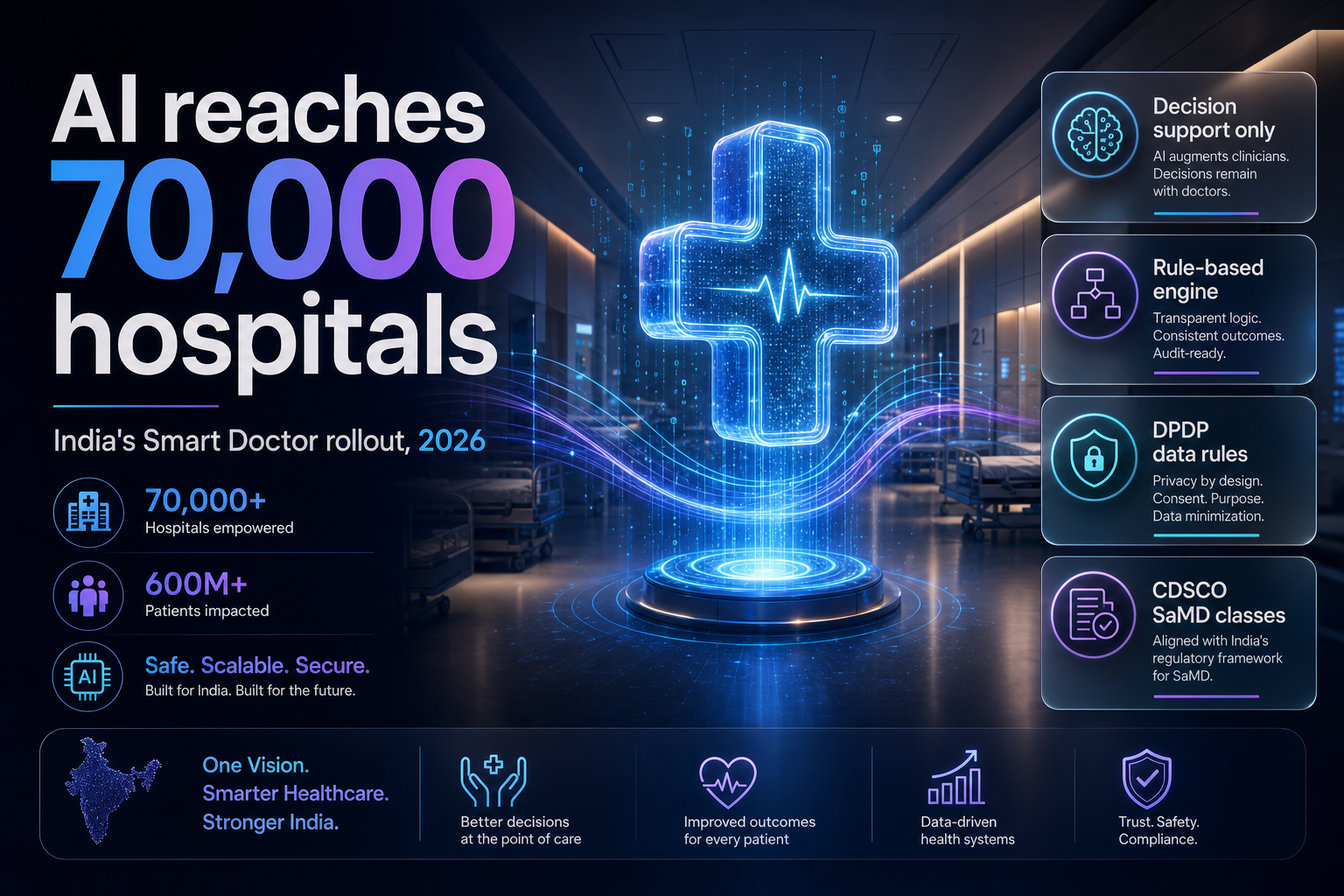
Summary. India's National Health Authority (NHA) is rolling out Smart Doctor, an AI clinical decision support system (CDSS) built by AIIMS New Delhi, across nearly 70,000 public and private hospitals under the Ayushman Bharat Digital Mission (ABDM). The plan was reported in late December 2025, and the NHA has directed states and union territories to activate the CDSS module in their hospital software. The tool is rule-based, not a machine-learning black box: it cross-references symptoms and treatment protocols against a standardized database and focuses first on non-communicable diseases such as diabetes and hypertension. It assists clinicians and leaves the final call with the doctor. India's AI-in-healthcare market, worth about $758.8 million in 2023 and projected by Grand View Research to reach $8.73 billion by 2030, now has its largest single deployment. This article explains what the rollout does, how CDSCO and the DPDP Act apply, and what it changes for anyone building clinical software in India.
The headline number is the story: 70,000 hospitals is not a pilot. It is national infrastructure. For a founder in Gurugram or a hospital CIO in Chennai, the questions are practical. How does a private tool sit next to a government CDSS? What does India's software-as-a-medical-device regime now require? And where does a patient's data go?
What Smart Doctor actually is
Smart Doctor is a rule-based clinical decision support system developed by AIIMS New Delhi and supported by the National Health Authority. According to Digital Health News and Medical Buyer, it works as a digital assistant that helps doctors cross-reference a patient's symptoms and history against standardized protocols, then suggests evidence-based options including drug selection and dosage. Its first focus is long-term non-communicable disease management, starting with diabetes and hypertension.
Two design choices matter for builders. First, it is rule-based. It applies curated clinical rules rather than learning from data at inference time, which makes its recommendations explainable and easier to validate, at the cost of the pattern-finding an ML model offers. Second, it is advisory by design. "The CDSS is fundamentally a decision support mechanism designed to assist clinicians, not to override their judgment," an NHA official said, per HealthBuzz. The doctor keeps final authority, which shapes both the liability model and how the tool is received on the ward.
It ships inside existing hospital software rather than as a separate app, distributed through the ABDM stack. That distribution is the reason a government tool can reach 70,000 sites at once, and it is the same rail a private product has to plug into to be useful. The official brochure and portal are published on the ABDM AIIMS CDSS page.
The regulation changed under it: CDSCO and SaMD
If you build clinical AI in India, the regulatory ground shifted in late 2025. In October 2025, the Central Drugs Standard Control Organisation (CDSCO) released draft guidance on Medical Device Software under the Medical Device Rules, 2017, setting a risk-based, lifecycle approach for software-driven healthcare products, including AI-enabled and cloud-hosted ones, as Cyril Amarchand and Freyr detail.
The guidance separates Software in a Medical Device (embedded in hardware) from Software as a Medical Device (SaMD, standalone software with a medical purpose), and classifies SaMD by clinical risk.
| CDSCO SaMD class | Risk / clinical impact | Licensing authority |
|---|---|---|
| Class A | Low | State licensing authority |
| Class B | Low to moderate | State licensing authority |
| Class C | Moderate to high | CDSCO central authority |
| Class D | High | CDSCO central authority |
For AI and ML tools that keep changing, the most consequential piece is the Algorithm Change Protocol (ACP): a pre-agreed protocol that lets a model be updated iteratively without a fresh licence for every change. That single mechanism decides whether a learning product is shippable in India or stuck in re-approval. A rule-based tool like Smart Doctor sidesteps much of this, which is part of why the government chose that design for a national first step. We go deeper on the compliance path in our guide to clinical AI under CDSCO and DPDP.
Where the data goes: DPDP and health records
A CDSS reads patient data to work, so the Digital Personal Data Protection Act, 2023 (DPDP) is central. Health data is sensitive, consent has to be specific, and processing has to align with the DPDP Act, the National Digital Health Mission framework, and ICMR guidance. In practice that means detecting and classifying personal and health identifiers, then anonymising or minimising them before they move, often with NLP over unstructured clinical notes.
Under ABDM, records tie to a patient's ABHA (Ayushman Bharat Health Account) identity, which centralises consent and access. For a builder, the design rule is simple: keep identifiable data inside the consent boundary, log every access, and design so a data-processing agreement can be signed with a hospital without rework. A model that needs raw records off-site is a harder sell in 2026 than one that processes within the hospital or a compliant region. Our healthcare AI deployment guide walks through the data architecture that survives a DPDP review.
The national strategy behind the rollout
Smart Doctor is one piece of a larger push. At the India AI Impact Summit 2026, Union Minister for Health and Family Welfare J.P. Nadda launched SAHI (Strategy for Artificial Intelligence in Healthcare for India) and BODH (Benchmarking Open Data Platform for Health AI). Nadda called SAHI "the first comprehensive strategy emerging from the Global South, guiding India's healthcare journey in an ethical, transparent and people-centric manner," per PIB and New Kerala.
The clinical results already reported give a sense of the ceiling. AI screening tools for cervical and breast cancer at district hospitals are reporting diagnostic accuracy above 90%, per eHealth Magazine, and AI-assisted MRI can cut scan times while raising image resolution. Dedicated AI research centres now run across 22 AIIMS campuses. India's AI-in-medical-diagnostics market is projected to grow sharply through 2030, per SecondMedic and IMARC Group.
What it means for healthtech builders
The rollout is a floor, not a ceiling, and that is the opportunity. A government rule-based CDSS covers standardized protocols for common conditions. It does not cover specialty workflows, imaging triage, documentation, revenue-cycle work, or ML-driven risk prediction. Those remain open, and now they have a distribution rail and an identity layer to build on.
| Dimension | Smart Doctor (government CDSS) | A typical ML-based SaMD product |
|---|---|---|
| Method | Rule-based, explainable | Machine learning, data-driven |
| Regulatory path | Internal national tool via ABDM | CDSCO SaMD, Class A to D |
| Model updates | Curated rule revisions | Algorithm Change Protocol required |
| Data layer | ABHA / ABDM consent | Own pipeline, DPDP-aligned |
| Clinical role | Advisory, doctor decides | Advisory, doctor decides |
| Distribution | Built into hospital software | Must integrate with ABDM |
Three moves make sense now. Build ABDM- and ABHA-native from day one, because interoperability with the national stack is becoming table stakes. Treat CDSCO SaMD classification and the Algorithm Change Protocol as product-design inputs, not afterthoughts, especially for anything that learns. And design the data path so a hospital's legal team can approve it against DPDP without a custom project each time. The teams that win the next few years in Indian healthtech are the ones whose products slot into this public architecture instead of fighting it.
India-specific considerations
Adoption risk is human, not just technical. A CDSS that fires too many low-value alerts trains clinicians to ignore it, so alert quality matters more than alert quantity. Language and workflow fit matter too: a tool validated on Indian patient populations and built for high-volume outpatient departments will land better than a ported Western product. And because the doctor retains final authority, the value case is reducing errors and standardizing care, not automation headcount. Price to the reality that most deployment sites are cost-sensitive public hospitals, where a per-seat model measured in a few hundred rupees a month travels further than enterprise licensing.
FAQ
How eCorpIT can help
eCorpIT (eCorp Information Technologies Private Limited, founded 2021, Gurugram) builds healthcare software that fits India's public digital-health architecture. Our senior-led, CMMI Level 5 teams design ABDM- and ABHA-native applications, structure data pipelines that align with DPDP Act requirements, and plan CDSCO SaMD classification into the product from the start. We work with hospitals and healthtech founders to ship clinical tools that clinicians actually trust. To scope a compliant build, contact us.
References
_Last updated: July 13, 2026._