On this page · 9 sections
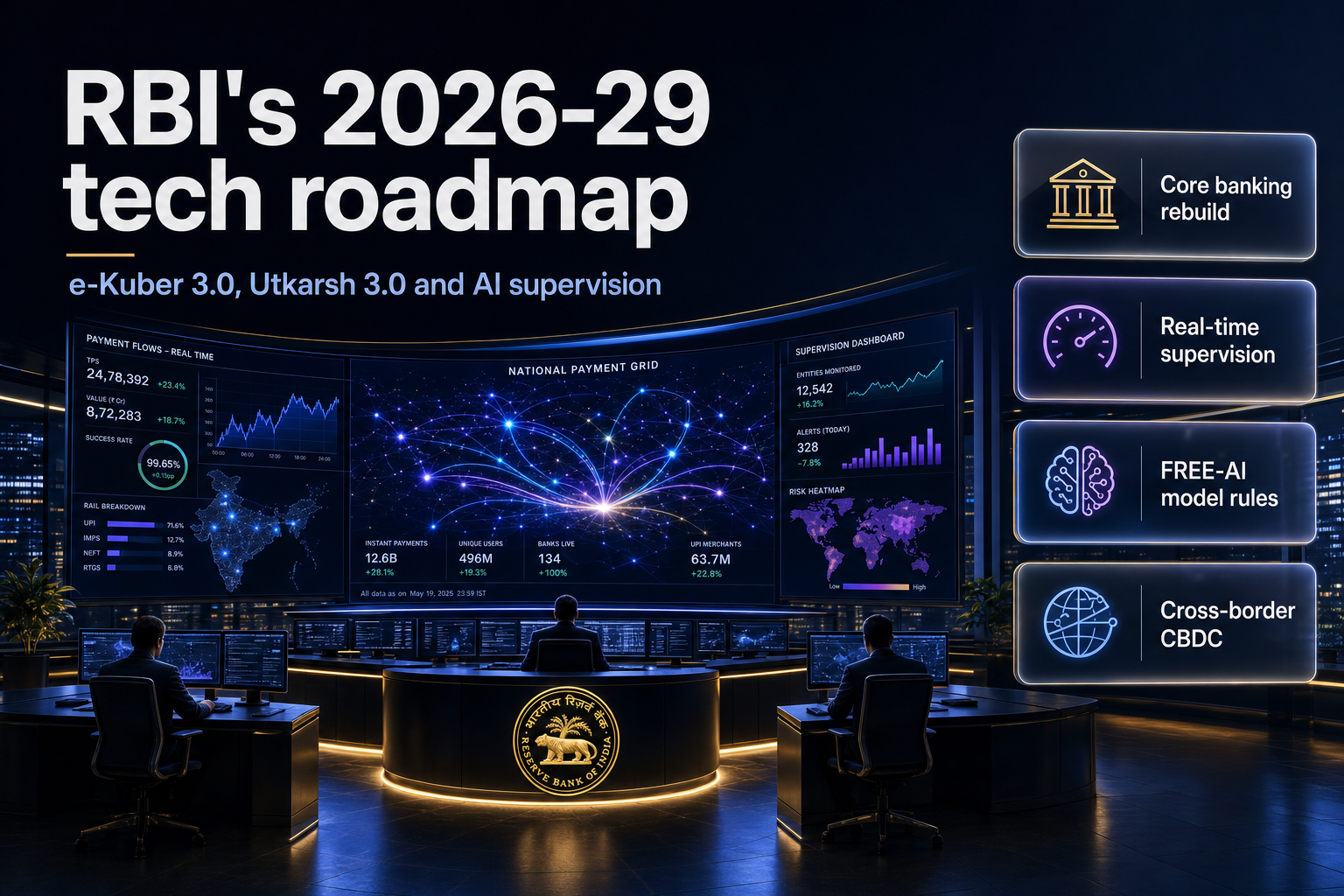
Summary. The Reserve Bank of India's Central Board approved the bank's 2026-27 budget and its medium-term strategy framework, Utkarsh 3.0, for 2026 to 2029 at its 622nd meeting in Patna on 20 March 2026, chaired by Governor Sanjay Malhotra. Digital innovation is one of its pillars, and the plumbing behind it is being rebuilt: RBI is developing e-Kuber 3.0, the next version of the core banking system it has run since 2012, alongside a shift to near real-time, AI-assisted supervision. The regulator has also set the rules for AI itself through the FREE-AI framework, released on 13 August 2025 with 26 recommendations. This matters because the digital rails carry real weight: UPI alone processed 22.72 billion transactions worth ₹28.92 lakh crore in June 2026, according to NPCI. For banks and fintechs, the takeaway is concrete. The way you connect to RBI, the data you report, and the way you govern AI models are all changing inside a three-year window, and the teams that prepare their integration and model-governance work now will spend far less later. This guide sets out what was announced and what to do about it.
None of this is a single product launch with a single date. It is a programme, and the individual pieces land at different times across 2026 to 2029. That is exactly why the work is worth starting early: the banks and fintechs that treat it as a standing roadmap, rather than a set of last-minute compliance sprints, will carry the lower cost.
What RBI actually approved
At the 622nd meeting of its Central Board on 20 March 2026, held in Patna and chaired by Governor Sanjay Malhotra, RBI approved two things: the budget for the accounting year 2026-27 and the Utkarsh 3.0 medium-term strategy framework for 2026 to 2029. Utkarsh is RBI's internal strategy plan, and this is its third edition.
Utkarsh 3.0 sets the direction rather than the code. Its stated priorities are financial stability, tighter control of inflation, stronger supervision of banks and non-banking financial companies, and heavier use of data analytics and real-time monitoring in policymaking. Digital innovation is a named pillar, with a focus on expanding the digital payments ecosystem, growing the central bank digital currency (the digital rupee), and supporting the fintech sector. For a bank or a fintech, the framework is the signal of where the supervisory attention and the infrastructure investment will go for the next three years.
e-Kuber 3.0: the core banking rebuild
e-Kuber is the core banking solution RBI has operated since 2012. It gives every bank a single current account with the central bank, with secure portal-based access from anywhere, and it settles government transactions and market operations. It is one of the older large central-bank core banking systems still in daily use, and RBI selected Intellect Design's Quantum core banking platform back in 2022 to underpin the next generation.
e-Kuber 3.0 is RBI's in-house next-generation build of that system. Reported plans center on modernising its core functions, including the primary auctions and public debt management it already runs, and integrating it with a common, bank-wide enterprise platform so that RBI's systems share data rather than sitting in silos. For banks that connect to e-Kuber for settlement, auctions and government business, a core system change of this size eventually reaches the counterparty. Interfaces, message formats and reconciliation logic that have been stable for years can move, and the integration test cycle that follows is not small. The safe assumption is that any bank touching e-Kuber will need a planned migration effort, and that the cost of that effort falls sharply when it is scoped early instead of discovered during a cutover.
The supervision shift: near real-time and AI-assisted
The change that reaches the widest set of firms is not a payment rail. It is how RBI watches them. Governor Malhotra said in January 2026 that India needs technology-driven, near real-time supervision of the digital financial system. RBI is moving from periodic onsite inspections toward AI-assisted, near real-time offsite monitoring, building on supervisory systems such as DAKSH, launched in 2022, and its existing OSMOS and CRILC data pipelines.
For a regulated entity, near real-time supervision changes the reporting contract. Data that used to be assembled for a quarterly or annual return is increasingly expected to be available continuously, clean, and reconcilable on demand. That is an engineering requirement before it is a compliance one. Firms that still produce regulatory data through manual extracts and spreadsheets will feel the strain first, and the fix, reliable data pipelines with lineage and validation built in, takes months to stand up. Our engineering checklist for RBI data governance covers the groundwork this depends on.
FREE-AI: model governance is now a regulated capability
If your lending, fraud or collections stack uses AI, RBI has already told you how it expects that to be governed. The Framework for Responsible and Ethical Enablement of Artificial Intelligence (FREE-AI) was released on 13 August 2025, from a committee RBI constituted in December 2024. It sets out principles and 26 recommendations across governance, consumer protection, infrastructure and assurance, and it treats AI in finance as a regulated capability that needs the same rigour as credit, capital or liquidity, not an optional add-on.
The framework pairs that rigour with what its authors call a tolerant supervisory stance: RBI has signalled it will accept first-time AI errors where an institution has adequate safeguards in place. The practical reading for a fintech is that model documentation, validation, monitoring and a clear human-accountability trail are moving from good practice to expected practice. Building an AI feature without that scaffolding now carries regulatory risk on top of the operational risk. This sits directly on top of the RBI digital lending directions that already govern how many of these models are used.
CBDC and cross-border: what is actually being piloted
The digital rupee is where RBI's ambition is most visible. In its 2025-26 reporting, RBI set out plans to run cross-border CBDC pilots with select use cases and to join multilateral projects, including BIS Innovation Hub work, on the technical and governance standards for cross-border payments. It built the Unified Markets Interface (UMI), a platform for tokenising financial assets with wholesale CBDC used for settlement, and ran a pilot with tokenised certificates of deposit. On the bilateral side, RBI signed a memorandum of understanding on digital-asset collaboration with the Monetary Authority of Singapore and held discussions with both Singapore and the Central Bank of the UAE on operationalising a cross-border CBDC pilot.
For most fintechs this is a two-to-three-year horizon, not a next-quarter integration. The point to note now is direction: RBI is building programmable money and tokenised settlement as first-class infrastructure, and firms in payments, trade finance and capital markets should be tracking the standards work rather than waiting for a mandate.
What banks and fintechs should do now
| RBI 2026-29 initiative | What it is | What banks and fintechs should prepare |
|---|---|---|
| Utkarsh 3.0 (2026-29) | RBI's medium-term strategy, digital innovation a named pillar | Map your roadmap to RBI's priorities; expect supervisory focus on data and AI |
| e-Kuber 3.0 | Next-gen core banking rebuild, new auction and debt modules | Scope a migration effort for e-Kuber interfaces, message formats and reconciliation |
| Near real-time supervision | AI-assisted offsite monitoring via DAKSH, OSMOS, CRILC | Build clean, continuous regulatory data pipelines with lineage and validation |
| FREE-AI framework | 26 recommendations governing AI in finance | Stand up model documentation, validation, monitoring and human accountability |
| Cross-border CBDC and UMI | Tokenised settlement and cross-border digital rupee pilots | Track standards; assess tokenisation and programmable-money use cases early |
| DPDP compliance | Data-protection duties across all of the above | Design data minimisation and consent into every new pipeline from the start |
The pattern across every row is the same. RBI is moving supervision and infrastructure toward continuous, data-rich, AI-aware operation, and it is publishing the direction years ahead. The engineering work that pays off is unglamorous: clean data pipelines, documented models, and integration test plans scoped before a deadline is announced. Under the Digital Personal Data Protection Act, 2023, every one of those pipelines also has to handle personal data with minimisation and consent designed in, which is far cheaper to build once than to retrofit under audit. A bank or fintech that starts on the data and model-governance foundations in 2026 will meet each landing in this roadmap as a planned release rather than a fire drill.
How eCorpIT can help
eCorpIT (eCorp Information Technologies Private Limited) is a Gurugram technology consultancy, founded in 2021, that builds regulated fintech and banking systems for the Indian market. We are CMMI Level 5 assessed and MSME registered, with senior-led engineering teams and partnerships with AWS, Microsoft and Google. For RBI's 2026-29 roadmap, that means building the regulatory data pipelines that near real-time supervision needs, the model-governance scaffolding FREE-AI expects, and integration plans for core-system changes, all designed aligned with RBI and DPDP requirements rather than claimed as blanket certification. If you are planning this work, talk to our team about a readiness review, and see our DPDP-ready app development approach for the data foundations it rests on.
FAQ
References
_Last updated: 26 July 2026._