On this page · 11 sections
- What actually shipped on 13 August
- The mapping, and what it costs you
- The three places the docs disagree with the blog
- Where the date does and does not appear
- What breaks, and how to tell if it is you
- The rate-limit trap at the top tier
- India-specific considerations
- What is still unknown
- FAQ
- How eCorpIT can help
- References
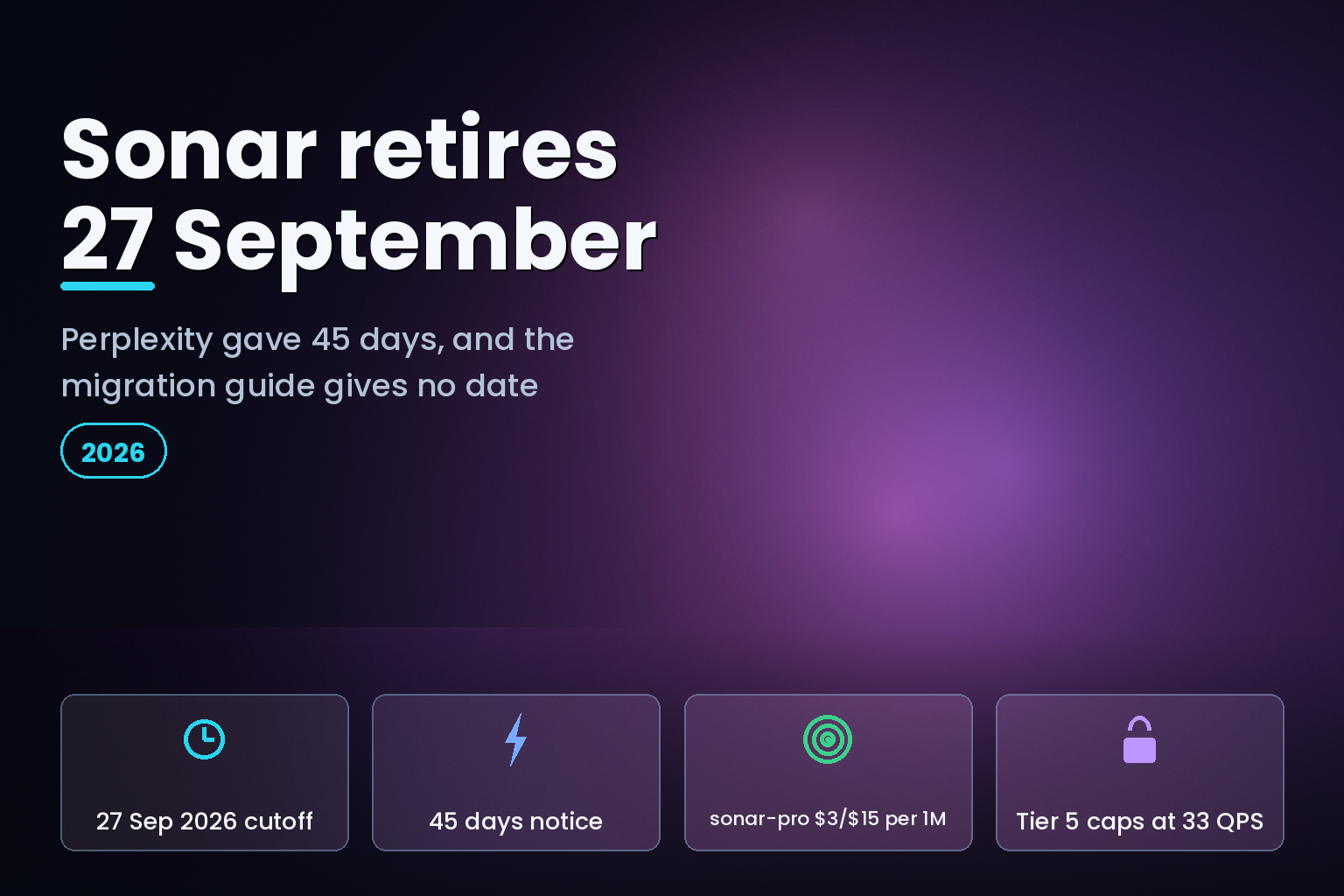
Summary. On 13 August 2026 Perplexity published "Agent API: One Place to Build with LLMs, the Web, and Agents" and, four paragraphs in, dated the end of its Sonar API: "On September 27, 2026, the Agent API becomes the main surface for this work, and Sonar tiers retire on the same date." That is 45 days of notice for an endpoint carrying production traffic. Three things make the migration harder than the post suggests. The migration guide Perplexity links to states no retirement date at all and says Sonar "remains supported". The changelog, which Perplexity's own FAQ names as the place retirements are announced, contains no entry for 27 September and files the Sonar item under July 2026. And the benchmark data Perplexity publishes in its docs does not match the blog: the low preset scores 40.00 on BrowseComp against Sonar Pro's 7.33, which is 5.46x, not the "roughly a 7x improvement" the post claims, and it costs $0.0679 per query rather than "approximately $0.05". If you are running sonar-pro at $3 in and $15 out per million tokens, the date is real. The numbers you plan against should come from the docs, not the announcement.
What actually shipped on 13 August
Almost nothing new. Perplexity's own changelog puts the Agent API at general availability in February 2026, moves the canonical endpoint to /v1/agent in March 2026 with /v1/responses kept as an alias, and adds the finance_search tool in May 2026. The 6 May 2026 blog post announcing Finance Search already describes it as shipping "in the Perplexity Agent API", three months after GA.
The presets are a rename, not a new abstraction. The docs say it plainly: "Agent API presets now use tier-based names: fast-search → fast, pro-search → low, deep-research → medium, advanced-deep-research → high, and ultra → xhigh."
So the substance of the 13 August post is two operational facts: every Sonar customer is being auto-upgraded to a preset, and Sonar has a date. Everything else is repackaging.
The auto-upgrade language is worth reading closely: "Today we're upgrading all Sonar customers to an Agent API preset that scores higher on benchmarks at lower cost." Perplexity is moving you, not asking. The one carve-out is contractual: "Customers with existing contractual commitments to Sonar are covered through the end of their current term."
The mapping, and what it costs you
Sonar tiers map to presets one for one: sonar to fast, sonar-pro to low, sonar-reasoning-pro to medium, and sonar-deep-research to high. The xhigh preset sits above all of them.
Here is what the docs publish for the four Sonar models you are being moved off.
| Sonar model | Input / output per 1M tokens | Per 1,000 requests (high / medium / low context) | Context |
|---|---|---|---|
sonar |
$1 / $1 | $12 / $8 / $5 | 128K |
sonar-pro |
$3 / $15 | $14 / $10 / $6 | 200K |
sonar-reasoning-pro |
$2 / $8 | $14 / $10 / $6 | 128K |
sonar-deep-research |
$2 / $8 | citations $2/1M, reasoning $3/1M, $5 per 1,000 searches | 128K |
Note the sonar-pro context window: 200K, the largest in the lineup. Perplexity publishes context lengths for all four Sonar models and publishes none for the Agent API. Neither the Agent API models page nor the pricing page carries a context figure. What exists instead is a per-preset max_output_tokens, running from 8,192 on fast to 128,000 on medium and above. If you moved to Sonar Pro specifically for the 200K input window, there is currently no published number telling you whether you keep it.
The Agent API bills tools separately from tokens, and those prices are published:
| Tool | Price | Note |
|---|---|---|
web_search |
$2.50 per 1,000 invocations | |
fetch_url |
$0.50 per 1,000 invocations | |
finance_search |
$5 per 1,000 invocations | tokens billed separately |
people_search |
$5 per 1,000 invocations | |
| MCP tool calls | free | "Agent API does not charge a per-invocation fee for calling a remote MCP server" |
| Sandbox session | $0.03 per session | billing window covers up to 20 minutes of active use |
The step budget is where the cost actually moves. The docs list fast at max_steps=1, low at 5, medium and high at 15, and xhigh and wide-research at 100. Each step can fire a web_search at $2.50 per 1,000. A low call that exhausts its budget bills up to five searches; an xhigh call can bill a hundred. A per-request price on a preset is a distribution, not a number, and Perplexity does not publish the distribution.
The three places the docs disagree with the blog
The 7x claim. The post says the low preset "delivers roughly a 7x improvement on BrowseComp compared to Sonar Pro at approximately $0.05 per query." The migration benchmarks page gives BrowseComp scores of 7.33 for sonar-pro and 40.00 for low, at a cost of 67.9 per 1,000 requests. That is 5.46x at $0.0679 per query. The direction is right and the improvement is large. The multiple and the price are both overstated.
"A fraction of the cost." The post says presets "can match Sonar Deep Research at a fraction of the cost." sonar-deep-research maps to high. On the docs' own numbers, high costs more than Deep Research on two of the three benchmarks: 777.6 against 611.0 on BrowseComp, and 939.0 against 581.5 on WideSearch. Only DSQA goes the other way, 527.8 against 565.6. Perplexity's migration guide hedges it correctly, to "often at a lower per-request cost than Sonar Deep Research". The blog does not.
"Thousands of retrieval steps." The post says the top presets "run thousands of retrieval steps in a single call". The current preset values in the docs cap xhigh and wide-research at max_steps=100.
There is also a preset-count mismatch. The blog names six: "fast, low, medium, high, xhigh, and wide-research". The migration overview names five. The pricing calculator's preset array holds five. Only the presets page lists six, and wide-research has no changelog entry.
Where the date does and does not appear
This is the part to escalate internally, because it decides whether your vendor-risk process ever sees the deadline.
| Surface | States 27 September 2026? | What it says |
|---|---|---|
| 13 Aug blog post | Yes | "Sonar calls will stop working" if nothing changes |
| Docs warning banner | Yes | "Sonar will be supported until September 27, 2026" |
| Migration guide overview | No | "While Sonar Chat Completions remains supported…" |
| Agent API quickstart | No | no notice |
| Changelog | No | Sonar item filed under July 2026, undated |
Perplexity's FAQ says: "When a model is retired, we announce it in the changelog along with a recommended replacement… watch the changelog for deprecation notices." A team that follows that instruction exactly will not find this one. The date lives in a blog post and in a reusable warning component rendered on the pricing, rate-limits and Sonar model pages. It does not live where the vendor tells you to look.
If you monitor vendor deprecations by diffing changelogs, and most engineering teams that monitor them at all do it that way, this deadline is invisible to your tooling. The same failure mode showed up in the OpenAI Assistants API shutdown and in the DeepSeek legacy API cutoff: the date was real, the announcement surface was not the one teams watched.
What breaks, and how to tell if it is you
Sonar Chat Completions is an OpenAI-compatible chat endpoint. The Agent API is not the same shape. You are changing the endpoint path, the request body, and the response parsing, not swapping a model string.
Check for these:
- Hardcoded model strings. Grep for
sonar,sonar-pro,sonar-reasoning-pro,sonar-deep-researchacross application code, prompt templates, config maps and infrastructure-as-code. The preset names are not drop-in replacements for the model names.
- Chat-completions response parsing. Anything reading
choices[0].message.contentneeds rewriting for the Agent API response.
- Citation handling. Sonar's citation array is what most teams built their source-attribution UI on. Re-verify the field names before you cut over.
- The 200K context path. If any request depends on
sonar-pro's 200K window, you have no published Agent API equivalent to plan against yet. Ask Perplexity in writing.
- Cost alarms. Your per-call cost model changes from a token price to a token price plus a variable number of tool invocations. Budget alerts calibrated on Sonar will misfire.
You are not affected if you only call the Search API. It is a separate product, it carries no deprecation notice, its pricing stands at $5.00 per 1,000 requests, and the docs state that "Search rate limits are independent of your usage tier."
The rate-limit trap at the top tier
Perplexity's usage tiers are cumulative, not current: "Tiers are based on cumulative purchases across your account lifetime, not current balance." Thresholds run $0, $50, $250, $500, $1,000 and $5,000.
Agent API limits by tier are 1, 3, 8, 17, 33 and 33 queries per second, with per-minute caps of 50, 150, 500, 1,000, 2,000 and 2,000.
Read the last pair again. Tier 5 costs $5,000 in cumulative spend and buys exactly the same Agent API throughput as Tier 4 at $1,000. If you are sizing a migration on the assumption that spending more lifts your ceiling, it stops lifting at Tier 4. Anything above 33 QPS is a conversation with sales, not a spend threshold.
India-specific considerations
Two points matter for teams building from India.
The people_search and web_search tools send query content to a US-hosted service and bill at $5 and $2.50 per 1,000 invocations. If those queries carry personal data, that is a cross-border transfer under the Digital Personal Data Protection Act 2023, and it belongs in your consent notice and your processor register before the cutover, not after. Design the tool-call boundary so identifiable fields are stripped before the request leaves your infrastructure.
Second, 27 September 2026 is a Sunday, and it falls in the last week of the September quarter. If your delivery process runs a quarter-end change freeze, a migration that touches endpoint shape, response parsing and cost alarms will not clear it. The work has to land by mid-September or take an exception. That leaves under four weeks from today.
What is still unknown
- No per-request or per-preset price is published. The pricing page renders a calculator, and the calculator's own metadata states the preset token counts are median values from representative runs, "NOT billed values".
- No Agent API context limit is published. Only
max_output_tokensper preset.
- `xhigh` and `wide-research` are absent from the benchmark data, while the docs describe
xhighas "leading across the benchmarks we run".
- Neither blog post carries a byline or a named quote, so there is no accountable statement beyond the documentation itself.
Send Perplexity three written questions before you commit a sprint: the Agent API context window, a per-preset cost band for your traffic mix, and confirmation in writing that 27 September 2026 is the hard date given the migration guide omits it.
FAQ
How eCorpIT can help
We run vendor API migrations as scoped engineering work, not as a code search. Our senior engineering teams inventory every call site, model the new cost shape against your real traffic mix, and cut over behind a feature flag so the rollback is one config change. If Sonar is in your stack, our API migration engineering service covers the same pattern we applied to the Assistants API shutdown. See our work on production AI agent architecture and on LLM routing and API spend decisions, or contact us for a migration scope.
References
- Agent API: One Place to Build with LLMs, the Web, and Agents, Perplexity Blog, 13 August 2026.
- Migrate from Sonar: overview, Perplexity Docs.
- Migration benchmarks, Perplexity Docs.
- Agent API presets, Perplexity Docs.
- Pricing, Perplexity Docs.
- Rate limits and usage tiers, Perplexity Docs.
- Changelog, Perplexity Docs.
- FAQ, Perplexity Docs.
- sonar-pro model card, Perplexity Docs.
- sonar-deep-research model card, Perplexity Docs.
- web_search tool, Perplexity Docs.
- people_search tool, Perplexity Docs.
- MCP tool support, Perplexity Docs.
- Sandbox tool, Perplexity Docs.
- Search API quickstart, Perplexity Docs.
- Introducing finance search in the Agent API, Perplexity Blog, 6 May 2026.
Last updated: 21 August 2026.