On this page · 11 sections
- What Microsoft actually announced
- The 1,000× claim: what it actually means
- How AI built the chip: the Microsoft Discovery story
- What is real vs what is positioning
- Where this sits in the broader quantum landscape
- What enterprise buyers should do in 2026 H2
- What "by 2029" actually means
- Frequently asked questions
- A short closing note
- Further reading
- References
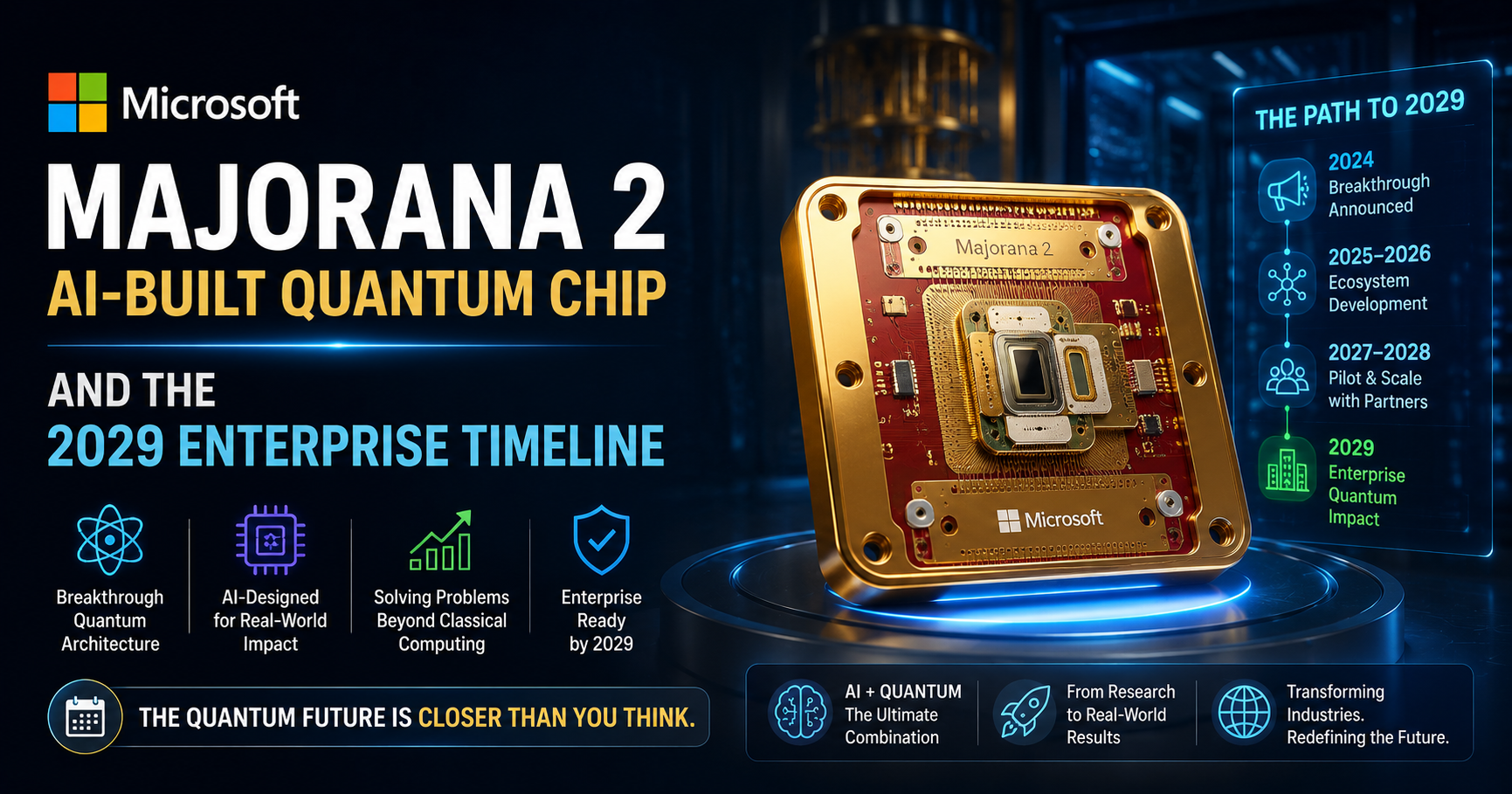
Summary. Microsoft unveiled Majorana 2 at Build 2026 in San Francisco — a next-generation topological quantum chip with qubits roughly 1,000 times more stable than its 2025 predecessor and a switch from aluminium to a lead-based superconductor that helps shield qubits from cosmic-ray disturbances. The "developed with AI" framing is real: Microsoft's agentic AI research platform Microsoft Discovery automated qubit measurements that previously took weeks, and is now generally available to enterprise customers. The 2029 commercial-quantum target — halved from earlier projections — is meaningful but should not change 2026 H2 enterprise AI investment plans. This guide does the facts, separates what's real from what's positioning, and gives buyers a practical lens.
Talk to eCorpIT about a Microsoft AI engagement · Microsoft Build 2026 enterprise takeaways
What Microsoft actually announced
The verified facts, sourced across at least two reputable outlets.
Majorana 2 chip unveiled at Microsoft Build 2026, San Francisco, 2 June 2026. Reuters and BNN Bloomberg report Satya Nadella confirmed the chip during the conference keynote, framing it as the centerpiece of Microsoft's quantum strategy.
Topological qubit architecture, lead-based superconductor. Per Tom's Hardware and SiliconANGLE coverage, Majorana 2 uses a new materials stack centered on lead rather than the aluminium used in the first-generation Majorana chip announced in 2025. Lead's atomic structure helps shield the fragile quantum states from cosmic-ray and other environmental disturbances.
1,000× stability improvement. Microsoft claims qubit stability roughly 1,000 times higher than Majorana 1. Per the company's own announcement and multiple independent outlets, mean qubit lifetimes now hit around 20 seconds, with some devices reaching as long as one minute. For context, most competing qubit approaches measure lifetime in microseconds — a 20-second lifetime is a meaningful step.
Microsoft Discovery generally available. The agentic AI research platform Microsoft used to develop Majorana 2 is now available to enterprise customers. This is the part of the announcement that should matter most to enterprise buyers in 2026 H2 — agentic AI for materials science and complex research is now a commercial product, not just an internal Microsoft tool.
Commercial-scale quantum target moved to 2029. Microsoft's previous projection of 2033 (per some accounts, 2035) has been compressed to 2029. Per Reuters via US News, this puts Microsoft on the same year as IBM, which announced a $10 billion quantum investment with a 2029 target in May 2026.
The 1,000× claim: what it actually means
The headline number deserves careful reading.
A 1,000× improvement in qubit stability sounds revolutionary. In quantum physics specifically, the comparison frame matters. Microsoft is comparing Majorana 2 to Majorana 1 (its own 2025 chip), not to the broader quantum-computing landscape.
Against Majorana 1: Genuinely a thousand-fold improvement, per Microsoft's published claims and external coverage. Mean qubit lifetime from microsecond-to-millisecond range up to ~20 seconds. This is a real engineering achievement.
Against the broader quantum landscape: The picture is more nuanced. Other quantum-computing approaches (superconducting qubits used by IBM and Google, trapped-ion qubits used by Quantinuum and IonQ) have different stability profiles and error-correction strategies. They reach effective stability through error correction rather than raw qubit lifetime. A direct "1,000× better than IBM" comparison is not what Microsoft is claiming.
The strategic significance: Topological qubits — Microsoft's chosen architecture, based on Majorana zero modes — have always been the "high-risk, high-reward" approach. They are theoretically far more stable than other qubit types because they encode quantum information in collective properties of matter that are intrinsically protected from noise. The catch: nobody had built a working topological qubit at scale. Majorana 2's 20-second lifetime is the first credible signal that the topological approach can deliver.
This matters because if topological qubits work, error correction becomes much cheaper. Today's quantum-computing approaches need roughly 1,000 physical qubits to make one usable logical qubit through error correction. Topological qubits might need a tenth of that ratio. If Microsoft scales Majorana 2 to thousands of physical qubits, the path to commercial-utility quantum gets meaningfully shorter.
How AI built the chip: the Microsoft Discovery story
The "AI built it" framing is the part of the announcement most worth understanding for enterprise buyers, because Microsoft Discovery is now a generally-available product.
Microsoft Discovery is an agentic AI research platform. Per the Microsoft newsroom feature on the Majorana 2 development, the platform's autonomous AI agents:
Analysed nearly two decades of internal research data. Patterns, dead-ends, materials experiments, fabrication notes. The agents identified correlations across the corpus that human researchers had not surfaced.
Automated qubit measurement processes. A measurement cycle that previously took weeks of human researcher time — adjusting voltages, mapping qubit conditions, running experiments — got compressed to hours through parallel autonomous agent runs.
Built continuous three-dimensional maps of qubit conditions. Rather than discrete experimental runs followed by manual analysis, the AI agents produced continuous condition surfaces that let the human team identify the right materials and configurations faster.
Managed engineering dependencies and surfaced manufacturing issues. Cross-disciplinary signal that would have taken cross-functional teams months to coordinate.
The honest framing: Microsoft Discovery did not "invent" the chip. Human researchers designed the experiments, interpreted the results, and made the architectural decisions. The AI accelerated the cycle. The reported productivity improvement: research that would have taken years compressed to months.
For enterprise buyers, the implication matters more than the chip itself. The same Microsoft Discovery platform that accelerated Majorana 2 is now generally available. Materials science, drug discovery, energy research, complex engineering — any R&D-heavy domain with decades of accumulated data and multi-variable experimentation can theoretically benefit from the same agentic-AI cycle compression.
What is real vs what is positioning
Honest separation, the same shape as our Microsoft Build 2026 enterprise takeaways and the MS-Uber Claude Code analysis.
Real product, available today:
- Microsoft Discovery generally available to enterprises.
- The Majorana 2 chip exists as working hardware in Microsoft's lab.
- The 20-second qubit lifetime is independently confirmed.
- The lead-based materials stack works at the demonstrated scale.
Real progress, deployment timeline measured in years:
- Scaling Majorana 2 from a small-scale demonstration to a working commercial quantum computer.
- Building the cryogenic infrastructure required at commercial scale.
- Software, algorithms, and error-correction systems for topological-qubit machines.
- Integration with Azure cloud as a customer-facing quantum compute service.
Strategic positioning, treat the timeline with caution:
- "Commercial-utility quantum by 2029" — Microsoft has restated this timeline before, and quantum hardware roadmaps have a history of slipping. The new chip is genuine progress; the timeline is a target, not a commitment.
- "Halved from earlier 2033 or 2035 projections" — true at face value, also reflects normal R&D revision rather than a specific accelerator.
- "First credible signal topological qubits will work at scale" — true today, with the caveat that "credible signal" and "working commercial machine" are still several years apart.
For 2026 H2 enterprise planning, focus on Microsoft Discovery's availability. Treat the Majorana 2 progress as long-term signal and the 2029 timeline as aspirational.
Where this sits in the broader quantum landscape
Context for why this matters competitively.
IBM. Announced a $10 billion quantum investment in May 2026 with a 2029 commercial-utility target of its own. IBM's approach uses superconducting qubits and aggressive error-correction systems. Different architecture, similar timeline, similar ambition.
Google. Quantum AI division targeting commercial utility on a similar horizon. Google's superconducting qubit work has produced consistent incremental progress; Google has been less specific publicly about its commercial-machine timing.
Quantinuum. Honeywell's quantum spinoff, using trapped-ion qubits. Different stability profile, different scaling challenges. Has shipped commercial systems already at smaller scale.
IonQ. Publicly traded quantum-computing company also using trapped ions. Commercial cloud-quantum service available today; the question is when "useful" arrives.
The big picture for 2026: Three serious approaches (topological, superconducting, trapped-ion) all targeting roughly the same 2029-2032 commercial-utility window. The race is genuine, the timelines are real targets, and Microsoft's Majorana 2 represents credible technical progress on a track that was previously the riskiest of the three.
For enterprise buyers, the practical implication: quantum is not arriving tomorrow, but the question of which approach wins is becoming clearer year by year. Topological qubits just moved up the credibility table.
What enterprise buyers should do in 2026 H2
Five practical takeaways for enterprise AI procurement teams.
Microsoft Discovery is the actionable announcement, not Majorana 2
The chip will not change anyone's 2026 H2 buying decisions. The Microsoft Discovery platform might. For R&D-heavy organisations — pharmaceuticals, materials science, chemistry, energy, aerospace, advanced manufacturing — agentic AI for research-cycle compression is now a generally-available capability.
Pilots make sense in 2026 H2. Plan to test Discovery on one well-defined research workload before committing budget for enterprise rollout.
Do not pause AI investments waiting for quantum
The single most damaging response to quantum-progress announcements is "let us wait until quantum is ready before committing serious AI budget." Commercial-utility quantum is at least 3-5 years away regardless of which vendor's timeline holds. AI workloads — agents, RAG, customer service automation, mobile and web AI features — pay back today. The "wait for quantum" framing is procurement procrastination dressed up as strategy.
Update your post-quantum cryptography roadmap
The one quantum-related action every enterprise should be working on in 2026: post-quantum cryptography migration. Quantum computers, when they arrive at scale, will break current public-key cryptography (RSA, elliptic curve). NIST published its first set of post-quantum cryptography standards in 2024. Migrating long-lived data and systems takes years; starting in 2027 will be too late for some workloads.
Track Microsoft's overall AI stack strategy
Microsoft Build 2026's broader announcements — MAI-Thinking-1, Surface Axion, Project Solara, Microsoft IQ, Maia 200 chips — frame the company as building every layer of the agent stack. Majorana 2 is the quantum layer. The strategic direction is clear: Microsoft wants enterprises to run their entire AI stack on Microsoft surfaces. Enterprise procurement should evaluate Microsoft AI commitments with this 5-year arc in mind.
Maintain multi-vendor optionality
The quantum race has three serious players and three architectures. Avoiding lock-in to any single approach makes sense given that the "winning" architecture is genuinely unclear today. The same applies to AI models, AI chips, and AI development platforms. Multi-vendor optionality is the right posture for the next 24-36 months across the AI and quantum stack.
Need help framing Microsoft Discovery into your 2026 H2 AI roadmap? eCorpIT runs Microsoft AI architecture reviews for enterprise teams — Foundry, Copilot Studio, Microsoft IQ, Discovery adoption, post-quantum cryptography planning, token-economics modelling. Talk to our team about a review.
What "by 2029" actually means
The 2029 framing deserves a closer read because it will shape enterprise planning conversations.
"Commercial-utility quantum computer" is doing significant work in that phrase. Microsoft's stated definition is a quantum computer capable of running practical algorithms faster or better than classical computers for specific use cases (typically materials simulation, optimisation problems, and certain cryptography tasks).
What 2029 commercial-utility quantum probably looks like, if Microsoft hits the timeline:
- A quantum machine accessible via Azure cloud, billed similarly to other Azure compute.
- Available for specific use cases (materials simulation, optimisation), not general-purpose computing.
- Useful in conjunction with classical computing, not as a replacement.
- Expensive per workload — early commercial quantum compute will be premium-priced.
What 2029 commercial-utility quantum will not be:
- A laptop or desktop replacement.
- A general-purpose AI accelerator.
- Cheap or commodity-priced.
- Suitable for most enterprise workloads.
For 2030-2032 planning, quantum becomes a real budget consideration for R&D-heavy enterprises. For 2026-2028, focus on the classical AI and the post-quantum-cryptography preparation. The window where "we have a working quantum computer in our environment" matters for typical enterprise workloads is later than the headlines suggest.
Frequently asked questions
A short closing note
Microsoft's Majorana 2 chip is real engineering progress. The 1,000× stability claim is defensible when read against Microsoft's own previous chip. The agentic-AI development story via Microsoft Discovery is genuine and arguably more important to enterprise buyers than the chip itself, because Microsoft Discovery is now generally available. The 2029 commercial-quantum timeline is meaningful but should not change 2026 H2 AI investment plans.
For enterprise AI procurement teams, the practical 2026 H2 work remains the same: invest in classical AI that pays back today, plan post-quantum cryptography migration that takes years to execute, evaluate Microsoft Discovery for research-heavy workloads, and watch the quantum race without betting on a specific winner. The headlines compress; the engineering does not.
If you want a senior, honest read on what Majorana 2 and Microsoft Discovery mean for your specific Microsoft AI roadmap, that is what we do.
Further reading
- Microsoft Build 2026: Enterprise AI Takeaways — the broader Build 2026 announcements context.
- Microsoft and Uber Cut Back on Claude Code in 2026 — the enterprise AI cost-discipline context.
- ChatGPT Hits 1 Billion Monthly Active Users — the consumer AI scale context.
- AI Chatbots for Customer Service: Real Cost Savings in 2026 — enterprise classical AI ROI.
- AEO vs GEO vs SEO Complete Guide — getting your AI work cited.
References
This article will be reviewed and refreshed quarterly, and immediately if Microsoft, IBM, Google, or other quantum-computing leaders announce major milestones. Next planned refresh: September 2026.