On this page · 9 sections
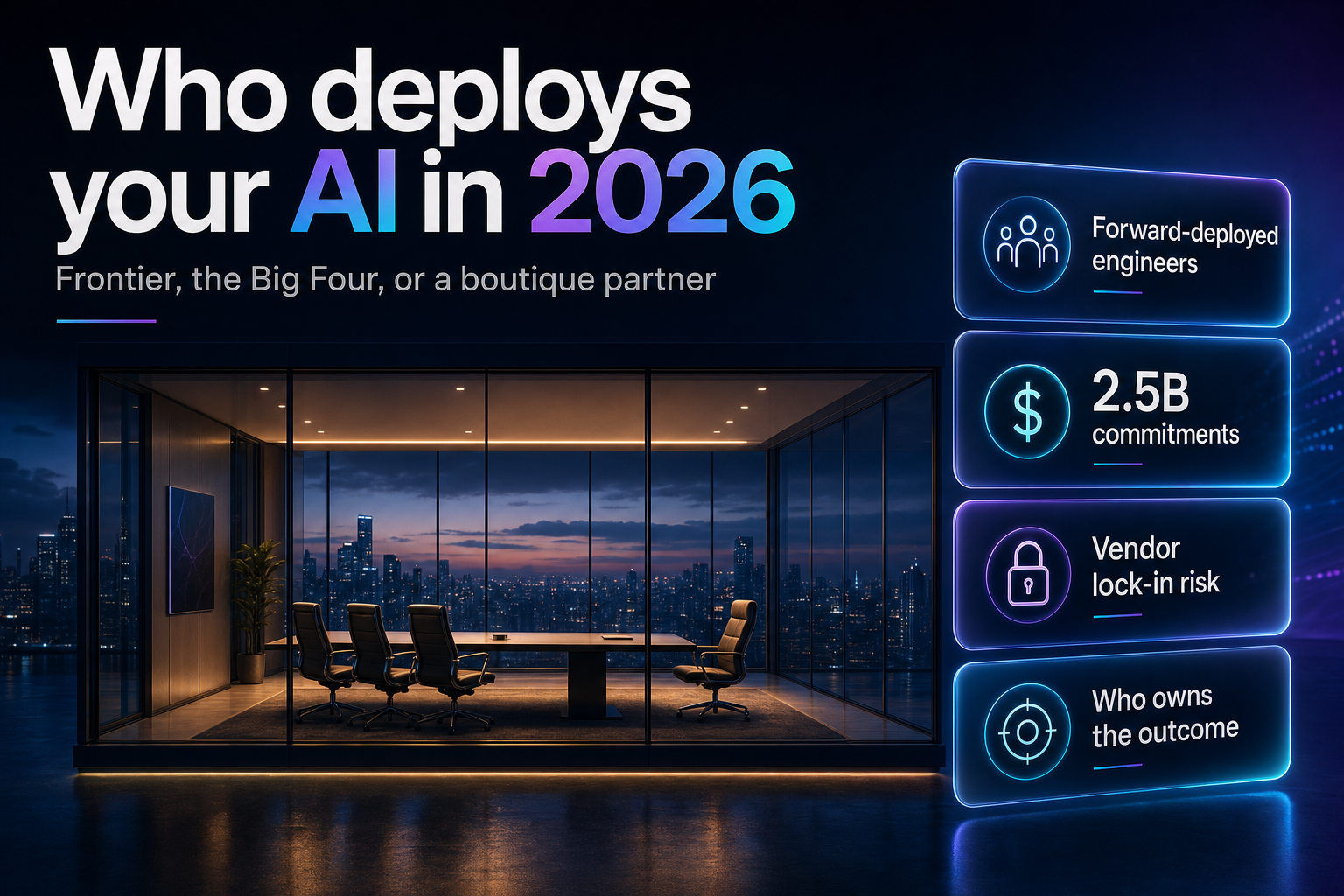
Summary. On July 2, 2026, Microsoft launched Microsoft Frontier Company, backing it with $2.5 billion and 6,000 industry and engineering experts to build and run AI systems inside customers' operations. It was the fifth such commitment in ten weeks. Anthropic announced a joint venture on May 4, 2026 valued at $1.5 billion; OpenAI followed on May 11 with The Deployment Company, which raised more than $4 billion from 19 investors; AWS committed $1 billion around June 30. Accenture, meanwhile, has 80,000 AI and data professionals and reported $11.5 billion in cumulative advanced AI bookings across 11,000 projects before it stopped disclosing the number. The collective bet is that the bottleneck in enterprise AI is no longer the model. It is the deployment. That diagnosis is correct. The buying decision it creates is harder than the vendors are making it sound, because for the first time your implementation partner and your model vendor can be the same company.
Disclosure before anything else: eCorpIT is a boutique partner. We are one of the options described below, which is exactly why this article gives you the questions to ask rather than an answer. Read the framework, not the recommendation.
What actually happened, in ten weeks
Forward-deployed engineering is not new. Palantir built a business on it. What is new is that the model vendors are now doing it themselves, at scale, with balance sheets behind it.
| Venture | Commitment and scale | Announced |
|---|---|---|
| Microsoft Frontier Company | $2.5 billion, 6,000 industry and engineering experts, led by Rodrigo Kede Lima, most recently president of Microsoft Asia. Initial clients include Unilever and Novo Nordisk | July 2, 2026 |
| AWS forward deployed engineering | $1 billion, seeded with "thousands" of FDEs in teams of roughly five or six. Early customers include Southwest Airlines, Cox Automotive, Ricoh, the NBA and the NFL | June 30, 2026 |
| OpenAI, The Deployment Company | Raised over $4 billion from 19 investors, anchored by TPG with Advent International, Bain Capital and Brookfield as co-leads. Acquired consultancy Tomoro and about 150 FDEs | May 11, 2026 |
| Ode with Anthropic | Valued at $1.5 billion, with a $300 million founding commitment split between Anthropic, Blackstone and Hellman & Friedman. Goldman Sachs a founding partner | May 4, 2026 |
| Accenture | 80,000 AI and data professionals. $11.5 billion cumulative advanced AI bookings, 11,000 projects, $4.8 billion revenue, advanced AI in 1,300 of 9,000 clients | Reporting discontinued after Q1 FY2026 |
Two things stand out. The first is speed: five commitments between May 4 and July 2, 2026. The second is the direction of travel. AWS was the first hyperscaler to move, and Microsoft answered within days with more than double the money.
The bottleneck they are all describing is real
The vendors are unusually candid about why they are doing this, and their diagnosis matches what buyers report.
Anthropic's CFO, Krishna Rao, put the supply problem plainly: "Enterprise demand for Claude is significantly outpacing any single delivery model." Blackstone's president and chief operating officer, Jon Gray, framed the venture as an attack on "one of the most significant bottlenecks to enterprise AI adoption", meaning the scarcity of engineers who can implement frontier systems quickly.
Accenture's chief executive, Julie Sweet, has been making the same argument from the other side of the table, and her version is the more useful one for a buyer because it names the actual work:
"Enterprise AI is fundamentally different than consumer AI. Consumer AI adoption is instant. In the enterprise, you can't adopt it unless you have the right security. You've done the right work around processes and most companies have fragmented and siloed processes. You have to have the right data and most companies have mountains of data with a lot of issues in the data, and we call it they have process debt, they have data debt. And of course, they need a modern digital core. And that's why so many companies are still early in the journey."
Then the number that should shape your budget more than any vendor commitment: Sweet said at least half of Accenture's advanced AI projects also require a data project. Not a model project. A data project.
That single statistic reframes the whole decision. If half your AI programme is data plumbing, then the question "whose engineers should deploy our AI" is downstream of a bigger one: who is going to fix the data, and do they have any incentive to tell you that the data is the problem?
The conflict nobody is putting on the slide
Here is the structural issue with the vendor-led model, stated neutrally.
When Microsoft Frontier engineers deploy AI in your business, they are excellent at deploying Microsoft's AI. When AWS FDEs arrive, the answer will be AWS-native and, in AWS's own framing, agentic-first. This is not a criticism of the engineers, who are likely to be very good. It is a description of the incentive. You are hiring your model vendor's implementation arm to evaluate whether your problem needs that vendor's model.
Some of these ventures have deliberately structured against this. AWS says deployments are built around shared goals and business outcomes rather than billable hours, and that customers should be self-sufficient when a deployment ends. That is a meaningful commitment and worth holding them to in writing. OpenAI's Deployment Company is majority-owned and controlled by OpenAI. Anthropic's venture brought in Blackstone, Hellman & Friedman and Goldman Sachs as outside partners, which dilutes but does not remove the alignment question.
The traditional systems integrator has the opposite profile. Accenture is model-neutral in a way Microsoft Frontier structurally cannot be, and it has 80,000 AI and data professionals plus the data-transformation capability that half of these projects turn out to need. The trade is that scale bundles. Sweet's own framing is that advanced AI is now "embedded in some way across nearly everything we do", which is why the company stopped breaking out the metric at all.
That disclosure change matters to you as a buyer, and it is worth being precise about it. Accenture was the first in its industry to report advanced AI bookings and revenue separately. Sweet announced that Q1 FY2026 would be the last quarter with those specific metrics:
"This will be the last quarter in which we share these specific metrics. The demand for AI is both real and rapidly maturing. We've now reached a point where advanced AI is being embedded in some way across nearly everything we do, and many of our clients are focusing on moving beyond standalone proof of concepts or initiatives."
The reasoning is defensible. The consequence is that the one public series that let outsiders track whether AI consulting was converting bookings into revenue has been switched off. In late 2023 the figure was $100 million across 100 projects. Two years later it was $11.5 billion across 11,000 projects with $4.8 billion of revenue. That is a real business. It is also now unobservable, which means your own pilot results are the only evidence you will get.
A decision framework that survives the pitch
Match the model to your actual constraint, not to the logo.
| Your situation | The model that usually fits | Why |
|---|---|---|
| Committed to one model vendor's stack, need speed, have clean data | Vendor FDE team (Microsoft Frontier, AWS, OpenAI, Anthropic) | Deepest product knowledge, direct escalation into the vendor's engineering, fastest path when the answer genuinely is that stack |
| Multi-year transformation, messy data across many systems, regulated industry | Large systems integrator | Data and process work at scale, model neutrality, the capacity to run a five-year programme |
| One high-value workflow, deep domain rules, you intend to own it | Boutique or regional partner | Domain depth, senior attention on a small programme, and the knowledge transfers to your team |
| You do not yet know if AI is the right tool | None of them yet | Every option above is paid to conclude that it is. Do the diagnostic separately |
| Pilot worked, scaling stalled | Depends on why it stalled | If it stalled on data, you have a data problem. If it stalled on process, no engineer fixes that |
The fourth row is the one people skip, and it is the cheapest advice in this article. Every organisation on that list, including ours, makes money when the answer is "yes, build it". If you have not separated the diagnostic from the delivery, you have outsourced the most consequential decision to the party with the least reason to say no.
The five questions to ask every one of them
Ask these in the room, and write the answers into the contract:
- What happens when the right answer is a competitor's model, or no model at all? Ask for a specific example from the last year.
- Who owns the code, the prompts, the evaluation suites and the fine-tuned artefacts when this ends?
- What does self-sufficiency mean concretely? AWS says customers should be self-sufficient when a deployment ends. Ask each vendor to define the exit state and put a date on it.
- Is the data work in scope or out of scope? Half of these programmes need it. If the proposal does not mention data, the proposal is incomplete or the cost is coming later.
- Who exactly is on my team, and what happens to them in month seven? Six thousand experts is an organisation. Five people are your project.
The second question is where most of the value leaks. An implementation partner that keeps the evaluation harness keeps the ability to prove the system works, which is the same as keeping you.
What this means for India
Two implications for Indian enterprises and for teams building from India.
The economics of forward-deployed engineering do not survive contact with mid-market budgets. Microsoft's 6,000 experts and Accenture's 80,000 AI and data professionals are aimed at programmes that justify their cost, and the named early customers, Unilever, Novo Nordisk, Southwest Airlines and the NBA, tell you the target size. If your AI budget is ₹50 lakh rather than $50 million, none of the five ventures above is really selling to you, whatever the press release says. The realistic options are a domestic partner or your own team, and the useful part of this news is the model rather than the vendor: small senior teams, embedded, working on one workflow, measured on outcomes.
The second is governance. Embedding a vendor's engineers inside your operations means giving outside staff access to production systems and personal data. Under the Digital Personal Data Protection Act, 2023, the obligation for that data stays with you as the data fiduciary, not with the firm whose badge the engineer wears. Settle access scope, data residency and processing terms before anyone is embedded, not in month three. We design applications aligned with DPDP requirements, and this is the clause that gets negotiated last and matters first.
For the wider picture on where this spending sits, our enterprise generative AI strategy guide covers the build-versus-buy decision, and the OpenAI and Anthropic pricing analysis covers the model-cost side that these deployment deals sit on top of.
The honest read
The vendors have correctly identified that implementation, not model quality, is what separates a pilot from production. TechCrunch reported on July 15, 2026 that Anthropic and Blackstone are betting implementation is the next trillion-dollar AI business. They may well be right about the market.
That does not make any of them the right choice for you. The strongest argument in this entire news cycle is not Microsoft's $2.5 billion or OpenAI's $4 billion. It is Julie Sweet's throwaway line that at least half of advanced AI projects also require a data project, because it tells you that most of what you are about to buy is not AI work at all. Buy the diagnosis from someone who is not selling the cure.
FAQ
How eCorpIT can help
eCorpIT is a boutique partner, and this article is deliberate about what that means: we are a good fit for one high-value workflow with real domain rules, where you want senior engineers embedded and the knowledge left behind with your team, and a poor fit for a five-year, multi-country transformation. Our senior engineering teams have built and run production systems since 2021, and we will tell you when the answer is a data project rather than an AI project. If you want that diagnostic before you sign with anyone, including us, talk to our team.
References
- Anthropic, Blackstone bet the next trillion-dollar AI business is implementation, not just models - TechCrunch
- Accenture says advanced AI is so pervasive it won't break it out anymore - Larry Dignan, Constellation Research
- Accenture's first quarter fiscal 2026 earnings press release - Accenture Investor Relations
- Microsoft launches $2.5B Frontier Company for enterprise AI - Tech Wire Asia
- What is a forward deployed engineer: the AI role OpenAI, Anthropic and Google are hiring in 2026 - MarkTechPost
- The rise of the AI forward-deployed engineer - TechTarget
- Digital Personal Data Protection Act, 2023 - Ministry of Electronics and Information Technology, Government of India
Last updated: July 16, 2026.