On this page · 10 sections
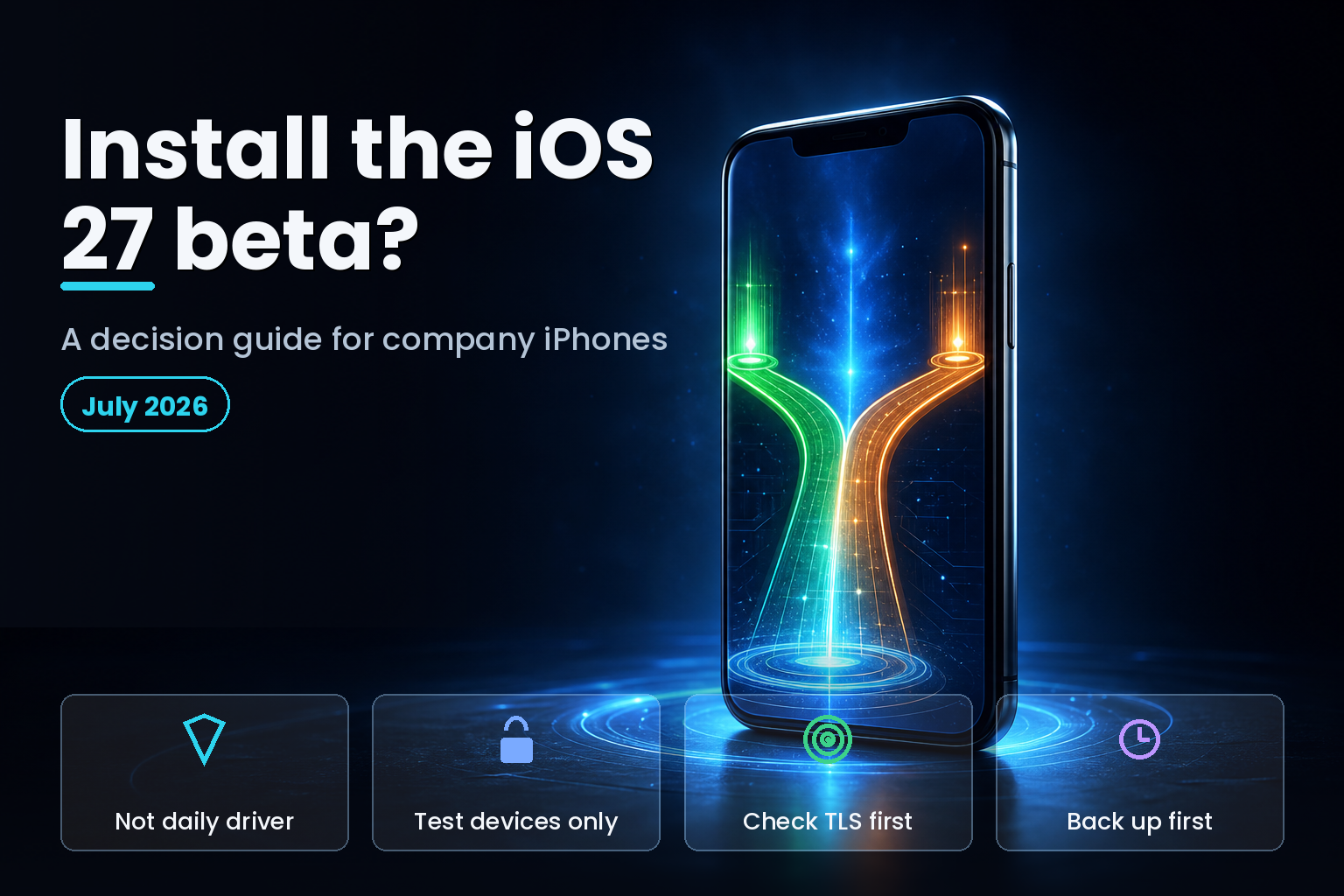
Summary. iOS 27 was announced at WWDC 2026 on June 9, 2026, and its public beta is expected around July 14, 2026, ahead of a general release near September 14, 2026. The short answer for company iPhones is clear: no on the devices people use for work, yes on a small set of dedicated test devices. Betas bring bugs, faster battery drain, and app breakages, and the only clean way back to iOS 26 is an archived backup taken beforehand. For a managed fleet there is a sharper risk: iOS 27 requires TLS 1.2 or later on the servers that run device management, and if yours are not ready, enrolment and updates can fail. With MDM already costing $3.25 to $9 per device each month, a self-inflicted outage across production iPhones is the opposite of value. This guide gives IT managers and CTOs a decision framework: where the beta belongs, where it does not, and how to test it safely before the fleet upgrades.
The instinct to try the new release early is right; the place to do it is wrong if it is a phone someone depends on. The whole point of the beta window is to find problems on hardware you control, not on the CEO's daily driver.
The short answer
Do not install the iOS 27 public beta on any company iPhone that someone relies on for work. Do install it, deliberately, on a small number of dedicated test devices that are enrolled in your MDM but kept out of production. This is the same discipline developers follow, keeping separate iPhones purely for testing, and the same one Apple's own guidance implies when it warns that betas belong on non-primary devices, per Business Standard's rundown. Everything below is the reasoning behind that split, and how to act on it.
Why not on company production iPhones
Three risks make production installs a bad idea. First, instability: beta software carries bugs, app compatibility issues, crashes, slowdowns, and battery drain, and a work phone that runs warm and dies by afternoon is a productivity loss you chose. Second, the one-way door: returning to iOS 26 requires erasing the device and restoring from an archived backup taken before the install, which means real downtime and a data-loss risk in a professional setting. Third, app breakage: your business-critical apps may not be ready for iOS 27, and discovering that on a user's live device turns into a support ticket at the worst time.
For a managed fleet there is a fourth, sharper risk. iOS 27 enforces stricter network security on the processes that run device management, requiring servers to support TLS 1.2 or later, per AppleInsider. If a device upgrades before your servers are ready, its enrolment and updates can fail. Pushing the beta to production iPhones risks breaking management on the exact devices you most need to control.
When you should install it
The beta earns its place on dedicated test devices. The two months between the mid-July public beta and the September release are your validation window, and the way to use it is to enrol a small, representative set of devices, one per hardware tier and per major user role, in your MDM but out of production, per SimpleMDM's testing guidance. For an organisation managing devices centrally, AppleSeed for IT is the enterprise beta track built for exactly this.
On those test devices, do the work that protects your fleet: confirm your MDM servers meet the TLS requirement, validate business-critical apps, and check that your management policies still apply. That is the difference between finding a problem in July on a spare phone and finding it in September across thousands. Our team install-and-test checklist and fleet readiness checklist cover the how.
A decision framework
Match the device to the decision rather than applying one rule to everything.
| Device or user | Install the beta? | Why |
|---|---|---|
| Executive or staff daily driver | No | Downtime and data-loss risk are unacceptable |
| Any single-iPhone user | No | No spare means no safe rollback |
| Dedicated test device in MDM | Yes | This is what the beta window is for |
| Developer test iPhone | Yes | Needed to validate apps against the SDK |
| Kiosk or shared production device | No | Stability matters more than early access |
| A CTO's spare, non-critical phone | Yes, with a backup | Safe way to evaluate features first-hand |
If you do install it, the guardrails
For the devices where the answer is yes, three guardrails keep it safe. Take an archived backup first, because a normal backup can be overwritten and only an archived one lets you return to iOS 26 cleanly. Keep the device enrolled in MDM but out of production, so you can test future policy pushes without risking a user. And log the exact build number with every issue you find, so your reports track the moving target as Apple ships new betas through the summer.
Then treat the findings as a plan. If a critical app breaks, you now have weeks to get a fix before September rather than filing the ticket the day users are stuck. If your MDM servers fail the TLS check, you have time to coordinate with your vendor and network team. The beta is a controlled test, and these guardrails are what keep it controlled.
What to do at the September release
The decision does not end with the beta. When iOS 27 ships around September 14, do not push it fleet-wide on day one. Use what your test devices found to drive a staged rollout, starting with a pilot group, then a broader cohort, then the wider fleet, controlling the pace with your update policy. Our iOS 27 enterprise rollout plan breaks that into stages. The beta answers "should we test it now"; the rollout plan answers "how do we deploy it safely later."
India-specific considerations
For IT managers and CTOs in India, two points apply. First, the TLS requirement is location-independent and urgent: any MDM or enrolment server, wherever hosted, must meet TLS 1.2 or later before iOS 27 devices connect, so verifying it belongs on your July list regardless of where your infrastructure sits. Second, budget and hardware: iOS 27 keeps the iPhone 11 supported, so a lab of a few second-hand supported handsets is an affordable way to test without touching production, which suits a cost-conscious Indian IT setup. Handle employee data on any test device under the Digital Personal Data Protection Act, 2023 (DPDP), keeping test data separate from production records. At $3.25 to $9 per device each month for MDM, a large fleet is a real cost line, so use the beta to confirm your existing vendor handles iOS 27 before you renew.
FAQ
How eCorpIT can help
eCorpIT is a Gurugram-based technology organisation with senior-led engineering teams that help companies test and roll out major OS releases without disrupting users. We can set up your iOS 27 test devices, confirm your MDM servers meet the new TLS requirement, validate business-critical apps, and design a staged rollout for the September release. If you want a clear beta-testing and rollout plan for your fleet, contact us. You can also browse the eCorpIT blog or read about our team.
References
_Last updated: July 5, 2026._