On this page · 13 sections
- Why a checklist beats a launch-day upgrade
- Point 1: confirm your MDM vendor supports iOS 27
- Point 2: migrate software update enforcement to declarative management
- Point 3: verify your servers meet the new TLS requirement
- Point 4: enrol test devices and track them with AppleSeed for IT
- Point 5: rebuild your Siri AI and Apple Intelligence restrictions
- Point 6: re-check your backup and restore runbook
- Point 7: validate apps and connectivity, then plan the rollout
- Sequencing the checklist during the beta
- India-specific considerations
- FAQ
- How eCorpIT can help
- References
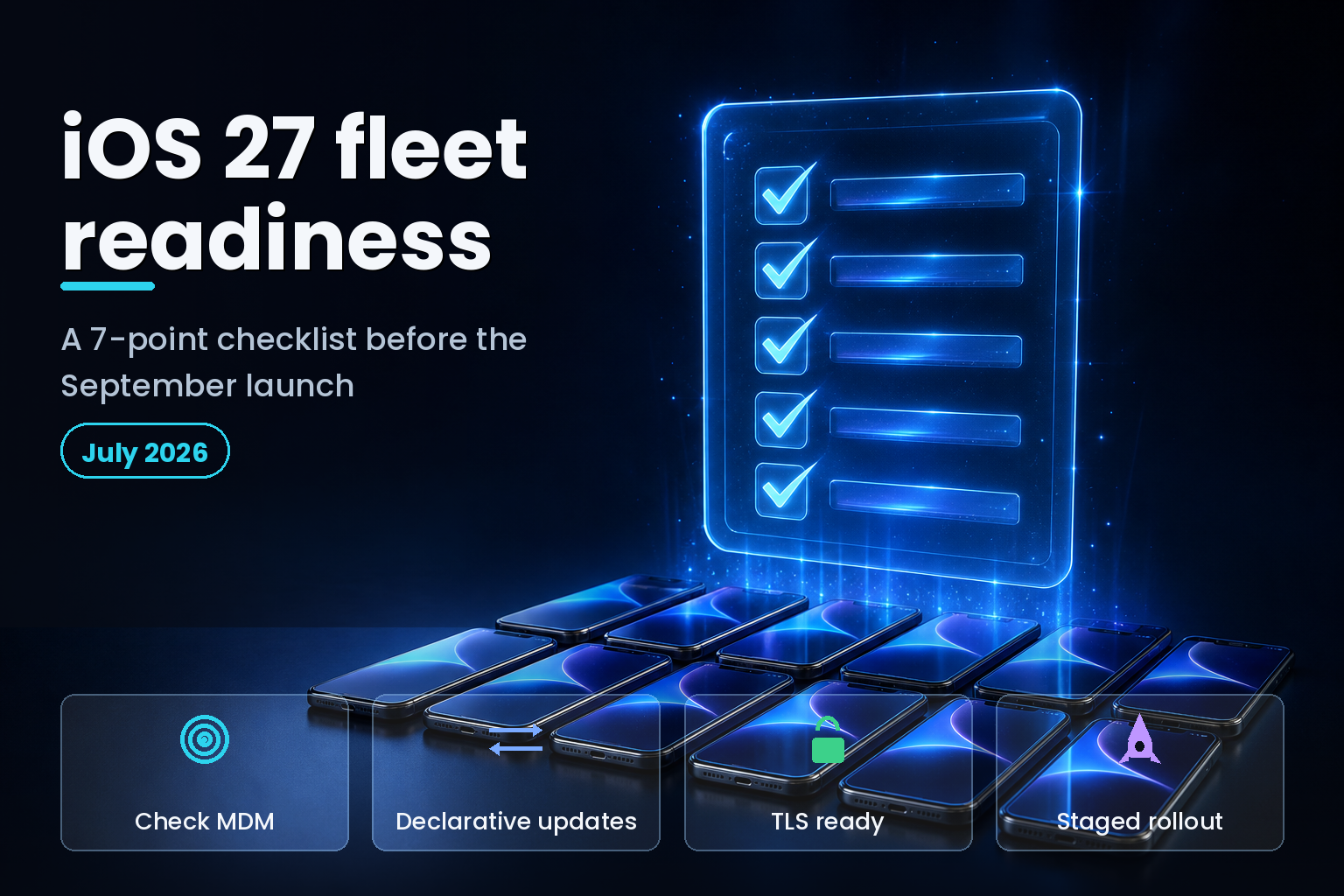
Summary. The iOS 27 public beta is expected around July 14, 2026, following the WWDC 2026 announcement on June 9, 2026, with the general release near September 14, 2026. For a fleet manager, this release is unusually heavy: declarative device management is now mandatory, legacy software update enforcement is removed, the processes that run management enforce TLS 1.2 or later, and iOS 27 devices no longer restore management state from backup. Getting these wrong across a fleet is a security and support problem, not a cosmetic one, and MDM licensing already runs $3.25 to $9 per device each month, so the fleet is a real cost centre to protect. This 7-point checklist gives IT admins and mobility teams a concrete sequence to run on the public beta, before the fleet upgrades in the autumn. Each point maps to a documented iOS 27 change, and the order matters, because the first item can block every other test.
The single most important message is that two of these changes, the software update migration and the TLS requirement, can silently break management the moment a device reaches iOS 27. The public beta is the window to catch them on a handful of test devices instead of thousands of production ones.
Why a checklist beats a launch-day upgrade
iOS releases used to be a compatibility check. iOS 27 changes the management model itself, so the safe approach is to validate on the public beta rather than react in September. The two months between the mid-July public beta and the September release are the practical window to confirm your MDM handles the new model, per the WWDC26 device management updates. Run the seven points below in order on a small set of enrolled test devices. For the wider rollout structure around this, see our iOS 27 enterprise rollout plan, and for the device-level install steps, our team install-and-test checklist.
Point 1: confirm your MDM vendor supports iOS 27
Everything else depends on this. Your MDM must have shipped support for the OS 27 declarative commands, because the whole management model moves to declarative device management. Get written confirmation from your vendor before you set any rollout dates, since a fleet running an unprepared MDM has no clean path onto iOS 27. The Jamf and Fleet breakdowns of WWDC 2026 both make vendor readiness the first gate, and so should you.
Point 2: migrate software update enforcement to declarative management
This is the change that can catch a fleet out. On all 27.0 operating systems, Apple removed the legacy software update MDM commands, so if your MDM still relies on them, you lose the ability to enforce or defer updates the moment a device upgrades, per the ManageEngine analysis. Rebuild your update policy in declarative software update management, which lets you target a specific OS version and an install deadline with clearer user messaging. Test that enforcement actually holds on a beta device before you trust it in production.
Point 3: verify your servers meet the new TLS requirement
Starting with iOS 27, select system processes enforce stricter network security, and the affected processes are the ones that run management: MDM, declarative device management, Automated Device Enrollment, configuration profile installation, app installation, and software updates. Per AppleInsider, your servers must support TLS 1.2 or later, with 1.3 recommended, meeting App Transport Security requirements. If a server lags, enrolment and updates can fail on iOS 27. Point a beta device at your infrastructure and confirm enrolment, profile installation, and updates all complete.
Point 4: enrol test devices and track them with AppleSeed for IT
Use the beta properly. Enrol a small, representative set of devices, one per hardware tier and per persona, through AppleSeed for IT, the enterprise beta track, and keep them in MDM but out of production. iOS 27 adds a declarative status report that gives visibility into beta program enrolments on managed devices, and supervised devices can defer beta and production releases, so you can remotely enrol different devices into different beta programs and run a phased testing approach. This is the mechanism that turns ad-hoc beta testing into a controlled, trackable program.
Point 5: rebuild your Siri AI and Apple Intelligence restrictions
If your organisation restricts AI features for compliance, those controls have moved. Apple shifted management of the Intelligence, Siri, and keyboard restrictions from legacy restriction payloads to declarative configurations, per the Addigy summary. Decide what your policy should restrict, whether that is Siri AI, writing tools, or specific keyboard features, and rebuild those controls in the declarative model. Test each restriction on a beta device, because a control that silently fails to apply is worse than no control, since it looks enforced but is not.
Point 6: re-check your backup and restore runbook
This one surprises teams. On devices with iOS 27, iPadOS 27, and visionOS 27, devices no longer restore device management information from a backup, including the enrollment profile, the management configuration, and supervision status, per Apple's deployment updates. Instead, a device that belongs to your organisation in Apple School Manager or Apple Business re-enrols automatically through Automated Device Enrollment after the restore, so it receives current management state rather than a stale configuration.
The practical lesson is to stop relying on backups to carry management, and to confirm your Automated Device Enrollment setup is correct, because that is now the path that re-applies management after a restore. Test a restore on a beta device and watch the device re-enrol cleanly.
Point 7: validate apps and connectivity, then plan the rollout
With the management plumbing confirmed, validate the user-facing pieces. Run your business-critical managed apps on a beta device, and test authentication end to end: single sign-on, MDM certificates, VPN, and encrypted DNS, since the new declarative network configurations touch all of these. Then plan a staged rollout rather than a launch-day push, moving from your test group to a pilot department to the wider fleet, using your declarative update policy to control the pace. Keep a documented rollback and a support plan for each wave.
| # | Readiness point | What breaks if skipped |
|---|---|---|
| 1 | Confirm MDM supports iOS 27 | No clean path onto the OS |
| 2 | Migrate to declarative updates | Lost update enforcement |
| 3 | Meet the TLS 1.2+ requirement | Enrolment and updates fail |
| 4 | Enrol and track beta devices | Untracked, ad-hoc testing |
| 5 | Rebuild AI feature restrictions | Compliance controls silently lapse |
| 6 | Fix the backup and restore runbook | Devices lose management on restore |
| 7 | Validate apps and stage rollout | Day-one outages across the fleet |
Sequencing the checklist during the beta
Order the work so a blocker never hides behind other tests. Points 1 to 3 are gates: confirm the vendor, migrate updates, and fix TLS first, because if enrolment or update enforcement breaks, nothing downstream is testable. Then run points 4 to 6, which set up your beta program, migrate AI restrictions, and correct the backup runbook. Finish with point 7, the app and connectivity validation, because it is only meaningful once management is solid underneath it.
| Window (2026) | Focus | Checklist points |
|---|---|---|
| Now, before July 14 | Vendor and server readiness | Points 1 to 3 |
| Public beta, from July 14 | Program, restrictions, backups | Points 4 to 6 |
| August, later betas | App and connectivity validation | Point 7 |
| September launch | Staged, policy-controlled rollout | All, in production waves |
India-specific considerations
For IT and mobility teams in India, three points carry extra weight. First, the TLS requirement is location-independent and urgent: any MDM or enrolment server, wherever it is hosted, must meet TLS 1.2 or later before iOS 27 devices connect, so this belongs at the top of the July list. Second, Apple Business, now available in more than 200 countries with Managed Apple Accounts and identity-provider integration, gives growing Indian organisations a cleaner enrolment path that pairs well with the new restore behaviour, since Automated Device Enrollment now carries management after a restore. Third, the Digital Personal Data Protection Act, 2023 (DPDP) governs employee data on managed devices, and the declarative model, which separates managed company data from private employee data, supports that boundary. Budget realism also applies: at $3.25 to $9 per device each month for MDM, a large Indian fleet is a real cost line, so validate your existing vendor on the beta before you renew.
FAQ
How eCorpIT can help
eCorpIT is a Gurugram-based technology organisation with senior-led engineering teams that plan and run enterprise device rollouts. We can audit your MDM for iOS 27 readiness, migrate update enforcement to declarative device management, fix the TLS server requirement, correct your backup and restore runbook, and design a staged rollout aligned with your DPDP obligations. If you want the launch-blocking items handled before September, contact us. You can also browse the eCorpIT blog or read about our team.
References
_Last updated: July 5, 2026._