On this page · 11 sections
- What the iOS 27 public beta is, and when it lands
- Which iPhones run iOS 27
- Before you install: the pre-flight checklist
- How to install the iOS 27 public beta, step by step
- The app and workflow test matrix
- Beta channels compared
- The timeline from beta to launch
- India-specific considerations
- FAQ
- How eCorpIT can help
- References
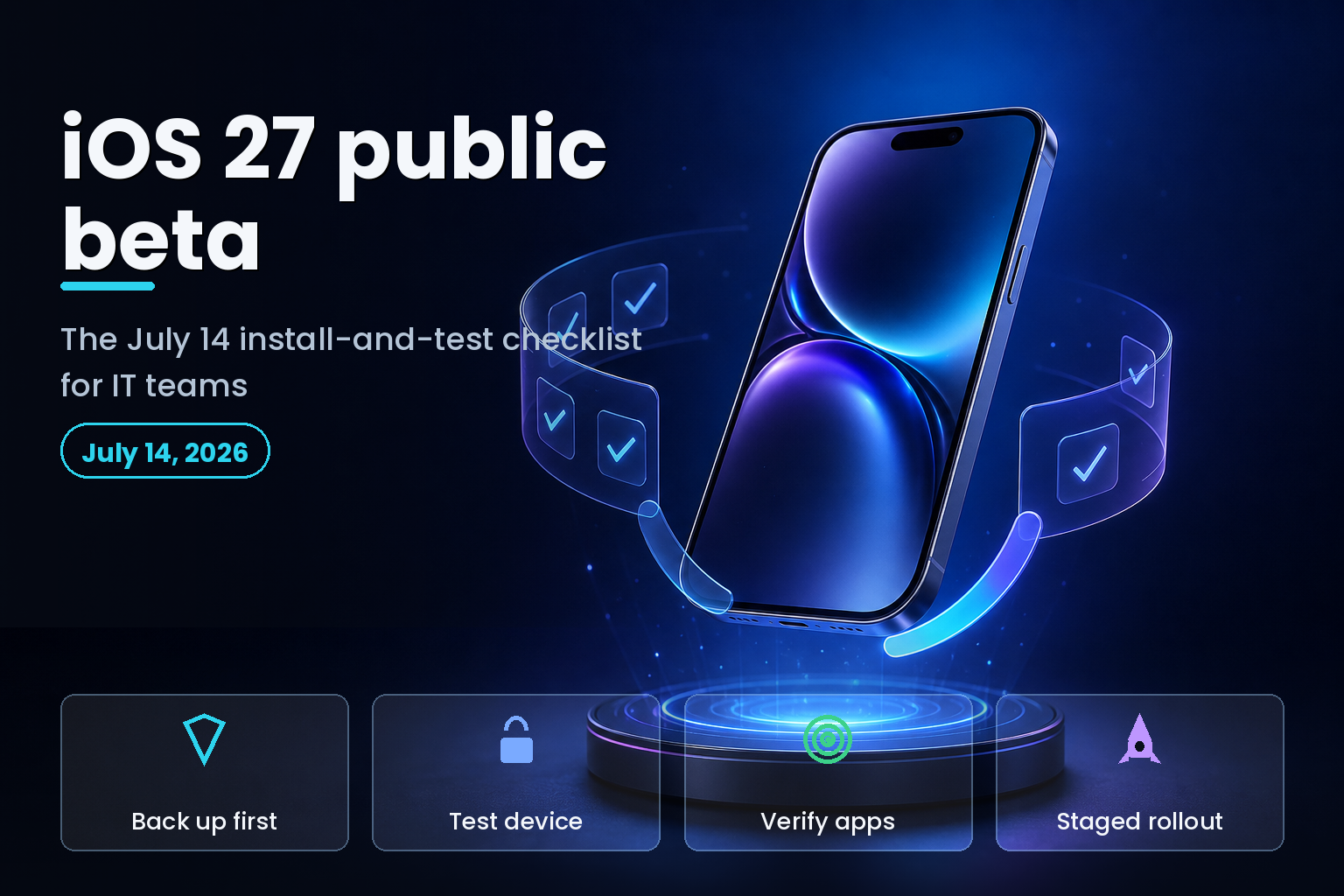
Summary. The first iOS 27 public beta is expected around Monday, July 14, 2026, days after the third developer beta on roughly July 7. Apple opened the developer beta on June 9, 2026 at WWDC, and the finished iOS 27 usually ships in the second week of September, near September 14. The beta runs on 31 iPhone models from the iPhone 11 (A13 Bionic) upward, but the new Siri AI and Apple Intelligence features need an iPhone 15 Pro or later with the A17 Pro chip and 8 GB of RAM. The beta itself is free through the Apple Beta Software Program; the real budget line for a team is a spare test handset and an MDM seat at roughly $3.25 to $9 per device each month. This checklist covers backup, enrolment, install, and app testing before you let iOS 27 near a production fleet.
For an IT admin, a CTO, or a lead developer, the public beta is not a toy. It is a nine-week head start. Between mid-July and the September release, you can find the app crashes, the MDM policy gaps, and the login failures that would otherwise hit users on day one. The cost of skipping that window is a support queue full of tickets the week your CEO updates a production phone. This guide turns the beta into a controlled test, not a gamble.
What the iOS 27 public beta is, and when it lands
The public beta is a free prerelease build of Apple's next iPhone operating system, distributed through the Apple Beta Software Program. Anyone with a compatible iPhone can install it after signing up. It sits one step behind the paid developer beta: Apple ships a developer seed first, lets it stabilise for a few days, then releases a close copy as the public beta.
The 2026 calendar is running to Apple's usual pattern. The developer beta opened on June 9, 2026, the day of the WWDC 2026 keynote. Reporting from 9to5Mac and MacRumors puts the third developer beta around July 7 and the first public beta on or near Tuesday, July 14. Forbes frames it the same way: the public beta is days out as of early July. The general release, going by Apple's second-week-of-September habit, should land around September 14, 2026.
iOS 27 is a large release. Apple rebuilt Siri around Apple Intelligence and added a "Liquid Glass" interface, and its own newsroom claims new photos appear 70% faster and AirDrop transfers run 80% faster than on iOS 26. Craig Federighi, Apple's senior vice president of software engineering, framed the assistant this way at WWDC: "We see Siri not as a separate chatbot, an unintegrated place you go and chitchat, but rather as an integral but conversational tool that you use in the moment." For a fleet owner, a bigger release means a bigger test surface, which is exactly why the beta window matters.
One regional caveat to log now: Federighi confirmed Siri AI will not ship to European Union users at launch, so a multi-region fleet will see different feature sets on the same build. Plan test cases for both.
Which iPhones run iOS 27
Compatibility widened this year rather than narrowed. Apple kept the iPhone 11 line on the supported list, so the minimum chip is the A13 Bionic, and AppleInsider counts 31 supported iPhones in total. The devices dropped are the iPhone XS, XS Max, XR, X, 8, 8 Plus, and the first-generation iPhone SE, all on the A12 Bionic or older.
The split that matters for testing is Apple Intelligence. Per Macworld, the Siri AI and Apple Intelligence stack needs an iPhone 15 Pro or later, because it requires the A17 Pro chip and 8 GB of RAM. Older supported phones get the interface, security patches, and standard features, but not the AI layer. Your test lab needs at least one device from each tier.
| Device tier | Example models | iOS 27 base features | Apple Intelligence / Siri AI |
|---|---|---|---|
| AI-capable | iPhone 17 Pro, iPhone 16 Pro, iPhone 15 Pro | Yes | Yes (A17 Pro, 8 GB RAM) |
| Modern, non-AI | iPhone 16, iPhone 15, iPhone 14, iPhone 13 | Yes | No |
| Older supported | iPhone 12, iPhone 11, iPhone SE (2nd gen) | Yes | No (A13/A15, under 8 GB) |
| Dropped | iPhone XS, XR, iPhone 8, SE (1st gen) | No update | No |
Buy or reserve test hardware against this table before July 14. If your fleet is mostly iPhone 12 and 13 units, the AI features are irrelevant to your rollout, and you can weight testing toward battery, MDM policy, and core apps instead.
Before you install: the pre-flight checklist
Every failed beta story starts the same way: someone installed it on the phone they actually use. Apple's own guidance and MDM vendors are blunt about this. As 9to5Mac puts it, betas "often have bugs and performance issues" and should never go on a daily driver. Do the following before any device touches the beta.
Take an archived backup first. A normal iCloud or Finder backup can be overwritten; an archived Finder or Mac backup cannot, and it is the only clean way back to iOS 26 if the beta misbehaves. You cannot restore an iOS 26 device from an iOS 27 backup, so the pre-install archive is your one exit route.
Use a dedicated test device, not a loaner someone needs on Monday. SimpleMDM recommends a small lab that mirrors your fleet: at least one representative unit per device type and tier. Keep those units enrolled in MDM but out of production so you can also test future policy pushes.
Enrol in AppleSeed for IT if you manage devices centrally. This is the enterprise track, separate from the consumer beta, and it gives IT teams seed builds plus documented known issues. Apple's deployment guide calls it the program most IT professionals should use, and you sign in with a Managed Apple Account from Apple Business Manager or Apple School Manager.
Name a small, tech-savvy tester group who report bugs clearly, rather than opening the beta to everyone who volunteers. Confirm your MDM can pin OS versions so a curious user cannot pull iOS 27 onto a production phone before you are ready.
How to install the iOS 27 public beta, step by step
Once Apple flips the switch around July 14, the consumer install is short. The steps below come from Apple's program and MacRumors; AppleSeed for IT uses a similar flow with a managed configuration profile.
- Sign up for free at beta.apple.com with the Apple Account you will use on the test device.
- On the test iPhone, take and verify an archived backup (see the pre-flight checklist above).
- Open Settings, then General, then Software Update, then Beta Updates.
- Select the iOS 27 Public Beta option. If it does not appear, restart the iPhone and check again.
- Return to Software Update, download iOS 27, and follow the on-screen steps. Keep the device on Wi-Fi and power.
- Record the exact build number so your bug reports and app-team tickets reference the same seed.
For managed devices, push the beta enrolment through your MDM or AppleSeed for IT rather than having each tester sign in by hand. That keeps enrolment auditable and lets you pull a device off the beta channel centrally.
The app and workflow test matrix
Installing the beta is 10 minutes of work. The value is in the fortnight of structured testing that follows. Do not test at random. Run every business-critical workflow on each device tier and log the build number, the result, and a screenshot for anything that breaks.
| Test area | What to check on iOS 27 | Why it matters to a fleet |
|---|---|---|
| Core business apps | Launch, login, sync, print, and export in your CRM, email, and line-of-business apps | Beta OS changes are the top cause of day-one app crashes |
| Authentication | SSO, MDM certificates, VPN, and passkey or 2FA sign-in | A broken cert profile locks out every managed user at once |
| MDM policy | Restrictions, app deployment, Wi-Fi and email payloads apply cleanly | Confirms your management stack understands iOS 27 |
| Siri AI features | New Siri and Apple Intelligence actions on iPhone 15 Pro and later | Only AI-capable tier; verify data-handling and any EU gaps |
| Battery and thermal | Drain and heat over a full working day | Early betas commonly regress battery life |
| Accessories and peripherals | Chargers, card readers, scanners, CarPlay | Hardware integrations often break before apps do |
Give app owners the build number and a fixed reporting channel. If a vendor app fails, you now have two months to get a fix or a workaround before September, instead of filing the ticket the day users are already stuck.
Beta channels compared
Not every tester belongs on the same track. Match the person to the channel.
| Channel | Best for | How to enrol |
|---|---|---|
| Developer beta | App developers who need the earliest seed and Xcode | Apple Developer Program account |
| Public beta | IT testers and pilot users on dedicated devices | Free sign-up at beta.apple.com |
| AppleSeed for IT | IT admins testing managed fleets and MDM policy | Managed Apple Account via Apple Business or School Manager |
The timeline from beta to launch
| Milestone | Expected 2026 date | What your team should do |
|---|---|---|
| WWDC developer beta | June 9 (shipped) | Read release notes; brief app owners |
| Third developer beta | Around July 7 | Confirm test hardware and backups are ready |
| First public beta | On or near July 14 | Install on lab devices; start the test matrix |
| Ongoing betas | July to early September | Re-test after each seed; log regressions |
| General release | Around September 14 | Stage a phased fleet rollout, not a same-day push |
The rule that saves the most tickets is the last one: never move a fleet to a brand-new iOS release on launch day. Let the beta findings drive a staged rollout, starting with your tester group, then a pilot department, then the wider fleet once your critical apps are confirmed clean.
India-specific considerations
For teams in India, two extra factors apply. First, budget test hardware in rupees against real resale value: because iOS 27 keeps the iPhone 11, second-hand units from that era hold value as dedicated test devices, which keeps a lab affordable for a Gurugram or Bengaluru IT team. Second, data handling under the Digital Personal Data Protection Act, 2023 (DPDP) matters when you test Siri AI and Apple Intelligence features that read on-screen content. Treat any beta device that touches employee or customer data as in-scope for your DPDP controls, and keep test data separate from production records. If your fleet spans India and the EU, remember that Siri AI is not launching in the European Union, so your India and EU users will run different feature sets on the same build.
MDM economics scale with the fleet. At the $3.25 to $9 per device each month that most solutions charge, a 200-device fleet is a real line item, so use the beta window to confirm your existing MDM handles iOS 27 before you renew or switch vendors.
FAQ
How eCorpIT can help
eCorpIT is a Gurugram-based technology organisation with senior-led engineering teams that help companies test and stage major OS releases without disrupting users. We can build your iOS 27 test lab, validate business-critical apps against each beta seed, and design a phased fleet rollout aligned with your MDM and DPDP requirements. If you want a structured beta-to-launch plan before September, contact us and we will map it to your device mix. You can also read our related guides on when iOS 27 is dropping and the full iOS 27 release timeline, or browse the eCorpIT blog for more.
References
_Last updated: July 5, 2026._