On this page · 10 sections
- The support window is the constraint, not the language
- What Go 1.27 will actually cost you to absorb
- Where the runtime bill moved, and why it changes your staffing mix
- The Lambda cliff a lot of Go services are already over
- What to test for when you hire Go developers
- Engagement models, and which one fits
- India-specific considerations
- FAQ
- How eCorpIT can help
- References
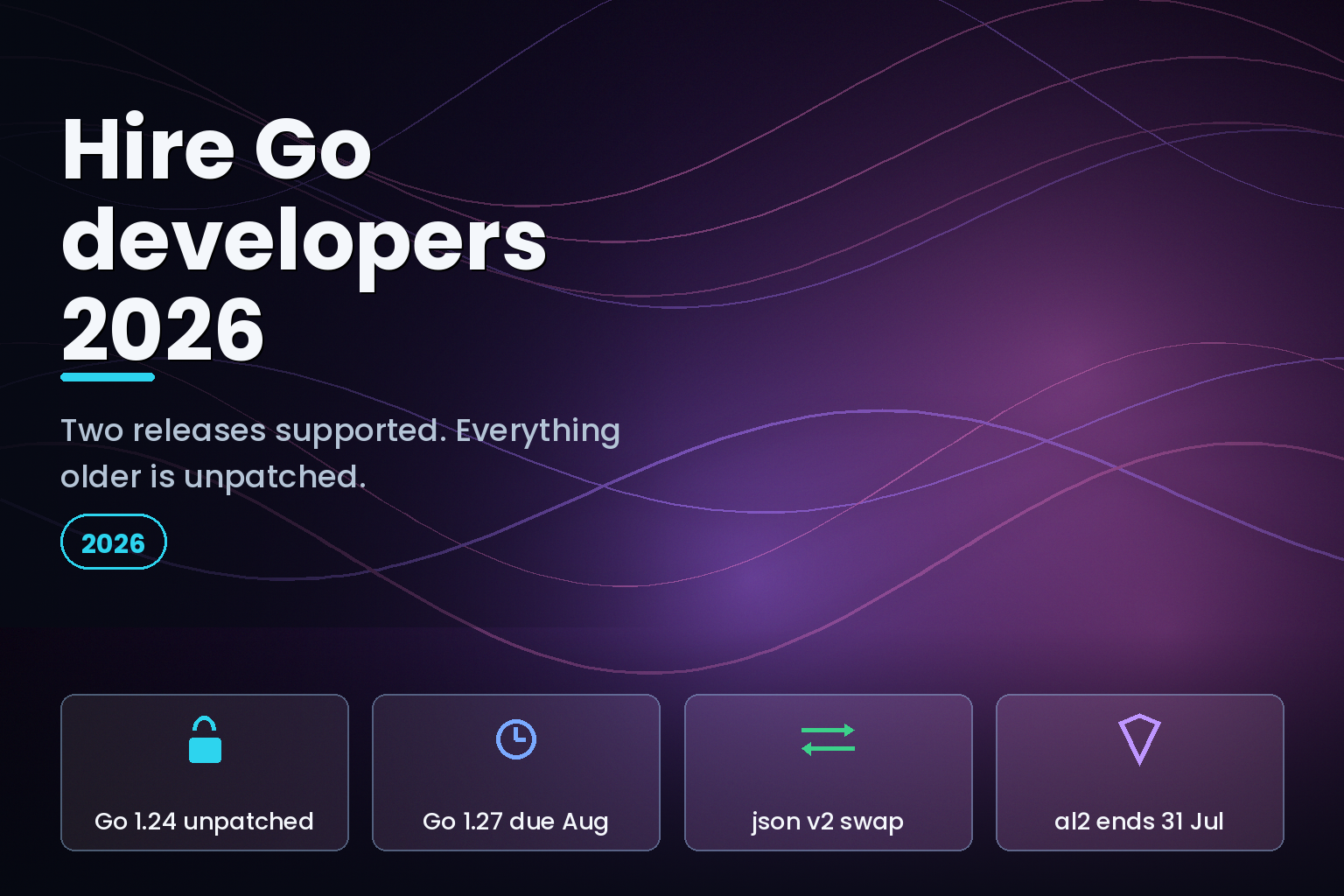
Summary. Go's support policy is short and unforgiving: "Each major Go release is supported until there are two newer major releases." Go 1.24 stopped receiving security fixes on 10 February 2026, the day Go 1.26.0 shipped. Go 1.27 is not out yet as of 18 August 2026, and its draft notes say it is "expected to be released in August 2026". When it lands, Go 1.25 goes dark the same day. That is a roughly 12-month security window per release, and it is the single largest cost driver in a Go engagement. The 13 August 2026 minor releases, Go 1.26.6 and Go 1.25.13, carried 10 security fixes between them. So the question when you hire Go developers is not who can write a goroutine. It is who can carry a service across two toolchain upgrades a year without a release freeze.
The support window is the constraint, not the language
Go's release history page states the policy plainly and gives worked examples. Go 1.24.0 shipped 11 February 2025; its final patch, Go 1.24.13, came on 4 February 2026, six days before Go 1.26.0 landed and ended its support. Go 1.25.0 shipped 12 August 2025 and is patched today, most recently as Go 1.25.13 on 13 August 2026. Only two lines are alive at any moment.
The Go Security Policy adds the detail that matters for planning. PRIVATE-track issues are "fixed in the next scheduled minor releases", and minor releases "occur ~monthly". Fixes are "prepared for the two most recent major releases and the head/master revision". Nothing is backported further. A team sitting on Go 1.24 today is not on an old but patched toolchain. It is on an unpatched one.
Go 1.26 alone shipped six minor revisions between March and August 2026, and every one carried security content. Go 1.26.6, on 13 August 2026, covered "security fixes to the go command, and the crypto/tls, encoding/asn1, encoding/xml, html/template, net, net/http, and net/url packages". The announcement for that pair of releases says they "include 10 security fixes following the security policy", among them CVE-2026-56865, a transparency-log verification bypass where "a malicious GOPROXY was previously capable of forging up to two sumdb tiles" and persisting attacker-controlled module content into a local module cache.
| Go release | Shipped | Security status on 18 Aug 2026 |
|---|---|---|
| Go 1.24.0 | 11 Feb 2025 | Unsupported since 10 Feb 2026; final patch 1.24.13 |
| Go 1.25.0 | 12 Aug 2025 | Supported; latest patch 1.25.13 (13 Aug 2026) |
| Go 1.26.0 | 10 Feb 2026 | Supported; latest patch 1.26.6 (13 Aug 2026) |
| Go 1.27 | Not released | Draft notes say "expected to be released in August 2026" |
| Go 1.28 | Not announced | Will end support for Go 1.26 when it ships |
What Go 1.27 will actually cost you to absorb
Most "upgrade Go" tickets are a one-line change in go.mod. Go 1.27 is not one of those. The draft release notes list several changes that break at build time or change behaviour silently.
The encoding/json package "is now backed by the v2 implementation". Marshal and unmarshal behaviour is preserved, but "the exact text of error messages may differ", and v2 "rejects invalid UTF-8 in JSON strings and rejects duplicate names within a JSON object". If your service accepts third-party webhooks, or your tests assert on error strings, that is a real regression surface. There is a GOEXPERIMENT=nojsonv2 opt-out, and the notes say that opt-out "is expected to be removed in a future release", so it buys time rather than a decision.
Five TLS and x509 GODEBUG settings, tlsunsafeekm, tlsrsakex, tls3des, tls10server and x509keypairleaf, "have been removed permanently", along with asynctimerchan. Channels created by package time "are now always unbuffered (synchronous), irrespective of GODEBUG settings". And the go command now fails outright if go.mod sets a removed GODEBUG to an old value. A team that reached for a GODEBUG to keep a legacy TLS client working has to fix the client instead.
Go 1.27 also requires macOS 13 Ventura or later, adds crypto/mldsa implementing the post-quantum ML-DSA scheme from FIPS 204, promotes the goroutineleak profile to general availability, and specialises small-object allocation, "reducing the cost of some small (<80 byte) memory allocations by up to 30%" for an expected "~1% in real allocation-heavy programs" and "about 60 KB" of extra binary size.
Where the runtime bill moved, and why it changes your staffing mix
Two Go 1.25 and 1.26 changes quietly repriced Go infrastructure, and both reward people who read release notes rather than people who tune flags.
Green Tea, the page-based mark phase, was experimental in Go 1.25 and became the default in Go 1.26. The Go team's own evaluation reports "reductions in garbage collection CPU costs between 10% and 40% in our benchmark suite", with "a 10% reduction in garbage collection CPU time" as the modal improvement, plus a further 10% on hardware with AVX-512. Their framing of the payoff is worth keeping honest: "if an application spends 10% of its time in the garbage collector, then that would translate to between a 1% and 4% overall CPU reduction". Some workloads do not benefit at all.
Container-aware GOMAXPROCS, added in Go 1.25, matters more for most teams. From Go 1.5 through Go 1.24, GOMAXPROCS defaulted to the machine's total core count, which is wrong inside a CPU-limited container. Go 1.25 defaults it to the CPU limit when that limit is lower, and rechecks periodically. The throttling arithmetic the Go team gives is the part engineers miss: "an '8 CPU limit' is actually a limit of 800ms of CPU time every 100ms of wall time", and "the throttling period is typically 100ms, so throttling can cause substantial tail latency impact". The behaviour only activates when go.mod declares Go 1.25.0 or higher. Sitting on an old toolchain declaration keeps the old, wrong default.
That is the practical argument for a maintained Go team over a one-off build. Both wins are free, and both are gated on a version bump nobody is scheduled to do.
The Lambda cliff a lot of Go services are already over
Go has no managed Lambda runtime. AWS states that "because Go compiles natively to an executable binary, it doesn't require a dedicated language runtime", so Go functions run on the OS-only provided family. The go1.x managed runtime was deprecated on 8 January 2024, with function creation blocked from 8 February 2024 and function updates blocked from 3 March 2027.
The live problem is one layer down. provided.al2 reached its deprecation date on 31 July 2026, three weeks ago, because Amazon Linux 2 "is scheduled for end of life on June 30, 2026". Function creation on provided.al2 is blocked from 1 February 2027 and updates from 3 March 2027. provided.al2023 runs to 30 June 2029. AWS says the migration needs "no code changes" and that the only changes "relate to how you build your deployment package and which runtime you use", and it buys arm64 on Graviton2, smaller binaries and "slightly faster invoke times". It is a build-pipeline job, not a rewrite, and it is exactly the kind of work that never gets a sprint of its own.
What to test for when you hire Go developers
The 2025 Go Developer Survey, run 9 to 30 September 2025 with 5,379 usable responses after cleaning, describes a market that has stopped producing juniors. The share of respondents with under a year of Go experience fell to 13%, from 21% in 2024, and the Go team writes that they "suspect this is related to industry-wide declines in entry-level software engineering roles". Over 80% learned Go after starting their professional career, and 81% have more general engineering experience than Go experience.
That reframes the interview. You are almost never hiring someone whose first language is Go. You are hiring an experienced engineer who picked Go up, which means the risk is idiom and operational judgement, not syntax. The survey backs this: the top frustration reported was "ensuring our Go code follows best practices / Go idioms" at 33%, ahead of "a feature I value from another language isn't part of Go" at 28% and "finding trustworthy Go modules and packages" at 26%.
So test for the things that break in production. Ask a candidate what changes when go.mod declares 1.25 versus 1.24 on a pod with a CPU limit. Ask what FETCH-style N+1 patterns look like in their data layer. Ask how they would find a goroutine leak, and whether they have used the new goroutineleak profile. Ask what happens to a service when encoding/json starts rejecting duplicate object keys. None of those need a whiteboard.
On tooling, the survey found 53% use AI coding assistants daily while 29% barely use them, and only 17% treat agentic modes as their primary workflow. Satisfaction with those tools sits at 55%, weighted to "somewhat satisfied" at 42% against 13% "very satisfied", versus 62% who are "very satisfied" with Go itself. A majority, 53%, said "creating non-functional code" was their main problem with AI tooling. Treat assistant fluency as useful, not as a substitute for review.
Engagement models, and which one fits
Contract hiring for Go usually fails for one of two reasons: the scope was a project but the need was continuity, or the reverse. The distinction is worth being explicit about, because it also separates this page from our Go development company page, which covers project-shaped delivery.
| Model | Fits when | Fails when |
|---|---|---|
| Dedicated Go engineers, monthly | You own the roadmap and need capacity plus upgrade ownership | Scope is a single fixed deliverable with a hard end date |
| Embedded pod with a tech lead | You have no senior Go voice in-house and need review standards set | You already have a strong Go lead and only need hands |
| Time and materials, capped | Migration work with a known shape, such as provided.al2 to provided.al2023 |
Requirements are still being discovered |
| Fixed scope | A well-specified service or SDK with a frozen interface | The toolchain will move under you mid-build |
| Maintenance retainer | Keeping a shipped service inside the two-release window | Nothing ships and nothing needs patching |
For most teams reading this, the honest answer is the maintenance retainer plus a small capped migration, not a dedicated squad. Two toolchain upgrades a year is a handful of engineer-days if it is scheduled, and a quarter of firefighting if it is not.
India-specific considerations
Indian engineering teams building for domestic users carry an extra constraint: the Digital Personal Data Protection Act 2023 makes breach handling a statutory matter rather than an internal one, so an unpatched toolchain is a compliance exposure and not only an engineering one. Three of the CVEs fixed on 13 August 2026 sit in net/http, net/url and crypto/tls, all of which handle user data on a public interface.
The other practical point is deployment. The survey found 96% of respondents deploy to Linux-based systems including containers, and AWS at 46% is the most common target, ahead of company-owned servers at 44%. If your Go services run in containers on AWS in an Indian region, the container-aware GOMAXPROCS change and the provided.al2 deadline both apply to you directly. Teams weighing an in-house build against staff augmentation services or a dedicated offshore product engineering team should price the recurring upgrade work into either option, because it does not go away.
Go's own case-study material makes the durability argument better than a vendor can. Bala Natarajan, Sr. Director of Engineering, Developer Experience at PayPal, said of their migration: "In our tightly managed environments where we run Go code, we have seen a CPU reduction of approximately ten percent with cleaner and maintainable code." That case study dates from June 2020, and the point still holds: the saving came from the code being maintainable, not from the language being fast.
FAQ
How eCorpIT can help
eCorpIT is a Gurugram-based technology organisation, founded in 2021, assessed at CMMI Level 5 and MSME certified, with senior-led engineering teams working across AWS, Microsoft and Google platforms. For Go work we take on the parts that get skipped: keeping services inside the two-release security window, absorbing the Go 1.27 encoding/json and GODEBUG changes, and moving Lambda builds off provided.al2 before the February 2027 create block. We staff either as embedded engineers alongside your team or as a capped migration engagement, and we will tell you which one your situation needs. Talk to us at /contact-us/.
References
- Go Release History - The Go Programming Language
- Go 1.27 Release Notes (draft) - The Go Programming Language
- Go Security Policy - The Go Programming Language
- Go Wiki: MinorReleases - The Go Programming Language
- security Go 1.26.6 and Go 1.25.13 are released - golang-announce, 13 August 2026
- The Green Tea Garbage Collector - Michael Knyszek and Austin Clements, 29 October 2025
- Container-aware GOMAXPROCS - Michael Pratt and Carlos Amedee, 20 August 2025
- Go Developer Survey 2025 Results - Todd Kulesza, 21 January 2026
- Go's Sweet 16 - The Go Programming Language
- Lambda runtimes - AWS Lambda Developer Guide
- Building Lambda functions with Go - AWS Lambda Developer Guide
- PayPal Taps Go to Modernize and Scale - The Go Programming Language
- Go garbage collector guide - The Go Programming Language
Last updated: 18 August 2026.