On this page · 11 sections
- What we actually build in Go
- The maintenance clock, and why it is the whole argument
- What Go 1.27 changes, in the order it will bite you
- The runtime change that shows up on the cloud bill
- How we run a Go engagement
- The stack we run
- India-specific considerations
- Who this is for, and what an engagement looks like
- FAQ
- How eCorpIT can help
- References
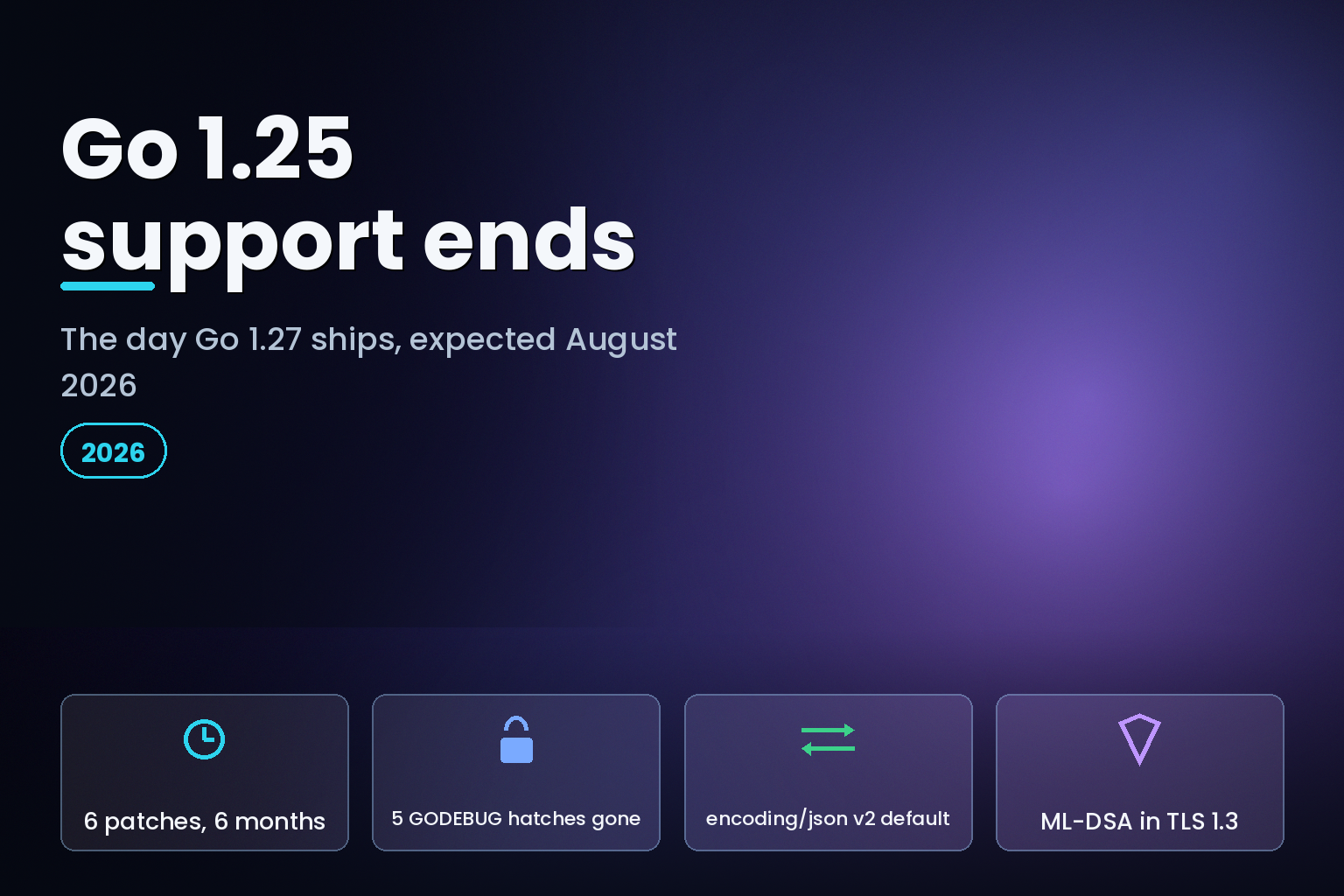
Summary. Go 1.26.6 was released on 13 August 2026, the sixth minor revision of the 1.26 line since 1.26.0 landed on 10 February 2026, and every one of those six carried security fixes. Go's own policy is blunt about what happens next: "Each major Go release is supported until there are two newer major releases." Go 1.27 is expected in August 2026, and the day it ships, Go 1.25 stops receiving security fixes. That is the maintenance clock any Golang development company is really selling against. The 2025 Go Developer Survey, published by the Go team on 21 January 2026 with 5,379 respondents, found 91% satisfaction with the language and 96% deploying to Linux-based systems including containers. Those are good numbers for the language and awkward numbers for the operator, because a containerised Go fleet is exactly where an unpatched crypto/tls becomes a reportable incident. In India, a failure to take reasonable security safeguards that leads to a personal data breach carries a penalty that may extend to ₹250 crore under the Schedule to the Digital Personal Data Protection Act, 2023. eCorpIT, founded in 2021 and based in Gurugram, builds Go backends and then keeps them on a supported toolchain.
What we actually build in Go
Go earns its place in a narrow band of work, and the honest version of a services pitch names the band rather than claiming the language suits everything.
The 2025 Go Developer Survey found that respondents' top use cases remain command-line tools and API services, with 55% saying they build both, and over a third specifically building cloud infrastructure tooling. That matches what we see in client estates. The Go work that pays for itself is request-response API services with hard latency budgets, control-plane and infrastructure tooling that has to ship as a single static binary, data-movement services where goroutine concurrency beats a thread pool, and internal platform CLIs that a team will install on 200 laptops without wanting a runtime on each.
The work we steer clients away from is equally specific. Heavy numerical and matrix workloads belong in Python with native extensions. Rich domain models with deep inheritance hierarchies fight Go's type system rather than fit it; the survey found 71% of respondents' next-favourite language has inheritance and 65% has type-safe enums, which is a fair summary of what people miss. If a service is mostly orchestration of third-party SDKs that only ship first-class Node or Python clients, the language choice should follow the SDK.
We also build in adjacent stacks, and a Go service rarely lives alone. Most of our Go work sits next to a Node.js development company engagement for the BFF layer or a Python development company engagement for the data side, under one software development company in India delivery contract.
The maintenance clock, and why it is the whole argument
Go does not publish long-term support branches. There is no Go equivalent of a five-year LTS you can sit on. The release history page states the rule plainly: a major release is supported until two newer major releases exist, and critical problems including critical security problems are fixed in supported releases by issuing minor revisions.
In practice that produces a monthly patch cadence with an annual cliff attached.
| Release | Date | What it means for a running service |
|---|---|---|
| Go 1.24.0 | 11 February 2025 | Out of support since Go 1.26.0 shipped |
| Go 1.25.0 | 12 August 2025 | Supported today; loses support the day Go 1.27 ships |
| Go 1.26.0 | 10 February 2026 | Current supported line, six patches deep |
| Go 1.26.5 | 7 July 2026 | Security fixes to crypto/tls and os |
| Go 1.26.6 | 13 August 2026 | Security fixes to the go command, crypto/tls, encoding/asn1, encoding/xml, html/template, net, net/http, net/url |
| Go 1.27 | Expected August 2026 | Not yet released; draft release notes published |
The 1.26 line alone shipped on 5 March, 7 April, 7 May, 2 June, 7 July and 13 August 2026. Every one of those six revisions listed security fixes. A team that upgrades Go twice a year is, on average, running four months behind a published security fix at any given moment.
The real cost is usually not the upgrade itself. It is the audit that discovers three services are still on Go 1.24, that nobody owns the base image, and that the go.mod toolchain directives disagree across nine repositories.
What Go 1.27 changes, in the order it will bite you
The Go 1.27 release notes are published as work in progress, and they are specific enough to plan against now. Four items break running code rather than merely adding surface.
The first is the permanent removal of a set of GODEBUG compatibility switches. The tlsrsakex, tls3des, tls10server and tlsunsafeekm settings, plus x509keypairleaf, have been removed permanently. These were the escape hatches that let an enterprise keep talking to an old payment gateway or a vendor appliance after Go tightened a TLS default. In Go 1.27 the hatch closes and the actual TLS configuration has to be fixed. Go 1.27 also makes the go command reject a removed GODEBUG in a go.mod or a //go:debug comment when it is set to an old value, so a stale directive fails the build rather than being quietly ignored.
The second is asynctimerchan, removed permanently. Channels created by package time are now always unbuffered, whatever GODEBUG says. Code that relied on the buffered behaviour introduced before Go 1.23 has nowhere left to hide.
The third is encoding/json. Go 1.27 adds encoding/json/v2 and encoding/json/jsontext, and backs the existing encoding/json package with the v2 implementation. Marshaling and unmarshaling behaviour is preserved, but the exact text of error messages may differ, and the v2 defaults reject invalid UTF-8 in JSON strings and reject duplicate names within a JSON object. Any test that asserts on an error string, and any upstream partner that sends duplicate keys, is a candidate failure. There is a GOEXPERIMENT=nojsonv2 build-time opt-out, and the release notes say that opt-out is expected to be removed in a future release, so it buys a quarter, not a strategy.
The fourth is the platform floor. As announced in the Go 1.26 release notes, Go 1.27 requires macOS 13 Ventura or later. That is a developer-laptop and CI-runner problem more than a production one, and it tends to surface the week of the upgrade rather than during planning.
There are gains in the same release. A new crypto/mldsa package implements the post-quantum ML-DSA signature scheme specified in FIPS 204, with ML-DSA support added to crypto/x509 and to TLS 1.3 through the MLDSA44, MLDSA65 and MLDSA87 signature schemes. A uuid package enters the standard library. The goroutine leak profile, experimental in Go 1.26, becomes generally available as the goroutineleak profile in runtime/pprof and at the net/http/pprof endpoint /debug/pprof/goroutineleak. The compiler now calls size-specialized allocation routines, cutting the cost of some allocations under 80 bytes by up to 30%, with an expected overall improvement of about 1% in allocation-heavy programs and a binary-size increase of roughly 60 KB.
The runtime change that shows up on the cloud bill
Go 1.25 changed the GOMAXPROCS default so that a process running inside a container with a CPU limit defaults to that limit when it is lower than the machine core count, and re-checks periodically in case an orchestrator moves the limit. From Go 1.5 through Go 1.24 the default was the total number of logical CPUs on the machine.
Michael Pratt and Carlos Amedee of the Go team wrote on 20 August 2025 that "Throttling is a blunt mechanism for restricting containers that would otherwise exceed their CPU limit: it completely pauses application execution for the remainder of the throttling period." With a typical 100ms throttling period, that pause lands directly in tail latency. Their worked example of the worst case is a small container receiving 2 CPUs on a 128-core machine.
The practical consequence for a fleet is that upgrading past Go 1.25 changes scheduling behaviour without any code change, and the change is usually good but not universally good. The Go team notes that particularly spiky workloads may see a latency increase, because GOMAXPROCS now prevents short-lived thread spikes beyond the CPU limit average. This is why we treat a Go major-version upgrade as a load-tested change with a rollback path, not a go.mod edit.
How we run a Go engagement
Five steps, and we do not skip the first one even when a client is certain of the scope.
- Estate audit. We inventory every Go module in scope: toolchain version in
go.mod, base image, direct and indirect dependency graph,GODEBUGsettings in use, and where TLS configuration is set explicitly. The output is a written upgrade order with the breaking changes named per service.
- Contract and load baseline. Before touching a version, we capture request and response contracts and a latency profile at production-shaped load, so a regression after the upgrade is attributable rather than argued about.
- Build and upgrade. New services are written to the current supported major version. Existing services move one major version at a time, with the
stdversionvet check that Go 1.27 runs by default ingo testused to catch standard-library symbols newer than the declaredgodirective.
- Observability and leak checking. We wire
runtime/pprofand, on Go 1.27, thegoroutineleakprofile into the same dashboard as request metrics. A goroutine blocked on a channel that can never be unblocked is the most common slow-burn failure we find in inherited Go code.
- Supported-version retainer. Because Go's support window is two major releases, keeping a fleet current is recurring work, not a project. We run the monthly patch and the twice-yearly major upgrade on a fixed cadence with a named engineer.
The stack we run
We build Go services with the standard library first and add dependencies deliberately, which is partly a maintenance position and partly a response to what Go teams report. The 2025 survey found "Finding trustworthy Go modules and packages" was the third most-cited frustration at 26% of respondents, behind Go idioms at 33% and missing language features at 28%. One respondent, a very satisfied developer with 10 or more years of experience in financial services, put it as "Many pacakges are just clones/forks or one-off pojects with no history/maintenance."
For HTTP we use net/http with the standard router unless a client requirement forces otherwise. For data access we use database/sql with a driver, and Go 1.27's new ConvertAssign function and RowsColumnScanner driver interface make custom scanning cleaner where it is needed. For deployment, the survey's own numbers describe the target: 96% of respondents deploy to Linux-based systems including containers, 46% to AWS, 44% to company-owned servers and 26% to Google Cloud Platform. We are partners with AWS, Microsoft and Google, and we build against whichever of those a client already runs rather than proposing a migration nobody asked for.
Where a Go service sits behind or beside a public API surface, we design it with the same contract discipline described in our API development company work, and where it is one part of a larger platform we deliver it under a custom software development company engagement.
India-specific considerations
For Indian data fiduciaries the patch cadence is a compliance control, not just hygiene. The Schedule to the Digital Personal Data Protection Act, 2023, as in force on 19 November 2025, sets a penalty that may extend to ₹250 crore for breach in observing the obligation to take reasonable security safeguards to prevent a personal data breach under section 8(5). A separate head, breach of the obligation to notify the Board or affected Data Principals of a personal data breach under section 8(6), may extend to ₹200 crore. Additional obligations of a Significant Data Fiduciary under section 10 carry up to ₹150 crore, and any other breach up to ₹50 crore.
Running a Go binary built on an out-of-support toolchain, with published crypto/tls and net/http fixes unapplied, is difficult to describe as a reasonable security safeguard after an incident. We design applications aligned with DPDP requirements and we keep the toolchain evidence, meaning the version, the patch date and the person who ran it, in a form that survives a question from a board or an auditor.
Who this is for, and what an engagement looks like
This is for platform and engineering leaders who already have Go in production, or who have decided on Go for a new API surface and want it built by people who will still be maintaining it in eighteen months. It is not for teams looking for the cheapest possible first build, because the first build is not where Go estates go wrong.
We work in three shapes. A fixed-scope build for a defined service or migration, with the estate audit as a separate paid first phase so the scope is set from evidence. A dedicated senior-led team embedded with your platform group for a rolling quarter. A maintenance retainer covering the monthly patch cadence, the major-version upgrade twice a year and on-call escalation. Commercial terms depend on team shape and coverage hours, and we quote after the audit rather than from a rate card.
eCorpIT is CMMI Level 5 appraised, ISO 27001:2022 certified and MSME registered, operating from Sector 83, Gurugram since 2021 with senior-led, multi-disciplinary teams.
FAQ
How eCorpIT can help
We audit your Go estate, name the breaking changes per service, and put a dated upgrade order in writing before anyone edits a go.mod. We build new Go services on the current supported major version with load-tested rollback paths, and we keep them there through a retainer that tracks Go's monthly patch cadence and its twice-yearly support cliff. Our teams are senior-led and work from Gurugram, with CMMI Level 5, ISO 27001:2022 and MSME credentials behind the delivery process. Start with the estate audit: contact us with your repository count and current toolchain versions.
References
- Release History, The Go Programming Language: release policy, Go 1.24.0, 1.25.0, 1.26.0 dates and the Go 1.26.1 to 1.26.6 minor revisions.
- Go 1.27 Release Notes (draft), The Go Programming Language: GODEBUG removals,
encoding/json/v2,crypto/mldsa,uuid, goroutine leak profile, macOS 13 floor, size-specialized allocation.
- Results from the 2025 Go Developer Survey, Todd Kulesza on behalf of the Go team, 21 January 2026: 5,379 respondents, 91% satisfaction, use cases, frustrations, deployment and cloud figures.
- Container-aware GOMAXPROCS, Michael Pratt and Carlos Amedee, 20 August 2025: throttling quotation, 100ms period, Go 1.5 to Go 1.24 default, 2 CPUs on a 128-core machine example.
- The Digital Personal Data Protection Act, 2023 (Act No. 22 of 2023), India Code: Schedule penalties of ₹250 crore, ₹200 crore, ₹150 crore and ₹50 crore.
- The Digital Personal Data Protection Act, 2023, Ministry of Electronics and Information Technology: MeitY copy of the Act.
- Go 1.25 Release Notes, The Go Programming Language: container-aware
GOMAXPROCSandSetDefaultGOMAXPROCS.
- Go 1.26 Release Notes, The Go Programming Language: macOS 13 announcement and the experimental goroutine leak profile.
- Go 1.26 is released, The Go Blog: release announcement for the current supported line.
- Go Security Policy, The Go Programming Language: how security fixes are prepared for the two most recent major releases.
- Security Policy, golang/go on GitHub: reporting process and supported-version scope.
- Managing resources for containers, Kubernetes documentation: how CPU limits and requests are enforced.
- go.uber.org/automaxprocs, pkg.go.dev: the Uber module that provided similar behaviour before Go 1.25.
- "Boring is good," says Go tech lead, promising future compatibility, DevClass, 16 August 2023: background on Go's compatibility guarantee and the GODEBUG mechanism.
Last updated: 18 August 2026.