On this page · 11 sections
- What changed on 20 August 2026
- The eligibility rule that decides whether any of this applies to you
- What the vendor did not write about the implementation
- Where Google's own documentation disagrees with itself
- The 600,000 number, and what it is not
- What to do this week
- India-specific considerations
- What is still unknown
- FAQ
- How eCorpIT can help
- References
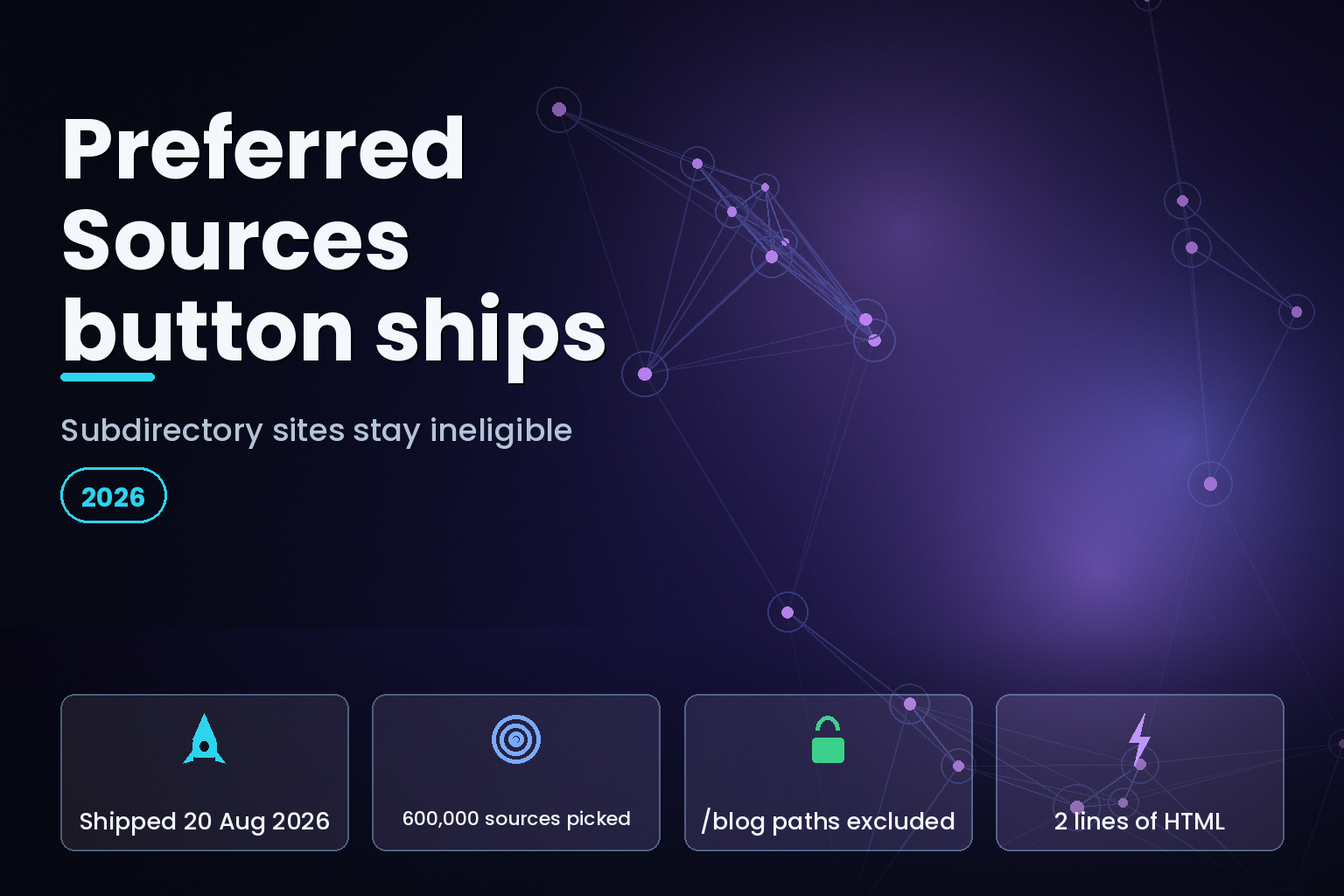
Summary. On 20 August 2026 Google released an embeddable "Add to Preferred Sources" button that publishers can drop into a page with two lines of HTML, and said readers have now selected more than 600,000 unique sources. That is up from more than 345,000 on 27 May 2026, a rise of roughly 74% in 85 days. The part Google did not put in the announcement is in the documentation, refreshed the same day: only domain-level and subdomain-level sites are eligible, so a site whose articles live under a path such as example.com/blog cannot be selected as a Preferred Source at all. The button also auto-initialises unless you explicitly set it to manual control.
What changed on 20 August 2026
Mrinalini Loew, General Manager of the Google Search Ecosystem, announced three things in one post on the Keyword: an interactive Preferred Sources button publishers can embed, natural-language tuning of the Google Discover feed, and curated audio briefings in the Google News app on Android.
The button is the only one of the three that requires engineering work on your side. Google's description is that a reader clicks it, the site is added as a Preferred Source, and the reader is returned "to where they left off on the publisher's page" — no round trip through Google's settings screen and no lost scroll position.
The Preferred Sources documentation on Google Search Central carries a "Last updated 2026-08-20 UTC" stamp, which is where the operational detail lives.
The eligibility rule that decides whether any of this applies to you
The documentation is blunt about scope: "Only domain-level and subdomain-level sites are eligible to appear in the source preferences tool." Its own example makes the boundary explicit — https://www.example.com/ and https://code.example.com/ qualify, but the subdirectory https://www.example.com/blog does not.
That single line disqualifies a large share of the companies most interested in the feature. A SaaS or services business whose editorial content sits at /blog/, /resources/ or /blog/ on the marketing domain cannot be added as a Preferred Source for that content in isolation. The domain as a whole can be, if the domain appears in the source preferences tool — but then the reader is preferring your entire site, product pages included, not your newsroom.
Google supplies a way to check rather than guess: enter your site in the tool's search box. Do that before writing a ticket. If the domain does not appear, the button is a no-op and a subdomain migration is the only route, which is a URL change with all the redirect and consolidation work that implies.
| Site pattern | Eligible for Preferred Sources | What a publisher can do |
|---|---|---|
example.com (root domain) |
Yes, per Search Central | Embed the standard button or a deeplink |
news.example.com (subdomain) |
Yes, per Search Central | Embed on the subdomain; readers prefer the newsroom only |
example.com/blog (subdirectory) |
No, explicitly excluded | Prefer the whole root domain, or move content to a subdomain |
What the vendor did not write about the implementation
Three implementation paths exist, and they are not equivalent.
The standard path adds <script async src="https://news.google.com/swg/js/v1/publisher.js"></script>, preferably in <head>, plus <div google-add-preferred-source-btn></div> wherever the button belongs. Two attributes tune it: data-theme accepts light or dark and defaults to light, and data-lang overrides the language, which otherwise follows the reader's browser settings.
The behaviour worth flagging to whoever owns your page performance budget is the default. Google's note is that if the preferred-sources-control="manual" attribute is omitted, the library "will search for and immediately initialize any elements with the google-add-preferred-source-btn attribute." An asynchronously loaded third-party script that injects a rendered button into your layout the moment it arrives is a layout-shift risk on any template where the button sits above the fold. Adding the manual attribute and binding the flow yourself moves that decision back to your code.
The advanced path gives that control. An ES module import pulls preferredSource from https://news.google.com/swg/js/v1/publisher.mjs, then preferredSource.init({ theme, lang }) and preferredSource.addPreferredSource() let you fire the flow from your own button, your own paywall milestone, or your own framework component.
The third path needs no JavaScript at all. A deeplink of the form https://www.google.com/preferences/source?q=example.com sends the reader straight to your entry in the source preferences tool, and it works in an email newsletter or a social post where a script cannot. It is the weaker experience — the reader does not land back where they were — but it is the only option for a CMS that will not take custom script tags.
One line in the documentation resets the priority order for all three: "It's not required to do them in order to appear as a preferred source." The button converts readers you already have. It does not create eligibility, and it does nothing for a reader who has never reached your page.
Where Google's own documentation disagrees with itself
Google's AI features guidance, last updated 2025-12-10, states that "There are no additional requirements to appear in AI Overviews or AI Mode, nor other special optimizations necessary," and adds that a page needs only to be indexed and eligible to be shown with a snippet.
The Preferred Sources page, updated 2026-08-20, describes something the AI features page does not cover: for users who have selected your site, "your content can be highlighted with a 'preferred' badge" in AI Mode and AI Overviews. Google is now shipping a JavaScript library whose purpose is to change how a specific user sees your links inside AI Overviews. Both statements can be technically true — eligibility is unchanged, presentation is not — but a team reading only the AI features page would conclude there is nothing to build, and would be wrong.
The same gap runs through the Discover half of the announcement. Google's Discover documentation, last updated 2026-03-09, tells site owners that "Traffic from Discover is less predictable or dependable when compared to keyword-driven search visits" and to treat it as supplemental. The 20 August post gives readers a three-dot menu in the Google app to say, in plain language, what they want more or less of, with the feed adjusting "on the fly" and remembering the request. A control that lets a reader suppress a topic is a subtraction lever as much as an addition lever, and nothing in the announcement suggests Discover becomes more dependable because of it. The older documentation is still the more accurate planning assumption.
The 600,000 number, and what it is not
Google's figure is unique sources selected by users, cumulative, across every market where the feature runs. It is not a count of publishers who installed the button, and it is not a measure of traffic. The trajectory is real — more than 345,000 on 27 May 2026, more than 600,000 on 20 August 2026 — but against the size of the indexed web it remains a narrow slice.
The click claim needs the same care. In the 27 May 2026 post, Google Search product manager Duncan Osborn wrote: "We've found that people are twice as likely to click through to a Preferred Source, and people have already selected more than 345,000 unique sources." Google has not published the methodology, the denominator, or any control for the obvious confound — a reader who deliberately marked a publication as preferred was already predisposed to click it. Treat the 2x as directional, not as a forecastable lift.
| Metric | 27 May 2026 | 20 August 2026 | Change |
|---|---|---|---|
| Unique sources selected (Google figure) | More than 345,000 | More than 600,000 | Roughly +74% |
| Surfaces carrying the "preferred" badge | Top Stories, AI Overviews, AI Mode | Top Stories, AI Overviews, AI Mode | Unchanged |
| Publisher-side install path | Deeplink and manual promotion | Embeddable JavaScript button added | New engineering work |
What to do this week
Check the source preferences tool for your domain first. If your content is on a subdirectory, stop and cost a subdomain move before anyone writes button code; that is a site-move decision, not a marketing task, and it belongs with whoever owns your SEO-safe replatform and migration work.
If the domain qualifies, load the library with preferred-sources-control="manual" and bind the flow to your own element. Place it where a reader has already decided they like you — the end of an article, a newsletter confirmation page — rather than in a homepage hero where it competes with your primary action.
Then measure the two surfaces separately. Search Console reports AI Overviews and AI Mode inside the "Web" search type of the Performance report, while Discover has its own performance report covering the last 16 months of impressions, clicks and CTR. Preferred Sources has no report of its own, so any lift you see is inferred, and you should say so out loud in the deck rather than let a colleague read it as attribution. Our existing analysis of Preferred Sources in AI Overviews and of why AI Overviews and AI Mode still run on SEO fundamentals covers the measurement side in more depth.
The honest read: this is an audience-retention feature dressed as a search feature. It rewards publishers who already have returning readers and gives nothing to a site trying to be found for the first time.
India-specific considerations
Preferred Sources runs globally for Top Stories in every language where Google Search is available, and in AI Mode and AI Overviews wherever those features are available, so Indian publishers are in scope on the same terms. Two local details matter. The button ships a script from news.google.com, a Google-controlled origin, so if your consent management platform gates third-party scripts you need to decide where this one sits in your Digital Personal Data Protection Act 2023 notice and consent flow before it goes live, not after. Second, the data-lang override matters more here than in single-language markets: the default follows browser settings, which for a Hindi-language reader on an English-configured handset will not match the page. Google publishes a downloadable list of supported language codes alongside the documentation.
What is still unknown
Google has not said whether the button's install base is measurable to publishers, whether a "preferred" badge changes ranking or only presentation, or when the Discover natural-language controls reach markets outside the initial Google app rollout, which the announcement dated only as "in the coming days." None of that is in the documentation as of 21 August 2026.
FAQ
How eCorpIT can help
We audit whether your domain is eligible for Preferred Sources, cost the subdomain move when it is not, and implement the button under manual control so it does not shift your layout or bypass your consent flow. We also separate the Search Console surfaces so nobody reports an inferred Discover swing Overviews win. eCorpIT is CMMI Level 5 and ISO 27001:2022 certified, and our senior engineering teams handle the site-move work end to end. Talk to us via /contact-us/.
References
- Personalize the content you see on Search, Discover, and News — Google, Mrinalini Loew, 20 August 2026.
- Help your readers find your site through preferred sources in Google Search — Google Search Central, last updated 2026-08-20 UTC.
- New ways to find your favorite sources and original content in AI Search — Google, Duncan Osborn, 27 May 2026.
- AI features and your website — Google Search Central, last updated 2025-12-10 UTC.
- Discover and your website — Google Search Central, last updated 2026-03-09 UTC.
- Source preferences tool — Google Search personalization settings.
- Google Search Essentials: technical requirements — Google Search Central.
- Creating helpful, reliable, people-first content — Google Search Central.
- Debug drops in Google Search traffic — Google Search Central.
- Understanding page experience in Google Search results — Google Search Central.
- Robots meta tag, data-nosnippet, and X-Robots-Tag — Google Search Central.
- Move a site with URL changes — Google Search Central.
Last updated: 21 August 2026.