On this page · 15 sections
- Why now: a correction, then a foundation
- 1. Smart classrooms and national digital content
- 2. Learning management systems and blended learning
- 3. School ERP and administrative automation
- 4. AI adaptive and personalized learning
- 5. Online assessment and learning analytics
- 6. Foundational literacy and numeracy technology
- 7. Teacher training and professional development
- 8. Parent engagement and communication
- The scale and the schemes behind it
- What it takes to actually go digital
- India-specific considerations: student data and the DPDP rules
- FAQ
- How eCorpIT can help
- References
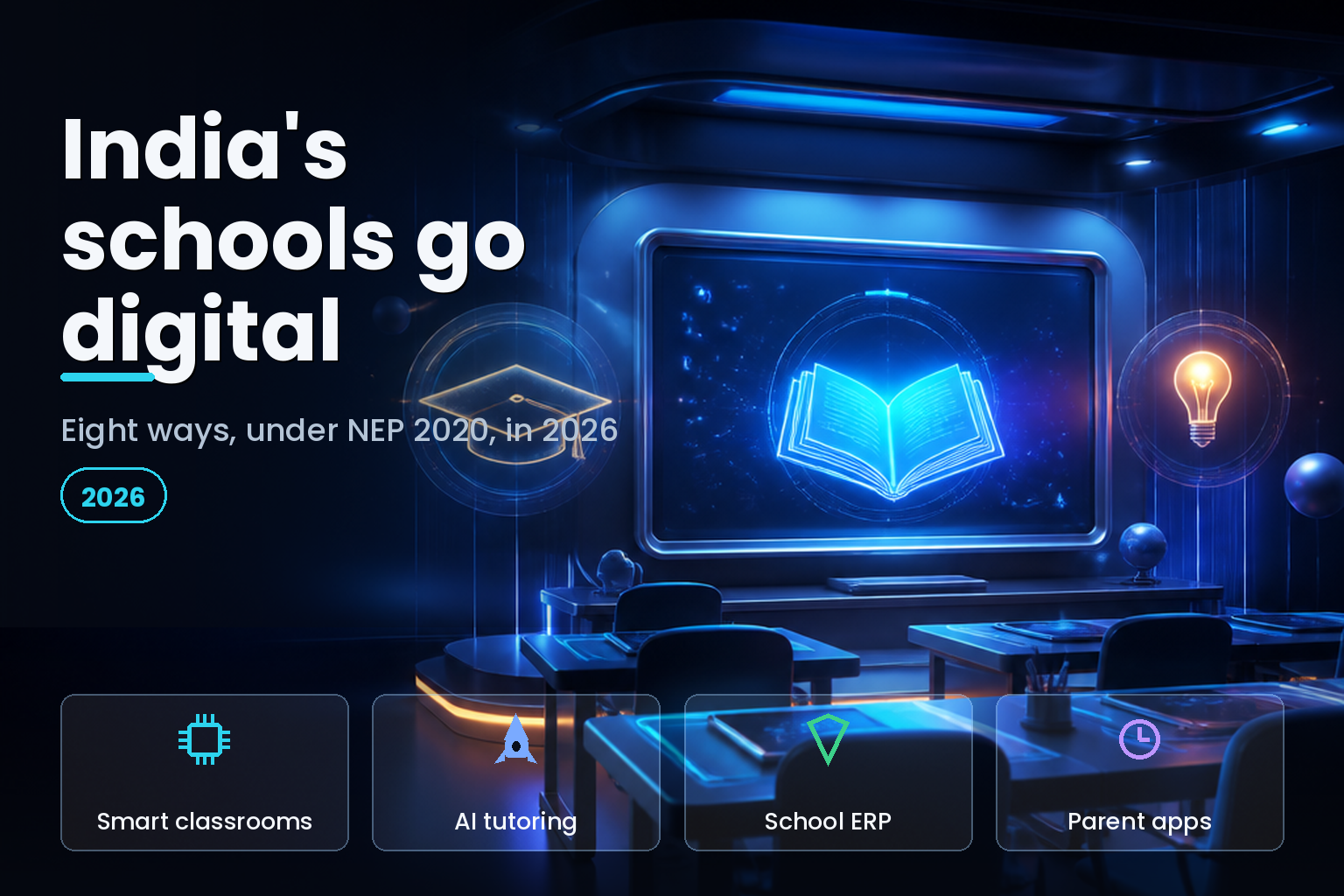
Summary. India runs the largest school system on earth, 14.71 lakh schools serving 24.69 crore students, and after the boom-and-bust of the pandemic edtech era it is digitising on firmer ground. The market correction was brutal, with BYJU'S collapsing from a $22 billion valuation while leaner players such as PhysicsWallah rose, yet the underlying shift held: India's edtech market was worth about $3.63 billion in 2025 and is forecast to grow at 19% to 28% a year through the early 2030s, with K-12 the largest segment at nearly 49% of revenue. The policy spine is NEP 2020, delivered through DIKSHA, which has logged 4.93 billion learning sessions, PM eVidya's 200 television channels reaching roughly 25 crore students, and 14,500 PM SHRI exemplar schools. In May 2026 NITI Aayog set the next direction, shifting the goal from access to quality across a 13-point roadmap. "The National Education Policy 2020 has a special focus on digital education," says Education Minister Dharmendra Pradhan. This guide sets out eight practical ways Indian schools are going digital in 2026, the scheme behind each, and what it takes to deploy.
The first wave of edtech sold supplementary tutoring directly to parents, and much of it overreached. The second wave is quieter and more durable: schools themselves adopting digital tools for teaching, assessment, and administration, with the government providing the rails. The eight moves below are where that is happening.
Why now: a correction, then a foundation
The collapse of the first edtech boom did not kill digital education in India. It cleared out the hype and left the infrastructure. NEP 2020 set the direction, the National Digital Education Architecture and DIKSHA built the plumbing, and the pandemic forced even reluctant schools online. What changed by 2026 is that the spending is institutional rather than speculative: schools and the state buying durable tools, not parents buying app subscriptions.
NITI Aayog's May 2026 report, a decade-long analysis across all 36 states and union territories, marks the turn. It shifts the national goal from expanding access, which India has largely achieved, to strengthening quality, with 13 recommendations, 33 implementation pathways, and more than 125 measurable indicators. It reports early signs of recovery in foundational learning after the pandemic, credited to NEP 2020, the NIPUN Bharat mission, and Samagra Shiksha. For a school founder, the message is that digital is now the baseline expectation, not the differentiator it was five years ago.
1. Smart classrooms and national digital content
The most visible change is the screen at the front of the room. Schools are fitting projectors, panels, and tablets, and filling them with content from DIKSHA, the national platform that has logged 4.93 billion learning sessions, carries material in 36 languages, and powers QR codes printed in physical textbooks so a student can scan a page and get a video. PM eVidya extends the same content over 200 television channels, one per grade and subject, reaching students without reliable internet. For a school, the content is largely free and curriculum-aligned, so the cost is hardware and the will to use it.
2. Learning management systems and blended learning
A learning management system turns scattered material into a course. It hosts lessons, sets and collects homework, tracks completion, and lets a teacher run a blended model where some work happens in class and some at home. NEP 2020 explicitly backs blended learning, and the practical win for an Indian school is continuity: lessons, notes, and assignments live in one place that survives a teacher transfer or a missed day. The discipline that makes it work is consistent use, because a learning management system that teachers ignore becomes another unused login.
3. School ERP and administrative automation
The least glamorous digitisation pays back fastest. A school enterprise resource planning system handles admissions, fee collection, attendance, timetabling, transport, and payroll in one place, replacing registers and disconnected spreadsheets. For an education group running several campuses, this is where the first clear return shows up: faster fee reconciliation, fewer errors, and a single view of every student and staff member. It also produces the clean data every later step depends on, which is why many schools sensibly start here rather than with classroom technology.
4. AI adaptive and personalized learning
The newest move bends the lesson to the student. AI adaptive platforms analyse how a child answers, then adjust the difficulty and sequence so a struggling student gets more practice and a quick one moves ahead. India is in the middle of a large rollout of these tools, and the framing across NITI Aayog and the NCERT is consistent: AI augments the teacher rather than replacing the human element of teaching, handling the repetitive diagnosis so the teacher can focus on the children who need them. The same judgement that governs any enterprise generative AI strategy applies in a classroom, with even higher care because the users are children.
5. Online assessment and learning analytics
Digital assessment does two jobs. It runs quizzes and tests at scale and marks them instantly, and it turns the results into analytics a teacher and a principal can act on, showing which concepts a class has not grasped and which students are slipping before a term-end exam reveals it too late. This is the engine behind NEP 2020's shift toward competency-based, continuous assessment rather than a single high-stakes exam. For a school, the value is early warning: a dashboard that flags a struggling cohort in week six is worth far more than a mark sheet in month six.
6. Foundational literacy and numeracy technology
NEP 2020's most urgent target is foundational literacy and numeracy, and the NIPUN Bharat mission aims for every child to reach it by 2026-27. Technology supports this directly, with assessment apps that let a teacher record where each young child is on reading and arithmetic, and adaptive practice that drills the specific gap. DIKSHA hosts thousands of foundational-learning resources for exactly this. For a school serving early grades, this is the highest-impact place to deploy digital tools, because the learning gap is widest and the long-term cost of missing it is highest.
7. Teacher training and professional development
Tools fail without trained teachers, and this is where India has invested heavily. DIKSHA's professional-development modules have registered more than 20 lakh teachers, delivering standardised training on both pedagogy and the digital tools themselves. For a school, the lesson is to budget for training as a first-class line item, not an afterthought, because the gap between schools that get value from digital tools and those that do not is almost always teacher capability rather than the technology. A short, regular cadence of training beats a one-off rollout.
8. Parent engagement and communication
The last move closes the loop with home. Communication apps push attendance, fees, homework, results, and notices to parents on their phones, replacing the diary note that never arrived. In the Indian context, where parents are deeply involved in schooling and increasingly smartphone-equipped, this is a low-cost, high-trust win that also reduces the administrative load of fielding the same questions by phone. The caution is restraint: a channel that floods parents with notifications gets muted, so the schools that do this well send less, not more.
| Way to go digital | What it digitises | NEP 2020 anchor |
|---|---|---|
| 1. Smart classrooms and content | Teaching material in the room | DIKSHA, PM eVidya, NDEAR |
| 2. Learning management system | Courses, homework, blended learning | NEP blended-learning push |
| 3. School ERP | Admissions, fees, attendance, payroll | Administrative efficiency |
| 4. AI adaptive learning | Personalised pace and practice | AI-supported pedagogy |
| 5. Online assessment and analytics | Testing and early-warning data | Competency-based assessment |
| 6. Foundational literacy and numeracy tech | Early reading and arithmetic | NIPUN Bharat |
| 7. Teacher training | Pedagogy and tool capability | DIKSHA training modules |
| 8. Parent engagement | School-to-home communication | Community participation |
The scale and the schemes behind it
The numbers explain why this is a national project, not a niche market. India's school system and the government programmes wiring it together are both vast.
| India education metric | Figure | Source |
|---|---|---|
| Schools in India | 14.71 lakh | NITI Aayog |
| School students | 24.69 crore | NITI Aayog |
| Edtech market, 2025 | About $3.63 billion | Market research |
| K-12 share of edtech revenue | Nearly 49% | Market research |
| DIKSHA learning sessions | 4.93 billion | Government of India |
| PM eVidya reach | About 25 crore students | Government of India |
| Government scheme | What it provides | Scale |
|---|---|---|
| DIKSHA | Digital content and teacher training | 4.93 billion sessions, 36 languages |
| PM eVidya | TV, radio, and online content | 200 channels, about 25 crore students |
| PM SHRI | NEP 2020 exemplar schools | 14,500 schools |
| NIPUN Bharat | Foundational literacy and numeracy | Goal of universal FLN by 2026-27 |
| NDEAR | Shared digital education architecture | National interoperability layer |
What it takes to actually go digital
The technology is the easy part. The schools that succeed sequence sensibly: start with the school ERP for clean administrative data and a fast return, add a learning management system and smart-classroom content where the curriculum support is strongest, then layer assessment, adaptive learning, and parent engagement on top. Teacher training runs through all of it.
Two constraints are real. The first is the digital divide: infrastructure quality still varies sharply between urban and rural schools, so a plan that assumes reliable power and bandwidth will fail in much of the country, which is exactly why PM eVidya still leans on television. The second is capability, because the binding limit is rarely the tool and almost always whether teachers are trained and willing to use it. As Education Minister Dharmendra Pradhan has noted, the benefits of digital education are realised only when every student also has access to a device, a reminder that access and quality have to advance together.
India-specific considerations: student data and the DPDP rules
Schools handle the personal data of children, which makes data protection central rather than optional. India's Digital Personal Data Protection Rules, notified on 13 November 2025, set specific duties for children's data: processing a child's personal data generally requires verifiable consent from a parent or guardian, and tracking, behavioural monitoring, and targeted advertising directed at children are restricted. For a school or an education group choosing edtech vendors, this turns into concrete due diligence: confirm where student data is stored, that parental consent is captured properly, that the vendor does not monetise children's data, and that breach notification within 72 hours is contractually covered. A school is the data fiduciary for its students, so the responsibility does not transfer to the vendor.
The practical rule for Indian school leaders is to treat digitisation and data protection as one project. Choose tools that are NEP-aligned and DPDP-ready together, start with the administrative systems that prove value fastest, invest in teacher training as heavily as in hardware, and design for the device and bandwidth reality of your students rather than the brochure.
FAQ
How eCorpIT can help
eCorpIT is a CMMI Level 5 technology organisation in Gurugram whose senior engineering teams build and integrate digital systems for schools and education groups, from school ERP and learning platforms to assessment dashboards and parent apps. We help education leaders sequence digitisation for fast returns, integrate with national platforms such as DIKSHA, and build it to be NEP-aligned and DPDP-ready, with children's data protected by design. You can read more about eCorpIT and its director Manu Shukla. To scope a school digitisation project, contact our team.
References
_Last updated: 21 June 2026._