On this page · 11 sections
- The five signals, in the order they usually appear
- What staying actually costs
- The workflow gap: why the last 20% costs more than the first 80%
- Rebuild, wrap or stay
- A staged migration that does not stop the business
- What "production software" means in this context
- India-specific considerations
- How we scope this at eCorpIT
- FAQ
- How eCorpIT can help
- References
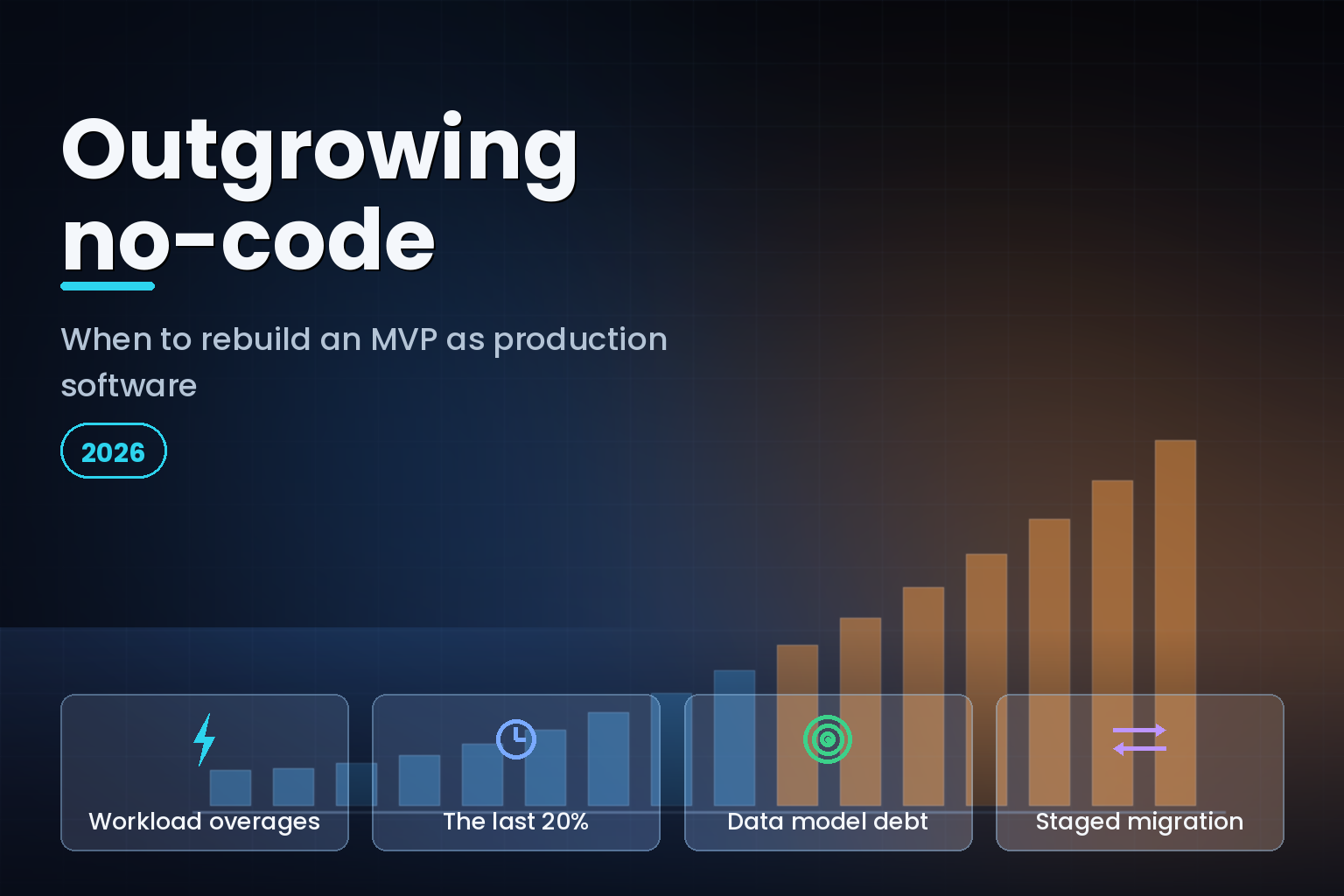
Summary. A Bubble app that exceeds its monthly workload allowance is billed at $0.30 per 1,000 workload units, and if you switch overages off to cap the spend, Bubble takes the app offline until the next billing period. That single pair of facts, both from Bubble's own documentation on 22 July 2026, is the clearest statement of the trade you accepted when you built on a platform: uncapped bill, or an app that can go dark. Bubble's paid plans start at $29 a month for web on annual billing and reach $549 a month for the Web + Mobile Team tier, plus $3 per 100 GB of extra storage. The 2025 DORA report, based on responses from 90% of technology professionals who now use AI at work, found that higher AI adoption raises both delivery throughput and delivery instability, and its researchers put the problem plainly: a prototype can be built almost instantly, but the final stretch "can take more effort than if the project had been built manually from the start". That is the sentence every founder with a fast MVP and a slow roadmap needs to read twice.
This article gives you five measurable signals, the arithmetic on both sides, and a staged migration that does not stop the business while it happens.
The five signals, in the order they usually appear
None of these is "we hit a wall". Walls are rare. What actually happens is that four small frictions compound until the roadmap stops moving.
Signal one: your platform bill scales with usage, not with revenue. On Bubble, workload is consumed by database operations, workflows and web requests, and Bubble's documentation is explicit that user count is not necessarily the main driver, because "the load of each activity is just as important as the quantity of activities". A single badly-shaped search running on every page load can cost more than a thousand extra signups. When your infrastructure cost moves independently of your revenue, you have lost the ability to forecast, and that is a business problem before it is an engineering one.
Signal two: the cost cap and the uptime guarantee are the same switch. Bubble lets you disable overages so the app cannot exceed your plan. The documented consequence: "If your app hits the workload limit while overages are disabled, you will receive an email notification that your app has been taken offline", and the app returns at the start of the next billing period. There is no third option on the platform. Owning your own infrastructure is how you get one.
Signal three: a feature your customers ask for is not expressible on the platform. This is the honest test. Not "it would be hard", but "the platform has no primitive for this". Background jobs with retry semantics, row-level access rules that vary by tenant, a real-time collaborative surface, an offline-first mobile flow, an integration that needs a persistent connection. When the answer to a paying customer becomes "our tooling cannot do that", you are already paying for the rebuild in lost deals.
Signal four: nobody can safely change the data model. Most no-code MVPs and most AI-generated prototypes share one weakness, and it is not the UI. It is a schema that grew by accretion, with denormalised copies, fields that mean different things depending on the record, and no migration history. Every new feature costs more than the last one. That curve does not flatten on its own.
Signal five: you cannot answer "what happened?" in production. No structured logs, no traces, no error budget, no way to reconstruct a customer's session when they report a bug. Teams tolerate this until the first incident that costs a customer, and then it becomes the only thing that matters.
Three or more of these together is a rebuild conversation. One on its own usually is not.
What staying actually costs
Take Bubble as the worked example, because its pricing is published in detail. These are the list prices on Bubble's own documentation as of 22 July 2026.
| Bubble plan (annual billing, per month) | Web only | Mobile only | Web + Mobile |
|---|---|---|---|
| Starter | $29 | $42 | $59 |
| Growth | $119 | $169 | $209 |
| Team | $349 | $449 | $549 |
| Monthly billing, Team tier | $399 | $529 | $649 |
| Extra file storage | $3 per 100 GB | $3 per 100 GB | $3 per 100 GB |
The plan fee is the part founders quote. It is rarely the part that hurts. The variable costs are workload overages at $0.30 per 1,000 units without a workload tier, plugin subscriptions, and any third-party APIs those plugins call. Plans are per project, so a second product means a second plan. Every paid app also includes 100,000 monthly workload units for the development environment, which is a real allowance but one that testing and bulk data operations consume quickly.
There are operational constraints that matter as much as the money. Bubble's mobile plans include a fixed number of app-store builds: 10 in the first three months on Starter and 5 after that, 15 then 10 on Growth, 25 then 20 on Team. Live mobile versions are capped at 3, 5 and 8 respectively. If you remove a mobile plan, live versions pause, and after 14 days a new build is required. A team shipping weekly to the app stores will feel the build allowance before it feels the invoice.
Add it up over a year on the Web + Mobile Team tier at annual billing and you are at $6,588 before a single unit of overage, a plugin subscription or an extra gigabyte of storage. That is not expensive for what it does. It is expensive when the platform is also the reason you cannot ship the feature that closes your next three deals.
The workflow gap: why the last 20% costs more than the first 80%
The most useful research on this is not about no-code at all. It is about AI-assisted development, and it describes the same shape.
The 2025 DORA State of AI-assisted Software Development report found that 90% of technology professionals use AI at work and over 80% believe it has increased their productivity, while higher AI adoption is associated with an increase in both software delivery throughput and software delivery instability. Writing for DORA, Google Cloud's software delivery research programme, Jessica Baolin and Nathen Harvey summarised the mechanism from a thematic analysis of 1,110 open-ended responses from Google software engineers collected in Q3 2025: "AI's primary role in software development is that of an amplifier. It magnifies the strengths of high-performing organizations and the dysfunctions of struggling ones."
They name the specific failure this article is about as the workflow gap. Their description: "While a prototype can be built almost instantly, the final stretch, which requires precision, edge-case handling, and integration with internal systems, can take more effort than if the project had been built manually from the start."
That is the whole economics of a vibe-coded or no-code MVP in one sentence. Getting to a demo is nearly free. Getting to something you can operate, secure, bill from and change safely is where the cost lives, and starting from a fast prototype does not always reduce it.
The report also found that 30% of developers report little to no trust in AI-generated code, which is why DORA's advice to leaders is blunt about estimation: "Project timelines must explicitly account for the discrepancy between rapid prototyping and the effort required to achieve production-grade quality. Don't reduce estimates before investing to close this gap."
If you are budgeting a rebuild off the speed at which the prototype appeared, you will be wrong by a large multiple.
Rebuild, wrap or stay
Rebuilding everything is usually the wrong first move. There are four options and most teams should be choosing between the middle two.
| Option | When it fits | Typical duration | Main risk |
|---|---|---|---|
| Stay and optimise | Costs are annoying but the roadmap is moving | 2 to 4 weeks | Buys time, changes nothing structural |
| Extract the backend | Data model and business logic are the bottleneck, UI is fine | 6 to 12 weeks | Two systems to run during the transition |
| Rebuild the surface | UI and mobile experience are the bottleneck, data is sane | 8 to 14 weeks | Underlying data debt survives the rebuild |
| Full rebuild | Three or more of the five signals, and the platform blocks a revenue feature | 3 to 6 months | Feature freeze if you sequence it badly |
Durations here are planning ranges for a small senior team on a typical B2B SaaS or marketplace MVP, not a quote. The scope that actually drives the number is the count of distinct workflows and integrations, not the number of screens.
The option most teams underweight is extracting the backend first. You move the data model and the business rules into a system you own, keep the existing front end calling it, and only then decide whether the front end is worth replacing. It de-risks the migration because the hardest part, the data, moves once and moves under test.
A staged migration that does not stop the business
The pattern that works is incremental replacement, not a big-bang cutover. Four phases.
Phase 1, instrument and freeze the schema. Before writing new code, get structured logging and error tracking on the current app and produce an honest map of the data model as it exists, not as it was designed. Freeze schema changes on the platform for the duration. This phase is where most of the surprises surface, and it is far cheaper to find them here.
Phase 2, stand up the new backend behind the old front end. Build the data model properly, with migrations under version control, and expose an API. Dual-write from the platform where you can, or run a scheduled reconciliation where you cannot. The goal for this phase is a system of record you trust, running alongside the one you have.
Phase 3, move surfaces one at a time. Take the highest-value or highest-friction screen first, point it at the new API, and ship it. Then the next. Each move is independently reversible, which is the entire point. Working in small batches is one of DORA's named countermeasures to delivery instability, and it applies to migrations as much as to features.
Phase 4, decommission and cap. Remove the platform dependency, cancel the plan, and set the budget alerts you never had. Keep a read-only export of the old system for at least one full financial year.
The sequencing rule that matters: never run a feature freeze longer than one sprint. If your migration plan requires a three-month freeze, the plan is wrong, and the business will overrule it in week five.
What "production software" means in this context
The phrase gets used loosely, so here is the checklist we hold a rebuild to. If a rebuild does not deliver these, it is a rewrite, not an upgrade.
- A normalised data model with migrations in version control and a documented rollback for each one.
- Authentication and authorisation as a distinct layer, with row-level access rules that are tested, not assumed.
- Automated tests covering the workflows that touch money, personal data or customer state, run on every commit.
- CI/CD with a deployment that any engineer on the team can perform and reverse.
- Structured logging, error tracking and enough tracing to reconstruct a single user's request path.
- Backups you have actually restored from, at least once, into a scratch environment.
- A documented data retention and deletion path, which under India's Digital Personal Data Protection Act 2023 is not optional for personal data.
- Cost observability, so that infrastructure spend per active user is a number someone owns.
Items 6 and 7 are the two most often skipped, and the two that turn an incident into a legal problem.
India-specific considerations
Three points change the calculation for founders building from India.
The first is currency exposure. Platform fees are billed in dollars while most early revenue for an India-first product is in rupees. A $549 monthly plan is a fixed dollar liability against variable rupee income, and workload overages make the exposure variable too. Owning your infrastructure does not remove cloud cost, but it does let you commit to reserved capacity and forecast it.
The second is data protection. The Digital Personal Data Protection Act 2023 places obligations around consent, purpose limitation, retention and deletion on the entity collecting the data, and those obligations do not move to your platform vendor because the app was built on it. If you cannot answer "where is this user's data, and how do we delete all of it", the platform is not the reason, but it may be the obstacle. We cover the build-side implications in DPDP-ready app development and the remediation side in DPDP legacy data remediation and consent backfill.
The third is talent economics. The reason no-code was attractive in 2023 was that it removed the need to hire engineers early. In 2026 the constraint has shifted: senior engineering capacity is available on a project basis, and the expensive part is no longer writing the code but knowing which parts to write. That is an argument for a small senior team on a defined scope, not for a large one.
How we scope this at eCorpIT
eCorpIT is a Gurugram-based technology organisation founded in 2021, assessed at CMMI Level 5 and MSME certified, with partnerships including AWS, Microsoft, Google and Shopify. Our teams are senior-led and multi-disciplinary, which for this kind of work means an engineer, a data specialist and a product lead in the room from day one rather than a handover chain.
A no-code to production engagement usually starts with a two-week assessment, and we ask for four things to make it useful: read access to the existing app and its data model, your last three months of platform invoices including overages, the list of features you have told customers you cannot build, and your incident history if you have one. The output is a written map of the current data model, a phased migration plan with the sequence above, a cost comparison of staying versus moving, and a recommendation that is sometimes "stay and optimise" when the numbers say so.
From there the build follows the four phases, with the backend extracted first in most cases. We design applications aligned with DPDP requirements and with the security practices the workload needs, and we hand over the repository, the pipelines and the runbook, because a rebuild that leaves you dependent on us has repeated the original mistake in a new form.
Related work: SaaS MVP development, custom web application development, and AI prototype to production for teams whose MVP came out of a coding agent rather than a no-code builder. If the mobile app is the pressure point rather than the web app, legacy mobile app rewrite versus refactor covers that decision specifically.
FAQ
How eCorpIT can help
eCorpIT's senior-led engineering teams take no-code and AI-generated MVPs from a platform you rent to software you own, using the staged migration above so the business keeps shipping while it happens. We start with a two-week assessment that produces a real data-model map and a stay-versus-move cost comparison, and we will tell you when the answer is to stay and optimise. Everything we build is handed over with the repository, pipelines and runbook, designed aligned with DPDP requirements. If your platform bill or your roadmap is the thing that woke you up this week, talk to us.
References
- Pricing and plans, Bubble Docs - plan pricing, storage add-on cost, mobile build allotments and live version limits, checked 22 July 2026.
- FAQ: Pricing and Workload, Bubble Docs - the $0.30 per 1,000 unit overage rate, the offline consequence of disabling overages, and the 100,000 development workload units.
- Workload, Bubble Docs - what workload measures and which activities consume it.
- Workload Explained, Bubble blog - Bubble's own explanation of the workload metric.
- Balancing AI tensions: Moving from AI adoption to effective SDLC use - Jessica Baolin and Nathen Harvey, DORA, 10 March 2026, on the amplifier effect, the verification tax and the workflow gap.
- 2025 DORA State of AI-assisted Software Development report - the source of the 90% adoption, 30% trust and throughput-versus-instability findings.
- Announcing the 2025 DORA Report - Google Cloud's summary of the report.
- 2025 DORA State of AI Assisted Software Development - the report landing page.
- What the 2025 DORA Report Teaches Us About Observability and Platform Quality - independent analysis of the platform-quality findings.
- DORA Report 2025 Summary - Scrum.org summary of the report's findings.
- DORA 2025: Measuring Software Delivery After AI - RedMonk analysis, 18 December 2025.
- AI Won't Fix Broken Systems: Lessons from the 2025 DORA Report - on the instability finding and the practices that offset it.
Last updated: 22 July 2026.